Showing posts with label lynching. Show all posts

Wednesday, November 6, 2019

Strange Fruit by Lillian Smith


Source of book: I own this.

This was my selection for Banned Books Week. It took longer than a week, but I did start it during Banned Books Week. 

Just as a reminder, I use the week to read books which have been banned, which means that a government has outlawed sale, publication, or possession of the book. I do not count challenged books - those which citizens or parents have sought to keep out of school curricula or libraries. This isn’t because I think challenges are uninteresting, but because I wanted to focus my once-a-year project on those where the power of the state was employed in censorship. I believe that is a different level from a challenge. After all, any library has limited space and budget, and decisions must be made. (Personally, I would have preferred an extra - and local - copy of The Rest is Noise rather than one of the 20ish copies of Eat, Pray, Love.) Likewise, students can only study so many books, and the choice of which to study is a judgment call.

Here are my past selections, plus the introduction to Banned Books Week.

Catch-22 by Joseph Heller

***

“BANNED IN BOSTON!” is now a bit of a badge of honor, and it has a long history. Strange Fruit may not have been the first work that the overzealous Boston city officials (influenced by Anthony Comstock and his eponymous law), but it was the first number one bestseller to be banned in Boston. 

Strange Fruit was ostensibly banned due to references to sex - which are both crucial to the meaning of the book and handled in a tame manner by today’s standards - but everyone knew the real reason it was banned: the book is about a forbidden sexual and romantic relationship between a white man and black woman. In the Jim Crow South, this was literally illegal at the time the book was written - and was considered immoral and scandalous even in the North. 

It took me a while to get into the book, mostly because the first 50 or so pages jump around in time a lot. We know very early in the book what has happened: Tracy Deen has gotten Nonnie Anderson pregnant, and she is happy about it. Smith then fills in the backstory of both families. Nonnie Anderson is an elegant and educated young African American woman. Her family is well respected (after a certain fashion), and Nonnie turns everyone’s head. Her sister, the stolid and responsible Bess, can’t understand why Nonnie still works as a maid, rather than go north with their brother Ed, who has gotten a white-collar job. Nonnie claims to just not be ambitious, but the real reason is that she loves Tracy Deen.

Tracy is the feckless son of the local white doctor (the black doctor, Sam, figures prominently in the book as well - he is the best and most complex character in the book, in my opinion.) As we learn, when Nonnie was age 6, she was saved from a sexual assault by a group of white boys by Tracy. This is a moving incident, because the boys assume that Tracy “owns” Nonnie, and that is why they leave her alone. The idea that raping a black child was wrong never occurs to them. 

In fact, as the story unfolds, it becomes clear that many - maybe most - of the white men in town have had sex with black girls and women. Some of them openly keep a black woman as a concubine. (“That’s the bible word for it,” Tracy says.) 

Tracy is, despite his inability to figure out what he wants to do with his life (other than that he hates his dominant and controlling mother), isn’t a bad guy. He and Nonnie do eventually become sexual, coming together occasionally in their teens and then after she returns from college, and he from World War One. It is in their 20s that she gets pregnant - to his surprise - he figured that a college educated woman would somehow just know how not to get pregnant. (He’s not the sharpest tool, but, to be fair, men didn’t really learn about female bodies at that time. Information on contraception was still illegal to distribute in Georgia.) 

This pregnancy, naturally, causes no end of trouble. 

In a perfect world, Tracy and Nonnie would marry, and probably have a happy life together. Tracy actually considers taking her to France, where interracial marriage was accepted. But he has no nerve, no career other than his parents’ attempt to get him to take over the family store or the old farm. Nonnie doesn’t seem to know exactly what she wants. It is implied that she would accept being his concubine, but we never really know her thoughts on this. She is too smart to think he will marry her, and she never asks him to. 

Tracy is pressured by his family to finally “go straight,” which means joining the church, getting married, and settling down. The preacher (a complex character who combines some good traits with the wrong kind of pragmatism) tells Tracy that most men have had “nigger girls,” but that God wants him to repent of that and marry a virginal white girl. Tracy’s mom has the perfect one picked out. Tracy isn’t attracted to her, but he can’t tell his mother no. 

In an attempt to both “go straight” and settle things for Nonnie, he borrows a large sum of money from his mother (no questions asked), and tries to bribe Nonnie to marry the Deen family cook, Henry (who was Tracy’s childhood companion), and Henry to marry her. Henry doesn’t want to - he is in love with Dessie - but he can’t talk back to a white man in public. 

The meeting with Nonnie goes even worse: Tracy ends up hitting and raping her as a thoroughly unconstructive way of attempting to compartmentalize his relationship with her as “she’s only a nigger - they manage.” Meanwhile, Ed overheard the conversation with Henry, and when he sees that Nonnie is traumatized, he shoots and kills Tracy in the dark. 

With Sam’s help, Ed is rushed back to New York before the body is discovered in the woods. Henry is blamed for the death, and despite the efforts of Mr. Deen and the local factory boss (another complex and semi-decent character), is taken from jail and lynched. 

Billie Holiday claimed that Lillian Smith named the book after her song about lynching of the same name. Smith never confirmed this, and said that she meant “strange fruit” to mean the way humans, black and white, are twisted and damaged by America’s racist culture, rather than a literal reference to lynched bodies hanging in trees. It sure seems as if there was an intentional connection. 

There is lot to unpack from this book. The summary of the plot fails to capture all of the different facets of Southern Jim Crow culture - Smith grew up in the South, and portrays the culture with accuracy and detail. It is an unsparing portrait, painting the many ways in which the underlying belief in the superiority of white-skinned people warps and damages and destroys. 

Smith does not go easy on the role of religion. This part of the book was spookily familiar in the Trump era, where the Ku Klux Klan is again in open collaboration with white religion. It is no surprise that Smith deftly exposed the hypocrisy of Southern religion. As a young adult, she rejected religion, in part because of her experience with the double standards of the Southern church. In addition, Smith was outspoken in favor of civil rights for minorities - and also for women - both of which positions made her unwelcome in church. 

If that weren’t enough, Smith was lesbian in an era when it was even more taboo than racism. She lived with her partner, and the two of them published a magazine together. As their letters (discovered after their deaths) made clear, however, they were more than business partners. Lesbian themes make it into Smith’s books, including this one. Tracy’s younger sister (the one who seems made to succeed - and who is one of the very few truly progressive characters in the book) has a naked female figure in her drawer, and a relationship with another woman in town is hinted at, although not expressly stated. 

Another controversial theme in the book is abortion. Tracy and Bess and others wish Nonnie would just make the issue go away by quietly aborting the pregnancy. The local black herbal healer can get her some herbs, or she can go to the city and see a doctor there. But it isn’t just Nonnie. A 14 year old white girl gets pregnant from a young white boy, and her father goes to Dr. Deen to beg that he perform an abortion. There is an extended internal monologue where Dr. Deen wrestles with his conscience. What is most devastating about this is that he is clear that he would do the abortion without question if she had been raped or if the father was black. But, because it was consensual and the father is white, he can’t bring himself to do it, although part of him wishes he could. He ends up referring them to a city doctor. 

I noted above some of the more complex and conflicted characters. One of them is the newspaper publisher, Prentiss Reid, who has to keep his progressive ideas to himself or go out of business. It is an uncomfortable compromise - one made necessary by the culture of racism. He is also one of the few openly non-religious characters. He delivers this zinger to the daughter of the mill boss (who is more genuinely progressive):

“You’ve got it wrong, haven’t you? What they want you to do, my dear, is sponsor religion, not practice it. Don’t let your conscience mix you up. If you practiced the teachings of that man Jesus here in Maxwell, we’d think you were crazy - or communist. Don’t make any mistake about it--be damned embarrassing.” 

Not much has changed, alas. Try to actually practice the teachings of Christ these days, and you will, like me, be asked to leave the church. Know what else hasn’t changed? Religious views of gender and race. As Preacher Dunwoodie tells Tracy:

“On this earth, there’s two worlds, man’s and woman’s. Now, the woman’s has to do with the home and children and love. God’s love and man’s. The man’s world is--different. It has to do with work. Women teach us to love the Lord, and our children, and the we build the churches, don’t we, and we keep them going….Now, when a man gets over into a woman’s world, he gets into bad trouble. He don’t belong there...Too much love makes you soft.” 

He goes on to explain that being a good Christian means very different things for men and women. And yep, I feel like I have heard this sermon more than once. 

Tracy is susceptible to this sort of thing, of course, and finds himself trying to justify abandoning Nonnie. 

It’s like an obsession. Seems true to you, but everybody says it isn’t. You can’t love and respect a colored girl. No, you can’t. But you do. If you do--then there must be something bad wrong with you. It’s like playing with your body when you were a kid. You had to touch yourself. It felt good. It was good. But everyone told you it wasn’t good. Said it would drive you crazy or kill you. Decent people didn’t do it. Well...you did. You did it and liked it. And felt like hell afterward. You’d outgrown that. Now the preacher said time to outgrow this other. Past time. 

It’s this sort of gaslighting that characterizes so much of religious teaching about sex, of course. But in the American version, the sexual puritanism and the racism are one and the same. They are inseparable. Tracy never does get over Nonnie, as much as he tries. 

You’d think God wanted to play a fine joke and had made Nonnie. Here, He said, is a woman any man would love and be proud of. She has everything you could desire. But you can’t have her. No. You can have sips and tastes, but you can’t have her. And you’ll be ashamed and sneak around and feel nasty...That’s the price you have to pay--for the sips. 
Well...white men had paid it before. And thought it cheap. Guess he could too. 

This casual disrespect for the humanity of non-whites permeates the culture in the book. Even the “good guys” accept white supremacy at some level - nobody can escape it. Ms. Sadie, who is horrified by the way white men treat blacks, still thinks that “the entire Negro race was a mammoth trick which nature had played on the white race.” 

There is another great line about Mrs. Stephenson, who is quietly a loving and gracious person - but one who was strangely detached. 

You had a queer feeling about it--as if Mrs. Stephenson had died some time when nobody was noticing and now nothing was left of her but good deeds blooming like little flowers on her grave.

I want to return a bit to the role of religion as shown in this book. Preacher Dunwoodie shares something with modern preachers: he wants to save the “respectable” sorts. Meaning the wealthy, who will keep the church in business. All the Tracy Deen’s of the world are nice and all, and it is a good thing to save the mill hands, but what he really wants - and how he knows God is blessing his ministry - is for the “prominent citizens” to return to the church. And my goodness is this still true. I firmly believe one of the reasons my former pastor couldn’t do the right thing - even a little thing like keeping hate groups out of the church - is that certain prominent (and tithing) members were the driving force behind it. Address the white supremacist beliefs, and he would have lost some of his financial base. It’s that simple. 

But white supremacy goes deeper than money in religion, then and now. There is a chilling scene when the lynching party sets out. Smith makes it clear that the point isn’t justice - it is putting the “nigger in his place.” And lynching, just like our current cruelties toward brown-skinned people, is driven by a weird religious feeling. Smith describes it thus:

And sometimes there was laughter, or drawled words of voices not unkind in sound and not without humor; but eyes were hard and hating as they hunted a black victim to sacrifice to an unknown god of whom they were sore afraid. 

There is so much fear in white religion in America. A desperate fear of outsiders, of people who are different, whether racial minorities, immigrants, LGBTQ people, atheists, and especially people who don’t vote for Trump. Lillian Smith is on to something here - they seem eager to sacrifice other humans to an unknown god who they cannot name, but who terrifies them. Every time you see a brutal and cruel separation of immigrant families, children in cages, another African American murdered by the cops, or another gay or transgender person denied housing or a job - well, you are seeing a human sacrifice to a terrifying god that Evangelicals cannot name, even to themselves. 

Near the end, even as he realizes he can’t really publish an anti-lynching article, Reid thinks to himself of the core problem. 

That’s the South’s trouble. Ignorant, Doesn’t know anything. Doesn’t even know what’s happening outside in the world! Shut itself up with its trouble and its ignorance until the two together have gnawed the sense out of it. Believes world was created in six days. Believes white man was created by God to rule the world. As soon believe a nigger was as good as a white man as to believe in evolution. All tied up together. Ignorance. Scared of everything about science, except its gadgets. Afraid not to believe in hell, even. Afraid to be free. 

You can perhaps put “Evangelicalism” in for “South,” and “White Republican Americans” for “white man.” It’s the same thing today. Walled up in its own bubble of fear and ignorance and hate. It has been nearly three years since I left that cesspit, and as time goes by, I am ever more thankful I got out. 

This wasn’t an easy book to read. There is so much darkness in the human heart, and so much destruction caused by racism and hate. And religion, then and now, seems all too eager to feed the hate. This book is well worth reading, though, and shines an uncomfortable light on the dark realities of our culture. 

***

My wife found this book for me used. This hardback was the 13th printing (copyright 1944) Inside are a few notes by the previous owner, Kae Bell, and an inscription from the person who gave the book to her, apparently in 1944.

 Click to expand. The inscription appears to read "To Kae "44 from Bobby and Jan."

"Good comparison of life of a white & negro - so different? Afraid not. Damn these prejudices."
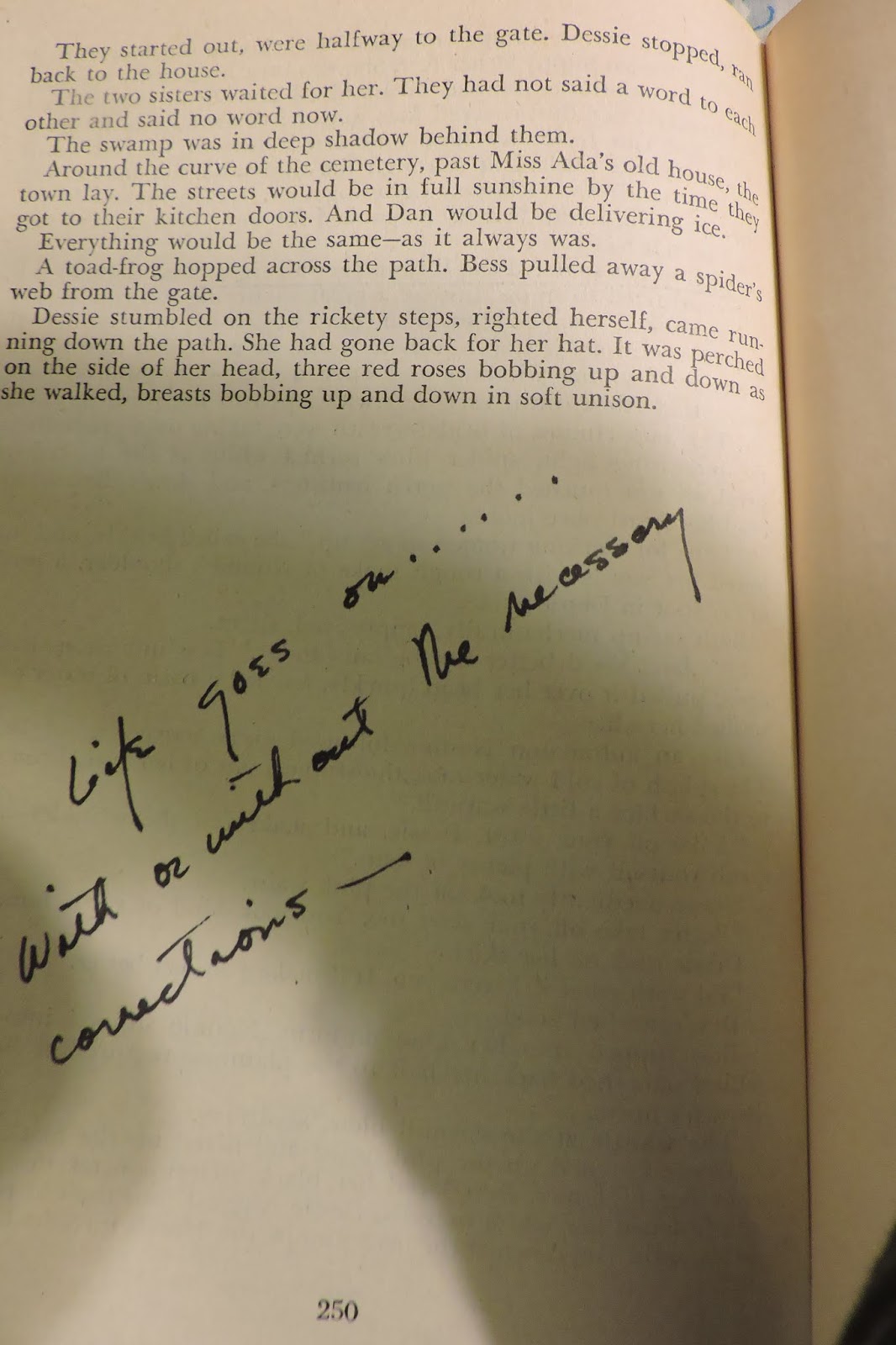
"Life goes on....... with or without the necessary corrections --"

***

Take it away, Billie Holiday:

Southern trees bear a strange fruit
Blood on the leaves and blood at the root
Black bodies swinging in the southern breeze
Strange fruit hanging from the poplar trees

Pastoral scene of the gallant South
The bulging eyes and the twisted mouth
Scent of magnolia, sweet and fresh
Then the sudden smell of burning flesh

Here is a fruit for the crows to pluck
For the rain to gather, for the wind to suck
For the sun to rot, for the tree to drop
Here is a strange and bitter crop

Saturday, November 24, 2018

Devil in the Grove by Gilbert King


Source of book: Borrowed from the library.

This has to be one of the hardest books I have ever read. Not because it is difficult, but because it is so horrifying - particularly in the difficult times we are in right now. The events in this book took place a little over 70 years ago - during the lifetimes of some of my parents’ generation. And, sadly, the last few years have proven that we haven’t moved forward all that much since then either.

On the one hand, this book is about great heroes. It is about the hope that people can change their minds and become better. But it is also about the unfortunate fact that the good people do not always win. And also that humans can be simply horrid: full of hate, prejudice, and easily incited to murder by whatever means they have at hand.

My older daughters have each had to read To Kill a Mockingbird for freshman English - they had already read it, so they had a head start. I remember my mother reading it to us. I read it for myself the first time in junior high, and again as an adult. It never gets easier; it is still one of the most moving and horrifying stories in the canon. It is precisely because it is all too true that makes it horrifying.

The events in Devil in the Grove likely inspired Harper Lee’s novel, although she certainly had her pick of judicial lynchings to choose from. This particular case is interesting in part because Thurgood Marshall played a role in it. As a result of his involvement, the FBI did a series of investigations into aspects of the case. Sadly, political realities kept the findings of these investigations secret for decades afterward, and the truly guilty parties went to their graves without paying any meaningful penalty for their roles in the murders. Gilbert King was able to access these files, and illuminate what really went down - information which Marshall lacked during the trials, and which could have changed the course of a number of lives.

The underlying story is one repeated thousands of times across the Jim Crow south: a white woman cries rape, some young black men are arrested, beaten into confessing, and either lynched, or given a sham trial and executed. Never mind any exculpatory evidence. Never mind rock solid alibis. Never mind due process. The honor of all white women must be avenged, and human sacrifice committed.

In the Groveland case, two of the men had indeed had brief contact with the woman and her semi-estranged husband. But their behavior afterward looked nothing like that of men who even suspected a charge of rape would be made. The other two men, believe it or not, could not possibly have committed a rape. In one case, he was clearly out of town long before it could have been done, while the other was...wait for it...in police custody when the rape was alleged to have occurred. But never mind, blood sacrifice was needed.

These facts were generally known at the time of trial. But there was more. The behavior of the alleged victim afterward was completely inconsistent with that of a rape victim. Multiple witnesses saw her and talked with her, and her appearance, story, and actions were at odds with her later story. Even more damning: she was given a medical exam, and no semen or signs of force were discovered. This fact was withheld from the defense, and the judge refused to let the doctor be called as a witness. (Just one of many obvious actions by the judge to guarantee a conviction. Seriously, as a lawyer, it is astounding that this sort of stuff happened routinely. I guess this is the sort of judge that Le Toupee thinks we should have…)

After the arrests, the three defendants were beaten nearly to death. Two of them confessed - including the one, a mere teen, who was in custody at the time of the alleged crime. The third never did confess, but the sheriff made sure the newspapers printed that all of them had confessed. (Yep, more tampering with justice.) The fourth defendant was gunned down by a posse.

And then, the KKK showed up - from other towns. A few unsuccessful attempts at gaining access to the prisoners to lynch them, they went and blew up and burned down most of the African American neighborhood. The sheriff stood by and watched it happen, and then refused to identify any of the perpetrators. In addition, the local head of the NAACP, Harry Moore, and his wife were murdered by a bomb put under their house. Again, no arrests were ever made.

Although Thurgood Marshall was involved in the preparation for the first trial, it was Franklin Williams and Alex Ackerman who actually tried the case. Both deserve props for outstanding work. Williams as a young black attorney taking a huge personal risk by even appearing in court in Florida, and Ackerman for essentially sacrificing his political career for the sake of justice.

Unsurprisingly, the verdict was guilty. However, in the case of the teen who was clearly not guilty, the jury recommended only life imprisonment. That’s as close to an exoneration as an African American could expect in Jim Crow Florida in the 1940s.

Marshall then appealed the case, barely keeping ahead of the prosecution’s efforts to have the defendants executed without delay. Eventually, the Supreme Court heard the case, and reversed it.

Prior to the second trial, however, the sheriff took the two defendants (only those two cases were appealed, for strategic reasons), drove them to a remote location, and shot them, claiming they tried to escape. One of them survived, however.

The second trial - now for just one remaining defendant - went about the same, despite Marshall’s personal involvement in the case. During the appeals of this second sham trial, Florida elected a new governor, one more eager to shed Florida’s reputation as a racist hellhole in order to attract investment from wealthy Yankees. The death sentence was commuted to life. And yet, despite this, while out on a temporary parole, this defendant was found dead under suspicious circumstances. It was rule “natural causes” and that basically ended the matter.

So yeah, a really sad story. The silver lining, to the extent there was one, was in the fact that this case played a key role in galvanizing the Civil Rights Movement. The open murder by the sheriff and the railroading of justice by a corrupt judge led to outrage in the North, and shined a light on the festering evil that thrived in places like Florida. Bad publicity eventually led to political pressure to change.

The other positive was that a few characters in this book - including Mabel Norris Reece, a journalist who originally was staunchly against the defendants - changed their minds as a result of seeing Southern “justice” in action. Sadly, many more stuck to their views even when it became obvious that the authorities had murdered innocent men.

If I had read this book a few years ago, I probably would have felt relief in the idea that things are a lot better now. And in some ways, yes they are. In other ways, though, things are much the same. Our whole discussion of the Black Lives Matter movement is nothing more or less than a continuation of this story. The casual murder of unarmed black men (and sometimes women) by police, with a weak “I was afraid” used to justify it, even in the face of video evidence to the contrary continues. Protestors are still demonized (including by the most powerful politician in America), and “ungrateful” is just another term for “uppity negro.”

For that matter, the KKK hasn’t gone away. Sure, it is unusual to see white robes and hoods in public. But the new white hood is the red MAGA hat. And the new euphemism is the “Blue Lives Matter” response to BLM. It’s still the same argument. Most discouraging was to read statement after statement dehumanizing blacks, and realize that while we don’t usually use the N-word anymore in public, the statements are largely unchanged. It isn’t even a shock anymore to see a Florida candidate warn the public about “monkeying it up” by electing an African American candidate. And of course the racist white guy won, because Florida hasn’t changed that much.

I do think, though, that the book does point to some ways to fight back against hate and the KKK. First, those who do not subscribe to these ideas need to stand up and say it out loud. We also need to keep exposing the evil. Over and over as often as necessary. As young(er) people, we need to remind our “racist uncles” that their words and behavior are not acceptable to us, and that they will not be coddled. And, of course, VOTE! One reason we have the KKK in the White House is that too few of us decent people showed up - particularly in the swing states.

While the entire book is exceedingly quotable, a few things stood out to me. First is the history of the NAACP and Thurgood Marshall. I was 15 when Marshall retired from the US Supreme Court. I remember watching the announcement with my dad, and his chuckle at his line, “What’s wrong with me? I’m old!” (See 3:20 in this clip from his press conference.) At the time, even though I was reasonably informed about law and politics, I didn’t really grasp just how much of a legal badass Marshall was. Once I got to law school, obviously, I saw him in a new light. Arguing (successfully) Brown v. Board of Education while he was with the NAACP was obviously a highlight, but he had a whole string of cases that chipped away at the foundation of Jim Crow. 


Likewise, the work done by the NAACP and its legal branch was singularly impressive. I jotted down the three criteria used to determine if they would get involved in a criminal case:

Marshall issued a memorandum that established three rules to be applied “to the types of criminal cases we accept…(1) That there is injustice because of race or color; (2) the man is innocent; (3) there is a possibility of establishing a precedent for the benefit of due process and equal protection in general and the protection of Negroes’ rights in particular.”

Rape cases presented a particular problem. King gives a few examples of contrasting cases. Often, when a consensual liaison between a white woman and a black man was discovered, she cried rape rather than face the scorn of her fellow whites. These charges were often impossible to defend against. Furthermore, as in the case of Joseph Spell and Eleanor Strubing, she actually abused her position to blackmail him into sex. (All too similar to Joseph and Potiphar’s wife…) In many states, a rape conviction meant a death sentence for a black man.

In contrast, even if a white man was convicted of raping a black child, he would get off with a fine or time served. Even worse if the white rapist was wealthy and/or powerful. An extended quote from The Mind of the South by W.J. Cash is interesting:

“[T]he actual danger of the Southern white woman’s being violated by the Negro has always been comparatively small...much less, for instance, than the chance that she would be struck by lightning,” it was “the most natural thing in the world for the South to see it as very great, to believe in it, fully and in all honesty, as a menace requiring the most desperate measures if it was to be held off.” In Cash’s estimation, the Southern rape complex “had nothing immediately to do with sex,” but rather with the feeling among Southerners that if blacks were allowed to advance beyond their severely circumscribed social station, they might “one day advance the whole way and lay claim to complete equality, including, specifically, the ever crucial right of marriage.”

This is why a rape accusation was so incendiary: the entire honor of all white women was at stake. As the crooked prosecutor in the Groveland case argued, (white) women valued their chastity more than life itself, and cited an apocryphal case of a woman throwing herself into the river rather than be raped. (Personally, given the choice between rape and death, I’d stay alive. Since I haven’t been raped or murdered, though, take that for what it is worth, I guess…)

It is not an accident that Le Toupee claimed that immigrants were “rapists.” This is deliberately loaded language aimed at dehumanizing minorities, and making racism into a “noble” defense of white chastity. And of course, has used such “desperate measures” as tearing children from their parents as punishment for seeking asylum. As I said, we have the KKK in the White House right now.

Those “desperate measures,” by the way, included flagrant misconduct. King tells of another of Marshall’s cases, where he and the defendant got the prosecutor to admit that he was literally present at the beating given to induce a confession. The prosecutor was literally shaking when Marshall was done with him. And yet. He still got a guilty verdict. The jury recommended a light sentence, though, which was as close as they could come to an acquittal. The greatest victory out of that case, though, was that the father of the (white) murder victim himself decided that the defendant was innocent and said so. And actually joined the NAACP.

Another thing which really struck me was the fact that the Civil Rights Movement has always been slurred by accusations of communism. Today’s Right does the same thing, of course, claiming everything is communism or socialism, whether or not it actually is. But it is a “conversation ender.” Accuse the other side of being communist, and that ends discussion. And thus it was in the 1940s too, except being accused of communism got you arrested or blackballed. (Ah, the halcyon days of McCarthyism…) I think this book actually explains pretty well why this happened. Under the name of “L. B. DeForest,” a young woman seeking to abolish the death penalty came to Lake County. She was also doing a bit of investigation for the NAACP in this case. What she heard was enlightening. Some church ladies offered their opinion of the case:

One of the ladies noted that “Negroes are o.k.,” but if they “step out of their place...they’ll burn.” Another said, “The Notherners spoil them and treat them like equals.”

I think this is ultimately the issue. “Communism” means, at an emotional level, that class and race get leveled. That prospect is, perhaps, the most terrifying. And also why racial equality is seen as “communism.” In that sense, nothing has changed. I myself have been accused of being a communist, which seems rich considering I have blogged extensively against communism and totalitarianism in general. But, if racial equality and public infrastructure that benefits all is communism, I guess I am one.

Speaking of the way things used to be - and still are - how about the connection between the KKK and violence against Jews? A few weeks ago, a Jewish center in Pittsburg got attacked by a White Supremacist gunman. Who was also racist against others. Well, same thing in the 1940s. The KKK gave equal attention to bombing Jewish targets along with the African American ones.

One other thing that was quite interesting was the way that certain historical figures came off. Douglas MacArthur has always been, shall we say, complex. On the one hand, he did some rather heroic things in war, and may have been right about Korea. (I still wonder if he had been allowed to march to Beijing, if we might have avoided Vietnam later.) But. But he was a thoroughgoing racist. Even after the Supreme Court in ordered the military desegregated (and president Truman concurred), MacArthur refused. Once he was relieved of command - for other reasons - the Army was desegregated in a few weeks. (A note here: I love air shows. One of the things I love about them is that our military men and women look a heck of a lot like America. Our finest young people are of all colors, and it makes me proud to be an American when I see them.)

Also not appearing particularly well was FDR, who seems to have been lukewarm at best to the idea of racial equality.

Eleanor Roosevelt, on the other hand: my goodness, what a magnificent woman. After Harry Moore’s murder - the first assassination of a civil rights leader - she came out with a prescient warning.

“That kind of violent incident will be spread all over every country in the world, and the harm it will do us among the people of the world is untold.” Indeed, stories in newspapers as far off as Asia and Africa reported the “violent incident,” and editorials in the world’s most influential newspapers condemned it.

Oh yes, this is so applicable to our own time. When even the most loathsome regimes can point to us and mock our own violence and hatred, we have a problem. (Hint: this is what you get when you elect a narcissist with a deep racist streak. Just saying…)

I’ll end with a quote from a pastor, Donald Harrington. I cannot help but think that if white pastors across our nation had had the courage to stand up and condemn the growing racism and xenophobia within their congregations, things would look different now. Anyway, here is a key part of his speech:

“Our whole country stands blackened and discredited in the eyes of the world because of Florida’s failure to protect the lives and liberties of all her citizens….I am ashamed of Florida, I am ashamed of the white race...I am ashamed of all the churches of Florida and elsewhere that have turned their eyes away from what has been going on in Lake County for these past years, and passed by on the other side while their fellow-Americans of a darker skin were being denied the most basic American and human rights and privileges. I weep for my country’s sacred honor.”

Amen, pastor Harrington. Amen. I too share that deep sense of shame at what so many of my race and religion have done to those who do not share their skin color. And how they justify racism, xenophobia, and hate by misusing the very name of God.

This book really should be required reading. It is horrifying, but it is all too true. The evils of racism continue in our society - where we really have never fully accepted the idea of true equality, where we value other people’s children like we do our own. We still live in a world where the KKK wields disproportionate power, and rogue sheriffs, prosecutors, and judges (see, respectively, Joe Arpaio, Jefferson Beauregard Sessions, and Roy Moore) work to terrorize non-whites while carefully maintaining white supremacy. But we also have the power to fix this. We are indeed in the middle of an epic civil rights battle. It is time for a renewed Civil Rights Movement, dedicated to the premise that all are equal under the law, and are entitled to social, political, and economic equality. Thurgood Marshall and many others fought for nothing less. We owe it not just to our children, but everyone’s children, to leave them a world in which this is not merely possible, but reality.