Showing posts with label Great Depression. Show all posts

Monday, February 10, 2020

Annie (Musical)


There are some things that are in our culture that we kind of take for granted and collectively “know” without being aware of their genesis or history. One of these things is the mythology surrounding a little orphan girl with red hair named Annie. Or Anne, or some variant thereon. Key elements include the red hair, the age (11 or so), the shocking yet charming personality, and the older man whose heart is melted by the girl. 

While many cultural myths have their origins shrowded in misty obscurity, the “Annie” myth has a definite beginning. Poet James Whitcomb Riley’s 1885 poem “Little Orphant Annie” was actually based on a real person: Mary Alice “Allie” Smith, an orphan girl who came to work as a servant in the Riley household when the poet was a child. The girl probably wasn’t an “orphan” in the sense of having dead parents, but was, like many orphans of the Victorian Era, a child whose parents couldn’t care for her for a variety of reasons. As such, she was cared for until she could (at a rather young age) work as a servant for her keep. As in the poem, the real life “Annie” told fantastic tales of horror to the children of the household. In a weird twist of fate, the name “Annie” was entirely an accident. Riley intended that “Allie” be used - but the printer bolloxed it up, and it was too late to fix. And thus, we have “Annie” as the quintessential orphan girl name ever after. 

It isn’t too hard to trace the eventual family tree of Annie. The Raggedy Ann dolls and the stories that followed. Anne of Green Gables. And, of course, the whole “Annie” Industrial Complex which arose over time. It is why when most of us think about an orphan girl, the spunky red-headed Annie/Anne is the first character which comes to mind. 

The musical was inspired by the comic strip created by Harold Gray in the 1920s and 30s. The strip ran for decades, and followed the adventures of Annie and her benefactor, the immensely wealthy Oliver “Daddy” Warbucks. Looking back, the strip was rather on the reactionary side, taking political shots at the New Deal, unions, and other progressive ideas. It also was in the vein of the stories of Horatio Alger - who is both the best known purveyor of the central American myth, and one of the most misunderstood authors of all time. We Americans often think of Alger as writing stories where hard work and bootstrapping raise a worthy young man from poverty to respectability - or even wealth. This is the Great American Myth™, of course. A person, no matter what their background, can rise - if only they work hard enough. And it occasionally is true. But it is more true that white, middle class boys become...white middle class adults. And the United States actually has rather low social mobility compared to other developed countries. Your socioeconomic status - and your race - are the biggest factors in your destiny. So the great American myth is mostly that - a myth. 

But also, the Horatio Alger story is most decidedly NOT a story of bootstrapping and hard work. It is amazing to me that more people don’t know this. The Horatio Alger story is actually this: poor boy who has character gets an amazing chance to perform an extraordinary act of bravery or honesty for a...wait for it...VERY RICH MAN, who then rewards his character with benevolence which gives the boy a chance to make good. 

That’s a very different narrative than our national myth. It’s more a story of Karma - goodness rewarded by luck. And actually, it seems remarkably similar to the narrative that many white people like to tell about young African American boys who dream of sports stardom. 

So, the Annie myth, at its core, is the same idea. A young girl makes good despite her poverty by a combination of her character and personality and a stroke of luck. This is less central to Anne of Green Gables, of course. Her “chance” is just the chance of a normal life with eccentric but definitely not wealthy people. (Which is why Matthew and Marilla Cuthbert remain delightful and timeless characters, while Oliver Warbucks seems hopelessly dated.) 

If anything, the idea of the billionaire industrialist as a force for good, rather than an exploiter, hasn’t aged well at all. Time and observation have proven that the Gilded Age (and the Roaring 20s for that matter) was indeed a time when the powerful preyed on the impoverished - much like our current age, come to think of it. Only doctrinaire libertarians (well, and the current GOP) truly believe that the cure for starvation wages is to kill unions, or that the real cause of the Great Depression was that the government didn’t give enough money to billionaires. In reality, the major economic catastrophes of the last century have been caused by unregulated rich people playing games to chase high return rates. And we are still (for now…) reaping the dividends of the New Deal and the Great Society. The best chance for a good life for most of us has come, not by being adopted by a billionaire, but by such radical ideas as a living wage, socialized retirement and medical care, and a belief that the wealthy have a responsibility to further the common good. 

On that note, let me discuss the musical, which opened in 1977, a decade after Harold Gray’s death. The musical itself is related to the comic, but takes significant liberties with the story. Of most significant note, in the musical, Oliver Warbucks is the world’s most eligible bachelor. In the comic, he is married to a harridan of a wife, who hates Annie, and sends her back to the orphanage whenever Oliver is called away on an extended business trip. (Thus the decades-long run of the comic - the same basic plot could be extended endlessly. Think of Shakespeare and Prince Hal’s “relapse” that enabled Henry IV Part II…) Of necessity, the musical had to reduce a rather long narrative arc into a short episode. 

Despite the differences, the same rather dated plot ideas dominate: a spunky young girl catches the attention and affection of an obscenely wealthy industrialist, and lives the life of dreams. The female version of the Horatio Alger story and the Great American Myth. Just be good (and cute and white) and a rich person will rescue you. As I said, the plot seems dated as hell. 

The musical, though, depends not so much on the plot - which, as I noted, is practically a standard in the American cultural imagination - but on the memorable songs and the acting of Annie. As a kid, my dad would sing bits from “Tomorrow” - one of the few songs he consistently got the lyrics right for in those pre-internet days. 

So, about the local production. We saw it locally at Stars Theatre Restaurant, in part because my high schoolers have a friend in it. I loved that they still use live music, even though the venue doesn’t allow for a full orchestra like it did when I used to perform with them 25 years ago. The band sounded great this time, I must say. Likewise, the vocal quality of the ensemble was good - community theater is by definition a bit uneven on that. You work with what you have in any case. But this show attracted generally excellent singers. 

There were some other highlights. Bruce Saathoff was convincing as Oliver Warbucks. He is a regular of local theater, although he has directed more than acted as of late. He struck a nice balance of imposing and vulnerable in the role. Rosie Ayala was delightful as the nefarious Miss Hannigan. I was somewhat surprised at Randy Jelmini’s turn as Franklin Roosevelt. He never quite got the British accent right in Crazy for You (and has mostly been known in local theater for tireless support and deep pockets rather than acting), but he was hilarious as the President. The pacing and diction were spot on, with perfect comedic timing. I won’t mention all the rest of the ensemble (in part because I keep missing people), but I will mention that overall, the other parts were good. 

The title part went to Addison Cline, the daughter of local fixtures in the theater community here in Bakersfield. When we saw Matilda last year, she was one of the actors in the title role, but not on the night we were there. Addison is all of 10 years old but already has a tremendous stage presence - and some serious pipes. I will particularly note (with approval) that she pulled some difficult notes out of the air on entrances. One of the things that I love most about the local theater scene is that so many are devoting serious time and effort to training the next generation of thespians. (I know some of these people personally, and they deserve serious props.) Bakersfield tends to be the butt of jokes in national media, but we have a vibrant arts scene. It is easy to feel inferior living next door to a cultural Mecca like Los Angeles - but in many ways that competition has spurred us to a higher commitment to artistic values. 

Anyway, despite some eye-rolling at the dated plot, we had a good time. The music and acting carried the musical. And I’m still finding myself singing “Tomorrow.” 

 Stars publicity photo - unfortunately, they don't post enough of them. 


Thursday, August 22, 2019

The Boys In The Boat by Daniel James Brown


Source of book: Borrowed from the library

I recall that this book was recommended to me by a few different sources, which is how it ended up on my ever-lengthening reading list. It rose to the top, however, when my brother read it and praised it. Since he has good taste (except for that Dirk Pitt thing), I figured I had to read it. 

The Boys In The Boat is mostly about the nine American rowers, from the University of Washington, who won the gold medal at the 1936 Berlin Olympics. But it is also about one of the rowers in particular, Joe Rantz, who had a backstory that really did need to be made into a book. His rise from poverty and abandonment to become one of the most famous athletes of his time is a great story. The author interviewed Joe extensively before his death, as well as one of his daughters, who had absorbed the old stories and could recount her father’s words. 

While the story focuses on Joe, there are other memorable characters. The other “boys in the boat,” most of whom came from similarly impoverished backgrounds, are given a bit of time in the book. Other rowers from other schools and nations get mentions to the extent that they are interesting, and the history of competitive rowing itself is told briefly as needed. In addition, the rivalry of the great rowing coaches, Al Ulbrickson of Washington, and Ky Ebright of Cal, is a crucial part of the story, as is the genius of George Pocock, arguably the best maker of rowing shells of all time. 

Of necessity, the book also addresses the rise of Hitler, and the massive propaganda machine that was created to whitewash the Nazi experience for the benefit of the rest of the world. The book specifically looks at the role of actress and filmmaker Leni Riefenstahl, and her propaganda film of the Games. And also a good bit at Goebbels, of course. In 1936, the elimination of Jews was already starting, but this fact was carefully hidden behind the glossy facade. Within a few years, of course, the world would be on fire again, and Hitler’s atrocities would be laid bare before the world. 

Before reading this book, I will admit I was pretty ignorant of rowing. Other than, I guess, the fact that I own a kayak, and can paddle well enough to get around. But rowing as a sport is a good bit different. Particularly eight man crew, which involves perfect timing and technique, a coxswain to steer and keep time, and a 62 foot long boat. The speeds are pretty insane too, and watching a race is pretty exciting. Fortunately, the author assumes the reader needs a bit of a primer, and subtly works information into the book as needed. This is completely unobtrusive, and well explained. 

The story of Joe Rantz would make a book in itself. Joe was the younger of two sons, with a significant age gap between him and his brother. When he was four, his mother died. After living with an aunt for a while, then with his older brother, he returned to live with his father...and wicked stepmother. Actually, that is a whole can of worms right there. Soon after Joe’s older brother married one of a pair of twins, Joe’s dad married the other. Awkward. Stepmom Thula hated Joe, and kicked him out of the house at age 10. Literally. He had to beg his food and fend for himself. From age 14 on, Joe lived in an old house his dad abandoned, and supported himself through school. All while his dad, stepmom, and their kids were living across Puget Sound and ignoring him. 

Joe eventually had the chance to pay his way through University of Washington. He tried out for Crew in order to earn some scholarship money, and went on to become one of the best rowers Ulbrickson had seen. By his side through much of this was his eventual wife Joyce, who herself came from poverty and a dysfunctional family. They would be a source of stability and love for each other for over 60 years. 

Of necessity, the book recounts a number of important races over the course of three years. Fortunately, the author does an outstanding job of pacing the book and filling in other details so that it never gets monotonous. A race will be followed by a section on Nazi Germany, followed by a bit on one of the rowers, or the boat, or other interesting related topics. 

Rowing is one of those sports which has historically been an upper-class thing. Which is weird because it started (in its modern form) with Thames boatmen. However, the Etonian sorts took it over, and by the 1930s, it was mostly an Ivy League thing. But that was already starting to change. The West Coast rowers were either a mix of classes (in the case of Cal) or overwhelmingly blue collar (in the case of Washington), and they were starting a run of dominance over their East Coast rivals. This didn’t sit well with the Ivy Leaguers, and this came to a head right before the 1936 Olympics. Washington won the trials, which meant it had the right to represent the US in Berlin. However, due to the Depression, funds were short to assist with travel expenses. The runner up, the Pennsylvania Athletic Club, had plenty of cash. And a bigwig with them also sat on the US Olympic committee. Which announced after the race that the Washington crew would have to pay their own way. But, if they were too poor, then Penn could take their place…

It is inspiring that the $5000.00 in necessary funds was raised by mostly small donors back in Washington, allowing the boys to go. 

Another inspiring scene occurred when the Americans sang “Hail, hail, the gang’s all here” out of time with the Nazi marching during the opening parade. It was just one example of subtle pushback by the American athletes (including the legendary Jessie Owens) during the games. Within a few years, an army of the same sort of young American men would be marching into Berlin under very different circumstances. 

The race itself was thrilling. The Americans faced several seemingly insurmountable obstacles. Their “stroke oar,” Don Hume, was suffering from a severe case of pneumonia, bad enough that he was confined to bed for the week before, and passed out at the end of the first trial run. He was nearly non-responsive at the start of the gold medal race, and failed to respond to Moch’s instructions during - although he rowed by instinct. Finally, something snapped, and Moch was able to drag him along by eye contact. 

The other issue was every bit as serious. The course had six lanes, and they were nowhere near equal in difficulty. The inner two were calm and sheltered. The outer two were subject to wind and currents. Ulbrickson calculated that the advantage was about two boat lengths - a huge amount of difference. Through an opaque process which still has not been adequately explained, the German and Italian boats were assigned to the best lanes, while the Brits and Americans were given the worst. Particularly the Americans. 

So, in order to win the race - by a very fine margin - the Americans had to overcome a 2 length disadvantage AND do it with a gravely ill oarsman. And yet they did. That’s the quintessential American mythology, though, right? Blue collar boys fend of the trust fund babies, overcome huge obstacles, and shove it in Hitler’s face? Oh so very much yes. 

It was also kind of interesting what happened to the boys afterward. The 1930s were essentially the dawn of a new age in America, with the New Deal, affordable education, an explosion of technology, and rapid social mobility for some. (If you were white.) The blue collar boys in the book made good. Joe would study hard and get his degree in engineering, and then work for Boeing the rest of his career. Others would opt for medicine or law or business. With the exception of one who died early of lung cancer, they would live long and prosperous lives. And, in some cases, be instrumental in the cause of the war. Not in combat, though. Ironically, they were too big. Rowers even in the 1930s were over six feet - often by a good margin - and wouldn’t qualify for military service as a result. By the time the war broke out, most had degrees in areas that were needed on the homefront - particularly the engineers. Rantz and others would design and build aircraft and vehicles, for example. 

One exception to the height was Bobby Moch, the coxswain. He had to be short and small to get the job. A picture of the crew is amusing, because there are eight giants...and one tiny shrimp. (Moch was my size, so I get to tease a bit.) 


Moch would make good himself, leveraging a coaching job for MIT into admission to Harvard Law School. Moch did a good bit of appellate work, arguing and winning a case in front of the US Supreme Court. I tried to find the case, but was unable to in a reasonable amount of time. I could probably go borrow the Lexis account at the local law library, I guess. I did, however, find his name as counsel on a few US Court of Appeals cases. Hey, a short badass lawyer. Got to love that. Also, Moch found out from his parents just before leaving for Berlin that he was Jewish, and that his family had hidden that fact due to rampant antisemitism both in Germany and in the United States. Judging from the way the race went down (and Moch’s subsequent career), he had ice running through his veins. 

One final tidbit which I thought was interesting. The book takes a bit of a detour to mention two of the British rowing crew. The coxswain, Noel Duckworth, was another tiny badass. He would win honors in the war, due to his time as a POW, during which he saved quite a few lives. Oh, and he wasn’t a soldier - he was a chaplain who went along with the prisoners so they wouldn’t be shot. The other English rower was Ran Laurie, who was the father of Hugh Laurie. Which was kind of a cool connection. 

The Boys In The Boat is a thoroughly enjoyable book. Brown clearly spent hours interviewing dozens of people, and going through the correspondence between Joe Rantz and Joyce, which contained a lot of good information. Coming on the heels of our own visit to the Seattle area, I was able to envision where much of the story took place, although obviously things look a bit different now. The writing is excellent, particularly in the way it takes an arcane topic and makes it not just understandable, but compelling. Brown also centers the story in history: the Great Depression, the rise of Hitler, the Dust Bowl, and the rapid westward shift of the center of American life. 

***

In the 1930s, rowing was a male domain. But now, women compete as well. Here is an exciting race from 2012. Not particularly the body language at the end. Six plus minutes of full body exertion takes it all out of them by the end. Insanely difficult work. 

Thursday, November 1, 2018

Bud, Not Buddy by Christopher Paul Curtis

Source of book: Audiobook from the library

This book is part of our somewhat random and unsystematic project of reading or listening to Newbery Award winners and finalists. Bud, Not Buddy was the winner in 2000. This book was also part of my goal that my children experience books by authors of color. I believe it is crucial to moral development to hear a variety of voices - particularly those who have historically (and too often in the present) been marginalized.


Bud, Not Buddy tells the story of an orphan boy, Bud (not Buddy - that is important) living in the Great Depression. After his mother dies when he is age 6, he bounces around between an orphanage and various foster homes. After one final disastrous experience in a foster home where he is tormented by the son and disbelieved by the parents, he runs away, and strikes out to find the man he believes is his father: the famous touring musician Herman E. Calloway. After trying to locate his favorite librarian (who has married and moved far away), he finds the local Hooverville, fails at jumping a train, then attempts to walk 200 miles to Grand Rapids. He is picked up by Lefty Lewis, a “red cap” who is out making an emergency delivery of blood to the hospital. Lewis assists him in finding Calloway, after which Bud discovers the truth of his family history.

That’s a pretty vague summary, and intentionally so. There are some fun twists along the way, which I didn’t want to completely spoil.

However, I do want to mention a few things about the book. First, just like I mentioned in my review of How To Create The Perfect Wife, in times of economic stress, the number of abandoned children skyrockets. During the Depression, parents literally had to choose which of their children to watch starve to death. So many did the “compassionate” thing and dropped a child or two at an orphanage, with the hope that they would at least survive, even if they never saw each other again. Pregnancy could literally mean death for someone when there is insufficient food. Bud notes this - he was literally orphaned, before the Depression, so he sees the rapid influx. As in other times past, this led to a push to place children with families, as this was cheaper than building more orphanages. Families might take on a foster child for the money. It wasn’t much, but it was steadier than employment at the time. This led to some unpleasant situations, as Bud experiences.

Bud has clearly lived a hard life for the last few years. One of the central recurring elements in the book is the collection of wisdom that Bud intends to publish some day: Bud Caldwell’s Rules and Things for Having A Funner Life and Making a Better Liar Out of Yourself.

These little aphorisms are sprinkled throughout the book, and every kid - or former kid - knows just how true they are. How to know when bad things are going to happen from stuff adults say - many have this theme. Others have to do with street smarts, common sense, and above all, the difficulties of navigating human relationships when you are relatively powerless and a mere child. The author shows deep perception of human culture and society in writing these. I’d almost say they were the best part of the book. Almost.

Before I mention the best part, there are a few other things that struck me. The description of the “Hooverville” was outstanding. In our own time, Hoovervilles are proliferating (Los Angeles is believed to have between 50,000 and 100,000 homeless), although low wages and high housing costs are driving the increase this time, rather than catastrophic unemployment. (With an assist from untreated mental illness and addiction - although those are a constant, not a new problem.) During the Depression, these sprang up all over as well. People do what they can to stay alive. What was particularly interesting in this book was the way that people worked together in the encampment. For the most part, everyone pitched in, shared, and formed, well, a society. Which is what humans do, in pretty much every situation. It is our one trait that has enabled us to survive and thrive where most primates struggle.

But not always. One of the most haunting scenes in the book is of the one family which refuses to join the rest of the group. They are not thriving, and the baby is dying of starvation and illness. They lack the things that the rest of the group has, and would clearly benefit from sharing with others. But they refuse. Why?

Because they are white and racist - they won’t contaminate themselves by sharing with “negroes.”

The author is correct about this, by the way. At the very bottom of society, racial prejudice is a luxury that most can’t afford. And during the Depression, there was a lot more racial cooperation in the Hoovervilles than many realize. (For what it’s worth, Doctor Who had a great portrayal of this in “Daleks in Manhattan.”) I love that Curtis isn’t heavy handed about this. He just shows a hurting family that would benefit if they would just swallow their pride and racism long enough to be helped.

I also love that the author found ways of showing basic human decency among many of the characters. There is the family (I forget the name) who lies and says that Bud is their son, so that he can share a meal at the soup kitchen, even though he is late. There is the white librarian who helps Bud research stuff, smuggles him some food, and shows the sort of compassion that is all too rare. There is Lefty Lewis, who, along with his sister, takes care of Bud during Bud’s darkest hour. They are realistic, memorable, and inspiring characters. Curtis has a knack for writing characters and dialogue; it was sad when Lewis left the story for good as the narrative moved on.

As a musician, I also found the description of the band to be fascinating. Calloway is a bit of an archetype: the jazz musician who got his start in the Harlem Renaissance, and managed to make a decent living even in the depths of the Depression. As with many bands of the era, the fictional “Herman E. Calloway and the Dusky Devastators of the Depression” had one white member so as to escape some of the restrictions of Jim Crow. The white member would make the arrangements - and the musicianship of the band would smooth over the hurt feelings. It’s also a reminder that one of the first and most important breaches of the Jim Crow barriers came through music. Art recognizes art, and artists have always been the consciences of humanity. While I give due credit to the integration of the military, the Civil Rights Movement (and the laws that resulted), and the many decent people who fought segregation, I believe music played a crucial role in bringing about the end of Jim Crow.

Let me end with the best part of the book. Whether you read or listen, be sure to include the afterword by the author, which is fantastic.

The story itself is purely fictional, although it is certainly historical fiction. However, there are two characters who are based significantly on real people. Curtis based Lefty Lewis and Herman Calloway on his own grandfathers - who were indeed a Redcap (and Negro League pitcher) and a musician, respectively,  during the depression. The personalities are drawn from those men, not just their professions. Also, the name of the band - which is pretty awesome. Curtis laments that he was too young and stupid to take time to listen to the old stories these two men told - now, he would have written as much down as he could. But he nevertheless did remember some, and he incorporated what he remembered into the story.

In my opinion, this is the best part. No wonder these two men seemed so real. They, in many ways were real, even though the story is fiction. I thought this was a worthy book, with good writing and characters, and a compelling story. It is yet another example of the rather excellent children’s literature published in the last 20 years.

***

The late James Avery narrated the audiobook. Solid job, well suited to the book.

Saturday, August 5, 2017

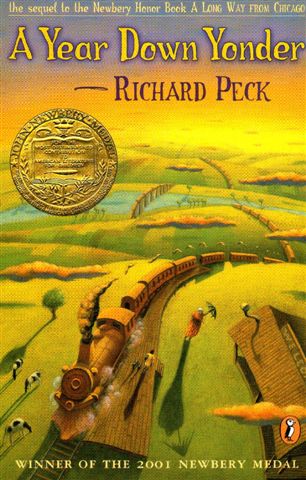
A Year Down Yonder by Richard Peck

Source of book: Audiobook from the library (but we also own it)

Richard Peck is one of our favorite authors, and we listen to his stories quite often on our trips. Here are the previous Peck selections:


A Year Down Yonder is the sequel to A Long Way From Chicago. While the first was a Newbery Honor book, the second won the medal itself. In the first book, Joey and Mary Alice spend summers (7 in all) in a small Illinois town with Grandma Dowdel, a large and thoroughly eccentric woman. In the second book, Joey is all grown up, and working out west for the CCC during the Great Depression. Their father loses his job, and the best they can do on mom’s wages is a small apartment with no room for a child. Thus, Mary Alice is sent to stay with Grandma Dowdel for the year. She is now 15, and not particularly thrilled to be back in a hick town for the entire school year.

However, Grandma Dowdel, while not exactly warm and effusive, is willing to take her in, and assist her in her new life. Along the way, there are some of the usual adventures involving Grandma: giving bullies their comeuppance, mild theft, stirring up the neighborhood, and generally humorous happenings. There is also a tornado, a WPA artist (whose nude painting session goes badly awry…), and general poking fun of the snootiness of the DAR.

As with the first book, this one is quite hilarious. Grandma Dowdel never fails to amuse. In fact, my second daughter opined that she would love to have a grandma like that. I told her I figured she would be a grandma like that, and I wasn’t joking.

I do want to mention the halloween episode. I come from small town farming stock - my paternal grandparents grew up in eastern Montana and told some similar tales of their escapades. My grandfather told of the pranks they used to play on halloween, including tossing scarecrows in front of speeding cars at dusk. But, like the hooligan boys in this book, they also used to tip over outhouses. At least until the one year they tipped over his parents’ one - with his mother in it. Inga was renowned for her fierce temper, and there was apparently hell to pay. In the book, Grandma Dowdel lies in wait with a trip line and a pot of glue, with delightful (or horrible - depending on your point of view) results.

The tale of the DAR meeting is also grand humor. My ancestors (at least the ones we know of) all came to the United States far too late to qualify for the Daughters of the American Revolution, but my wife has some blue bloods in her background. (Also moonshiners, so it cancels out…) But anyway, the DAR takes itself pretty seriously, particularly in small towns where it can make a difference between the hoi polloi and the “best” kind of people. So, when a bad case of menopause leads to a desperate plea to Grandma Dowdel to provide tarts for the annual meeting, she does not miss the chance to impose her will on the gathering, insisting it be at her house, and inviting some non-members. Which then goes downhill as Grandma Dowdel expected when an ancient lady mentions that the banker’s wife was really a foundling from the least respectable family in town - and the sister of Effie Wilcox, Grandma’s gauchely hick frenemy.

In the end, of course, Mary Alice finds she has enjoyed her time with Grandma, and isn’t eager to leave. She must, but she carries two things with her: the discovery that she wishes to write, which leads to her career, and a promise to write from Royce McNabb, her future husband.

I recommend both of these books. You don’t have to read them in order, but I think it is best if you do. Peck has a wide range of stories, from the mouse tales we first discovered, to ghost stories, and from mid-elementary level (in my opinion) to young adult. He writes both male and female characters with subtlety and believability, which makes for a nice blend of protagonists for my kids, which are as evenly split as five can be. Peck’s settings also vary, from the Victorian Age to modern times, and his period details are always well researched and matched to the stories. If you haven’t discovered Peck, there is no bad place to start, but the Grandma Dowdel books are a fun experience.

Tuesday, July 18, 2017

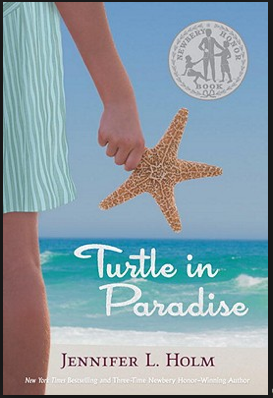
Turtle in Paradise by Jennifer Holm

Source of book: Audiobook from the library

This book is one in our series of not-particularly-systematic quest to read a lot of Newbery Award winners and honorable mentions. This book falls into the second category, named as an honor book for 2011. 


Author Jennifer Holm based the book loosely on the stories her great- grandmother told her of growing up on Key West during the Great Depression. Some of the characters are based on various relatives, and some of the incidents come from the stories. Not all, though, as the book has more of a narrative arc and drama than the originals. The buried treasure incident, for example, came from tales told by the Key West denizens (the “Conchs.”)

The basic gist is this: “Turtle” (we never learn her real name - or that of most of the other characters) is an eleven-year-old girl who is sent by her mother to live with her aunt and uncle in Key West. As we learn, this is just one twist in the hard life that Turtle’s mother has had. She got pregnant by a boy in Key West, was disowned by her rather vicious mother, and left, never to return. About all she can get for work is that of live-in housekeeper for rich people - and her latest employer will not permit children, so off Turtle goes. (This was pretty common in that day, actually. And it remains common in low income and immigrant communities. The idea that communities care for each other is one of the things that has been largely lost in middle class white suburbia…)

Turtle’s arrival comes as a shock to her Aunt Minnie - who didn’t receive the letter, because the local postal service misdirected it. But, she finds room for Turtle. Along with her aunt and uncle (who is mostly away working on the highway - one of the WPA projects), there are a bunch of boy cousins, and other local urchins. Turtle has to find a way to fit in, and find her place in Key West.

The book is full of local flavor - Holm draws on a universe of friends and family for help in getting the details of the past right. I was drooling at different points when the food was described. Particularly the tropical fruit. Other things were less attractive. Holm is up front that the Depression caused the economy of the Keys to collapse - and most residents were on aid in the 1930s. Rum running was a significant source of income, and everyone looked the other way. Financial hardship affected nearly everyone, and bootstraps weren’t enough.

Holm also writes complex characters. Turtle has to learn to be vulnerable - her hard life has led her to be cynical - and admittedly even within the story, she is given ample cause. Her cousins respond to her like you would expect real kids to. Nobody likes being displaced, and “Beans” is no exception. Aunt Minnie is stressed out already, so she alternates between compassion and irritation, like most of us would in a similar circumstance. There are few if any true villains, and no angels either. Just humans.

One of the more striking elements of the book is the group of boys that Beans heads. They are known as the “Diaper Gang.” Because they have made a business of assisting harried parents with their babies. They show up, swaddle the babies, and drag them around town in a wagon until they sleep. Or at least for a while so that the parents can have a break. The boys are actually quite good at it, and (amusingly) are unwilling to let a girl join them, because, well, girls aren’t as good at that sort of thing. (Holm apparently isn’t giving a modern gloss to this - the idea came from one of her great-grandmother’s tales. It is a reminder that the division of men’s and women’s work hasn’t always fallen along the same lines everywhere or at every time.) There isn’t money in this business, though - nobody has that to spare. However, the boys are given candy for their trouble.

The book is recommended for ages 8 to 12, which is probably about right. In my case, my 6 year old enjoyed it. And my older girls did too, in large part because of the humor, which takes the edge off what would otherwise be a tale of hardship and betrayal as much as it is of love and family. I also think this book succeeds at two of the main goals of fiction: it transports the reader to an unfamiliar time and place, and it encourages empathy for those in other circumstances.

The audiobook was narrated by Becca Battoe, who apparently was on Scrubs at one point. She is a pleasant enough reader - I have no complaints about her part of the recording. I was a bit irritated by the gaps between certain paragraphs. This is obviously a sound engineering issue, as I’m sure the book wasn’t read in a single take. A minor fault, but one amplified by the nature of listening to a CD in a vehicle: you can’t tell if there is a natural gap or if the CD has skipped. On the other hand, the relative volume levels were well balanced.