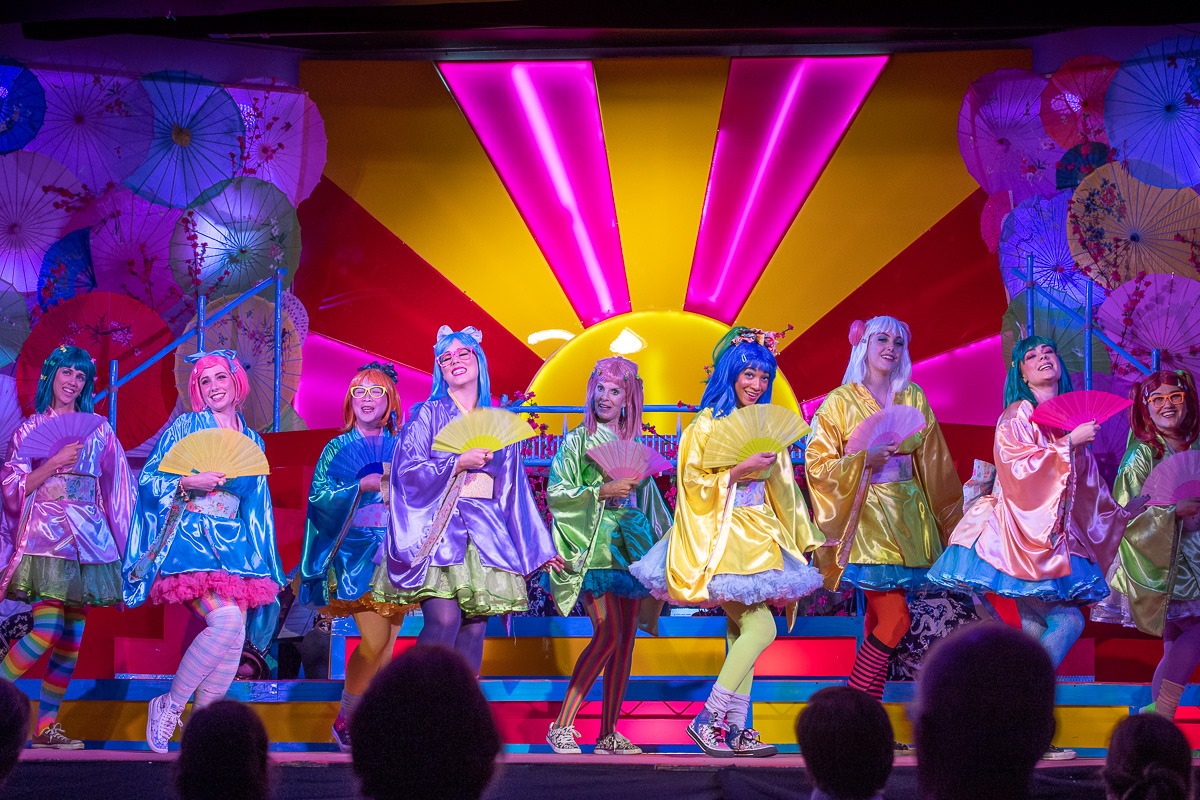
My wife has
been a Gilbert and Sullivan fan probably since birth, and, as with Broadway
shows, she has vast swaths of the lyrics memorized. Alas, even in the cultural
Mecca of California, live G&S shows have been hard to come by. We did go
see a local version of HMS Pinafore years ago - probably before kids -
that had a live piano accompaniment. (By the delightful Warren Dobson, now with
the Gaslight Melodrama.) However, that has been it. So we watched movie
versions, listened to soundtracks, and kept an eye open for more.
A musician
colleague of mine forwarded the schedule for the Pacific Opera Project (she
played for one of their larger orchestras), and we snapped up tickets to see The
Mikado.
This
particular production was at a fairly intimate venue in Highland Park (off of
Los Angeles’ oldest freeway), and was done in a brightly colored Harajuku
Style. Which was a lot of fun. Also appreciated was the use of a live orchestra
- a very small orchestra (12 instruments), due to space constraints - but an
orchestra nonetheless. The musicians were under part of the set, but on the
back of the stage, which meant we could see a bit when they were not blocked by
actors.
My wife got this picture - POP allows pictures as long as you don't annoy your fellow patrons.
For those
unfamiliar with The Mikado, it combines a love story with satire of
bureaucracy and British institutions. The lovely Yum-Yum is engaged to marry
her guardian, Ko-Ko, who has escaped a death sentence for “flirting” by
agreeing to become the Lord High Executioner of Titipu. Since Ko-Ko himself is
under a death sentence, the theory is that he cannot execute anyone until he
first executes himself, thus making the other flirts safe. Yum-Yum does not
love him - he’s at least twice her age - but prefers the dashing Nanki-Poo, a
handsome young musician. Okay, he is just disguised as a musician, but is
really the son of the Mikado, on the lam his father and an arranged marriage to
the ancient and overbearing Katisha. The town of Titipu is ruled (if that is
what you can call it) by Pooh-Bah, who holds literally every position except
that of executioner. The Mikado finds out that no executions have been done,
and threatens to eliminate Ko-Ko’s job and demote Titipu to the status of
village. (As Pooh-Bah quips in one of the many “updates” to the script, “We
will be known as the Village People.”) Nanki-Poo is in despair over Yum-Yum’s
engagement, and prepares to kill himself. Ko-Ko sees an opportunity to find
someone else to execute other than himself. But then the Mikado shows up
looking for his son, and, well things get awkward for everyone. This being a
comedy (and Gilbert and Sullivan), it has to end well. And humorously.
We brought
the kids along to this one, in part because the tickets (if you sit in the
cheap seats rather than at a dinner table) are shockingly affordable. And
because the kids love live theater and know many of the songs already. We all
very much enjoyed ourselves. I will add that even though ours were the only
kids there, the staff was courteous and welcoming.
The
production was outstanding - I can’t really think of anything to complain
about. The balance of voices and orchestra was good, the enunciation solid
(which is not easy in G&S), and both acting and singing were
enjoyable.
E. Scott
Levin played the part of Ko-Ko, and, now that I am back home, I realize that he
has performed with us at the Bakersfield Symphony Orchestra. (A quick search
and it appears he was Don Bartolo in our concert version of The Barber of
Seville. And I think Don Giovanni before that.) Anyway, he was great
when he was with us, and was delightful in The Mikado as well. As in,
really hilarious. Great comic timing and acting. Mr. Levin, if you somehow run
across this post, here’s a hello from Bakersfield. All the best.
Selfie time for Nanki-Poo, Ko-Ko, and Yum-Yum. POP publicity photo.
Phil Meyer
as Pooh-Bah deserves a mention, if for no other reason than the opening line in
his bio: “Phil Meyer’s opera repertory consists of Bad Guys, Old Guys, and
Funny Guys.” Which is exactly what a tall baritone tends to get cast as. It’s
the nature of opera.
Pish, Tush, Nanki-Poo, and Pooh-Bah. POP publicity photo.
Good work
from Charlie Kim (Nanki-Poo) Janet Todd (Yum-Yum) as the romantic leads. I
should also mention Matthew Ian Welch as The Mikado, who was clearly the best
dancer on stage. (Not to denigrate the others.) His performance was electric,
and overcame my eight-year-old’s drowsiness at the end of the late night.
All hail the Mikado ("Ah so!")
The Pacific
Opera Project tries to put interesting spins on the operas they do, including a
few lyrical changes with modern references. In this case, that meant that
characters took selfies, and complained about people who take selfies. There
were two songs just perfect for these modern touches. The first was “I’ve Got A
Little List.”
As some day it may happen that a victim
must be found
I've got a little list — I've got a
little list
Of society offenders who might well be
underground
And who never would be missed — who
never would be missed!
Instead of
the annoyances in the original, these were filled up with modern blighters,
recognizable to anyone who has lived in Los Angeles. They included such persons
as those who pick political fights on social media, instagramers, and - a
marvelous touch - those who add apostrophes where they do not belong. And
people who think we’d be safer with a wall. (Well played.)
This theme
is continued in “Let the Punishment Fit The Crime.” The familiar driver
(presumably in a BMW) weaving in and out of traffic (anyone who grew up in LA
knows what I am talking about) gets condemned to walk...or suffer through LA’s
abysmally incomplete public transportation system.
There were
more that were funny, but I can’t recall them all now, alas. In any case, well
done guys and gals.
I mentioned
the set and costumes briefly, but wanted to say a bit about that. The colors
were so bright and saturated that the world on stage seemed unworldly. Not
Japan or England or Los Angeles, but perhaps Wonderland. Pretty much every
character had a fan as a prop, and these were used to great effect. Snapping
open and closed on the beat and as punctuation, they reinforced the acting and
emotions. As a metaphor, they added an extra layer. Pooh-Bah, who has his
titles, but is hapless in doing any of his jobs, can’t master his fan.
Eventually, he shows up with a comically tiny fan, perhaps to represent his
diminished ego in the presence of the Mikado.
Snap those fans, ladies!
In contrast, Katisha (played with
impressive dourness by Adelaide Sinclair), unfolds a ludicrously giant fan upon
her appearance. It goes well with her booming deep voice and overwhelming
personality. She towers over Nanki-Poo, and even causes Pooh-Bah to shrink.
(And, of course, keeps talking over the Mikado to his great annoyance and to
the amusement of everyone else.)
Never mess with a woman with a giant fan. Ko-ko is giving it his best effort, though...
Another
interesting touch was making the character of Pish-Tush into two. Well, almost
two. In point of fact, he becomes a pair of Siamese twins (Pish and Tush), who
finish each other’s sentences.
There are so
many other things I could say, but this has already gotten long. It was a good
time, the operetta was well done, and we want to go back again.
“So we should do a musical. It will be about one of the founding fathers nobody knows much about (except lawyers and political history buffs), it will be about politics of the 18th Century, we'll use mostly African American actors, and do it with hip hop. It will be a smash hit!”
And of course it was. And I would love to have been a fly on the wall in that room where it happened.
My wife and I knew that when Hamilton came to California, we would go see it. It was inevitable after it sold out in New York, that Los Angeles would eventually get it - and the obvious venue was the gorgeous Pantages theater. Seriously, if you end up in LA, go see something there just to gawk at the Art Deco interior, which is quite a masterpiece.
I am probably in a minority in that I never got the soundtrack or read up on the plot in advance. I decided to go in with merely my own knowledge of history, the opinions of my friends, and an open mind. (My older daughters, however, got to hear quite a bit of the soundtrack from their friends, one of whom is a theater nut and can lay down the lyrics like a pro.)
That isn’t to say I didn’t know the plot at all. I went to a law school that focused to a degree on the Federalist Society type of conservatism (in addition to the more official Reconstructionist leanings of the then-parent organization), which came with a certain reverence for the Founding Fathers and the trio that wrote the Federalist Papers in particular. So I knew a thing or six about Alexander Hamilton and his life and death. And also Aaron Burr, who, it turns out, had a really crazy lifeafter his quarrel and duel with Hamilton. (In fact, one of the most important court cases on treason involved Burr.)
So yes, when Hamilton shocks everyone by endorsing Thomas Jefferson and accusing Burr of having no core beliefs, I am thoroughly in the Hamilton camp there.
But, about the play itself. There may be spoilers here, but, seriously, Hamilton has been dead for what, 200 years?
Let me start with an important observation. One of the things I always do when I go see a show in LA is check to see who is playing in the orchestra. After all, we hire a few from down south to fill out our own local orchestra, so you never know when you will see a familiar name. (Hey, S____, nice to see you a few years back playing for Phantom of the Opera…) No such luck this time, but I was gratified to see that strings were included. Strings make everything better - even hip hop. Just saying. So, in this case, two keyboards, string quartet, electric guitar, electric bass, banjo, and drums. And yes, live drums also make hip hop better. In my opinion. The orchestra was great - really tight, and perfect with the actors. That is so much harder than anyone who hasn’t played a show from the pit really realizes.
The music itself, I must say, was fantastic. I’ll confess, I hadn’t ever seen anything by Miranda previously - although my wife saw a local production of In The Heights. I was impressed that Miranda did the book, music, and lyrics. And the arrangements. Everything. Even the great opera composers didn’t tend to write the librettos - and when they did, you ended up with The Ring Cycle, which has fantastic music...and lyrics which are both poor poetry and endlessly long and repetitive. Stick to what ya know, Wagner.
But Hamilton suffers no such defect. Miranda’s lyrics are fantastic. I was impressed with the quality of the rap, both lyrically and musically. Growing up in a mostly minority neighborhood, and spending much of my teens in an integrated church, I was steeped in the sound. I had friends who aspired to a career in hip hop, and could improvise a witty rap pretty well. I could pick out some of the beats and rhymes, even when I couldn’t recall exactly which MC was being referenced.
Just a note here. I grew up around the sound, but my family didn’t listen to modern “secular” music. (Except when my dad would corrupt us with the Beach Boys or Motown on the radio.) Particularly suspect was music that was liked by my generation, low brow, or worst, African American - rap/hip hop failed on all accounts, so we did not have it in our home. So, I have kind of had to learn my own generation’s music as an adult. Except that I knew the sounds, just not the artists, because it was everywhere.
At least among white, classically trained, reactionary sorts, the status of rap as music has been in dispute. And I think the fact that it is not based on melody or harmony is the main reason why. What should not be in dispute is that rap is poetry. At its best, it can be amazingly good poetry. A common misconception (at least in the circles I ran in) is that rap is just a bunch of boasting and cussing and low class speech. Not so. In fact, a good vocabulary and firm grasp of the rhythm of language is necessary - to say nothing of thinking on one’s feet.
Throughout Hamilton, which requires careful attention to every word, I was thrilled by the clever rhymes, dramatic pacing, and the continual use of the perfect word. And the wit! Many of the direct quotes from the letters of the characters make it into raps, with just a word or two, or maybe just the timing, changed up just enough to pop. Eighteenth Century phrases meet modern hip hop phrasing.
As I noted at the beginning of this post, the whole idea sounds hopelessly crazy, but it works!
When my wife and I talked at the intermission, I noted the epiphany that I had during the first half. I was used to Broadway musicals having set numbers at key moments, with the bulk of the action taking place in ordinary dialogue. Hamilton eschews this modern style, and goes back in time to an earlier era. The comparison was unmistakeable. Miranda has practically zero spoken dialogue. Everything is in the context of music - hip hop music.
This is opera!
The idea of using recitative to serve as dialogue and further the plot dates to the beginning of the operatic form. And, believe it or not, a recitative isn’t really that different from a rap, if you think about it. A set rhythm (and harmony, in the earlier case) with the words fit into the form. A stylized form of storytelling in poetry.
Or maybe we should go back further, to Homer (and his predecessors), who told whole epics this way. Rap is nothing less than a modern incarnation of a timeless (and pan-cultural) form of storytelling. The rhymes, rhythms, and forms aid in the memorization of long stories, and connect with the intended audience, because all of these are both predictable and familiar while allowing the bard or MC to use his or her creativity within the form.
Anyway, Miranda was much better than I expected at writing a story within the form. I don’t use the word lightly, but I think genius applies here. From conception to execution, Hamilton is a masterpiece.
It's not just the hip hop, either. Miranda hits the notes from R & B, classical Broadway, and a bit of pop and classical for fun.
What else was interesting? Miranda manages to make Hamilton’s back story interesting. It was a bold move to just go ahead and plunge into a straight telling of the tale, from his illegitimate birth (which meant he was barred from Church of England schools) to his orphanage, to his hard work to succeed with little help, to his rise through hard work and brash attitude. This could easily have been borrrrrrring. But it wasn’t. Between the creative choreography and that first, brilliant rap, it was fascinating. And that is the genius. “Let’s educate an audience about 18th Century history without them falling asleep…”
I also loved the contrast of characters. The obvious one is the central one. Hamilton versus Burr. The impetuous hothead and the cautious plodder. The consummate politician and the revolutionary.
But there are more too. Thomas Jefferson and George Washington are a contrast in style, as are Washington and King George.
Perhaps the most intriguing was the one between Eliza Schuyler, who marries Hamilton, and her sister Angelica, who carried on a long (and seemingly emotionally intimate) correspondence with Hamilton even after she married a British nobleman. In the musical, Eliza is the loyal sweet - and somewhat naive - wife, while Angelica is the worldly, cynical, and brash contrast.
This required some excellent work by the actors portraying these parts. Solea Pfeiffer played Eliza, and really brought out her natural devotion and sweetness - but also her strength. In contrast, Angelica was played by Emmy Raver-Lampman, and, well, damn. Eliza is a worthy woman, and not to be underestimated. But Angelica owned the stage. No wonder men from Hamilton to Jefferson to Lafayette to Washington (and more) remained fascinated by her. (Jefferson went so far as to semi-jokingly suggest an affair.) The correspondence she had with these and other figures were invaluable to historians. She apparently talked statecraft as well as any man.
Solea Pfeiffer (Eliza Schuyler), Emmy Raver-Lampman (Angelica Schuyler), and Amber Iman (Peggy Schuyler).
Iman also played Maria Reynolds, Hamilton's paramour...
But let us not forget Eliza - the play ends with a brief recounting of what she did with herself in the 50 years after Hamilton died. Just little stuff, like founding a society to aid widows, starting and running an orphanage, editing the tens of thousands of pages of documents Hamilton wrote and publishing them to preserve her legacy. And, well, raising their seven children too. By all accounts, the Schuyler sisters were pretty badass. (My kind of women, clearly.)
In the LA version, the parts of Hamilton and Burr are played by Michael Luwoye and Joshua Henry, respectively. Both were fantastic. I know it is pretty widely known, but Miranda chose to cast the major American parts using non-whites. Bold, and effective. I am reminded of the casting in Theatricum Botanicum’s version of All’s Well That Ends Well.
Michael Luwoye (Hamilton) and Isaiah Johnson (George Washington)
We got Dan Belnavis as Washington, but I couldn't find a good picture.
The other three parts for which the casting really stood out were Jordan Donica in the dual role as Lafayette and Thomas Jefferson (the latter with an epic ‘fro) and Rory O’Malley as the simpering King George.
Ah yes, King George, who serves both as the comic relief, and as the “sassy gay friend,” as my wife put it. Miranda chose to make the numbers by King George cheesy homages to classic Broadway. And giving George stereotypically flamboyant gestures and pouts. He was hilarious.
Rory O'Malley as King George III
Speaking of Broadway references, Miranda has nods to so many great lines and songs, it is a veritable treasure trove for someone like my wife (or, these days, me, since she has corrupted me.) One of my favorites is George Washington’s little riff on Gilbert and Sullivan:
“The model of a modern major general
The venerated Virginian veteran whose men are all
Lining up, to put me on a pedestal.”
I was better at naming these references than the hip hop ones, but this cheat sheet and this one are at least a good place to start. Perhaps my more educated readers can add some - because this is fun stuff!
I guess before this gets too long, I’ll mention some of my favorite moments from the show.
Perhaps one of the best riffs on the process of politics is “The Room Where it Happens.” Ironically, one of the worst things to happen the last few years is the abandonment of the messy process of give and takes that makes democracy happen. Compromise and tit for tat are necessary to bring people together, like it or not. “Winning” isn’t quite as effective in real life, it turns out…
I also loved “My Shot.” Both as a hip hop trope and as a synecdoche of the entire story. Hamilton and the new nation are determined to not waste that one shot for success. And, ironically, Hamilton “wastes” his shot in the fatal duel, for moral reasons. Darn good song.
And then, the “Ten Duel Commandments.” Oh my goodness. Let’s take the Notorious BIG’s Ten Crack Commandments and use it to teach a legitimate lesson about history. Fan. Tast. Ic. When this one started, my jaw was on the floor. I know a bit of history, and, yes, Miranda got it right. And I knew the reference from somewhere, I just couldn’t quite place it…an absolutely amazing song - I have played it a few times tonight just because it is so good.
I am such an amateur when it comes to hip hop - I really should sit down with an expert and find all the references. Again, totally brilliant.
And a final one, even though I could mention many more: the cabinet battles. Seriously. I avoided all the debates this election cycle. Not because I am uninformed (quite the contrary, as anyone who reads this blog would know). But because our debates suck. Badly. After watching Hamilton, I think we should just scrap them and go with a rap battle format. Not because they would lead to a nuanced discussion of issues (which too few voters would actually care about, sadly), but because it would be a LOT more fun. And because I suspect that a toddler level of discourse (like, say, a certain elected narcissist who shall not be named) wouldn’t stand up to the skill of someone with a real vocabulary and interest in reading.
There is so much more to say, about the dancing, the sets, the lighting, the costumes, and so on. This show isn’t inexpensive, and the detail that goes into a show like this is amazing - you get your money’s worth at this level. I wish I could afford to see it a dozen times, and concentrate on a different facet each time. But that isn’t in the cards for me, alas.
But let me note a moment that really struck me. After a catastrophic battle led by an incompetent general, Lafayette and Hamilton strike a deal for arms (this is real history) and strategy, and give a nice little fist bump, with the line, “Immigrants get it done!”
At this point in the show, the audience erupted in cheers. This is Los Angeles, my hometown (I grew up in the San Fernando Valley), and LA and California are the West Coast epitome of the melting pot that many of us - including past GOP presidents - believe is the strength of America. We could see around us people of every color and nationality, and the cheer raised the roof. It did my heart good.
I wish I had time to look up the full script, and pull every great quotable line. But let me just go with this one, from George Washington to Hamilton:
“Winning was easy, young man - governing’s harder…”
It’s nice to win on slogans and utopian ideologies. But when it comes down to it, governing isn’t just about forcing an agenda on everyone. It requires getting others on board, and seeking the common good. Something the GOP hasn’t really had to face lately (thanks White Nationalism, Ayn Rand social darwinism, and Tea Party…), but which is absolutely necessary to have a stable and successful government. As Hamilton points out, almost as an aside, Alexander Hamilton had his biggest successes when he learned to compromise and trade a bit. Others got what they wanted, he got what he wanted, and ultimately, his ideas set the stage for a stable union, a killer financial system, and a two-party system that has mostly served our country well.
My wife and I made an overnight date of this, complete with food (of course), drinks, and a couple days of discussion. I am deeply indebted to her for many of the insights I have shared in this post. Like Eliza, she deserves more of the credit for the best of me than anyone can know.
Hamilton is subtitled “An American Musical.” I wholeheartedly agree. The story is of a chapter in our founding, in all its glory and shame. Both aspirational freedom and slavery get a mention, as they should. But at its heart, Hamilton represents the best of us. The dream of freedom and equality, the melding of the old and the new, the use of what Dvorak (back in the 1890s!) called American’s true folk music, the African American tradition in imaginative combination with the Broadway tradition of the past (itself influenced by immigrants like Irving Berlin), and the glorious amalgam that is the American Dream, where all of us aspire to find our own place in the fabric of the nation, regardless of race, nationality, religion, or political affiliation.
Let me end with a couple of the best songs. Enjoy.
Source of book: I own this. (It’s my wife’s book, actually, but close enough)
It
is always interesting to read a controversial work, and attempt to
comment in a meaningful manner, while knowing that one can never really
understand all of the issues from other perspectives.
Although
it was hardly the first time that a white male had written about the
African-American experience, by the 1930s, it was already acknowledged
to be fraught with danger of condescension and unconscious racism.
Eighty years later, we are even more aware of the inherent problems of a
work like this. However, like other works that are worthwhile, even
while a product of their times, Porgy and Bess deserves a read - and a listen.
There are actually three versions of Porgy and Bess. DuBose Heyward originally wrote a novel, entitled Porgy in 1925. Two years later, he and his wife Dorothy adapted the story into a play, Porgy and Bess,
which had some changes in the plot from the book - most notably the
ending, which was more pessimistic in the novel. Composer George
Gershwin latched on to Porgy,
and began to collaborate with the Heywards even before the play was
complete. The text of the play was further adapted into an opera
libretto, and set to music by Gershwin. That version is the one best
known to us today. It is also the version that I read - it is nearly
impossible to find the novel, and the play and opera are substantially
similar.
(l-r) George Gershwin, DuBose Heyward, Ira Gershwin
From
its debut in 1935, the opera was surrounded by controversy. Virgil
Thompson (a white composer) and Duke Ellington both criticised what they
perceived as racial stereotyping - particularly the assumption that
African Americans lived in poverty, took drugs, were sexually loose, and
solved their problems with violence. (These stereotypes are alive and
well today. In addition, there is the assumption that they are on
welfare as well.)
Ellington,
however, changed his mind later in life, and came to admire Gershwin's
music in particular. The opera continues to split opinions within the
African American artistic community. It is clearly an important artistic
work, full of history - and still arguably the best opera composed by
an American composer. The characters do suffer from some stereotyping,
but are more nuanced than that. They are not played for laughs the way
that the blackface of the time was, and Heyward and Gershwin intended
for them to be taken seriously as complex persons.
I
found it intriguing that George Gershwin insisted that the actors be
African American rather than white actors in blackface. In addition, his
brother Ira (who inherited the rights on George’s untimely death)
absolutely refused to grant permission for the opera to be performed in
South Africa using white actors.
For
my part, I have decided to treat the work the same way that I would any
in literature that display problematic elements. When reading Tom Sawyer
to my children, I had to explain the offensive racial epithets,
including why they were acceptable 150 years ago, but were not now. We
discussed slavery and racism - it really was a good starting point. I
had to point out that even Mark Twain, who was far ahead of his time in
treating minorities as fully human, unconsciously looked down on them
occasionally. I also think of the casual anti semitism and acceptance of
domestic violence that are scattered throughout literature -
particularly literature from Europe from the Middle Ages forward. (See
my discussion of Medieval Drama, The School for Scandal, and Richard Wagner. The Merchant of Venice
also comes to mind as a work that is commonly performed today, despite
its thorny issues.) All of these works have merit, but one must
acknowledge the problems, rather than gloss over them.
So what of the opera itself? Porgy and Bess
is set in “Catfish Row,” Charleston, South Carolina. It is a poor
community of fishermen, peddlers, and lowlifes. Among these is Porgy, a
crippled beggar. During a clandestine craps game, Robbins wins some
money off the violent Crown, who kills him. Crown flees the scene,
leaving his woman Bess behind, but promising to return for her when
things blow over. Bess falls in love with Porgy. Later, Bess and most of
the others have a picnic on a nearby island (Porgy can’t get on the
boat due to his disability), and Bess discovers that Crown is hiding out
there. He forces himself on her (the line between seduction and rape is
rather fine in context - one of the disturbing elements of the opera),
and promises again to come from her, despite her pleas to the contrary.
Soon
after, the men are out on their fishing boat when a hurricane blows in,
terrifying the women. In the middle of the storm, Crown appears, having
somehow swam from the island during the storm. When Crown tries to take
Bess by force, Porgy intervenes, and manages to kill Crown.
Porgy
is arrested, not as a suspect, but as a “material witness” necessary to
identify the body. (Everyone else denies any knowledge of Crown or the
murder.) The drug dealer, “Sportin’ Life,” convinces Bess that Porgy
will be convicted and never return, and talks her into going to New York
City with him. Porgy, instead, is held overnight for contempt of court
for refusing to view the body, and manages to win a bunch of money off
his cellmates. He returns looking for Bess, and eventually heads for New
York to find her.
Religion
and superstition are intertwined throughout the opera, with references
to “faith healing,” judgment day, spirituals, and, of course, Sportin’
Life’s irreverent song, “It Ain’t Necessarily So.” I always found the
sinuous tune for this song to be fascinating. It combines a chromatic
descent in a triplet meter with an accompaniment in double meter. Like
other Gershwin tunes, it is an odd amalgam of jazz and Jewish liturgical
music. It resembles a Spiritual in its call and response, but draws as
much from the blues as from the altar. Here is David Whitehead’s
performance. (The scene starts with Crown hiding out in view of the
picnic.
I think it instructive to note Sportin’ Life’s summary of “The Gospel:”
To get into Hebben
Don' snap for a sebben !
Live clean ! Don' have no fault !
Oh, I takes dat gospel
Whenever it's pos'ble,
But wid a grain of salt.
Not
too far off from the old doggerel: “Don’t Smoke, Drink, Dance, and Chew
or Date Girls Who Do.” Here’s the list of cultural “don’ts” to observe -
and that’s how to get into heaven. The specifics have changed a bit
with time, but all too often, this has become the mantra, the focus on
easily observed externals.
Another
thing that hasn’t changed nearly enough since 1935 is the casual
injustice of law enforcement. After Crown murders Robbins, the police,
not able to find Crown, take Peter (a poor peddler) into custody, again
as a “material witness,” even though it is clear that he is not guilty
of anything. Throughout the play, the (white) authorities of various
sorts are completely oblivious to the damaging effect they are having on
the finances and families of the main characters - and on their
reputation within the community. I’ve heard far too many tales from
friends and clients about their experiences being stopped and frisked
for, essentially, “driving while being a young minority” to believe that
this attitude has entirely gone away. I would also note here the hidden
camera video (done by ABC, not some shady PAC) that has gone viral recently.
On
a lighter legal note, there is one comic scene in the opera involving a
shady lawyer (Frazier), who offers to get Bess divorced from Crown.
FRAZIER: Ah ha, ah ha, Porgy's Bess, eh? Den I guess she'll be wantin' divorce. PORGY: Huh? FRAZIER: Ef de woman livin' wid you now, she got to have divorce from Crown or else it ain't legal.
(Takes document and shows it to Porgy)
PORGY: How much dat t'ing cost? FRAZIER: One dollar. Dat is, if there ain' no complication. PORGY: Bess, you likes to have divorce? BESS: What you think, Porgy? PORGY: I'm agoin' to buy you a divorce.
(Hands Frazier money)
FRAZIER: Wait a minute, it ain't legal yet. Yo' name? ALL: Bess! FRAZIER: Yo' age? BESS: Twenty year. ALL: Lord, Lord, listen what she say. Dat girl's thirty if she's a day! FRAZIER: You desire to be divorce from dat man Crown? ALL: Sho' she do, sho' she do, Yes suh, yes suh, sho' she do! FRAZIER: I'm askin' you. BESS: Yes, boss, dat's true. FRAZIER: Address the court a "Yo' honor." ALL: Yes, yo' honor. Yes, yo' honor. FRAZIER: When was you an' Crown marry?
BESS: I don't rightly remember, yo' honor. FRAZIER: One yeah, five yeah, ten yeah, what?
LILY: Dat gal ain' never marry! FRAZIER: Ah, dat's a complication!
ALL: Dat's a complication. Dat's a complication, Lord, Lord -- MARIA: Dat is a complication. PORGY: You can't sell her divorce, gimme back my dollah!
(Everybody laughs)
FRAZIER:
'Course I sells divorce. You got no right to laugh, but it take expert
to divorce woman what ain't marry, an' it cos' you, ahem, a dollar an' a
half. BESS: Don't pay him, Porgy. Don't let him take you in. FRAZIER: All right, go on livin' in sin.
(Porgy counts out money and gives it to Frazier, who signs and seals paper and hands it to Bess)
Good day to you, Missis Porgy. Only dollar an' a half to change from woman to lady.
Creative marketing at its worst, or best...
Ultimately,
the story is one of the choice that Bess faces. There is the
hardworking but violent Crown, the cheap thrill of “happy dust” and
Sportin’ Life, and the kind but impoverished Porgy.
The
story and dialogue are interesting to read, but what makes the opera is
the music. George Gershwin's composing was at its best and most
creative at this time, and many of the tunes have endured as true
classics. While Ira Gershwin is credited as assisting with the lyrics,
most were written by DuBose Heyward, and are likewise memorable.
Sadly, George Gershwin would be dead of a brain tumor at age 38, two years after the debut of Porgy and Bess. One can only wonder what other masterworks he might have written.
While
I have not had the opportunity to play the entire opera, I have played
two orchestral suites arranged by Robert Russell Bennett. One is a pops
oriented arrangement, which is pleasant enough. The other is better, in
my opinion, as it contains more of the music, including scene music,
rather than just the big tunes.
Several songs have become vocal standards, and are still a source of inspiration for artists today.
“Bess, You is My Woman Now” sung by Willard White and
Cynthia Haymon, with the original orchestral accompaniment.
A modern jazz arrangement of “Summertime” by Norah Jones