Showing posts with label Anarchism. Show all posts

Thursday, March 28, 2013

The Secret Agent by Joseph Conrad

Source of book: I own this.

Conrad is one of those individuals that I find amazing for unlikely achievement. Born Józef Teodor Konrad Korzeniowski in 1857, in the Ukraine, but to a family of Polish nobility, he managed to become one of the most highly regarded English authors. This despite not attaining a fluency in spoken English until his 20s, and waiting until his mid-30s to switch from his maritime career to writing. 
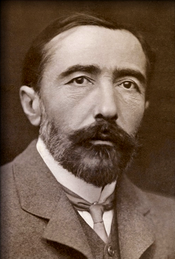


His parents took part in the resistance movement, seeking to throw off Russian domination of both Poland and the Ukraine. As a result, they were both exiled to northern Russia when Conrad was a small child. Both would die of privation and tuberculosis by the time their only child was eleven. He was then raised by a maternal uncle, until departing for training for a seaman’s career at sixteen. Since Conrad showed no interest or skill in academic pursuits - although he was an avid reader - his uncle figured he needed to learn a trade. He also seemed to have a knack for languages, learning French, German, Latin, and Greek: a useful skill for a merchant sailor.


As the son of a dissident, he could not well return to Russia, so he sought foreign citizenship, eventually becoming a British subject and rising to the level of Captain in the Merchant Marine.


But for a fortunate meeting, he might have been a footnote in the ledger of the annals of the British Empire. On one of his voyages, he met a discontented young lawyer named John Galsworthy, who was himself considering a career change. As a result of this meeting, both resolved to seek their fortunes in literature. Both would go on to success, and the literary world may be forever grateful for this fortuitous meeting.


Conrad is generally a pessimistic author, and things do not typically end well for his characters. While this was not particularly popular in his time, it was influential on later generations of writers. Furthermore, the Twentieth Century played out in a way that followed his dark vision far more than the optimism of the late Victorian period. Removed from their time and technology, his books could easily represent our own times.


The Secret Agent was written toward the end of the early part of Conrad’s writing career, in 1907, before he gained a real literary reputation.


The title character, Mr. Verloc, is a lazy double agent of sorts. He is not a glamorous James Bond type, but a man seeking to make a living to support his wife, her mother, and her half-wit brother. To this end, he nominally runs a shop selling goods of dubious legality and morality, while working as an agent for the Russian embassy in London. At the same time, he also serves as an informant to the local police force.


These two jobs were not really in opposition in practice, however much they might be in theory. Verloc’s job is to infiltrate and inform on a local anarchist cell, which both the Russians and the London police wish to keep in check.


Compared with the far more successful Communists, the Anarchists never really accomplished enough to gain a significant following in the United States, although they were a key factor in the Spanish Civil War. (See my review of the excellent The Cypresses Believe in God.) They came to my attention a few years ago with their rather bungled protests of the World Trade Organization. While not a major factor in the last fifty years, they were once a force nearly as feared as the Communists themselves.


(Quick primer: Anarchists believe in the complete destruction of both government and all authorities and hierarchies. Many support the use of violence and destruction to accomplish this. While this much is agreed, the various branches of Anarchism differ as to what should replace the status quo. Some support complete collectivism resembling Socialism or Communism. Others envision a libertarian society. Still others believe that once the current institutions are destroyed, a new society will spontaneously arise, a kind of utopia perhaps. All of these viewpoints find their homes in characters in this book.)


Conrad uses the Anarchists as the basis for his plot, in the process giving a remarkable picture of their beliefs and goals. Impressively, he does this using very little of the book, sneaking it into the conversations of the characters in a minimum of space, never interrupting the narrative enough to bog it down.


The inciting event occurs soon after the opening. Mr. Vladimir, who works for the embassy, has become Verloc’s new boss. He demands that Verloc earn his keep by arranging for a bomb to be set off at the Greenwich Observatory, which would then be blamed on the Anarchists, leading (Vladimir hopes) to the British people suspending their pesky belief in the rule of law and simply liquidating the Anarchists without proof of overt acts. Verloc knows that this is not at all in his line of work, and he further knows that the motley group of “revolutionists” that meets at his apartment lacks anyone with both the nerve and the desire to do it. In theory, these are dangerous men, but in practice, only the “Professor,” who manufactures explosives, poses any danger in reality. And the Professor has no intention of getting his own hands dirty: he is, after all, the only one who can make bombs.


As becomes rapidly obvious, this cannot possibly end well. And, indeed, it ends in “success” for the authorities, the disgrace of Vladimir; but the utter destruction of the smaller players in the drama. The attempted bombing goes horribly awry; and an inexorable destiny leads to a stabbing, suicide, and insanity.


Along the way, Conrad takes jabs at both the Anarchists and the hierarchies they seek to destroy. Mr. Verloc himself is of the Establishment, as he muses early on.


He surveyed through the park railings the evidences of the town's opulence and luxury with an approving eye. All these people had to be protected. Protection is the first necessity of opulence and luxury. They had to be protected; and their horses, carriages, houses, servants had to be protected; and the source of their wealth had to be protected in the heart of the city and the heart of the country; the whole social order favourable to their hygienic idleness had to be protected against the shallow enviousness of unhygienic labour.


What I particularly love about this passage is that he cuts right to the heart of class snobbery. The great “unhygienic” masses.


Also in that vein is Conrad’s description of the wealthy patroness who supports Michaelis, the formerly imprisoned Anarchist.


A certain simplicity of thought is common to serene souls at both ends of the social scale. The great lady was simple in her own way. His views and beliefs had nothing in them to shock or startle her, since she judged them from the standpoint of her lofty position. Indeed, her sympathies were easily accessible to a man of that sort. She was not an exploiting capitalist herself; she was, as it were, above the play of economic conditions. And she had a great capacity of pity for the more obvious forms of common human miseries, precisely because she was such a complete stranger to them that she had to translate her conception into terms of mental suffering before she could grasp the notion of their cruelty.
She had come to believe almost his [Michaelis’] theory of the future, since it was not repugnant to her prejudices. She disliked the new element of plutocracy in the social compound, and industrialism as a method of human development appeared to her singularly repulsive in its mechanical and unfeeling character. The humanitarian hopes of the mild Michaelis tended not towards utter destruction, but merely towards the complete economic ruin of the system. And she did not really see where was the moral harm of it. It would do away with all the multitude of the "parvenus," whom she disliked and mistrusted, not because they had arrived anywhere (she denied that), but because of their profound unintelligence of the world, which was the primary cause of the crudity of their perceptions and the aridity of their hearts. With the annihilation of all capital they would vanish too; but universal ruin (providing it was universal, as it was revealed to Michaelis) would leave the social values untouched. The disappearance of the last piece of money could not affect people of position. She could not conceive how it could affect her position, for instance.


Lest one think that Conrad sympathises with the one side of the issue, there are corresponding passages in which he skewers the beliefs of the other characters in turn. None escape either his mockery or his sympathy.


For example, “Toodles,” the (unpaid) personal secretary to the Home Secretary (equivalent to our Secretary of State), has socialist ideals. But he never lets these ideals interfere with his desire to hobnob with high society.


Toodles was revolutionary only in politics; his social beliefs and personal feelings he wished to preserve unchanged through all the years allotted to him on this earth which, upon the whole, he believed to be a nice place to live on.


The characterizations are really the most memorable part of this book. The plot is necessary to reveal the characters, but they never are there just to serve the plot. The plot takes the shape it does because of who the characters are, and how they react to bad circumstances and worse luck.


Verloc, of course, is well drawn.


Mr. Verloc would have rubbed his hands with satisfaction had he not been constitutionally averse from every superfluous exertion. His idleness was not hygienic, but it suited him very well. He was in a manner devoted to it with a sort of inert fanaticism, or perhaps rather with a fanatical inertness. Born of industrious parents for a life of toil, he had embraced indolence from an impulse as profound as inexplicable and as imperious as the impulse which directs a man's preference for one particular woman in a given thousand. He was too lazy even for a mere demagogue, for a workman orator, for a leader of labour. It was too much trouble. He required a more perfect form of ease; or it might have been that he was the victim of a philosophical unbelief in the effectiveness of every human effort. Such a form of indolence requires, implies, a certain amount of intelligence. Mr. Verloc was not devoid of intelligence - and at the notion of a menaced social order he would perhaps have winked to himself if there had not been an effort to make in that sign of scepticism. His big, prominent eyes were not well adapted to winking. They were rather of the sort that closes solemnly in slumber with majestic effect.


The others of the Anarchist cell are interesting individuals. Michaelis, released after a lengthy prison sentence for serving as a locksmith in a prison escape that went wrong, who becomes a mystic and, as it were, a saint; content in his belief in the inevitability of the Revolution. Karl Yundt, the fiery old man - who has never actually lifted a finger in action. Ossipon, the lecherous and hunky young man, who lives more to leverage his Anarchism to aid him in bedding women than in taking any personal risks. The Professor, short and unimposing, who attempts to compensate for the lack of respect he gets through firmness of will -  who carries a bomb in his vest at all times to prevent arrest. The authorities also are memorable. The Chief Inspector, who would much rather be chasing burglars, who abide by a recognizable code. The Home Secretary, who seems more concerned with arcane domestic issues than terrorism. The Assistant Commissioner, who was forced to leave his preferred employment in Colonial Asia because of his marriage to a controlling woman.


The complex relationships between the members of Mr. Verloc’s extended family are also well drawn. Verloc himself fancies that he is loved simply for being himself, but the reality is more complicated. Mrs. Verloc intended to marry a poorer man, but was prevented because she was weighed down by her crippled mother and mentally challenged brother. She considers it her duty to make provision for their support. Thus, Verloc is primarily important to her because of what he represents as both breadwinner and as a father of sorts to her brother. When things unravel, these expectations lead to a tragic and violent end.  


The Secret Agent formed the basis for Alfred Hitchcock’s early film, Sabotage. It was also adapted to film in a more faithful version in 1996. This scene between the Professor (Robin Williams) and Ossipon (Gerard Depardieu) in the cafe preserves most of the original dialogue, and is remarkably faithful to the original. And, the score is by Phillip Glass. The cello solo (played by Fred Sherry) undergirding this scene is stealthily sinister. (Note: I haven't seen this movie, so I assume it takes liberties elsewhere, but this scene at least is well done.)


Friday, January 6, 2012

The Cypresses Believe in God by José María Gironella


Source of book: Borrowed from the library

I have read a few spooky books in my time; thrillers, horror, and suspense. I think that this book, a work of historical fiction, has creeped me out more than any other. What is Cypresses, and why did I find it to be so discomfiting?

Written in 1953 in Spanish, and translated a couple of years later, it is set in Spanish city of Gerona in Catalonia in the five years leading up to the Spanish Civil War.

The book assumes a certain knowledge of the historical events, political parties, and major figures. Fortunately, there is an appendix with the characters, figures, and parties for reference. This last one is particularly key as Spanish politics were anything but simple in the 1930s. I also spent a bit of time learning about the history of the conflict.

The book opens in 1931 during the time of the so-called “Second Republic”. The last vestiges of the monarchy had been banished, and a new constitution approved. However, while Spain was on the brink of unimaginable chaos and destruction, few if any recognized the seeds. Many sound all too familiar for our day and time. Widespread and growing unemployment, the rise of socialist parties with revolutionary rhetoric, resentment against the wealthy. Also present and contributing to the disaster were the rise of the anarchist and fascist parties, control of the land by longstanding families with titles dating to feudal days, widespread resentment of the Catholic Church as a controlling political and economical power, and failure to modernize agriculture. The final piece, which plays a huge part in this book, is the discontent of the Basque and Catalonian regions, which contained much of Spanish industry, and felt that they were not represented by the current government.

Gironella focuses on one particular middle class family in Gerona, the Alvears. The father, Matías, works at the telegraph office, making him solidly white collar middle class, but a non-professional. He is the sort that most readers will identify with. He wishes to be good-hearted toward all, in conflict with as few as possible, to raise his family in peace, see them established in good careers, and so forth. His wife is deeply religious and fiercely loyal to her family. The oldest child, Ignacio, is truly the protagonist of the story, although the narrator takes a fairly omniscient view, telling certain parts of the story while observing the actions and even the thoughts of other characters.

Ignacio is also sympathetic to the reader, as he is a young man struggling to decide what he believes. He admirably attempts to think through the various philosophies he is exposed to, but finds himself drawn more to the people he knows than the philosophies themselves. The course of Ignacio’s struggles give the author space to describe in detail the various currents of political thought, without making the book feel like a textbook. Ignacio is not alone, of course, in this dilemma: the book itself is driven by the characters. They act the way they do and adopt the beliefs they do because of who they are, and because of their backgrounds. Thus, when the catastrophe comes, each is hedged in by his or her character and the political commitments they have made.

For those who, like me, had only a vague idea of what happened during the Spanish Civil War, here are the basic facts. After the parties of the right wing won the election of 1933, the left wing parties became more radical and demonstrative. The anarchists led an uprising, which was put down fairly quickly, but left a mark. In 1935, the leftist parties finally managed to unite long enough to win the elections that year. Acts of violence and reprisals against the parties of the right escalated, and the military began to plot to overthrow the government. At this time, the Falange (the Spanish fascist party, related more to the Italian than the German variety) grew rapidly in numbers from the disaffected members of the right. The communists, not content to have a place in the new government, combined with the anarchists to throw a general strike in an attempt to shut down all commerce until a dictatorship of the proletariat was granted – including confiscation of all private property. At this point, the middle class was ready to panic, the upper classes having already predicted ruin.

The event that sparked the war was the assassination of José Calvo Sotelo, a conservative member of parliament. The police were involved in the assassination, which was viewed as a follow-through on a threat made by a leftist politician. The military then attempted a coup, which was only partially successful. The south and west of Spain fell into military and fascist hands, while the north and east (where Gerona is located) remained in the hands of the republic, and therefore the leftists. On each side, tens of thousands of civilians were slaughtered for their political and religious views. In the leftist dominated areas, roughly 50,000 priests and nuns are believed to have been murdered. In the fascist dominated areas, any threats to General Franco and his allies were exterminated. The conflict continued through the beginning of World War II, essentially removing Spain from the conflict. In excess of a half million lives were lost, and at least that number fled to France and elsewhere for asylum.

As in all memorable books, the characters are what bring the narrative to life. Ignacio with his big heart, but youthful lack of self control and mental discipline. Matías as the pillar of the community watching his world crumble about him. Julio, the chief of police, cynical and inscrutable, doing his best to hedge his bets and keep the city from getting out of control: he is the one who foresees the death squads, but they are far beyond anyone’s control. David and Olga, the hippie communist teachers, who unwittingly assist in the rise of violence by giving the leftists respectable cover, but later risk everything to protect an enemy from death. Jose and Mateo, the young fanatics for opposite sides, Jose for the anarchists, and Mateo for the Falange. Cosme Villa, the middle class intellectual who eventually rises to power and becomes a killer. El Responsible, the anarchist with a horrific past, and a heart full of hatred and revenge. All these and more are impartially portrayed in thoughts and actions.

A few minor details, only loosely connected to the narrative, stood out to me. The first was the description of the prostitutes. “Most of them had tweezed out their eyebrows and replaced them with a black or brown penciled line. Sometimes the line slanted up, giving them a diabolical air. At times it drooped wearily. Exceptionally there was one who had stumbled on the natural curve, and she suddenly seemed a handsome, normal woman.” If Gironella had only seen Bakersfield in 2011.

The second is the proof that Vince McMahon was not so original after all. During the time of high unemployment, one of the methods used to entertain the masses was a wresting competition series, in which all of the components of WWE are present. The wrestlers wore flashy cloaks with catchy names like Panther or The Ogre. All kinds of foul play was allowed, and even encouraged. The Good and the Bad seemed to always face off, with the contestants playing to their roles. The matches had a reputation for being fixed, but this never stopped their popularity.

Finally, there is an exchange between the young priest, Mosén Francisco and Ignacio regarding Ignacio’s saint-like younger brother César. Francisco remarks that living with a saint is no easy matter. Ignacio replies, “Dear Mosén, living with anyone, even a normal person, is no easy matter.”

Despite these lighter moments, and many more that are hopeful and human, the threat of bloodshed continues to grow. As Olga says of the fascists, “When Mussolini or one of the others shouts ‘Long live our historic mission!” you ask yourself how many coffins are going to be needed.” Indeed, this is the problem with both sides. Totalitarianism and fanaticism lead invariably to purges, to massacres, and to hatred in the name of progress. The sad thing is that this book shows that the defenders of Hitler had one valid point: the Communists were equally prone to mass murder. We forget that there was a fairly legitimate point of view in the run up to World War II that Hitler was needed as a counterbalance to Stalin. Then, of course, once it became clear that Hitler was an evil menace to civilization as well, it became necessary to enlist Stalin to counteract Hitler. And both, of course, slaughtered millions. In Spain, this tragedy took place in a similar matter as the basic humanity we take for granted in our neighbors disintegrated into hatred, revenge, and pointless murder. As much as I hate to admit it, the triumph of Franco seems to have been the least of the possible evils.

All of this is made even more chilling by the conversation between the priest Mosén Alberto and the mayor Noguer over the morality of killing. How is one to know what is self defense when everyone is killing? The priest has no answer, as there can be no definitive answer. When the world is gone mad, what is to be done?

The book started to terrify me when the city, and by extension, Spain, started to turn on itself. True, unemployment and hardship is a problem, but somehow hardship gave rise to neighbors forgetting their natural bonds, their common humanity, and turned to radical ideas for action. The setting off of a bomb in a church came to be regarded as a good, despite the fact that it fed no one, helped no one. When the legitimate law enforcement and other government institutions lost credibility and power, everyone turned on everyone, as if blood was the only answer.

There are too many parallels with today around the world for comfort. Just today, I ran across an article about the budgetary problems in Spain. Again, unemployment is dangerously high. Will Spain remember the lessons of the past, or will there be mob rule and terror once again? Will the rest of the world be susceptible to the promises of food for all, of a better life for the poor, if only we could kill the wealthy? Or the educated. Or those who wear the wrong color of shirt.

This is the power this book holds: to make us ask those questions; to look deep within ourselves and ask if we too would kill; to ask if we could continue to sow love and not hate when the world goes mad.

The last several scenes in the book are of unbelievable tragedy, but also of grace and hope. On both sides of the conflict, individuals choose to do the right thing, even if they are powerless to stop the insanity. These individual acts of grace remind us of all those who have stood against tyranny and evil in ways large and small. For every Churchill, there are thousands of those who hid potential victims from those who sought their lives.

This was a worthwhile, but difficult read. At nearly 1000 pages, it is long, and requires the reader to keep track of a large number of characters, along with their political connections. Fortunately, the names are fairly easy. Gironella uses a single name for most characters, and keeps the names consistent from the time the character is introduced. The Spanish use different last names for the married women, so it helps to note family connections wherever possible. The appendix is very helpful. Family relationships are noted, as are political connections. Thus, it is easy to determine that a character would be, for example, an anarchist with a sweetheart who is a communist. Likewise, the appendix of political parties is indispensible for determining the ever-shifting alliances and oppositions.

Note on the Translation: This book was translated by Harriet de Onís. I am curious if some of the recurring phrases have a particular place in Spanish literature, much like our “once upon a time”. In particular, the phrases “life continued to move at a dizzying pace” and its variations and “[insert month] had [insert effect] on the people”. These connecting phrases tend to open chapters and take the narrative from the personal to the public. As is natural with any translated work, the idiom seems different, even if the language itself flows naturally.

Note on Gerona: In our times, the name of the city is often spelled Girona. Located somewhat near Barcelona, it is one of Catalonia’s colorful and distinctive cities. The Alvears live in a second floor flat on the bank of the river Ter, much as seen in this picture. Matías would fish off of the balcony. Gerona was a convenient setting as it was involved in the military uprising, but not so famously as to prevent the use of fictional characters.