Wednesday, January 8, 2025

How to Fight Book Censorship

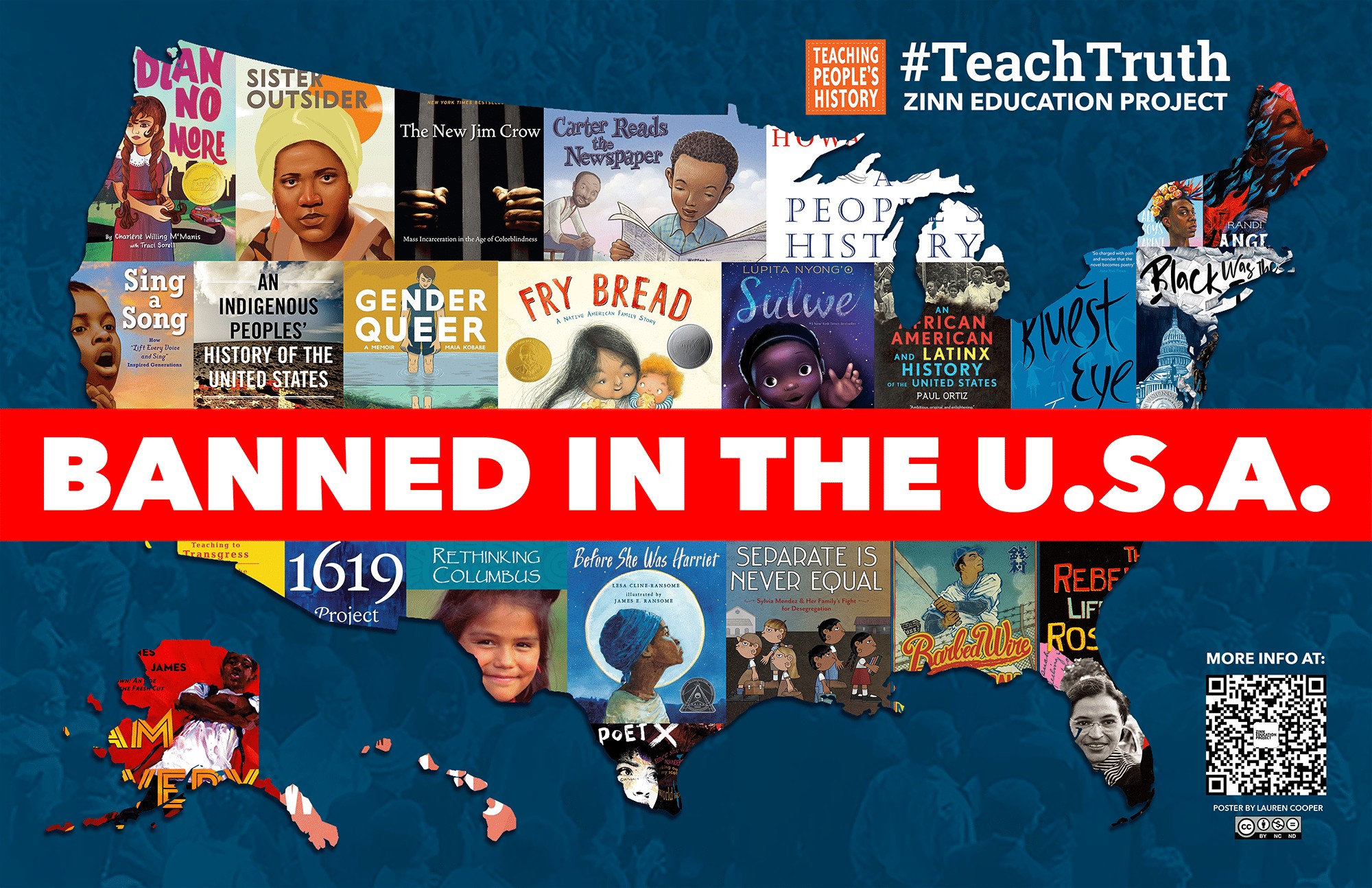
If you have been paying any attention to news over the last several years, you are no doubt aware of the concerted effort by extremist right wing groups to reduce or eliminate access to books that challenge their worldview. 


In addition to trying to repress books that illuminate the issues of gender, sexuality, systemic racism, and systemic misogyny; these efforts disproportionately attempt to silence certain kinds of authors. Specifically, non-white authors, women, and LGBTQ people


So far, the efforts have mostly been directed at schools, attempting to remove books they disagree with from school libraries and curricula. However, there are also ongoing attempts to limit access to these books at public libraries, and even in a few cases, stop bookstores from selling them. 


These are the open efforts, but even when these challenges fail, they still have chilling effects. 


For example, a school may choose not to purchase books that might draw a challenge, hoping to avoid a costly and time consuming fight. 


Or, publishers might turn down books by authors of color, or LGBTQ authors, to avoid “controversy,” or risk a fight with these extremist groups. 


Unfortunately, this is a real problem, and we are seeing the results already. 


So the question is:


What can we do about it?


As a person who cares deeply about books, free speech, and the importance of diversity of experience and perspective, I have thought about this, and explored ideas that others have proposed. Here are my suggestions for what we ordinary citizens can do:


1.      1. Realize that most people do not support book bans.


Because the bigots tend to be loud and obnoxious, it is easy to feel like they are the majority. They are not. Not even close. 


I think this is a key to the rest of the strategy. Realize that most people will be on our side, particularly if we frame the issue accurately: right wing bigots want to silence people they disagree with. 


2.      2. Read.


I would think this would be obvious, but it is still shocking how many people literally do not read books after they finish school. 


More than anything, if books do not get read, they will cease to have an impact. You want to see the voices of minorities, women, and LGBTQ people heard? Read what they write! 


If you have children, read these books to your children as well. 


If you want ideas, this blog has highlighted a number of excellent children’s books by and about authors of color, women, and LGBTQ writers. There are a lot more, of course, and there are places to find lists. I personally find LitHub and NPR to be good sources. I have also searched for lists, although I forget all of the different ones I have run across. The internet can be your friend here - and it doesn’t hurt to give traffic to sites devoted to diversity in literature.


Bottom line, though, is that you will not hear these perspectives if you don’t read. So find the books that are being targeted and read them!


3.      3. Share books with others. 


I do this in part through my blog, but you don’t need a website to do this. Talk to your friends about the books you read. Share recommendations on your social media of choice. 


A book that nobody knows about won’t get read. Don’t rely on marketing to create a market for these books. We have to do it ourselves. 


Oh, and give books as gifts. Lend out the ones you own. Encourage your friends and family to step away from the screens and the doomscrolling and read. A great side effect of this is that you will have something interesting to talk about together. 


4.      4. Join a book club.


One of the fascinating things about how totalitarian systems work is that they are threatened by civic organizations. Anne Applebaum wrote about this in Iron Curtain - fascinating book. 


Book clubs, like other groups, are a way that we humans can band together against power, against evil, against attempts to control. 


But also, there are few things better than getting together with friends and talking about books, ideas, and everything else. I am part of a local book club, and also an online one with a couple of friends. I greatly enjoy this, and have learned a lot by listening to other people’s thoughts on what we read. 


One of the few sad things about book clubs is that most are female only. This reflects in part the narrowing of culturally approved “masculinity,” where education and reading are seen as “female” things, and thus beneath a real man’s attention. 


This is stupid, of course. There is nothing unmasculine about books - hell, throughout history, literature was mostly the realm of men, and there are plenty of male writers today. 


So guys, grab a book and read it! 


I would also encourage book clubs to be open to all genders - we need to encourage men to engage in healthy ways. 


5.      5. Support and use your local library.


It has been said recently that public libraries would never be approved now - they would be considered “too socialist” for our current political climate. There is some truth to this. 


A low-water mark in my own community was several years ago, when our District Attorney literally said that she believed that every library in the county should be shut down before her office lost one dollar of funding. 


Yeah, that’s seriously horrible, and reflects the idea that the police state is the only government function that matters. Fortunately, she took some well-deserved heat for this, and our libraries were not defunded. 


In any case, libraries are a public good, and if we want to keep them, we have to support and fund and use them. 


I have, since the beginning, noted on my blog which books I borrowed and which ones I owned. I want to make it clear how much I rely on our local library for many of the books I read, despite my rather large personal library. 


So, go to your library. Borrow books - particularly the ones targeted by censorship. Read them. Talk about them. Remind your friends and family of the benefits of libraries. 


And, when budget time comes, consider speaking up in your local government meetings in support of our libraries. 


The same applies if you have kids in school. Make sure you support and use the school libraries, and express your desire to see the voices of women, minorities, and LGBTQ people among the books they stock. 


6.      6. Buy books.


Publishers aren’t going to publish books if they can’t sell them. So, if you want to hear diverse voices, you need to buy their books. 


It does no good to complain about all the trashy pulp novels that dominate many bookstore displays if you aren’t willing to purchase the better stuff. 


If you do not have room for much of a library, you can still buy books. Many used book stores will take them in trade, and you can also donate them after you read them. Your local Friends of the Library can then re-sell them in order to support the library. It’s a win-win. 


7.      7. Support your local bookstore.


I will admit, I do buy stuff from the big box and online sellers. Sorry. We do also have a local independent bookstore, and we support them when we can. 


This may surprise you, but the locals can order anything you can get online, and often charge the same amount for it. 


Throughout history, it has been the little guys that best defy censorship. If you read the important “obscenity” cases of the 20th Century, where book bans were ruled unconstitutional, you will invariably find that it was some brave small bookseller who defied the ban, and took the issue to court. 


Likewise, it was small booksellers like City Lights who championed controversial books like Howl, and even published works that the big guys wouldn’t touch. 


So, support your local bookseller whenever you can. And also, even on Amazon and similar sites, there are a lot of used books re-sold by smaller stores - for a lot of my own collection, I have looked for used, and am happy to support the little guys that deal in the trade. 


8.      8. Speak up against censorship.


This goes back to #1: most people oppose book bans. Don’t let the loudest, most bigoted people take up all the time and attention. Get out there at your local government meetings and make your voice heard. Write to your representatives. Write to your local media. You know the drill. 


It also can’t hurt to write to authors who need support. The amount of hate directed at authors by bigots is a lot, even before you get to the murder attempts directed at writers like Salman Rushdie. I bet they like to hear good stuff too. Most have websites where you can send a message, and it is not a bad idea to do so. I have had two authors get in touch with me after I blogged about their books, and it is always a good time when that happens. 


9.      9. Make connections with other readers.


People who read tend to be more empathetic, more educated, more informed, and more open to ideas and experience. You want to be friends with these people. Particularly in our era where ignorance and stupidity are celebrated and praised. 


One of the best things about the internet for me has been making those connections. (I have met several people in person later, and guess what? They are the same good people they are online.) 


However you find them, make and maintain these connections. We are going to need each other, and a willingness to learn and grow is probably the most important commonality we need. Perspectives will vary, experiences will vary, beliefs will vary. But a willingness to learn and grow in connection with others can bring us together despite differences. 


10 10.  Keep an open mind - and heart.


The reason for reading these books, for hearing these voices, is so that we keep our minds open to other perspectives. And even more important, so we keep our hearts open. 


The biggest evil facing our nation, and our world, is closed hearts. It has become all too easy to simply ignore the voices of those who are hurting - indeed, our national sin of white supremacy has always been about ignoring the cries of those we hurt. At the root of every evil, you will find this hardheartedness, this lack of caring for the wellbeing of others. (That’s why the love of money is so toxic - it renders us incapable of loving our neighbors.) 


If we instead keep our hearts open to the needs and the pain of others, we can also keep our minds open to perspectives that can lead us to better solutions to our problems. 


Humanity’s superpower is our ability to communicate and form social networks. When we fail to listen to communication and to open our networks to others, we are diminished as humans. 


As human inventions go, language is the most killer app of all time. Books are our way of preserving communication over time, and spreading that communication over distance and time. It is the way that our conversations, our knowledge, our shared humanity, can connect us even if we haven’t met. 


So, read. Support the institutions that preserve our shared knowledge. Bond with your neighbors and share the words that heal. And understand that those who would abuse others rely on the suppression of knowledge and truth. Don’t let them succeed. 


***


For more, I recommend the Zinn Education Project. Both because it has good information and resources, and because the godawful history professor my kid endured - the one who unironically threw the seig heil in class - had a vendetta against the late Howard Zinn. 


Tuesday, January 7, 2025

Midnight's Children by Salman Rushdie

Source of book: I own this.


Any of us who were around back in the 1980s should remember the huge hullabaloo surrounding Salman Rushdie. A seemingly ordinary book, The Satanic Verses, came to the attention of the fundamentalist regime in Iran, leading to a fatwa authorizing the murder of its author, previously known mostly to readers of modern literary fiction for his magical realism and historical fiction set in India. 


As I discuss in my post about that book, it seems clear that the mullahs never actually read the book - they just wanted a channel for their hate and violence. This is also the case for the vast majority of Fundie book banners here in the US as well. Rather than engage with ideas, they channel their hate against those who tell the truth and encourage different perspectives.


Midnight’s Children was Rushdie’s first big hit. It not only won the Booker prize, but later won the “Best of the Bookers” - a recognition that it is the best novel ever to win the prize. It is kind of ironic, therefore, that most people only know his name because of The Satanic Verses and the attempts on Rushdie’s life. 


The book itself is, like Rushdie’s other books from the 1980s, rather long - nearly 600 pages. I was noticing that it was a very different era for publishing. Literary authors such as Rushdie and Umberto Eco, to just name two I have read fairly recently, were able to get the green light for long, sprawling, epic books. These days, most genres (including literary fiction) have word limits, and publishers seem less inclined to take risks. 


Rushdie himself mentioned several books and authors that influenced him, and I can definitely see a few of them in Midnight’s Children.


The first is David Copperfield. Rushdie enjoyed Dickens as a child, as did I, and there is definitely some similarity here. Both are about the childhood and young adulthood of a boy. Both illuminate social issues, and satirize both personalities and politics of their era. 


The second is Tristram Shandy. That shockingly modernist masterpiece of the 18th Century shares the non-linear narrative structure of many modern works. In relation to Midnight’s Children, both books take a long time to even get to the birth of their narrators. In this case, 150 pages go by before Saleem manages to get born, and before that comes a narrative that jumps around, telling of Saleem’s ancestors. 


The third is One Hundred Years of Solitude. Clearly Rushdie adopted the Magical Realism style itself, but there are also other parallels. For example, both books use the characters as metaphors for the country itself. Saleem is born at midnight exactly when India gained its independence. From that point on, his life is intertwined with the nation, and, well, things he does affect politics as much as politics affect him. I could list a bunch of other sly nods to Marquez’ book (just like there are a lot in The Satanic Verses), but I’ll just encourage people to read both, and hunt for the Easter Eggs. 


That said, don’t get me wrong. Midnight’s Children is definitely not derivative. It is its own creative work, and rather unique. 


Saleem Sinai is one of those “Midnight’s Children,” born between midnight and 1 AM on the day of independence. These several hundred children all have some degree of magical powers, and are able to communicate with each other as children via Saleem’s mind. 


But this is only a little of the plot of the book, and not even the most important. The two main stories are that of Saleem and his family, and the greater history of India and Pakistan in the several decades leading up to independence and the three decades afterward. 


If you are unfamiliar with this history - and I definitely was - the book does a great job of incorporating it without getting bogged down. This means that you can learn as much or as little as you wish. For me, I looked things up as the book went along, and I thought it gave good context. But you can enjoy the book without these digressions if you wish. 


As with any Rushdie book, there is plenty of satire. And it is spread around broadly. Expect every religion to get at least one barb thrown at it - and atheism too. No political party or movement is spared. No one is venerated. 


Some of these may go over the head of American readers - I know I must have missed some of the in-jokes that Indians and Pakistanis would get. But a lot of them are so universal. Charlatans, politicians, and mystics are found in every culture, after all. As are adultery, prostitution, unhoused people, and amoral capitalists. Just to name a few. 


This book is really sprawling, very much like those older influences. This is not a bad thing. Don’t read a book like this for a tight plot - it is a life story, not a murder mystery. Instead, enjoy how much is contained in it. It is a whole world, seen through the narrator’s eyes, in all its color and personality and complexity. 


There are, like in a Dickens novel, a lot of characters. I found it helpful to keep Wikipedia’s list of characters handy, particularly for when a character from a few hundred pages prior reappears. 


Unlike a Dickens novel, Rushdie writes believable female characters, several of which play significant roles in this book. Because of the first-person perspective, we don’t get directly inside their heads, but they are not cardboard cutouts. 


I rather enjoyed the book, and I do think Rushdie is a fine writer, with a wonderful command of the English language. Here is the opening of the book, which drew me in right away. 


I was born in the city of Bombay…once upon a time. No, that won’t do, there’s no getting away from the date: I was born in Doctor Narlikar’s Nursing Home on August 15th, 1947. And the time? The time matters too. Well then: at night. No, it’s important to be more… On the stroke of midnight, as a matter of fact. Clock-hands joined palms in respectful greeting as I came. Oh, spell it out, spell it out: at the precise instant of India’s arrival at independence, I tumbled forth into the world. There were gasps. And, outside the window, fireworks and crowds. A few seconds later, my father broke his big toe; but his accident was a mere trifle when set beside what had befallen me in that benighted moment, because thanks to the occult tyrannies of those blandly saluting clocks I had been mysteriously handcuffed to history, my destinies indissolubly chained to those of my country. For the next three decades, there was to be no escape. Soothsayers had prophesied me, newspapers celebrated my arrival, politicoes ratified my authenticity. I was left entirely without a say in the matter. I, Saleem Sinai, later variously called Snotnose, Stainface, Baldy, Sniffer, Buddha and even Piece-of-the-Moon, had become heavily embroiled in Fate - at the best of times a dangerous sort of involvement. And I couldn’t even wipe my own nose at the time. 


This also gives an idea of the style. Saleem is telling his story to his mistress, Padma, and writing it down. This explains many of the discursions, as he has to explain things to Padma, who lacks knowledge of all his family history, to say nothing of all the other characters in the book. 


The magical realism goes hand-in-hand with a great deal of ambivalence about the supernatural, about gods and religion. Which is an interesting twist on the usual formula. I loved this line about Saleem’s grandfather. 


And my grandfather, lurching upright, made a resolve. Stood. Rolled cheroot. Stared across the lake. And was knocked forever into that middle place, unable to worship a God in whose existence he could not wholly disbelieve.


In contrast to the skeptical Aadam Aziz is his wife, the devout and indeed superstitious Naseem, later referred to as Reverend Mother. 


She had become a prematurely old, wide woman, with two enormous moles like witch’s nipples on her face; and she lived within an invisible fortress of her own making, an iron-clad citadel of traditions and certainties. 


That last line is perceptive - and I definitely know people like that. 


By the time of the narration, Saleem has become the proprietor of a pickle and chutney making factory, and indeed, has bottled a chutney for each chapter of the book. Because Saleem’s other superpower is smell (he can smell emotions), fragrance is woven throughout the book, and green chutney - “grasshopper green” - serves a significant symbolic purpose, and recurs throughout the story. 


So let me obfuscate no further: I, Saleem Sinai, possessor of the most delicately-gifted olfactory organ in history, have dedicated my latter days to the large-scale preparation of condiments. But now, ‘A cook?’ you gasp in horror. ‘A khansama merely? How is it possible?’ And, I grant, such mastery of the multiple gifts of cookery and language is rare indeed; yet I possess it. You are amazed; but then I am not, you see, one of your 200-rupees-a-month cookery johnnies, but my own master, working beneath saffron and green winking of my personal neon goddess. And my chutneys and kasaundies are, after all, connected to my nocturnal scribblings - by day amongst the pickle vats, by night within these sheets, I spend my time at the great work of preserving. Memory, as well as fruit, is being saved from the corruption of the clocks. 


Later in the book, during one of the recurrences of this idea, comes this passage. 


Because I sniffed the air; and scented, behind the solicitous expressions of my visitors, a sharp whiff of danger. I intended to defend myself; but I required the assistance of chutney.


Here is another passage that is delicious:


Family history, of course, has its proper dietary laws. One is supposed to swallow and digest only the permitted parts of it, the halal portions of the past, drained of their redness, their blood. Unfortunately, this makes the stories less juicy; so I am about to become the first and only member of my family to flout the laws of halal. Letting no blood escape from the body of the tale, I arrive at the unspeakable part; and, undaunted, press on. 


The Tristram Shandy-style joke here is that he most certainly is not about to get to the point. He has dozens of pages to go before that happens. 


Saleem’s nanny is a young woman, Mary, who has a huge role in the story, not least of which because she switched babies at birth. One of the fun digressions is this bit about her experience in Catholic school. 


‘Blue,’ the young priest said earnestly. ‘All available evidence, my daughter, suggests that Our Lord Christ Jesus was the most beauteous, crystal shade of pale sky blue.’

The little woman behind the wooden latticed window of the confessional fell silent for a moment. An anxious, cogitating silence. Then: ‘But how, Father? People are not blue. No people are blue in the whole big world!’

Bewilderment of the little woman, matched by perplexity of the priest…because this is not how she’s supposed to react. The Bishop had said, ‘Problems with recent converts…when they ask about colour they’re almost always that…important to build bridges my son. Remember,’ thus spake the Bishop, ‘God is love; and the Hindu love-god, Krishna, is always depicted with blue skin. Tell them blue; it will be a sort of bridge between the faiths; gently does it, you follow; and besides blue is a neutral sort of color, avoids the usual colour problems, gets you way from black and white; yes, on the whole I’m sure it’s the one to choose.’ 


I was unable to find anything to suggest that this was actually taught, but I do wonder if Rushdie experienced it somewhere. It seems too good to have been made up, too implausible for fiction. 


There is a good bit of philosophizing by the narrator, not least about the whole idea of India. After all, prior to the British colonization, India was a patchwork of small entities. The giant nation, cobbled together from multiple religions, languages, and ethnicities, was a modern invention. 


August in Bombay: a month of festivals, the month of Krishna’s birthday and Coconut Day; and this year - fourteen hours to go, thirteen, twelve - there was an extra festival on the calendar, a new myth to celebrate, because a nation which had never previously existed was about to win its freedom, catapulting us into a world which, although it had five thousand years of history, although it had invented the game of chess and traded with Middle Kingdom Egypt, was nevertheless quite imaginary; into a mythical land, a country which would never exist except by the efforts of a phenomenal collective will - except in a dream we all agreed to dream; it was a mass fantasy shared in varying degrees by Bengali and Punjabi, Madrasa and Jat, and would periodically need the sanctification and renewal which can only be provided by rituals of blood. India, the new myth - a collective fiction in which anything was possible, a fable rivalled only by the two other mighty fantasies: money and God.


That passage took my breath away. Wow. 


Here is another that resonated with my own experience. 


It had already occurred to me that our family believed implicitly in good business principles; they expected a handsome return for their investment in me. Children get food shelter pocketmoney longholidays and love, all of it apparently free gratis, and most of the little fools think it’s a sort of compensation for having been born. ‘There are no strings on me!’ they sing; but I, Pinocchio, saw the strings. Parents are impelled by the profit motive - nothing more, nothing less. For their attentions, they expected, from me, the immense dividend of greatness. 


Yeah, it took me a while to see the strings. “Greatness” in the way my parents expected it was a validation of their political, cultural, and religious beliefs - when I failed to share some of those preferences, I was failing to repay them for their investment. Sigh. 


The family dynamics in Saleem’s family are interesting. As the first-born, and as a male, he has some definite privilege in a way that his younger sister never has. To make things worse, she is a rough-and-tumble sort, loud and full of mischief. Due to her unusual hair color, the family calls her “the Brass Monkey,” a moniker that only goes away when she becomes a famous singer. 


But, at a few crucial junctures in the story, Saleem finds himself on the outs, and his sister unexpectedly - and to her horror - becomes the favorite.


Even the Brass Monkey was satisfied by my show of contrition - in her eyes, I had returned to form, and was once more the goody-two-shoes of the family. To demonstrate her willingness to re-establish the old order, she set fire to my mother’s favorite slippers, and regained her rightful place in the family doghouse. 


The problem for Saleem was that he had discovered his gift of reading minds, and yet had to hide it, because his parents neither believed him nor approved. There is another interesting line in this regard, after Saleem admits he used his powers to cheat on school tests.  


This behavior - not, I confess, the behavior of a hero - was the direct result of a confusion in his mind, which invariably muddled up morality - the desire to do what is right - and popularity - the rather more dubious desire to do what is approved of. 


Oh man, this is a sore point for me. I’m not good at dissembling, and I’m not a popularity chaser. I have always had my own code of morality that matters more to me than approval. Furthermore, all too many of my pointless conflicts with my family have been over this issue. I wanted to do what I believed was right, while they wanted me to do what they approved of. Which were not the same thing. 


Here is another interesting bit, a critique of human nature throughout time, but certainly resonant in the Trump Era. 


Think of this: history, in my version, entered a new phase on August 15th, 1947 - but in another version, that inescapable date is no more than one fleeting instant in the Age of Darkness, Kali-Yuga, in which the cow of morality has been reduced to standing, teeteringly, on a single leg! Kali-Yuga - the losing throw in our national dice game; the worst of everything; the age in which property gives man rank, when wealth is equated with virtue, when passion becomes the sole bond between men and women, when falsehood brings success (is it any wonder, in such a time, that I too have been confused about good and evil?) … began on Friday, February 18, 3102 B.C.; and will last a mere 432,000 years!


This concept is later applied to the Midnight’s Children. 


But it is Kali-Yuga; the children of the hour of darkness were born, I’m afraid, in the midst of the age of darkness; so that although we found it easy to be brilliant, we were always confused about being good. 


In addition to the confusion of good and evil, there is also a confusion of what is real and not throughout the book. The family moves from Bombay to Karachi midway through Saleem’s childhood. 


It was, in those days, a city of mirages; hewn from the desert, it had not wholly succeeded in destroying the desert’s power. Oases shone in the tarmac of Elphinstone Street, caravanserais were glimpsed shimmering amongst the hovels around the black bridge, the Kala Pul. In the rainless city (whose only common factor with the city of my birth was that it, too, had started life as a fishing village), the hidden desert retained its ancient powers for apparition-mongering, with the result that Karachiites had only the slipperiest of grasps on reality, and were therefore willing to turn to their leaders for advice on what was real and what was not. 


In so many ways, that describes MAGA Land perfectly. It also fits with Saleem’s comparison of the Islamic authoritarianism of Pakistan with the “highly-spiced nonconformity of Bombay.” Something else that those of us who grew up in cosmopolitan cities experience in contrast to white enclaves in small towns. 


Another observation he has about places dominated by right-wing fundamentalist religion:


“No city which locks women away is ever short of whores.” 


As Saleem grows to manhood, India and Pakistan go to war over Kashmir. Saleem has an interesting theory about why. 


If it happened, what were the motives? Again, a rash of possible explanations: the continuing anger which had been stirred up by the Rann of Kutch; the desire to settle, once-and-for-all, the old issue of who-should-possess-the-Perfect-Valley? … Or one which didn’t get into the papers: the pressures of internal political troubles in Pakistan - Ayub’s government was tottering, and a war works wonders at such times. 


One of the craziest chapters in the book is “In the Sudarbans.” Saleem, suffering from amnesia due to a close bomb strike, has been sent by the military to fight at the border of what would eventually be Bangladesh. He decides to flee the battlefield, leading his three team-mates down the river into the Sundarbans, the coastal mangrove swamps. 


The descriptions here are vivid, from the endless rain to the leaches that cover the body at night. And the Nipa Fruit - something we grow here in the warm parts of California as an ornamental. 


After his escape from the war, an imprisonment, and rescue by Parvati-the-Witch (another of the Midnight’s Children), he finds himself seeking some sort of comfort and self-knowledge. 


[N]ow, seated hunched over paper in a pool of Anglepoised light, I no longer want to be anything except who I am. Who what am I? My answer: I am the sum total of everything that went before me, of all I have been seen done, of everything done-to-me. I am everyone everything whose being-in-the-world affected was affected by mine. I am anything that happens after I’ve gone which would not have happened if I had not come. Nor am I particularly exceptional in this matter; each ‘I’, every one of the now-six-hundred-million-plus of us, contains a similar multitude. I repeat for the last time: to understand me, you’ll have to swallow a world. 


None of India’s leaders are presented in a particularly positive light, but Indira Ghandi is particularly targeted. Her declaration of martial law and imprisonment of tens of thousands of people for political reasons was pretty shameful, and Rushdie takes aim at this incident near the end of the book. 


All sorts of things happen during an Emergency: trains run on time, black-money hoarders are frightened into paying taxes, even the weather is brought to heel, and bumper harvests are reaped; there is, I repeat, a white part as well as a black. 


For the record, despite claims to the contrary, the trains did not run on time under Mussolini. 


But what I learned from the Widow’s Hand is that those who would be gods fear no one so much as other potential deities; and that, that and that only, is why we, the magical children of midnight, were hated feared destroyed by the Widow, who was not only Prime Minister of India but also aspired to be the Devi, the Mother-goddess in her most terrible aspect, possessor of the shakti of the gods, a multi-limbed divinity with a centre-parting and schizophrenic hair…


The book is divided into three sections. The first is about Saleem’s ancestors, the second about his childhood through becoming an adult, the third about his adult life. I found the third part to be the most political and the weakest part of the story. Perhaps because children are more interesting than adults? Or the politics took more of a center stage because the adult Saleem was less insulated from politics? Whatever the case, the last part of the book felt a bit less magical than the first two parts. 


That said, I really did enjoy this book a lot, and recommend Rushdie as an author. That he is best known for being the target of religious violence is a shame, because he should be best known for writing imaginative, unusual, and magical works of fiction that illuminate the world we live in from a perspective we Americans often ignore. 


Monday, January 6, 2025

Authoritarian Parenting: Obey Whom?

“If you don’t teach your children to obey you, then they will not obey the other authorities in their lives - including God - when they are adults.” 


~ Literally every “christian” authoritarian parenting guru ever


Look in my eyes

What do you see?

The cult of personality

I know your anger, I know your dreams

I've been everything you want to be

Oh, I'm the cult of personality


Like Mussolini and Kennedy

I'm the cult of personality

The cult of personality

The cult of personality


Neon lights, a Nobel prize

When a mirror speaks, the reflection lies

You won't have to follow me

Only you can set me free

I sell the things you need to be

I'm the smiling face on your TV

Oh, I'm the cult of personality


I exploit you, still you love me

I tell you, one and one makes three

Oh, I'm the cult of personality

Like Joseph Stalin and Gandhi

I'm the cult of personality

The cult of personality

The cult of personality


Neon lights, a Nobel prize

When a leader speaks, that leader dies

You won't have to follow me

Only you can set you free


You gave me fortune, you gave me fame

You gave me power in your god's name

I'm every person you need to be

Oh, I'm the cult of personality


~ Living Color - “Cult of Personality” 

***


This is another installment in my Authoritarian Parenting series. You can find the others in my index of posts about toxic religion.


Here is the question:


What is the ultimate goal of authoritarian parenting? 


Well, to create humans who are docile and obedient, never questioning or talking back to authority. 


Who is that authority?


Well…that’s the real question isn’t it? 


OBEY WHOM?


In the short term, obviously, it is easier as a parent to have little compliant robots, particularly if (as I suspect is true for a lot of parenting gurus) you don’t actually like children, and wish they would just leave you alone. 


So there’s that. Never mind that it doesn’t actually work. Children have an astonishing ability to be human and resist becoming robots. And they are incredibly skilled at irritating parents - it’s in the union contract, I am pretty sure. 


But the long game is about something else entirely. That question of “obey whom?” is the key to understanding why the Religious Authoritarian Parenting industry was created and why it continues to be maintained. 


***


The usual explanation given by the Parenting Gurus is that the most important thing a child needs to learn is to obey, so that the child will be an adult who obeys God. 


This is problematic both as an idea and in practice.


After all, there seems to be a distinct lack of burning bushes and pillars of fire in our time. 


Furthermore, if someone claims to literally hear the voice of God, we rightly view them with suspicion and even alarm. Why?


Well, that “voice of God” seems more often than not to be telling people “murder your family to save them from the Devil.” Not good. 


Which is why, with our current scientific knowledge, we label this as mental illness, not an actual voice from the Divine. 


Even the parenting gurus do not literally intend to create followers who hear literal voices they think is God. In fact, if people were to follow a literal voice of God, that would be a problem for the gurus. 


The WORST thing that could happen is a generation of humans actually following Christ. 


Instead, the REAL goal is unquestioning obedience to certain approved humans. 


As a child, I was taught about some of these “approved” humans to obey. For example, teachers (which is fine - kids, you generally should behave for your teachers!) Or the police (which, most of the time, probably not an issue in our current society.) 


But the other two are really problematic. 


First, you are expected as an adult to obey certain approved religious leaders. In order to be approved, these religious leaders need to hold certain theological views (and only those theological views.) 


In other words, the goal is that a person be trained to obey another person who claims to speak for God.


That’s it. That’s the goal. Obey a human who has a god complex without questioning, talking back, or having a “bad attitude.” 


That’s the definition of authoritarianism, naturally. Someone else gets to take on the role of god in your life. 


So, disagreeing with one’s parents on theology is a huge problem, even as an adult child. This literally led to my mother threatening me with hell on my last birthday, because I was not “walking in truth.” (The specifics are beyond the scope of this post, but you can probably guess some if you read this blog regularly.) 


As I have discussed in other posts, there is no such thing as One True Interpretation™ of scripture - at every level, there is human involvement. Human decisions as to which ideas to embrace and which to reject - because everyone picks and chooses. There are zero exceptions. The loyalty in this case is to specific human doctrines and teachings which have risen to the level of ideology, immune from challenge or reconsideration. 


Second, certain right wing politicians are considered legitimate authorities. Specifically, right wing Republicans with certain views about race, religion, gender, and economics. As many of us have noted, there are never any consequences for clergy or congregation for moving further to the right. But any step even remotely to the left is immediately punished. 


You can even see this split in our recent Covid epidemic, where white Evangelicals were the worst at refusing basic public health measures such as masking and staying home when sick. Why? Well, the authorities weren’t seen as “legitimate.” They weren’t right wing enough. Too “woke.” 


Sense a trend here? 


If you wonder why white Evangelicals so completely embraced worship of Donald Trump, this is a significant reason. They have been primed for two generations to “obey approved authority.” (And, in my experience, parents who embrace authoritarian parenting are actually the ones who are most conditioned by the experience toward blind obedience of approved authorities.) 


In a previous installment, I talked about this as being the way to create the perfect concentration camp guard, who would “follow orders” regardless of their morality. 


It helps to understand that the goal of Authoritarian Parenting is thoroughly POLITICAL. It is to maintain an ideology of hierarchy - men above women, white people above everyone else with black people at the bottom, rich over poor, Americans over everyone else, cultural fundamentalists over liberals, and so on. 


What a reactionary movement like the Religious Right needs is foot soldiers who obey without questioning, without talking back, without thinking too hard about the morality of what they are being asked to do. 


And thus, the REAL goal of Authoritarian Parenting isn’t what it claims to be at all. God has nothing to do with it. Certain men (and they are mostly men) want to be like gods, and have compliant minions to help them fulfil their political goals and express their power.


It is thus no surprise that when a skilled demagogue like Trump comes along, and dog whistles the core political agenda, people already trained to obedience line up to kiss the ring. 


***


For me, one of the reasons I fought back at my parents so much over the years was that I have an active bullshit detector. (My wife is the same.) 


When you can see through the religious charlatans your parents are following - and see that they are fakes - it is difficult to believe in their teachings. Although god knows I tried for a long time, in order to please my parents. 


Asking the question of WHOM I was supposed to obey as an adult eventually led to my rejection of the entire idea - and I know I am far from the only child of authoritarian parents to do this. In fact, the estrangement rates are really high in authoritarian families. 


***


Throughout history, there have been heroes who stood up against authoritarianism. We bible nerds would naturally cite figures like Shadrach, Michach, and Abednego - who refused to bow down to the king who claimed to speak for the gods. Or, their compatriot Daniel, who stuck to his moral values rather than outsourcing them to his authority. 

 You can't go wrong with Gustave Dore's classic illustrations...

We might in more modern times point to the various people who were part of the Underground Railroad and helped the enslaved escape to freedom. Or the men and women in Europe who hid Jewish people from the Nazis. Or those like Galileo, who refused to simply agree with authority, but explored the universe in search of truth, not dogma


There are so many more, most of which will never be famous. 


The ones who are the villains of history, though, are not just the Hitlers of the world, but the millions who valued submission to those who claimed to speak for God over the lives and wellbeing of other humans. 


I intend in a future post to look at the two competing models for morality, which I think is, more than anything else, at the core of our current political polarization. But understand that the point of authoritarianism is to get people to ignore their consciences and do the unconscionable. 


Friday, January 3, 2025

Paradise Rot by Jenny Hval

Source of book: Audiobook from the library


This is definitely an odd book to kick off my 2025 reading with, but it unexpectedly came available on audiobook earlier than I thought. Our local library system doesn’t have it, and I was hesitant to buy it, but I was able to borrow the audiobook from the LA County library. 


First, let me give a warning: if you have sensory issues, do not read this book. I don’t generally have problems, but this book is a sensory overload, and not in a pleasant way. Sound, smell, touch, vision - all of these are visceral, and generally not in a cozy way. Rather, there is a lot of, well, rot. Apples going from ripe to rotting, mold and fungus everywhere, and a lot of pee and menstruation. So if that bothers you, skip it. 


That said, oh my goodness can the author (and the translator, Marjam Idriss) write descriptions. If you can handle the subject matter, this is fantastic writing that makes you hear and see and very much feel. I can’t think of many books that can do this quite this effectively. 


The basic premise of the book is this. Norwegian biology student Jo comes to Australia for college. She struggles to find housing until she runs across Carral, who lives in a converted brewery. This odd place lacks full walls, so sounds travel everywhere. The place is damp and unfinished, and seems haunted in a weird way. But it is housing, and Carral seems nice enough, if a bit odd. 


Later, Jo meets the neighbor, Pym, who both she and Carral have sex with eventually, after reading his poem-novel, which is kind of about the three of them. But eventually, Jo and Carral become sexually involved. 


I can’t even describe the ending, which potentially changes everything that went before, but is so uncertain as to what is real and what is not that, well, who knows? This isn’t a bad thing, though. The entire novella is arguably metaphoric and phantasmic anyway. 


One could read it as a coming-of-age novel, perhaps? A sexual awakening? As horror? As bizarre fantasy? Or perhaps just as an internal journey through the sensations of decay and fecundity? 


The author is an artist in everything from visual arts to music, and her stuff is…weird


I was reminded of a few other books, which have some similar motifs, although none of them are really close to this book in style or plot. Mexican Gothic has the mold and the melding. Earthlings has the kind of gross and disturbing use of bodies. The use of urine as a recurring device is a bit like another book in translation, Visitation.


One thing that I also want to mention is the title. In the original Norwegian, the title translates as “Pearl Brewery,” which is, in my opinion, a far inferior title. “Paradise Rot” captures the themes of the book so much better. 


For example, there are references to Eden and The Fall throughout, and the ending, where Jo leaves the brewery, consciously parallels the eviction from Eden. 


There is also this passage, in the middle of the book, which is fantastic and disturbing:


"I'll tell you the fairy tale of the apple. Eve ate the apple, and then Adam came and did so too. Afterward, this apple was forgotten, and it was assumed that it rolled away in the grass while Adam and Eve were chased out of the garden. But that's not true, because secretly the apple rolled in between Eve's legs, scratched open her flesh, and burrowed into her crotch. It stayed there with the bite marks facing out, and after a while, the fruit-flesh started to shrivel, and mold threads grew from the edges of the peel."


These ideas work their way through the book much like the mycelium of a fungus, another metaphor used often. 


I’m not sure “enjoyed” is the operative word to describe my experience with this book, but I found it compelling in its own bizarre and gross way. Again, the writing is really, really good - things come alive…or maybe they come decayed? I can only say that, if you can tolerate gross stuff, you will find the language in this book powerful and evocative. 


And maybe you can decide what the ending means, and if there is anything truly real in this book or not. 


The audiobook was narrated by Brie Jackman, who I think captured the naivety and internal life of the narrator, Jo, quite well. She also kept a straight face (voice?) reading it, which is impressive. To deadpan all of the gross stuff takes talent. 


Thursday, January 2, 2025

Christmas Books 2024

Happy New Year everyone! 


For twelve of the thirteen years since I started this blog, I have made a short post about the books (and sometimes music) I received as gifts for Christmas. (And in this case, also the used books I found in my post-Christmas shopping.) In addition to being fun, it also serves as a teaser for the reviews to be written in the upcoming year. As usual, I try to link the reviews to these posts as I write them.


Here are the past editions:


2011

2013

2014

2015

2016

2017

2018

2019

2020

2021

2022 

2023


***


This year, we stayed home for the holidays, so I didn’t end up succumbing to the temptation to buy way too many used books. This means this year wasn’t as epic as last year, or 2021. Not that I am lacking books to read - check back on those prior years to see what I still have left from priors. 


As usual, I am looking forward to another year of reading, and hope my blog readers enjoy following along. 


1. Voice From the Street by Philip K. Dick


Our book club hosts often give out random books at our Christmas gathering. This time, I got this book. This one, Dick’s first book, looked interesting. It is an early book by the author - and not science fiction. It remained unpublished until 2007. 


2. The Selected Works of Audre Lorde


I already own Lorde’s complete poetry - you can read my post about Coal here - but her prose is a bit harder to find, at least by itself. My brother-in-law and his wife got me this. If you read back through the years, you can see many excellent books that they got me, including some I was not aware of previously. 


3. Ralph the Heir by Anthony Trollope


Wait, what? A Trollope I didn’t already own? Who knew? Well, regular readers of this blog know I am a big Anthony Trollope fan, and own most of his books already. My wife found one I didn’t own. Stay tuned because I am planning to read Rachel Ray with some friends, as soon as their copies arrive. 


4. Mojave Ghost by Forrest Gander


One of my kids is studying geology in college, so we have been able to share our enjoyment of a number of nerdy books. This one is an interesting crossover. Gander’s degree was in geology, but he has ended up writing poetry and doing translation. So go figure. This is his latest collection, and is the latest in offbeat poetry collections my wife has found for me. So far, I have very much enjoyed them, so looking forward to this one as well. 


5. Parable of the Talents by Octavia Butler


I have been a fan of Butler ever since my late cousin-in-law introduced me to Kindred. Later, during Covid, our book club read Parable of the Sower, which is the first book in this two-part series. Now, my wife got me the companion volume (in the same attractive hardback edition), and I look forward to reading it as well. Butler, perhaps because she was queer and black, anticipated our current toxic political and religious situation all too well. 


6. A Book of Luminous Things


I haven’t looked through this one much yet, but it is an anthology of poetry - mostly modern - from around the world. I still want to get a good edition of Milosz’ own poems, but this anthology is well regarded, and will probably serve as a jumping off point for poets from outside the English-speaking world. My wife got this for me. 


7. Complete Plays by Henry James


Well, Henry James, what can I say? I haven’t read his drama, but, as readers of this blog know, I am a big fan boy of both Henry and his brother William. My wife got this one for me as well.