Wednesday, August 9, 2017

Birthday Books 2017

I don’t always blog about it, but for the most part, my birthday presents are in the form of books. Gee, I wonder why…

Anyway, I wrote a bit about some in 2012, and again last year in 2016.

Another trip around the sun, and here I am again. Here is what I got:

  1. A Literary Feast: Recipes Inspired by Novels, Poems, and Plays by Jennifer Barclay


This book was from my in-laws, and is modeled above by my second daughter, who aspires to be a professional chef. (She just made herself flan from scratch as her birthday dessert - she’s well on her way.) I have scanned through it enough to believe that the recipes were seriously intended to be legitimate and edible. (Which is a contrast to, for example, attempts to duplicate the recipes of the past, which are often impractical and, frankly, gross.) Now, whether I can actually use it myself, or whether my daughter will appropriate it for herself remains to be seen.

2.     Let Us Now Praise Famous Men by James Agee and Walker Evans (Photography)


This classic work was published in 1941, and is a documentation of the impoverished lives of Alabama sharecroppers during the Dust Bowl and Great Depression. I suspect my older daughter (who devours anything she can find about the Depression era) will be interested as well. In light of our current political situation, I suspect this book will be more relevant than ever, as it shows that hard work alone is not, and never has been, enough to enable a rise from crushing poverty. And also that structural injustice cannot be wished away or ignored. My wife found this for me, used of course.

3.     Plum Sauce: A P. G. Wodehouse Companion (edited by Richard Usborne)


I have long been a Wodehouse fan, as any reader of my blog can see. This is kind of the coffee table book version of bon mots and other stuff. Probably fun to browse a bit at a time, rather than read straight through. I am impressed that, despite being “used,” it appears unread. On the one hand, that is sad. On the other, well, I have a new book and will read it.

4.     A Clearing in the Distance by Witold Rybczynski


This is a biography of Frederick Law Olmstead, best known for designing New York City’s Central Park. He was also an early abolitionist and had a rather diverse set of interests and talents. This book looks fascinating for its subject alone. I also enjoy Rybczynski for his writing in various magazines on architecture and city design, and for his book, City Life, which is marvelous, and gave me a new perspective on how zoning and city planning can either help or exacerbate poverty.

Well that should give me some stuff to read. 

***

Hey, some birthday flowers. These are Lycoris squamigera, commonly known as Magic Lillies, or, more racily, Naked Ladies. They have lush green leaves during the winter, which then die back to the ground. In July or August, they send up long stems with the flowers on the end. Like magic.

These bulbs were already in the ground (although neglected) at a house I moved to when I was nine years old. I kept them watered, and have moved them from place to place since then. This year, the flowers opened on my birthday itself. 


***

I’ll also mention that lasagna is my favorite food. (Italian in general and I are friends…) My wife always makes me some for my birthday, despite the hard work it requires. So, let’s have a tribute to this delicious food:

Tuesday, August 8, 2017

A History of the World in 6 Glasses by Tom Standage

Source of book: Borrowed from the library

I have read some pretty serious (and often challenging) non-fiction this year, so it was nice to take a step back and read something a bit more lighthearted. Not fluff, exactly, but something not as heavy or long.


A History of the World in 6 Glasses (Yes, it uses the numeral. No, the style guides do not approve…) isn’t anything like a true history of the world, of course. Rather, it traces the influence of six specific beverages during particular eras in the history of Western civilization.

The book is divided as follows:

First is beer, which, as the book points out, wasn’t invented, but rather discovered. Once humans learned to harvest and cook cereal grains, it was only a matter of time before something left out a bit long fermented. From there, beer became a major factor in the establishment of cities, accounting, and more. This period and beverage are associated (by the author) with the first known human civilizations: Mesopotamia. It was interesting that the first writing and the first records of beer went hand in hand. Once beer was discovered, it became subject to accounting, with the towns keeping records of how much grain people contributed, and giving them a proportional ration of beer. Later, as jobs became more specialized, the ration was specified by class, sex, and age. In what would turn out to be a constant for all the beverages in this book, beer functioned as a currency, and as a form of payment for labor.

Next is wine, which, although (like beer) discovered rather than invented long before, is truly associated with Greece and Rome. From the Greek Symposium - the gathering of freemen as equals to drink and discuss the ideas of the day - to the Roman obsession with fine wine as a status symbol and medicine, wine is intertwined with Greco-Roman society in a way that beer was not. (And beer was for the plebes, not the aristocracy, at first. Later, as prices fell, it became more universal.) While Greece and Rome do fit this vision, I do have to mention the strong role that wine played in the history of Israel too: between sheep and wine, you have most of the great metaphors of the old testament. Another fascinating book that focuses on that part of history, I recommend Divine Vintage. I found the history in this section particularly fascinating, as those elements of Greco-Roman culture are usually a sideline in other discussions.

The third is that of distilled spirits. Ironically, the first four of these beverages originated in the Middle East. Although Islam generally rejected the use of alcohol (although that is, shall we say, complicated, as the book points out…), it was Arabic alchemists that can be said to have invented the distillation of alcohol. (In fact, “alcohol,” like “algebra,” is an Arabic word. Alcohol meant a distillate of any sort - ethanol is “alcohol of wine.”) Originally used in chemical reactions, distilled alcohol also found a use as a solvent and as a base for medicinal preparations. It also turned out to be both tasty and an effective means of intoxication.

The author, however, doesn’t look at the early history of distillation as the era associated with hard liquor. Rather, he ties it to the Colonialist period. There are several excellent reasons for this. First, because hard liquor is easier to preserve - and transport - it made for an excellent shipboard form of booze. Most famous, of course, is the ration of Grog given to British sailors. This mixture of rum and lemon or lime juice turned out to be the cure for scurvy, and helped the British Navy become the dominant water power of its time.

However, there is also a seriously dark side to this. Rum is made from molasses, a byproduct of sugar production. Sugar was then produced largely in the Caribbean, on plantations dependent on slave labor. This led to an unholy triangle. The Caribbean sent molasses to the American colonies (particularly New England), who then made it into rum, which they then sent to Africa, where it was used to purchase slaves, which were then sent to the Caribbean (and the southern colonies too.) By the mid 1700s, rum production accounted for no less than 80% of New England’s exports, and formed the largest industry in its economy. So New England certainly can’t claim innocence when it comes to blame for slavery. Actually, come to think of it, New England was kind of like the Columbia of its time, supporting itself in significant part on selling intoxicating drugs...just saying.

The fourth drink also originated in the Middle East, which initially made it suspicious to Europeans. It had the advantage of being a stimulant, rather than an intoxicant, which made it acceptable under Islamic law. But this advantage also meant that it was the perfect drink for the Age of Enlightenment. Just as wine lubricated the Greek symposium, coffee was the perfect drink for the European coffeehouse, where political ideas were discussed, and culture bloomed. No less a character (and revolutionary) than Jonathan Swift said he was “not yet convinced that any access to men in power gives a man more Truth or Light than the Politicks of a Coffee House.” Naturally, those men in power were deeply distrustful of these dens of dissent. While English coffee houses were important, their role in France and the French Revolution was crucial. It is unlikely that the ideas would have spread as they did without them. I found particularly interesting that one significant problem in France before the revolution was the exemption of the ultra-wealthy and the Church from taxation. We are still fighting over that question today, with the actual tax burden (once you factor in all taxes, not just income tax) falling heavily on the lower and middle classes, and most loopholes benefiting the most wealthy.

Coffee eventually spread around Europe and to the Americas as well, but while it was popular in England initially, it would be supplanted by the fifth drink: Tea.

It is unsurprising that tea would be associated with the British Empire. However, it is important to note that tea more properly belongs to the civilizations of China and Japan (and even India) than it does to Britain. However, given the book’s focus on Western history, and the important role that tea did play in the Empire, the choice is defensible. I did want to mention the glossing over of the role tea played in the eastern world. To the author’s credit, he did give some important background information on the history of tea.

The Opium Wars naturally enter the book here, as the export of opium was necessary (at least it seemed at the time) to balance out the trade deficit with China. Hey, that’s two cases already where the Anglo-Americans sold drugs to other countries....

One additional interesting tidbit in this section is that each of the first five beverages were at some point restricted in access to exclude women. Beer was originally for male rulers, only later being issued to women and children. Wine was for men - wealthy men originally - and only later for women. It wasn’t until recently that women could drink whisky in public without risking their reputation. Coffee was believed to harm women more than men - and most of the coffeehouses were, naturally, men only. Tea too was originally off limits to women. The tea houses were male only, and women could not purchase tea themselves, but had to send a male servant to do so. This state of affairs didn’t survive the Feminist movement, however, and women eventually came to be important and influential consumers of tea.

Also fascinating is the history of the East India Company, perhaps the most dominant corporation of all time, wielding tremendous political power. At one time, its taxes accounted for an astounding 10% of all revenue to the British government. It is not at all surprising, therefore, that it pretty much got its way. Except in the case of those pesky American colonists who had the audacity to rebel and start a war and all. (My wife has an ancestor who threw tea in Boston Harbor, for what that is worth.) The whole sordid history is a good lesson on why it isn’t a good thing when corporations control government.

The final beverage is Coca-Cola, which is (surprise!) associated with 20th Century American Consumerism. And really, it is still the world’s most recognizable brand, and the one thing you can find pretty much everywhere in the world.

The history of the beverage is pretty fun, of course. It was originally a “patent medicine” during the heyday of unregulated snake oil remedies. And it contained cocaine, as did plenty of “medicines” - including those marketed for children. (Yep, and heroine and morphine too…) It was the combination of the remedy with chilled soda water and a brilliant shift in marketing from a cure to a refreshment that gave it the boost it needed to succeed.

It also came at a crucial junction in a uniquely American history. The Temperance movement was gaining steam, and there was a lot of political pressure to suppress the saloons and alcohol consumption. Coca-Cola was perceived as a culturally acceptable alternative; and the soda fountain at the drugstore a wholesome counterpart to the dark and sordid bar. The rest is history.

Well, there were a few hiccups. For example, the lawsuit filed by the US Government, claiming Coke was harmful to children, and should be restricted. Unsurprisingly to any student of American history, the government pearl clutching was joined by the religious fundamentalists, who claimed that (and you must have known this was coming…) the caffeine in Coke promoted illicit sexual activity.

There were some intriguing sections on the partnership of the US military and Coca-Cola in spreading Coke around the world. It certainly was a comfort to the servicemen and women, and endured more than, say, cigarettes. On the one hand, it is kind of an uncomfortable form of cultural imperialism. But on the other, Coke is pretty benign as far as things go. Certainly less so than production of, say, coffee, sugar, or bananas. In any event, I am not really a soda sort of person. It’s a rare treat, but not something I would bother with in France or England.

In fact, Coke is really the only one of the six drinks that I do not consume with some regularity. More than anything, that is because sugar and my body do not play well together, and I feel better when I limit my intake. And, I was born too late for the heyday of American consumer culture, I’m afraid. My generation really pioneered the more globalist and eclectic consumerism, partaking more of traditions from around the world than from the most recognizable American brands.

One more fun factoid from this book that doesn’t really fit elsewhere. In the first century BCE, there was a whole industry devoted to “universal antidotes,” preparations of wine and herbs and chemicals that would (allegedly) give immunity to poisons. In the legend, King Mithradates was given such a mixture by Galen himself, with the result that he became immune to all known poisons. This proved to be a disadvantage, however, when his son overthrew and imprisoned him. The logical solution at the time was suicide, rather than disgrace. But how? He eventually had to bribe a guard to stab him to death.

This book is fun rather than academic, to be sure. That said, the information is accurate and supported by primary sources, from what I can determine. It is intended to give an amusing yet informative account of the role of these important beverages in history. Perhaps the most important point is that each in its own way has been a weapon against tainted water, from the boiling of beer and coffee, to the natural antiseptic qualities of wine, tea, and liquor, to the sterile preparation methods of Coca-Cola. Access to each has had health benefits in that sense, from allowing humans to live in close proximity without dying of dysentery, to being a reliably germ-free liquid on the battlefield.

Standish mixes a good combination of science, history, and sociology with an intriguing narrative. Hard to beat that for a light summer non-fiction read.  

Saturday, August 5, 2017

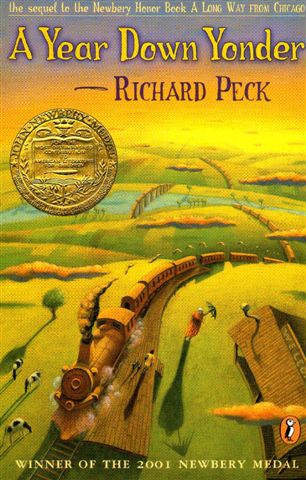
A Year Down Yonder by Richard Peck

Source of book: Audiobook from the library (but we also own it)

Richard Peck is one of our favorite authors, and we listen to his stories quite often on our trips. Here are the previous Peck selections:


A Year Down Yonder is the sequel to A Long Way From Chicago. While the first was a Newbery Honor book, the second won the medal itself. In the first book, Joey and Mary Alice spend summers (7 in all) in a small Illinois town with Grandma Dowdel, a large and thoroughly eccentric woman. In the second book, Joey is all grown up, and working out west for the CCC during the Great Depression. Their father loses his job, and the best they can do on mom’s wages is a small apartment with no room for a child. Thus, Mary Alice is sent to stay with Grandma Dowdel for the year. She is now 15, and not particularly thrilled to be back in a hick town for the entire school year.

However, Grandma Dowdel, while not exactly warm and effusive, is willing to take her in, and assist her in her new life. Along the way, there are some of the usual adventures involving Grandma: giving bullies their comeuppance, mild theft, stirring up the neighborhood, and generally humorous happenings. There is also a tornado, a WPA artist (whose nude painting session goes badly awry…), and general poking fun of the snootiness of the DAR.

As with the first book, this one is quite hilarious. Grandma Dowdel never fails to amuse. In fact, my second daughter opined that she would love to have a grandma like that. I told her I figured she would be a grandma like that, and I wasn’t joking.

I do want to mention the halloween episode. I come from small town farming stock - my paternal grandparents grew up in eastern Montana and told some similar tales of their escapades. My grandfather told of the pranks they used to play on halloween, including tossing scarecrows in front of speeding cars at dusk. But, like the hooligan boys in this book, they also used to tip over outhouses. At least until the one year they tipped over his parents’ one - with his mother in it. Inga was renowned for her fierce temper, and there was apparently hell to pay. In the book, Grandma Dowdel lies in wait with a trip line and a pot of glue, with delightful (or horrible - depending on your point of view) results.

The tale of the DAR meeting is also grand humor. My ancestors (at least the ones we know of) all came to the United States far too late to qualify for the Daughters of the American Revolution, but my wife has some blue bloods in her background. (Also moonshiners, so it cancels out…) But anyway, the DAR takes itself pretty seriously, particularly in small towns where it can make a difference between the hoi polloi and the “best” kind of people. So, when a bad case of menopause leads to a desperate plea to Grandma Dowdel to provide tarts for the annual meeting, she does not miss the chance to impose her will on the gathering, insisting it be at her house, and inviting some non-members. Which then goes downhill as Grandma Dowdel expected when an ancient lady mentions that the banker’s wife was really a foundling from the least respectable family in town - and the sister of Effie Wilcox, Grandma’s gauchely hick frenemy.

In the end, of course, Mary Alice finds she has enjoyed her time with Grandma, and isn’t eager to leave. She must, but she carries two things with her: the discovery that she wishes to write, which leads to her career, and a promise to write from Royce McNabb, her future husband.

I recommend both of these books. You don’t have to read them in order, but I think it is best if you do. Peck has a wide range of stories, from the mouse tales we first discovered, to ghost stories, and from mid-elementary level (in my opinion) to young adult. He writes both male and female characters with subtlety and believability, which makes for a nice blend of protagonists for my kids, which are as evenly split as five can be. Peck’s settings also vary, from the Victorian Age to modern times, and his period details are always well researched and matched to the stories. If you haven’t discovered Peck, there is no bad place to start, but the Grandma Dowdel books are a fun experience.

Thursday, August 3, 2017

The Evolution of Calpurnia Tate by Jacqueline Kelly

Source of book: Audiobook from the Library

This is another book in our not-particularly-methodical trek through the Newbery award books. This one missed out on the award, which went to When You Reach Me by Rebecca Stead, which we listened to earlier this year, but it did get an honorable mention. It could easily have won, in my opinion. (2010 was a good year. We also enjoyed Where the Mountain Meets the Moon by Grace Lin.) 


The book is historical fiction, set at the turn of the 20th Century, in post-Civil War Texas. Calpurnia is an 11 year old tomboy in an upper-middle class family. You know, the kind that has a cook and a housekeeper. But she definitely doesn’t fit in well. Her mother missed out on the debutante experience due to the war, and is determined that Calpurnia “come out” and eventually get married. But Calpurnia isn’t into that sort of thing at all, and finds the domestic arts to be dreadfully dull. It is hard to blame her, in some ways, though. After all, why learn to cook and sew when neither of her parents do? Learning those crafts just to show off for a beau - and to other females - when it is expected you will have the help do those tasks anyway just seems silly. (Calpurnia does eventually understand some of her privilege, to her credit, but she does assume a lot of things based on her life as she knows it.)

But that isn’t really where this book goes. Instead, Calpurnia has a burning desire to know things. In particular, she wants to know about nature and the world around her. As her parents are not particularly helpful, she attempts to request The Origin of Species from the library, only to be humiliated by a prudish librarian. She decides to be brave and approach her crusty and remote grandfather in his library. He is a Confederate veteran who moonlighted as a naturalist even while building a cotton gin business. Now retired, he spends his days collecting specimens and attempting to make whiskey from pecans. She knocks, he responds with “enter, if you must,” and thus begins an unexpected relationship. Calpurnia learns to collect and observe and record. And she gains a scientific education that her school will not provide.

Each chapter is headed by a quote from Darwin’s book, and Calpurnia’s journey is one from childhood to an adult world of scientific rigor, spiced with wonder and humor. The relationship between her and her grandfather is the true heart of the story, as is their quest to prove they have discovered a new species of vetch. Along the way, she has to navigate the changes that come with time. Her oldest brother (and best friend) falls in love, and Calpurnia makes some horrible missteps out of her jealousy. Three of her other brothers (there are six total…) fall in love with the same girl, and she tries to stay out of the middle of that mess. Progress is on the horizon, with the new motor cars and society is changing. Some people are not taking the shift well, while others, like Grandfather, embrace the long-awaited changes.

I liked that Calpurnia is a complicated character, never too sweet or too sure of herself. Coming of age is never easy, and her successes and failures seem realistic. Kelly also writes realistic supporting characters, although it is occasionally difficult to distinguish all of the brothers. (And really, Grandfather can’t tell them apart either...) But three definitely stand out. Harry, the oldest son, is Calpurnia’s confidant, and nearly grown up. Lamar is rude and entitled, and perhaps represents the old-style male. Travis is the sensitive animal lover. The others are more anonymous.

The book is more episodic than not, and Calpurnia’s problems never really resolve. After all, just turning 12 and flipping to the new century doesn’t change the basic dynamics of the family. However, it is easy to imagine that she will manage somehow to get into the university, and change the trajectory her parents have for her. After all, she has discovered knowledge, and there will be no turning back for her.

This book kept my kids’ attention well, with enough humorous bits for the younger kids, and themes that resonated well with my older daughters, who are themselves beginning to plan for their futures. More than 100 years later, their choices are definitely different. It is assumed that all my kids will go to college, and it is also assumed that they will have domestic skills - and yes that includes the boys. No servants for them, which is a good thing. But also, there is no black and white choice between domesticity and education, which really is one of the ways that our current century is better than the past.

I’ll also add that I appreciated that the science in this book passes two important tests. First, it is accurate, which is not always a given in children’s books. Second, it is matched to its setting. The state of science in the book is what it would have been at that time.

This book is considered “Young Adult,” probably because of an amusing underaged drinking incident and some oblique references to sex. (How do you discuss evolution without it?) Nothing I found objectionable, even for my youngest.

The audiobook was read by Natalie Ross. I particularly appreciated the fact that there were tracks roughly every minute, which made finding our place after stops much easier.


Wednesday, July 26, 2017

The Irregulars by Jennet Conant

Source of book: I own this.

Did you know that before he was a beloved children’s author known for subversive and quirky books that independent-spirited kids have loved for decades, Roald Dahl was a British spy? And not only was he a spook, but he spied on the United States on behalf of Britain?

Neither did I.

But it is true. Dahl was injured in an airplane crash while part of the RAF early in World War II, and was assigned to the British Embassy in Washington D.C. as part of a public relations campaign in support of the Lend Lease program. While he was touring and telling his stories (and writing the famous Disney wartime propaganda book, The Gremlins), he was recruited by the British Security Coordination (BSC), a thinly disguised spy agency headed by Canadian William Stephenson.

Dahl ran with the social set in DC, and spent time with the Roosevelts and other politicians, newspaperman Charles Edward Marsh (who astonishingly does not even have a Wikipedia page, despite his influence which rivaled William Randolph Hearst), actors, and a plethora of socialites in and around Washington. His job was two-fold. First, he was to keep his ears open for interesting information - and there is evidence he passed along plenty of that. His second was to engage in counter-espionage - particularly by countering the narrative of the “American First” elements and other Nazi-sympathetic groups. It was interesting to read of the BSC from the other side: I had already read Winston Churchill’s World War II series, and he mentioned the work done through official and unofficial channels, but this gave a better “on the ground” view.

Reconstructing this story was not terribly easy, as good spies don’t leave behind incriminating evidence, and their own stories of what they did are not, shall we say, likely to be the most reliable. However, Ms. Conant pulls from a variety of sources to reconstruct a good deal of what happened from what Dahl was allowed to write down and what others in the business had to say afterward.

Dahl was hardly the only literary figure. Noel Coward worked in the same agency. Ian Fleming (of James Bond fame) worked fairly closely with Dahl. There were a number of other names that I recognized, both British and American. The line between friend and foe was a bit fine, particularly because Roosevelt was generally on the side of the British interests, and encouraged the BSC. Likewise, the official diplomats tended to hate the spooks, and tried to undermine them. It is rather fascinating stuff. 

The other characters in this book are interesting as well, from author-turned-congresswoman Clare Boothe Luce to actor Gregory Powers. Ms. Conant takes time to explore the lives of many of the close associates of Dahl, and how they fit into the political and social structure of the time. 

 Dahl and Hemingway

Also of particular interest to me, with my love for aviation and knowledge of the history of the airlines was the negotiations between the British and the Americans over the future of commercial aviation. Long before the war ended, the two bickered over the use of airfields built by each party around the world, whether commercial aviation should be a monopoly or a free for all. Complicating this was the fact that Pan Am was politically powerful, and the Brits were probably right that the negotiations were largely dictated by corporate lobbyists.

A few observations from this book: if anything, politics is even dirtier than spy work. Good lord, the skulduggery. I felt like taking a bath after reading some of this stuff. Also, anyone who tells you sexual mores are worse now hasn’t really read much history. Our current president would have fit right in with the 1940s culture, where rich men could marry and discard women at will, harassment was accepted as a matter of course, and nobody blinked at the history of abortions beautiful women had to hid their affairs. Pretty sordid stuff, and a reminder that in matters of morals, the only question that really mattered (and to a large degree still matters) is how much money and power you have. A star really could get away with just about anything.

There are also some outstanding quotes in this book, that are worth it even if they weren’t part of a larger narrative.

Lord Mountbatten’s distant nephew, Ivar Bryce, was a friend of Dahl’s, and not the most reputable one either. Bryce was born into wealth, and never really had to grow up. Mountbatten once said of him:

“It’s terrible, the advantages he’s had to overcome.”

David Ogilvy was another young spook who figures prominently in this story. He spent time working with George Gallup, who was essentially inventing the art of polling at the time, and later observed about research:

“There is no great trick to doing research. The problem is to get people to use it - particularly when the research reveals that you have been making mistakes. Most people have a tendency to use research as a drunkard uses a lamppost - for support, not for illumination.”

Isn’t THAT the truth.

Finally, there is one rather chilling and prescient passage. Stephenson believed that Americans were easily duped, and that therefore, he had to do his best to dupe them better than the opposition. To this effect, he employed some pretty ludicrous propaganda, including astrologers to predict Hitler’s fall. As he said about it later:

“It is unlikely that any propagandist would seriously attempt to influence politically the people of England, say, or France through the medium of astrological predictions. Yet in the United States this was done with effective if limited results.”

This is a lesson that was apparently not lost on certain foreign powers in the runup to our last election. I found I had seriously overestimated the ability of my countrymen to identify obvious falsehoods and fake news, but so many preferred to believe propaganda that supported their political preferences.

This is a fascinating look at a complex man, interesting times, and a lesser-known facet of a famous conflict.

Tuesday, July 25, 2017

Part 2: Scripture and Culture

Part 2: Scripture and Culture

In the first part of this series, Christianity and Culture PART 1: Asking the Right Questions, I explored the definitions of culture and Christianity in the sense of following Christ, and looked at how we can tell if a battle is really between Christ and culture, or just a battle between cultural preferences. I also looked at areas where the teachings of Christ very much conflict with culture, but Evangelicals have chosen the culture over Christ.

I also should note, after a discussion with a Catholic colleague of mine, that my particular perspective is that of a Protestant, but also one raised in the Evangelical tradition. While I do not necessarily agree with the Catholic or Orthodox positions on everything, their perspectives on culture are often different.

In this installment, I hope to set forth my own approach to scripture and determining what speaks to our own challenges, and what is the cultural baggage from the time it was written.

I will disclose at the outset that I am not a theologian. I will not pretend to make a thoroughgoing theological defense of my position. I will particularly not attempt to convince believers in the literal dictation of an inerrant scripture direct from the mouth of God that my approach is correct. I cannot hope to convince them, I’m afraid, because their belief system will inevitably be theonomic. That is, knowing right from wrong will be solely a matter of teasing all the rules out of the bible and enforcing them as literally as possible. (At least the ones they want to. Love Your Neighbor isn’t usually one that is taken literally at all. Or the one about embracing immigrants and refugees...) Believe me, I grew up in that culture and belief system. Theonomy, Dominionism, Reconstructionism. Old Testament Sharia law. Been there, done that. Didn’t get a T-Shirt. (Blue slacks and white shirts only…)

But let’s be honest, nobody, past or present, takes all of scripture literally. For example, every single one of the hard-core theonomists I have had a discussion with are vehemently anti-immigration. So it is pretty obvious that they do not literally believe that Christ will send them to hell for turning away the stranger. Each and every one of us picks and chooses, interprets and applies. We make choices. Or, more often, we let professional Christians make them for us. We let doctrinal statements, theological frameworks, and pastors or priests make those decisions for us. And, in the Culture Wars™, we let people and organizations with political motives and agendas make those decisions. (See, for example, pro-segregationists Phyllis Schlafly and Jerry Falwell Sr. and modern racists like Jerry Falwell Jr. and the spokespeople for the American Family Association.)

My intent, therefore, is to explain my own framework for addressing the issue of culture in scripture and how I seek to resolve the ensuing conflicts and issues. Ultimately, I believe that the Law of Love is primary, and we should look at the fruit if we want to know if the tree - or doctrine - is good. If something doesn’t look like love in our culture and circumstances, it probably needs to be carefully reevaluated as it may turn out to be inseparable from the culture in which it developed.

Let me start with the premises that I accept:

  1. The bible, while inspired by God (in my belief system), was written by humans, and subject to human limitations, prejudices, and cultural baggage.

I’m going to give some credit to Peter Enns and Christine Hayes among others for insight into this. The bible was written - and collected - and revised - by many different people over at least a couple thousand years. These people had different beliefs, theology, points of emphasis, prejudices, cultures, and blind sides, just like all humans. Just as we should not be surprised to find that the bible’s creation story is a retelling of a prior myth and assumes an Ancient Near East cosmology and science, we should not be surprised to find that other parts of scripture reflect the attitudes and beliefs and prejudices of the times and cultures in which they were written. So, we should expect to find a belief that women are the chattel of men in the Old Testament (and often in the New), because those were the beliefs of the time in which it was written. We should expect to find acceptance and regulation of polygyny and slavery and genocide because those were endemic to the culture of the time and place. We should expect that Aristotle’s philosophy will dominate the discussion of gender - and indeed all household relations in the New Testament, because his philosophy dominated the Greco-Roman world (and still reverberates today.) We should expect that women will be spoken of as if they were intellectually, morally, physically, and spiritually inferior to males, because nearly everyone believe that up until the Feminist movements beginning just over 200 years ago. In fact, we should be surprised when we don’t see these cultural prejudices.

Because of these human prejudices and limitations, we should not assume that specific rules should apply in every case, or that the cultural assumptions of the authors of the bible were correct. The authors of the Torah may not have understood slavery to be wrong - but it is. The authors of the Torah may have believed that male ownership of females was appropriate - but it isn’t. Saint Paul may or may not have believed that women were as inferior to men as men are to God - but that doesn’t mean that men are superior to women.

We should assume these cultural prejudices and baggage exist, and take them into account in our interpretation.

And that leads to the second premise:

2. We should pay particular attention where the bible appears to speak in opposition to the culture in which it is written.

So when Saint Paul talks about men and women, his acceptance of the fact that women were legally obligated to obey men is much less interesting than his radical assertion that men are to love and sacrifice for women.

Likewise, where Christ’s words stand in stark opposition to the culture and values of His time, we need to listen and take those words to heart.

And the flip side:

    3. Where the bible appears to affirm the culture in which it is written, we should be extremely wary of applying that affirmation to our present culture.

This was one major mistake that the pro-slavery Christians made in the runup to the American Civil War. They truly believed God was on their side, and had all the scripture verses to prove it. In the Dominionist culture in which I spent time, the restoration of Patriarchy, whether on the Old Testament or New Testament cultural models was the foundation of the entire belief system. And at least in the hard-core cult-like groups, they were honest that literal implementation of the rules required a return to the culture of the ancient Near East. Or, for another egregious example, religious purges from the Inquisition to the Salem Witch Trials have relied on the cultural belief that religion was to be enforced at the point of a sword. Most of us Christians in our modern times, even the conservative ones, have rejected this idea.

In the same way, when we encounter cultural beliefs in the bible, we should be careful to not assume that they are true just because a writer of the bible believed them to be true. This should be particularly true of beliefs of the past which seem immoral. We do not have to accept that we should dash the brains of the infants of our enemies out on rocks, even if some writers of the Old Testament believed God commanded them to do it. We do not have to believe that women are inferior to men just because that belief is foundational to the gender relations we find in the New Testament. We do not believe it is appropriate to kill women who don’t bleed on the wedding night, even though this was considered normal by the writers of the Torah.

And this leads to the conclusion:

    4. Interpreting and applying scripture requires sifting out the cultural baggage or else we end up applying the prejudices and injustices of the culture of the past to our lives - and the lives of others - as if it were God’s will.

The most forceful argument that my atheist friends and prominent atheists like Richard Dawkins have been able to make against Christianity is this: we excuse great evil and injustice because it was excused in our sacred writing. And worse, we enshrine evil and injustice as the will of God to be imposed on others. Yes, we have committed genocide in the name of God. Yes, we justified slavery with an appeal to scripture. Yes, we currently tell women that their worth is primarily in their hymens and that they are to obey men. Yes, we tell women that they are more virtuous if they have children and stay at home with them than if they forego children or work outside the home. (Not all, but this is a strong idea in Evangelical culture.) Yes, we tolerate teachers who tell women to stay and be beaten. These are indeed evils we have and continue to perpetrate in the name of our God. To the extent that these constitute “Christianity,” Dawkins and Hitchens are absolutely right: the world will be a better place when these ideas go away.

And they come back to the same error: The culture of the past is not pure and clean. It is full of injustice, evil, oppression, hate, and violence. It also contains nobility, good, love, and kindness, of course, because every culture, including our own, is a mix of good and evil, kindness and hate, and so on. And despite what Evangelicalism loves to insist, it wasn’t better in the past. (If you take violence as your measure, then you can make a solid argument that 21st Century America is a far less evil place than Ancient Israel. And also that Western Europe is currently less evil than America. Or you could look at how well we feed the hungry, clothe the naked, heal the sick, care for widows and orphans. I think Christ himself said something about that.)

This is why the error is so damaging in the Culture Wars™. It ends up supporting the injustices of the past, whether segregation (the reason the Religious Right was established - to restore segregation to Bob Jones University and other “christian” schools) - or gender roles. And it ends up ignoring the parts of scripture which truly conflict with our own culture.

How does it look when you focus on the ways that scripture went against its own culture?

Here are some examples. In a culture that assumed child sacrifice was normal and acceptable, Abraham’s hand was held back.


4000 years ago, we openly sacrificed humans to the gods to ensure a good harvest. During the slave trade and the conquest of America, we sacrificed brown skinned people to the god of Manifest Destiny. During Jim Crow, we let black children die for lack of food and medical care. Now we watch refugees drown as a sacrifice to the god of National Security, and attempt to take medical care away from the poor, elderly and disabled so they can quietly die where we don't have to watch. It was wrong then, and it is wrong now...

In an Ancient Near East where the previous codes gave different penalties to slaves, freemen, and aristocrats for the same act, the Torah imposed the same penalty on all.

In a culture where tribalism reigned and immigrants were treated as slaves, the Torah says that the immigrant is to be treated exactly the same as a native. Why? Because YHWH is the God of immigrants - and the Israelites too were immigrants. (When is the last time you heard a sermon on this?)

In a culture where the rich preyed on the poor, paying them starvation wages, while accumulating multiple houses and vast wealth, believing that their keeping of the religious rituals and beliefs would make God happy, the prophets came and denounced them and proclaimed that the nation would be destroyed because of their greed. (Does this sound at all familiar?)

In an era when religious and racial purity was considered an important goal, the writer of Jonah sets forth a parable with the opposite lesson: even our enemies can become part of the Kingdom of God, not by adopting cultural or religious practices, but by repentance from the perpetration of violence. (Nineveh was the symbol for violence and genocide - the Sin City of violence, if you will.)

Christ comes on the scene and castigates the religious establishment for its focus on purity and self righteousness, piling burdens on others while being unwilling to give assistance. He preached an upside down kingdom where the weak are strong, the first will be last, and hierarchies are blown up. He invited a woman, a woman! to “sit at his feet,” which meant in that culture that he had invited her to train under him as a rabbi. And then scolded her sister for trying to get her back to her gender appropriate place in the kitchen.

He refused to enforce sexual rules against those would were on the wrong end of society’s power differential, and didn’t scold the woman at the well, but chose her as his emissary. His life was a life of service to the vulnerable and warning to the rich and powerful.

In the two times Christ talked (arguably) about hell (Matthew 25 and Luke 16), he didn’t mention theological orthodoxy or sexual behavior, or adherence to cultural standards, but explicitly tied our destiny to how we treated the poor and the aliens.

Following in Christ’s example, Saint Paul and others upheld a vision of masculinity as being about kindness, sacrifice, and meekness - in stark contrast to the Roman obsession with masculine bravado and power.

These are just a few of the ways that scripture pushes back at a culture of power, of violence, of greed, of exclusion, of hierarchy, of a lack of love. Once you subtract out those areas where the existing culture is tacitly accepted, you start to see this pattern emerge. And it is amazing how much these things speak to our own culture of greed and power and so on.

The Pattern of the Culture Wars™

In contrast to the pattern seen when the cultural baggage is taken out of the equation, there is a contrary pattern to the Culture Wars™

Instead of looking at the ways Christ (and the scripture) opposed the culture of their days, the focus is looking for the ways that the culture of the past is different from the present - and choseing the past. And thus, the emphasis is on perpetuating the the injustices of the past, recreating that past, and punishing those who violate their cultural preferences.

I believe the reasons for this are thus:

  1. The Fundamentalist (and Evangelical) belief that the Bible was dropped out of the sky by God, insulated from the culture in which it was written.

This is a fundamental difference that I have with Evangelicalism on the nature of the Bible, and I believe it is a significant reason for the Culture Wars™. Combine this with a Theonomic approach, and you end up viewing the scriptures as God’s Little Instruction Book™ containing a map for human living - and indeed a template for “godly” culture. Thus, the focus is on searching for rules, and missing the revolution.

2. Comparing cultural differences between the past and present as the basis for morality.

For the expressly Theonomic sorts I grew up with, the Bible was written in a specific place and time because that particular time was the best example of “Godly” culture, and that we must adopt those cultural preferences. I suspect this was in part because if you plan to enforce Old Testament laws, you need the culture too, or the rules make no sense whatsoever. This was, to a large extent, the way the original Mormons approached culture too. They just went the whole way to polygyny. Ditto for the modern day FLDS - they are trying to re-create the culture of the Ancient Near East.

For American Evangelicals, I don’t think they have quite that rigorous of an approach. Rather, they already have the idea that the past - specifically some combination of the 1950s and the 1850s - was the pinnacle of "godliness," and read their Bibles to see how the culture of those times looks more like their preferred past and less like the present. And then those are the rules to enforce. In both cases, it is the injustices of the past that get perpetuated. 

3. A focus on Culture as the basis for Christian Living.

I think this is about the only way to explain the fact that Cultural Warriors - and many Evangelicals - can find all kinds of ways to nuance around the commands of Christ in most areas, but are adamant that certain cultural beliefs are sacrosanct. This is why, for example, beliefs about sexuality are THE litmus test for orthodoxy, yet beliefs about how we treat immigrants and refugees are most certainly not.

As I have experienced it, there is a general approach to the Bible that looks for rules to apply to cultural issues first. Or, perhaps, looking to find ways the Bible can be used to justify one’s cultural preferences. (I think this is more likely.)

In particular, of course, the obsession of the Cultural Warriors centers around a particular area of culture: what genitals a person has, what this means they should be like, and what they do with said genitals.

The Religious Right (the term I find best for describing the political-cultural organizations carrying on the Culture Wars™) was originally founded to preserve racial purity. This never really went away. We just call the contempt for non-white culture a case of Christ versus Culture. The focus of the Culture Wars™ now is the use of money and political power to enforce certain sexual rules and certain cultural - and political - preferences. If you give money to Culture War™ organizations, you should be aware that they generally do NOT support the Violence Against Women Act (because it promotes the feminist idea that abuse is about power, or that women are justified in leaving abusers), they oppose the social safety net, particularly aid to children (which guys like the AFA’s Bryan Fischer say enable African Americans to “rut like rabbits”). They tend to sell propaganda claiming that it is God’s will that all women be stay at home moms, that women should obey their husbands, and stay even if they are beaten. They stoke hysteria about toys that are not gender specific enough (see: easy bake ovens for boys), promote gender essentialism and Victorian gender roles. They spread lies, conspiracy theories, and hate about LGBTQ people and Muslims. You will see them attempt to bully retail clerks into endorsing their religion. The common thread in this is a belief that a return to the white middle-class culture of the past, a whiter, pre-feminist past, is God’s will, and that political action is needed to make it so.

What you will not see from these organizations: any use of political power to feed the hungry, clothe the naked, give medical care to the sick, stop mass incarceration, or welcome immigrants and refugees. You will not see them stand up for the interests of the weak, but instead seek to benefit the powerful. You will see them line up to endorse a man whose entire life seems a calculated antithesis to the example and teachings of Christ - and even expressly say that their support is because this man will keep the poor, brown skinned people out.

I think we need to ask ourselves if this has any real relation to Christ. Or is this really just about imposing our culture and our privilege on everyone else.

***

Note: I am by no means a flaming liberal. I lean center-right as far as politics go, and I am a moderate in the sense that I believe our political systems work best when we have compromise and dialogue about how to solve problems. I left the GOP in 2013 because it had become apparent during the government shutdown over the Affordable Care Act (or whatever the hell the GOP eventually decided they did it for…) that the GOP no longer shared the goal of making our country better for everyone. I had believed during the Reagan and Bush (both of them) years that we shared the common goal of providing health care, food, and a living wage to anyone willing to work - we just differed politically about how to best accomplish those goals. Instead, the last few years have shown that the philosophy of Ayn Rand has taken over the GOP. (Paul Ryan, Ron Paul, and Rand Paul - interesting name that - are expressly Rand acolytes.) Objectivism, at its heart, is an atheistic belief in Social Darwinism. (Don’t confuse this with Secular Humanism, which is quite opposite politically, although it too is secular.) So for the dominant wing of the “new” GOP, it is considered a positive social good if some people do without health care, if the poor have to fend for themselves on ever-declining wages, and education becomes a privilege for the wealthy rather than something provided to all. That this appeals to the Religious Right isn’t really a surprise. A movement founded in segregation - literally the denial of access to society to a disfavored group - is likely to embrace the same result by other means.

***

Don’t take me to mean that there are no Evangelical organizations which are doing good work in following Christ’s commands. Nothing makes me prouder to be a Christian than the many men and women in the medical field who volunteer overseas - and risked their lives treating ebola patients. (Even if Ann Coulter - who is sure beloved by the Religious Right - considers them fools.) I also commend the various organizations dedicated to eliminating world hunger, assisting third world families in obtaining education, and so on. Even more than this, there are still some individual churches who work to feed the hungry through food pantries, feeding and clothing the homeless, and assisting families who need medical care. And many individuals are personally generous on their own in this area.

My beef is with Culture War™ organizations, and the Evangelical Industrial Complex, who are usually far more visible, vocal, and well financed than those organizations who perform actual charity. And as far as political lobbying, the white Evangelical focus is clearly on the Culture Wars™, and on the exclusion of others, not on easing the burdens of the less fortunate.

***

It is beyond the scope of this post to go into too much detail - I may do that in the future - but I do want to mention that the areas of sexuality and gender are particularly connected with the culture. Views of men and women (and specifically the inferiority of women) are intimately tied up together with sexual rules and taboos. Furthermore, such terms as “marriage,” “adultery,” and “divorce” do not mean what they did back in Biblical times. Four years ago, for example, I wrote about the legal status of women as property, and the way that this explains some seemingly bizarre laws and stories in the Old Testament. From the sexual double standard (including the way that modern Evangelicals excuse predatory behavior from rich dirty old men) to proscription of male homosexuality to the denial of the biological existence of intersexuals, you cannot separate the cultural beliefs about sex, gender, and sexuality from each other. We should tread very carefully when interpreting scripture in these areas because of the intertwined cultural beliefs about the inferiority of women and the resulting ownership of them and their bodies by men. The more I have studied the writings of the past, the more I am struck by how it is all connected.

***

Interesting links:

This survey on attitudes and actions of American Christians is fascinating. Do our attitudes and actions resemble those of Christ? Or those of the Pharisees? It isn’t perfect (I note once again the lack of questions with racial implications, and fact that in my experience, people exaggerate their good attitudes and actions), but it does have some interesting demographic breakdowns. Particularly unlikely to have christlike attitudes and actions are seniors and men. This is absolutely zero surprise to me. Most of the culture war hate I have experienced and seen has come from Baby Boomers. And pretty much all of the Social Darwinism crap has come from privileged males. (Hmm, maybe their sense of self-worth and “godliness” comes from their wallets, not their hearts…)

And this one, which I think has a misleading headline. It should read: “When the Church Loves Political Power. [full stop] And Doesn’t Love People Who Aren’t Exactly Like Themselves. [full stop]” Unfortunately, as this last election - and especially the rhetoric before and after by Religious Right figures - has proven, the damage done to people classified as “the other” is looked on as a desirable result, not just collateral damage.