Sunday, September 9, 2018

Dancing at Lughnasa by Brian Friel


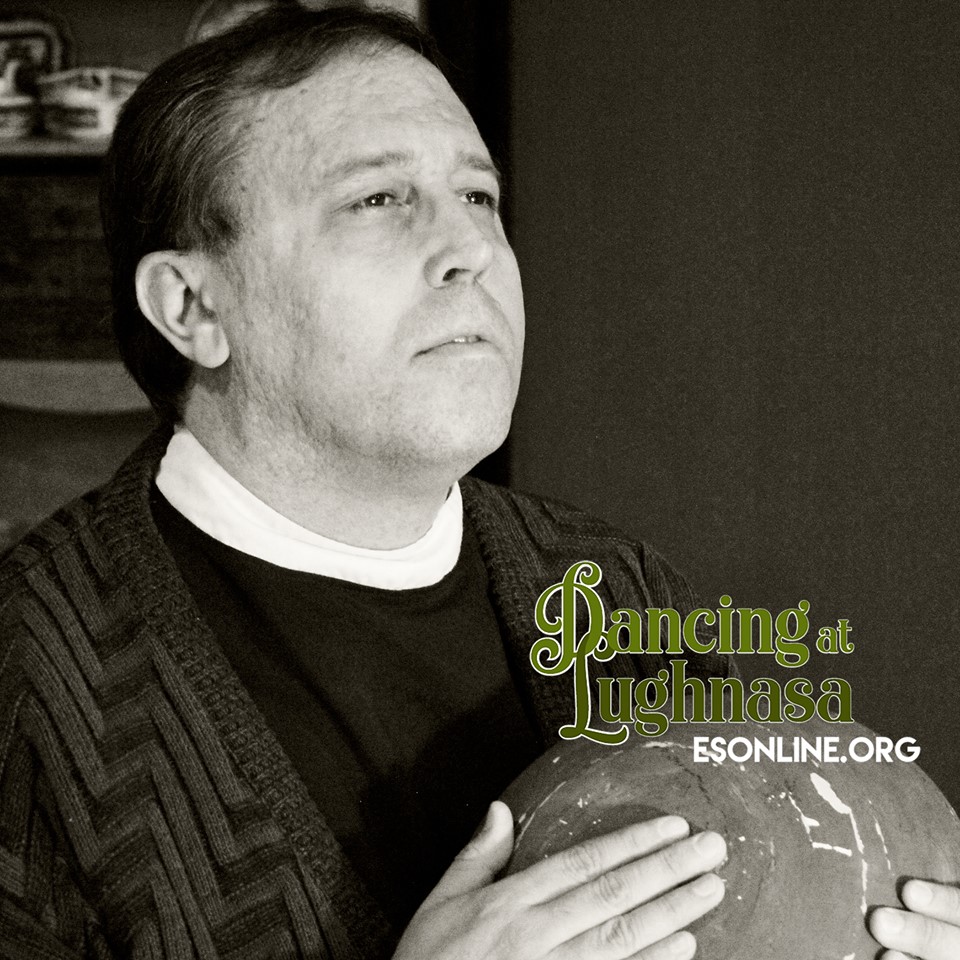
The last few years, local theater The Empty Space has blended familiar classic and modern plays with some unusual and bold selections. Alas, I haven’t been free to see everything, but have caught some of the best ones. My wife and I had an evening free, and went to see Dancing at Lughnasa, which I hadn’t previously heard of, but thought might be interesting.

Based loosely on his mother’s family, Dancing at Lughnasa was written by Irish playwright Brian Friel in 1990. It was later made into a movie starring Meryl Streep, apparently. I’m not much of a moviegoer, so I haven’t seen it.

The play has certain similarities to a couple of other plays that TES has put on in the last two years, notably Three Sisters, with its ensemble of sisters living together with a brother who is challenging to say the least. There are also similarities to The Glass Menagerie, with the missing father, and a son who leaves to seek his fortune. Perhaps the reason that variants on the same story are told so many times is that it is a common one in human experience.

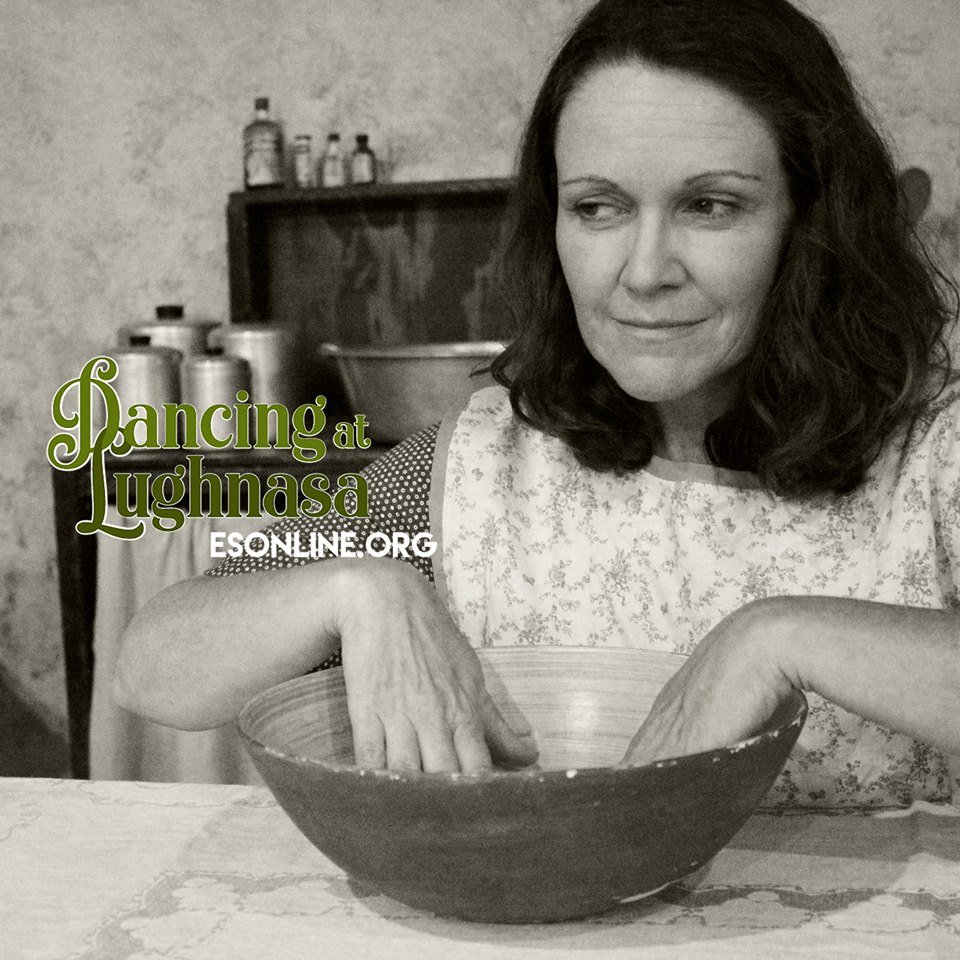
The five sisters in this play are Kate, the eldest, who is employed as a school teacher, and is devoutly Catholic; Maggie, who is a bit of a clown outwardly, but who keeps house and keeps everyone together; Agnes, quiet and yet wishing to get out and dance at the festival; Rose, developmentally disabled and childlike; and Christine, the youngest, who has a child with a man who abandoned her. The play is told from the perspective of the child, Michael, who appears only as an adult narrating the play from beyond the action. The other two characters are Uncle Jack, a missionary to a leper colony in Uganda, who has been sent home because he has essentially “gone native” and abandoned the Catholic faith; and Gerry Evans, Michael’s father.

The sisters are, shall we say, “past their prime,” and have extremely limited prospects in the Ireland of the 1930s. Kate loses her job because she is “tainted” by her brother’s apostasy. Agnes and Rose knit gloves until a factory puts them out of work. Christine is unemployable as a “fallen woman.” They scrape by, but it is a hard life. Society really has little use for old maids, particularly ones who have tainted families.

When Gerry reappears, he turns out to be not quite the irredeemable rake that Kate claims he is. He is catastrophically unsuccessful at gainful employment, to be sure. And, as Michael discovers many years later, he also has a family back in Wales. But he seems genuinely in love with Christine, and makes attempts at being a good father.

In a similar way, Jack is a sympathetic character. He is suffering from malaria, and some sort of mental break which has affected his memory and his cognition. He can’t keep his sisters straight, struggles to remember English words, and is confused about whether he is in Ireland or Uganda. But the tales he tells of African ceremonies and his former life are scintillating, and he is clearly a decent man who devoted his life to helping others.

Even Kate, who seems to be a killjoy and prig has a human side, and her care for Jack even as she fights with him over religion is admirable. And, let us not forget, she is the main source of income, so it is understandable that she expects to be in charge of major decisions.

The play isn’t exactly dark, but it is rather sad. Things don’t end well, as it appears they didn’t for the playwright’s family. There just weren’t a lot of good options for 40ish unmarried women in that era.

The cast was quite small for this play. The six siblings, Gerry, and Michael, so eight in all. In general, this meant that each part was important, and there were really no “bit” parts. Every actor, therefore, had a lot of lines and a distinctive emotional role in the drama. Although all were acted well, I do want to specifically mention some of the roles in connection with the relationships portrayed.

Maggie was played by Kamala Boeck, who I am not sure I have seen before. She is on the faculty at CSUB, and has done professional voice-over work among other things. Whenever there was singing in the play, she did it, and did it well. Maggie is an interesting role, as the heart of the family, and the clown hiding her own sorrow. As such, her chemistry with the rest of the cast was crucial. 

 Kamala Boeck as Maggie

Jared Cantrell was (if I recall) Teddy in Arsenic and Old Lace last year. This role is a bit less nutty, but he still had to get the tics just right. 


Jared Cantrell as Jack


Sheila McClure has been in a number of things locally, so I have seen her in various roles. As Kate, she had to be both stern and soft, and play off of Agnes and Jack. 

 Sheila McClure as Kate

DeNae Brown and Katelyn Evans (Agnes and Rose respectively) are TES regulars. Evans in particular had to portray a developmental disability without caricature - I thought it was a sensitive bit of work. 

 DeNae Brown as Agnes

 Katelyn Evans as Rose

Brian Purcell is likewise a regular, as well as a board member for TES. He’s made a career of playing the straight men, which is never the easiest job, but there is a reason he gets the roles. He doesn’t dominate the spotlight, but reliably brings a “boy next door” vibe to his roles. 

 Brian Purcell as Michael

This brings me to the couple. Chris and Gerry are a rather nuanced couple. Eight years ago, it is plenty likely that Chris was naive and easily seduced by the charming Gerry. But by this time, she knows he is totally full of shit. He still tries to spin his tales and his boasts and his plans for the future. She knows he is just making stuff up, and tells him so. But she still loves him in a way, and he loves her. Christina Goyeneche hasn’t been on stage locally for a while, but I swear I remember her from something a number of years back, although I cannot recall exactly what. Perhaps at a Bakersfield College production? Anyway, she is riveting to watch. Gerry was played by Eric Tolley, a veteran of local theater - and one of the actors I could watch in anything. The two of them really had the chemistry in this one - Gerry trying his old tricks even as he can see they are falling flat, Chris trying not to fall for him again, keeping him at arms’ length, and vacillating between mocking his lies and wanting to be with him anyway. I guess one could say, the chemistry of awkwardness. 
 

 Christina Goyeneche as Christine

 Eric Tolley as Gerry

The play itself wasn’t as scintillating as some - I think Chekhov did the psychology better, for example, and the action dragged a bit in spots. But the acting was compelling, and the characters drew you into the story. It was definitely worth seeing. Kudos to TES for bringing a less well known play back, with its look at a time and place less explored.

Dancing at Lughnasa was directed by CSUB Theater professor Mendy McMasters. If recent productions at CSUB are any indication, she is doing great with with our local students.

Friday, September 7, 2018

How We Got to Now by Steven Johnson


Source of book: Borrowed from the library

I have greatly enjoyed Steven Johnson’s books. He has a way of thinking through connections between related but seemingly unrelated areas of knowledge, and finding the connections between science and human experience. Previous books of his have have read are:


The Ghost Map is about the discovery of the connection between Cholera and contaminated water. Where Good Ideas Come From is a fantastic look at innovation which debunks the American myth of the sole genius motivated by the lure of fantastic profits. Both books are worth a read. 


***

How We Got to Now is about six key technologies and their history. But don’t think these are modern, monolithic ideas. Rather these are technologies that started out as simple, but exploded over the centuries into completely unforeseen areas. Thus, ancient discoveries can be traced to our modern world - they made us modern.

Key to understanding this is Johnson’s idea of the “Hummingbird Effect.” Most of us are familiar (at least in passing) with the “Butterfly Effect.” In essence, a small cause can have great - and unexpected - effects down the line. In the case of the Butterfly Effect, the causal links in the chain are not generally traceable or predictable. (Fun fact: while the term was coined by Edward Lorenz, it comes from Ray Bradbury’s short story, “A Sound of Thunder.”)

In the case of the Hummingbird Effect, however, the causal links are - while unexpected perhaps - quite visible. Think of it this way: as plants evolved, and pollination became a survival need, various animals co-evolved to fill this role - and get their food in exchange. For the most part, these are insects. But, in what is rather a surprise, a vertebrate - a bird - also managed to co-evolve with a different solution to the same problem of hovering. So, while one may not have been able to predict that a hummingbird would be the result of co-evolution, it is quite easy to see in retrospect how it happened.

Johnson introduces this concept in his excellent introduction, and it sets the tone for the whole book.

The six chapters are entitled “Glass,” “Cold,” “Sound,” “Clean,” “Time,” and “Light,” and are fairly self-explanatory. But from the first human-created glass (to use one example) we get a tour that includes literacy, books, microbiology, astrophysics, and electronics. Johnson even argues that the development of glass mirrors was a contributing factor to the rise of an individualistic view of self. To tie it together in a way is this tour-de-force in a paragraph:

Think of that iconic, early-twenty-first-century act: snapping a selfie on your phone as you stand in some exotic spot on vacation, and then uploading the image to Instagram or Twitter, where it circulates to other people’s phones and computers all around the world. We’re accustomed to celebrating the innovations that have made this act almost second nature to us now: the miniaturization of digital computers into handheld devices, the creation of the Internet and the Web, the interfaces of social-networking software. What we rarely do is recognize the way glass supports this entire network: we take pictures through glass lenses, store and manipulate them on circuit boards made of fiberglass, transmit them around the world via glass cables, and enjoy them on screens made of glass. It’s silicon dioxide all the way down the chain.

Every chapter is like this, although the details and time frames obviously vary. Johnson also ties this book to his other writing. Discussing these developments, it is impossible to avoid talking of the “adjacent possible,” from Where Good Ideas Come From; and the chapter on sanitation and germ theory certainly needs a mention of Cholera and The Ghost Map. This is the kind of connectedness that characterizes Johnson’s writing - and his wide knowledge of specific scientific, sociological, and historical disciplines serves him well. I always walk away from one of his books fascinated by a connection I hadn’t noticed, but now seems obvious.

There are a few things I decided to mention specifically in this post. One is the beginning of the chapter on “Cold.” This is about the history of artificial cold. While fire was first controlled by humans a hundred thousand years ago, artificial cold turned out to be far more difficult to manage. Sure, if you lived where there were cold winters and hot summers, you could preserve ice in an icehouse. But this was impossible in more tropical climes.

Until the someone monomaniacal Frederic Tudor decided to ship ice from New England to the Caribbean. This rather crazy story opens the chapter, and it gets more and more implausible as it goes on. I won’t spoil it by telling it badly, but I was reminded of a mediocre Harrison Ford movie I saw as a kid: Mosquito Coast. I suspect the book was better - but even the movie stuck with me. The idea of delivering ice to remote South American tribes was an obvious metaphor for colonialist missionary work - and it is a powerful picture. Looking back, it rather expresses why I have a lot of discomfort for a lot of what American (and Western) missionaries have done and continue to do. More often than not, it seems to be all about exporting the most toxic parts of our culture, making monolingual whites feel righteous for learning a second language, and mostly wasting time with little to no results. I’m sure some of this comes from being the grandchild of missionaries, and hearing from my parents how things really looked on the ground. (For a really fantastic discussion of this, check out Jamie Wright’s podcast with Peter Enns and Jared Byas. She really clarified what I was feeling.)

Another really interesting story comes in the chapter on Sound - which is about how we developed sound recording and transmission. A key player in this saga was the Bell Corporation. As Johnson notes, the Bell Labs subsidiary of Ma Bell had a hand in the development of pretty much every major technology of the 20th Century. This was no surprise. What WAS a surprise was that much of its ability to innovate came from the peculiarities of antitrust law as applied to Bell. My lawyer ears perked up at this, to be sure.

What happened was that Bell had a monopoly over phone service in the US. Until 1984, it was impossible to make a call - any call - without using Bell’s network. Starting in 1913, Federal antitrust regulators battled with Bell, which responded with claims that it was a “natural monopoly,” because its systems were too complex to be run by a bunch of companies. This argument had some merit, but the drawbacks to the monopoly were every bit as real. After decades of wrangling back and forth, a compromise was reached: Bell would retain its monopoly...BUT...any inventions coming out of Bell Labs would have to be freely licensed to anyone who could use it. In essence, Bell’s monopoly gave it lots of research and development funding - but the results belonged to everyone. That’s why, by the way, you can use the internet without having to use a Bell computer, a Bell cell phone, all using Bell microchips, Bell fiber optic lines, and so on.

Also fascinating in this chapter is the connection between sound recording, jazz, and the Civil Rights movement. I think Johnson is right that radio and recorded music gave African American artists access to a global medium, vastly amplifying their influence and visibility. On a related note, white supremacists HATE that African American athletes protest police brutality in a visible way. Protest is all very fine until it actually becomes visible and makes [white] people uncomfortable. The book has a great quote by Martin Luther King Jr.

It is no wonder that so much of the search for identity among American Negroes was championed by Jazz musicians. Long before the modern essayists and scholars wrote of “racial identity” as a problem for a multi-racial world, musicians were returning to their roots to affirm that which was stirring within their souls. Much of the power of our Freedom Movement in the United States has come from this music. It has strengthened us with its sweet rhythms when courage began to fail. It has calmed us with its rich harmonies when spirits were down. And now, Jazz is exported to the world.

I already mentioned it in a post long ago, but the cultic tradition I spent time in (Bill Gothard’s cult - but this teaching was everywhere) HATED all forms of music that were considered “Black.” From Jazz to Rock to anything with a drum set in it, these were considered evil and demonic - coming from Pagan Africa, of course. I think the racist patriarchists were on to something. Music is inherently political. And the rise of African American forms of music (which Czech composer Dvorak correctly identified as the truly American voice in music...back in the 1800s) was the beginning of the end of Jim Crow. Long live Jazz and Rock and Roll.

One final thing to mention. The book has an interesting epilogue, which I thought didn’t really fit the rest of the book. It actually would have fit well at the end of How Good Ideas Happen, and I wonder if he thought of it after the book went to press. It focuses on Ada Lovelace - the first computer programer. The daughter of Lord Byron, she had a truly original mind. A true genius at math, but with a broad range of knowledge, she was recruited by Charles Babbage for his computing machine project. While the steam powered gadget never really worked in practice, Lovelace’s programs for it turned out to be predictive of the future of computing. She saw that they would be more than just calculators - they would go far beyond that into a change in our conception of, well, everything.

Johnson cites her as an example of the rare exception to the rule. The person who was truly ahead of her time - and its technology. As I said, this would fit perfectly in his earlier book, but it seems to be just a bit out of place here. That said, as a stand-alone essay, it is great. So enjoy.

I really enjoyed this book, as I have all of Johnson’s writing. The experience in this case was enhanced by the fact that it was published in a high quality hardback. It just feels so delightful in the hands, I am tempted to buy one just for that reason.

Wednesday, September 5, 2018

Hypocrisy and Hate: The Poisonous Legacy of Phyllis Schlafly

Note: I wrote this two years ago, but didn’t post it, because of some pretty significant events. Namely, the election of an open White Nationalist to the presidency, due in large part to the collaboration of white Evangelicals. So I wrote about that. I got distracted last year, and totally forgot to post it. So this year, I am posting it on the two year anniversary.

***

This is not a eulogy. It is an accusation - an indictment of an evil person, and of those of my parents’ and grandparents’ generation who took her poison to their bosom.

***

From Merriam Webster:

Hypocrisy: a feigning to be what one is not or to believe what one does not; especially :  the false assumption of an appearance of virtue or religion

From Jesus Christ:

"And you experts in the law, woe to you, because you load people down with burdens they can hardly carry, and you yourselves will not lift one finger to help them.” (Luke 11:46)

***

Phyllis Schlafly has finally died.

While I do not rejoice in anyone’s death, I do breathe a sigh of relief when someone who has done great evil in the world becomes unable to do so anymore. The damage remains, however. I write this post so that we can remember the evil Schlafly stood for, and avoid perpetuating her poisonous policies.

I deliberately started this post with a couple of definitions of hypocrisy, because Schlafly was, more than anything else, one of the biggest hypocrites of my lifetime. She also did immense - and perhaps incalculable - damage to both the Republican Party and to Evangelicalism. The Religious Right as a movement was co-founded by her, and the arguments she made have become mainstream in both the GOP and Evangelicalism, unfortunately.

The two quotes above capture, in my opinion, two complementary features of hypocrisy.

First, let me clarify that I do not define hypocrisy as doing one thing, then learning from that mistake, and advising others to avoid it. All of us have embarrassing things we have said and done that we regret. I certainly have. Growing past those things is not hypocrisy - it’s improvement!

Rather, hypocrisy is holding others to a standard that you do not hold yourself to. That’s in the dictionary definition. A great example that I see all the time is upper middle class people who are always in debt and financial trouble - but who love to lecture lower income people about their budgeting failures. One standard for them - and a different one for us.

But I think Christ captures a second part, which is placing burdens on others that you yourself didn’t have to bear, and refusing to help. This is enjoying one’s privileges yet refusing to extend them to others. It’s taking advantage of opportunities, while denying them to others. It’s a sense of entitlement combined with a lack of compassion.

Schlafly exemplified both of these facets of hypocrisy in spades.

***

A quick biography. Schlafly was born in 1924. During the depression, her father lost his job and couldn’t find work (like so many in that era - 25% unemployment…), so her mother worked to support the family.

Schlafly herself would enter the workforce after her college education. At age 25, she married into a wealthy family. She would remain in the workforce essentially her entire life - but she had the financial independence which comes with hereditary wealth to set her own hours and do what she wanted.

She entered the political fray, and spent the early part battling against racial integration (as part of the self proclaimed “moral conservatives” that defeated a anti-segregation plank in the Republican platform of 1960.)

It was a later battle, however, which defined her. That battle was for the defeat of the Equal Rights Amendment, which would have forbidden discrimination on the basis of sex. The Amendment would fail to be ratified by the states as a result of her efforts. (More on this later.)

She would then go on to form the Religious Right, primarily with Paul Weyrich (who has admitted that it was support for segregation that held the coalition together), Jerry Falwell, and Bob Jones Sr. (president of the college of the same name - which only recently began to permit interracial dating, and only then under duress.) Schlafly herself formed the Eagle Forum, a political action group which would focus on opposition to Feminism.

Perhaps the most central idea to Schlafly’s activism was that women belonged in the home, that childcare and housekeeping were primarily “women’s work,” and that Feminism™ was the greatest threat to women. As I will point out, this idea manifested in a number of ways, but in the political sense, she opposed just about anything that would grant economic, political, or social equality to women. (That’s the dictionary definition of Feminism, by the way…)

But she didn’t live that way.

At the same time she was telling other women that they should stay home with their children rather than work, she was out lecturing, running for Congress, writing, and generally not staying at home.

Who cared for her kids?

Well, it turns out that she had a full time housekeeper/nanny who did that for her. This woman performed this function for decades. Schlafly also had a personal assistant, which likely freed her up to set her own schedule.

In a former era, this would be called “having servants.” Of course it is easier to do all the things Schlafly did if you can pay someone to do the grunt work for you - and raise your kids. But most women can’t afford that.

This is the textbook definition of a hypocrite. The standard she imposed on others was not one she had to abide by herself. Of course not! She was rich, so the rules really never had to apply to her.

Likewise, she placed the burden on other women, many of whom couldn’t afford to stay home full time. By making “Stay at Home Mom” into “God’s plan for all women,” she burdened millions of women with impossible expectations. (And, as her political activism against policies which would ease the burden on lower income women show, she had no intention of lifting a finger to help.)

***

Now, about her legacy. As I see it, she damaged both the GOP and Evangelicalism in a number of ways.

First, the political. Her work to keep integration out of the GOP platform in 1960, which was Nixon’s first run, led eventually to Nixon adopting the “Southern Strategy,” which was a rejection of the Republican heritage of supporting the Civil Rights Movement and an embrace of White Nationalist voters, if not always their policies. It is not a coincidence that pro-Segregation Whites switched en masse from the Democrats to the Republicans.

The founding of the Religious Right as a political force likewise had reverberations which continue to this day. As Paul Weyrich said, the Religious Right was founded on a pro-Segregation basis, and only later switched to an anti-abortion position. Schlafly too was instrumental in this switch, as she made opposition to Feminism the central plank in her platform.

This idea that the ideal family was one where the man brought home the bacon while the woman stayed home and kept house and raised the kids wasn’t a Republican issue at the time. In fact, although it is hard to believe now, Nixon came close to signing a bill for subsidized day care and paid family leave. The Religious Right (and the openly racist Pat Buchanan) defeated that, and ever since, opposition to what many of us consider basic family friendly policy has been vehemently opposed by the Republican party.

You can see the results even now, with a spokesman for The Toupee Who Shall Not Be Named claiming that what women care about most is that their husbands have well-paying jobs. (As I will show, this is nearly a direct quote from Schlafly.)

I’ll detail a few more policies which are directly drawn from Schlafly’s advocacy below. Suffice it to say that The Toupee Who Shall Not Be Named turns out to be pretty much Schlafly’s ideal candidate, as far as policies are concerned.

As for the legacy within Evangelicalism, let me start with this:

You would never know, given the strong anti-feminist advocacy of the Religious Right and most prominent Evangelical teachers, that 19th Century Feminism was actually an Evangelical movement.

The shift started before Schlafly, of course. In the aftermath of the Civil War, the conservative denominations within American Christianity sadly retrenched around Segregation and Patriarchy as core beliefs.

But it is important to remember that prior to the rise of the Religious Right, Feminism wasn’t that controversial of an idea for most Evangelicals. During World War II, many women entered the workforce while the men were away at war - and many of them remained there afterward. The Equal Rights Amendment wasn’t considered controversial either. The Republican platform of 1956 expressly endorsed it.  It had passed Congress by that time, and had been ratified by 30 states before Schlafly took aim at it.

And the text of the Amendment isn’t - or shouldn’t be - all that controversial.

Equality of rights under the law shall not be denied or abridged by the United States or by any State on account of sex."

That’s it. That’s the entire text. This is what Schlafly couldn’t abide.

By the way, in an Eagle Forum pamphlet opposing the ERA, she said: “Do you want the sexes fully integrated like the races?” (Oh yes, she was deeply and viciously racist. See more below.)

This is where the damage was done. American Evangelicalism these days has a strong undercurrent of hostility toward Feminism. Often this is based on a straw-man version of feminism which doesn’t exist except possibly on the fringes. (I know a lot of feminists - including my wife - and the caricature of the man-hating woman is a fiction. Even in my law practice, I meet 1000 men who hate women for every woman I meet who hates men.)

There is also a veneration of the “stay-at-home mom” and an idolatry of motherhood in Evangelicalism. I’ve pointed out before that this essentially denies the higher levels of “godliness” to women in lower income families.

It isn’t universal, but there are a great many - particularly within the more conservative circles - that outright state that a woman who works outside the home while she has children is living in sin. This is the one that is pretty personal for me, as my wife and I have gotten plenty of pushback from extended family over the fact that she works. Schlafly is largely to blame for this, which is ironic because she didn’t live this way.

Now let me turn to a few other things that Schlafly has said and done.

***

A quick Google search turns up a whole bunch of, um, interesting things that Schlafly has said and done. Here are a few:

Defended Joe Paterno, who knew his assistant was raping young boys, but covered it up:

After the National Organization for Women called for Paterno to resign following his defense of a player who assaulted a woman, she wrote in her column: "Just a few feminists with a fax machine will smear anyone in their war against football.”

Clearly football is more important than stopping sexual assault.

Blamed the Violence Against Women Act for broken marriages:

“When marriages are broken by false allegations of domestic violence, U.S. taxpayers fork up an estimated $20 billion a year to support the resulting single-parent, welfare-dependent families.” – Schlafly, Feb. 2011.

Did Schlafly really believe domestic violence was imaginary? Maybe. I find that upper middle class women of a certain age are in deep denial that anyone else could be experiencing spousal abuse. I get the feeling that Schlafly would rather have seen women get beaten than that they get divorced. I also seem to recall (although I can’t find it) that she, like the reality-challenged folks at the Council for Biblical Manhood and Womanhood believed that Feminism has increased spousal abuse rates.

Except that VAWA and other laws have reduced domestic violence significantly. The trend is actually very positive. Domestic Violence has been on a long term decline, but has really dropped in the last couple of decades, despite the fact that it is now more acceptable to report it. The culture is changing for the better on this issue - and Feminism deserves much of the credit.

Excused sexual harassment and blamed the victims:

“Non-criminal sexual harassment on the job is not a problem for the virtuous woman except in the rarest of cases.” -Schlafly before the United States Senate, 1981.

Yes, women ask to be harassed and assaulted, right? Only “sluts” get harassed, right?

Said that the way to prevent violence against women was for women to marry rather than have careers:

“So what’s the answer for women who worry about male violence? It’s not to fear all men. It’s to reject the lifestyle of frequent 'hookups,' which is so much promoted on college campuses today, while the women pursue a career and avoid marriage.” - Radio address August 28, 2014

Yep, if women would just (unlike her, of course) stay out of college and stay home instead...violence against them would go down. Really?

Said that husbands have the right to rape their wives:

“By getting married, the woman has consented to sex, and I don’t think you can call it rape.” – “Schlafly cranks up agitation at Bates” Sun Journal, 2007.

Because saying “I do” means you give up all bodily autonomy, right? In her defense, the law reflected her view for far too long. That doesn’t mean it is a right, or even remotely moral position to hold.

Said we don’t need to ever have a female president:

“Our greatest presidents have all been men,” she said, “and they’ve been very good for our country.”

Of course, we haven’t ever had a female president, so we have no idea if they would have been better than the man. One could as accurately have said “Our worst presidents have all been men, and they were terrible for our country.” (Looking at you, Andrew Jackson and Warren Harding.)

The easy counterexample is England. On a percentage basis, who has been better for England, the kings or the queens? Just saying.

Called for increasing the pay gap between men and women:

“The best way to improve economic prospects for women is to improve job prospects for the men in their lives, even if that means increasing the so-called pay gap.”

Again, say WHAT? But wait! This is what that Trump staffer said too. It’s a worldview: men earn, women stay home. The real world has never worked that way, though, particularly for lower-income families. As a friend pointed out, women of color have always worked. 


Called on Congress to pass a resolution specifically privileging marriages where the woman doesn’t work outside the home:

“Once Congress is on a roll to confer dignity, it should confer an extra measure of dignity on the single-earner family, where a provider-husband is the principal breadwinner and his wife is dedicated to the job of homemaker, a role more socially beneficial than working in the paid labor force.” - Newspaper column in 2015

This was part of a column condemning same-sex marriage, by the way. Apparently, the point of “traditional” marriage to her was in large part the preservation of gender roles.

And again, never forget that SHE didn’t stay home with her children and housework. She paid someone to care for her children and clean her house.

Argued against paid family leave:

She made the ludicrous claim that it would only benefit “highly-paid, two-earner yuppie couples” who could afford to take the time off without pay. Never mind, of course, that those would would benefit the most would actually be lower income women.  

Called for the elimination of Title IX:

This is the law which prohibits sex discrimination in education. She also called for a combination of quotas and elimination of student loans to reduce the percentage of women in college.  The hypocrisy of a highly educated woman seeking to deny the opportunity to other women is astounding.

Opposed scientifically accurate Sex Ed:

“Sex education classes are like in-home sales parties for abortions.” – Schalfly, Feb. 1997.

Actually, it turns out that comprehensive sex education and readily available contraception has resulted in a significant decrease in both teen pregnancy and abortion rates in the last couple of decades. There is ample and increasing evidence that the key to reducing abortion is a combination of better education and affordable contraceptives - particularly long-acting reversible contraception - lowers both pregnancy and abortion rates. In addition, accurate, consent-based education has been shown to be effective at delaying first intercourse - and dramatically reducing sex between teens and older adults.

Claimed that enforcing child support judgments was bad for children:

“People think that child-support enforcement benefits children, but it doesn’t.” – Schlafly, “Federal Incentives Make Children Fatherless,” May, 2005.

Say WHAT? So, it’s better that fathers not pay child support? I think the argument here is that women wouldn’t get divorces if they and their kids starved or something like that. I don’t even know many people who make this argument. Sheesh! (Okay, this has been a central plank in many ways of the “Men’s Rights Movement.” If women couldn’t get child support from men, then they wouldn’t be so dang disobedient to men’s wishes.)

This actually fits with Schlafly’s central belief about the economics of male/female relationships, which is that men need to be the primary earners, and women need to shut up and obey men. Except her, of course.

Opposed the teaching of science:

“It is long overdue for parents to realize they have the right and duty to protect our children against the intolerant evolutionists.” -Schlafly, “Time to End the Censorship,” Dec. 2004.

I know I’m probably in the minority on this one within my former Tribe, but I really don’t think we need to “protect” our children from learning things such as Astrophysics, Paleontology, Biology, and so on. The evidence is overwhelmingly in favor of an old universe, the Big Bang, biological evolution, and so forth. (I blogged about this a few years back.) It’s not a conspiracy, and it isn’t about “intolerance.” We do not teach a flat earth or geocentrism anymore either - and it isn’t because of a conspiracy.


This is just one of many, many statements that it was easy to find where Schlafly showed hostility toward non-Whites, immigrants, and poor people. Here are a few more:

Called for banning Latin American baseball players:

 “Cut off visas for foreign baseball players, and return our National Pastime to Americans,” the St. Louis native said in a radio segment in February. “When I was growing up, my favorite sport was baseball. One of my most exciting memories was attending the World Series in 1944 between the St. Louis Cardinals and the St. Louis Browns. Baseball is a wonderful activity for boys and young men. It helps develop mental discipline, patience, and obeying rules. A lower percentage of professional baseball players have post-career troubles compared with football and basketball players, and baseball is a safer sport, too. The best baseball players today are American-born. All six of the six recipients of the top awards this past season are native-born American. But more than a quarter of Major League Baseball players today are foreign-born, with whom our youth are less likely to identify. Some of these players cannot speak English, and they did not rise through the ranks of Little League. These foreign-born players enter on visas and take positions that should have gone to American players. Fewer than four percent of the Baseball Hall of Fame is foreign-born, yet 27 percent of today’s players are.”

Every time I read that, I am astounded by the racism. And the assumption that whites are the only true Americans.

Opposed (and torpedoed) a plank in the 1960 Republican platform calling for an end to segregation.

I mentioned this one above.

Argued that anti-segregation laws were unconstitutional:

Oh yes she did. This has ever since been a cherished belief of the fringe right, from the loathsome Matt Walsh to the equally loathsome Ron Paul. Never, ever, forget that Schlafly began her political career fighting against racial integration. Never, ever forget.

Supported vote-suppression laws:

Specifically the ones in North Carolina which were recently struck down by the courts because the expressly targeted African American voters. Why did she support them? On the grounds of...wait for it...the fact that low income and minority voters tended to vote for Democrats rather than Republicans. Because it is totally legitimate to make laws specifically to benefit your political party while making it harder for African Americans to vote.

By the way, you really should read the court’s opinion in the case. The legislature specifically asked for racial statistics, then wrote the law to change only those things that benefited African Americans. In case you were wondering, this is the case that changed my mind on Voter ID laws. They are expressly intended to make it harder for certain disfavored demographic groups to vote. There is a reason why even conservative judges are striking the laws down.

She repeatedly referred to a Jewish internationalist conspiracy:

It was pretty easy to find quotes about the influence of “financially connected minorities” with “internationalist” goals. Um, this is classic anti-Semitic code language used by the John Birch Society, among others. (Schlafly was a John Bircher for a while, before deciding she had other priorities.)

One final one on race I want to share. A friend of mine worked in media a while back, and did a radio interview with Schlafly. During the conversation, he brought up a current event: the push by Puerto Rico and other US territories for statehood. Schlafly was horrified at the idea. The last thing she wanted was more of “those people.” Here is a partial transcript, which my friend let me listen to.

Interviewer: (mentions Congressional hearing where American Samoa was suggested as well)
Schlafly: Well we don’t want them either.
Interviewer (stunned): Why so?
Schlafly: Well that does nothing but cause trouble.
Interviewer: Okay.
Schlafly: Okay, have a good day. (Hangs up on him.)

The contempt dripping from her voice is palpable.

She basically initiated the Religious Right’s political war on LGBTQ people.

I could spend plenty of time on this one, including the way that she (and many other Religious Right leaders then and now) grossly slandered LGBTQ people by claiming they were all child molesters out to get the kids. I could mention that despite having a gay son herself, she made opposition to any form of civil rights for LGBTQ people a central plank of both the GOP and Evangelicalism. If you want to look at the history of calls to deny LGBTQ people housing and employment and government services, and so on, you will see the line go back to her. Maybe I should mention that like modern day hate-mongers like Kevin Swanson (no relation, thank God!), she too waxed nostalgic about the days when you could kill and imprison people for gay sex.

I have written about this before, and I stand by it: the obsession with sex and the effort to deny LGBTQ people basic human rights, dignity, and access to society has been a disaster for American Christianity, and will - in my opinion - be a major reason that the next generation abandons the faith. When the focus of your faith is harming people, you are going to alienate the decent people, and attract the evil and violent sorts instead.

***

So many of these issues affect me and my friends and family. I discussed the ones related to sex discrimination in employment in my review of Gillian Thomas’ excellent book, Because of Sex. I have friends and family who would have lived under Jim Crow had Schlafly had her way. I have clients who have had issues getting ID due to destruction of birth records, and would be excluded from their right to vote. I know many who have been victims of domestic violence, and benefited from VAWA and other laws which take domestic violence seriously. I myself have benefited from parental leave. Many, many people I know and love rely on the income from women. And that includes me. I have a wife who works. I have LGBTQ friends and family who would suffer under the laws Schlafly promoted.

I also have suffered harm as a result of Schlafly’s teaching. A significant source of conflict with certain friends and family has been the fact that my wife does not adhere to the gender roles that Schlafly promoted. For everyone else, not her, of course.

***

Hypocrisy.

It’s pretty obvious, isn’t it? She holds other women to a different standard than she was willing to meet.

And talk about denying others the privileges she had. Maybe it was because she married money, which seems to make one entitled. (In fact, the most entitled people I work with in my practice are the wives of rich men.)

She of course was supported in luxury. The women that needed to work to survive, well, they just weren’t as good as her. She enjoyed living in the United States, but those brown skinned people that wanted the same? No way. Nothing good ever happens when you let those people in. Other women want to escape abuse? No dice. VAWA is bad for marriages. She could take a break from her work to give birth and recover. But other women shouldn’t have that. Unless they found richer husbands. College was fine for her, but most women should be discouraged from doing the same. I’m sure she would have objected had she been denied housing or health care because of her religion. But denying the same to LGBTQ people? Not just fine, but what we should do. And then throw in the opposition to desegregation...

Her entire political career can be summed up as an ongoing attempt to be sure that she and others like her got privileges that would then be denied to others.

This is the textbook definition of hypocrisy.

***

The rise of Donald Trump

As I researched this, I was struck by just how much Schlafly and Trump were alike. Le Toupee too has, um, distinct opinions on the role of women. He may be more vulgar about it, but he too believes women should focus on reproduction and housekeeping. (And he too has a fondness for farming the work out to nannies and servants…) He too dismisses sexual harassment. Hey, just get a different job - or better yet stay home. He too believes that the man earning the money is the way things should be. I don’t think I even need to draw the parallels on racial issues. His whole campaign could be Schlafly’s views proposed as legislation.

It is no accident that she endorsed Trump. And it is no accident that white Evangelicalism voted for him to the tune of about 80%. He isn’t really that different than she, and he largely represents the “values” that dominate Evangelical culture.

And it is due in significant part to her efforts that Evangelical culture DOES share the “values” of Donald Trump. She set this up over decades. White middle-class privilege as “godliness.” Gender Roles as the Gospel™. Antagonism and fear toward brown skinned people. Hatred of LGBTQ people. Hostility toward Feminism. The whole shebang.

And then, someone came along who represented the real values held by white Evangelicalism, but without the pretty and pleasant exterior, and everyone fell in line behind him.

In fact, religious affiliation is one of the two strongest indicators of whether a white person will vote for Le Toupee. (The other is low education…) That says volumes. And it isn’t good.

***

 Schlafly is losing in the long run, and she may take Evangelicalism down with her.

I’m not fond of politics in the first place, and I really do not care what happens to the GOP. They made their bed, and have become the party of old racist white people. That was their choice, and they will live or die with it.

What I am more concerned about is the long-term and horrific damage that Schlafly and the other founders of the Religious Right did to American Evangelicalism. More than anything, the Religious Right has made good on the guarantee that it would deliver votes to the GOP no matter what.

No matter how opposed the policies are to the teachings of Christ. And, as it turns out, no matter how evil the candidate. Open racism? Eh, Evangelicals will still vote for you. Dead refugees? Children in cages? Evangelicals won’t care about those people. Not really.

That’s Schlafly’s true legacy.

In the greater culture, however, she is losing. Despite her best attempts, feminism is winning. Because it works. Domestic violence is way down. Because of feminism, not because Schlafly got women to avoid college.

Speaking of that, women are seeking education in increasing numbers, and the opportunities available to them are greater than ever. The pay gap is decreasing. And, on a related note, men are increasingly willing to take on the “women’s work” of childcare and housework. (Hey, I’m one of those guys! Caring for children is wonderful, and I am grateful that I can work modest hours and be with them more.)

Ultimately, most of the goals of the ERA are being realized through other legislation, such as Title IX and various state laws forbidding discrimination on the basis of sex.

And, amazingly, the world has not fallen apart. Is there room for improvement? Of course. And many of us are working toward those improvements, rather than trying desperately to return to the past.

The problem is that the primary foe right now in the fight against domestic violence is white Evangelicalism. The primary foe in the fight to help refugees is white Evangelicalism. White Evangelicals are the problem in the fight against racism, modern segregation, police brutality, and a host of other issues. The main source of hostility toward brown skinned people turns out to be white Evangelicals. The ones most eager to deny fellow humans employment and shelter? White Evangelicals.

The risk here is significant: the Religious Right has made religion all about a political agenda that many of us find loathsome. And we are rejecting it. This is particularly true for people of color, younger people, and people with a college education.

Many Christians I know are bemoaning the increase in the number of people who are “nones.” This includes an increasing number of atheists, of course, but also a lot who believe in the Divine, but shun affiliation with religious groups. These Christians - white Evangelicals - however, are the ones least likely to look in the mirror, and acknowledge that white Evangelicalism is driving away people who have a conscience, who are troubled by racism and xenophobia, who have grave doubts about the claim that the Republican Party platform furthers the Kingdom of God, who eschew hatred of others - even atheists and gays. There is a significant - and growing - backlash against Schlafly’s hatred. And her intellectual and political heirs are crying “persecution.” Which is laughable for many reasons, many of which Ben Corey lays out here. What really is happening is people are revolted by religious bullying, or as I call it, being an “Asshole For Jesus,” which is exactly what she made her political career doing. More and more of us are saying, “enough!” The question isn’t whether we will reject religious bullying. It’s whether we will end up leaving American Christianity all together. (For now, the answer for me and my family has been that no, we will no longer participate in American “Christianity.”)

I’ve used the quote before, and I will continue to use it as often as necessary. This was a comment on a video by John Piper wherein he claims that Christianity teaches that women should stay and be beaten rather than leave the marriage and press charges against the abuser:

“Richard Dawkins wishes he were as effective as this video at convincing people that Christianity is a morally bankrupt mess.”

Herein lies the problem - and Schlafly’s true legacy.

Richard Dawkins can only wish and dream that he had been as effective as Phyllis Schlafly at convincing people that Christianity is a morally bankrupt mess.

Not only did she spend her life demonstrating the moral bankruptcy and hypocrisy of her religion, she did her level best to make American [white] Evangelicalism the morally bankrupt mess it is today.

***

It isn’t too often one can truly say of someone that the world is a far better place without them, but this is one of those cases. I do not rejoice in her death, but breathe a sigh of relief that at least one viciously racist person can no longer spew bile in this world.

So, Ms. Schlafly, farewell to this life, and may you find a better mercy than you were willing to bestow on others. May you find a truer justice than you accorded to others. And may you escape the hate that you poured out on others.

And that, my friends, is the best I can do.

***

I haven’t believed in the Evangelical version of hell since Junior High. (I read C. S. Lewis’ book, The Great Divorce then.) There are many reasons for this, one of which is laid out pretty well by John Pavlovitz in this post. Another is that it seems to be an Evangelical wet dream of a revenge fantasy to be inflicted on all those outside of the tribe. But if there is an Evangelical hell, Jesus Christ himself made it abundantly clear that our destiny doesn’t hang on whether we pray the right prayer: it’s how we treat the least of these, including immigrants, the poor, the incarcerated, and the ill. On that basis, IF there is an Evangelical hell, then Phyllis Schlafly is assuredly burning there right now.

I am more or less an annihilationist. I believe that someday, all of us will receive (as we lawyers say) full and complete disclosure. We see but through a glass, darkly. Someday, we see face to face. And we will have a chance to choose. Will we give up the evil part of us and enter into fellowship with the Divine? Or will we choose to give up existence. I believe that there are many who, faced with the prospect of being equal to - or worse, lower than - all those people they hated and oppressed during their lifetimes, will choose annihilation. I believe Hitler will choose that, rather than live with constant reminders of what he did.

I believe Phyllis Schlafly will likewise choose that. I hope she doesn’t, but I think she lived her life with her entire identity wrapped up in preserving her own privilege. Without that, she had nothing to live for.

***

Comment policy: Please read my comment policy before commenting. In particular, I will not tolerate any hate speech in the comments. I also will not tolerate any arguments regarding the morality of homosexuality. I’ve heard the arguments a million times. And I don’t think they matter in the context of our behavior toward our neighbor. Seeking to harm someone is hate. Feel free to read my longer post on this issue.


Monday, September 3, 2018

Claudette Colvin: Twice Toward Justice by Phillip Hoose


Source of book: Audiobook from the library.

While our audiobook selections have primarily been fiction, there are exceptions. This book is one of them.

When most of us think of the Civil Rights Movement, two names are usually the first to come to mind: Martin Luther King Jr., and Rosa Parks. And to be sure, both of them are deserving of honor. They played crucial roles in the struggle, and acquitted themselves well.

But throughout history, there are names that are unjustly forgotten, or even unjustly maligned, who are also important and inspiring. Fortunately, for some of them at least, history eventually recognizes their contributions.

One of those unjustly neglected heroes is Claudette Colvin. This book tells her story.

The Montgomery Bus Boycott was one of the key events of the Civil Rights Movement, and one that had long term repercussions. It formed a rallying point for the movement, brought Martin Luther King Jr. to leadership, and resulted in one of the most important court cases of the 1950s. Without the boycott, it is unlikely we would have seen the Civil Rights Act a decade later.

But this event is usually told in a way that misses much of the history. We all learn (okay, those of you who actually studied the Civil Rights Movement in school - A Beka pretended it didn’t happen…) that the boycott was sparked when Rosa Parks refused to move to the back of the bus in deference to a white person.

That is a half-truth at best.

Again, no disrespect to Rosa Parks, who took her life in her hands by her actions and is justly remembered as a hero. But she was a carefully selected protester, and her act a carefully planned stunt. And it wasn’t even the first act of protest.

Rather, about nine months before Rosa Parks refused to move, a 15 year old girl named Claudette Colvin did the same thing - and was likewise arrested and prosecuted. It was her act - done spontaneously on her own initiative - that inspired the plan to have a boycott and a specific trigger - Rosa Parks.

Let that sink in a moment. A 15 year old girl - a mere child - decided on her own to take on the system. She refused to yield her seat (on a technicality which the court later recognized), and was dragged off the bus by policemen, jailed, and prosecuted. Think of the courage that took. She had no guarantee that anyone would support her. And, in fact, after some initial support, she was largely abandoned and forgotten. 

 Claudette Colvin, one year before she protested.

It isn’t that hard to understand why, given the times she lived in. She got pregnant about four months after the incident, by an older married (but separated) man, thus ruining her reputation. She was also young, and although intelligent and a good student, lacked the gravitas to be a good figurehead for a movement.

In contrast, Rosa Parks was thoroughly respectable, middle class, middle aged, and lighter skinned. I am sad to have to add the last, and, again, none of this was Rosa Parks’ fault. That she was an outstanding embodiment of the evil done by segregation is to her credit in every way, and her dignity and decency helped defuse the stereotypes that were wielded in an attempt to stop desegregation.

However, Colvin’s brave act gave the idea to the community leaders in Montgomery. Segregated buses would be the issue, and a suitable protester - a rallying point - would be chosen. Rosa Parks, already active in the NAACP and well known, was the obvious choice. And Colvin was pushed aside.

After Parks’ arrest, the boycott started. Simultaneously with this, the NAACP along with attorney Fred Gray - who defended both Colvin and Parks - filed a federal lawsuit challenging segregation. This case, Browder v. Gayle, is one of those cases that lawyers and law students know, but most laypersons do not. In fact, while the boycott drew national media attention, it was in fact the legal case which actually ended bus segregation throughout the United States. Claudette Colvin was a star witness in the case, and Gray would later say that she was crucial in convincing two of the three judge panel in favor of desegregation.

This book is interesting in part because the author spent considerable time talking with Colvin after her retirement from a career as a nurse’s aide. The book is full of direct quotes from Colvin about the events, about her feelings and experiences. Thus, it can be said to be truly her story, not just a story about her.

I will confess that much of the information in this book was new to me, even though I do care about history, and have read quite a bit about the era. I knew that Rosa Parks wasn’t the first, but I didn’t know much about the others. And yes, there was more than one - at least two teenage girls came first. I am glad my kids got to hear this one.

I had a few thoughts about this book and the history behind it.

First is this: I think it is vital to understand that the lie that the past was better is one of the most pernicious falsehoods in our political and religious discourse in this country. No, it was not better. It was, in fact, horrible for many people. That is why it is so obvious that “Make America Great Again” is nothing less than a call for a return to white supremacy. That is why it is appealing in the first place. We can go back to the past when “women and negroes knew their place.” That is the meaning of MAGA.

The second, related point is that this isn’t ancient history.

These events took place during my parents’ lifetime.

We as a nation are so not over the Civil Rights Movement. Rather, there are many - including an entire political party these days - who are actively fighting against the victories that non-whites have won over the last 65 years. It is certainly no excuse to say this, but it is key to remember that my parents’ generation - the Baby Boomers - grew up when it was normal to tell blacks that they had to be humiliated so that whites would maintain superiority. I hasten to add that my parents don’t think this way, and certainly didn’t raise me that way. But too many white Boomers seem to have this belief that things were so much better back before MLK. It is surreal to me - growing up in the 1980s in California - just how recently segregation was the literal law of the land.

Third observation is that the courts have always played a crucial role in human rights. I really understand these days why the Right in the US hates the court system for the most part. It has served as a bulwark against racist laws from the 1950s on. Some important names came into the story in a collateral way. Earl Warren was perhaps the most influential person to come out of Bakersfield, although conservative whites in our town aren’t all that proud, sad to say. Thurgood Marshall argued for the winning side in Brown v. Board of Education, and was later appointed to the Supreme Court as the first African American justice. These are big names, and justifiably so.

But I want to mention two others. I noted Fred Gray above. When he defended Colvin, he was fresh out of law school, and thrown into the fire. This story - and a bit of research on him - was enough to convince me that he belongs in the gallery of badass attorneys in history. The book quotes from the transcript of the oral arguments and witness examination, and Gray was fantastic.

I also need to mention Judge Frank Johnson. A young judge (younger than me!) at the time of the trial in Browder v. Gayle, he went on to preside over a number of major civil rights cases in the Alabama district of the Federal Court. As Bill Moyers put it much later, he “altered forever the face of the South.” One could argue that he was as important as Lincoln himself in establishing the human rights of African Americans.

Three things bear mentioning here. First, Johnson received numerous death threats, had a cross burned on his lawn, and had his mother’s house firebombed. Opposing the Ku Klux Klan had real consequences back then, and he did the right thing anyway. Second, in what has to be one of the most infuriating (to me), if entirely common, events, Johnson received a letter essentially telling him he had better repent for elevating blacks to the level of whites, or he would burn in hell. Which is, alas, pretty much the position of the Religious Right these days when you challenge their racism. Third, Johnson was a Republican. Seriously, back in the not-that-distant past, the GOP was actually the party of integration. By the time Jimmy Carter nominated him to the Fifth Circuit Court of Appeals, that had been completely changed by Nixon’s Southern Strategy and the rise of the Religious Right. Sad and frustrating that things have changed.

On that note, something else really struck me. Here is the admonition of MLK during the boycott:

“If you have weapons, take them home; if you do not have them, please do not seek to get them. We cannot solve this problem through retaliatory violence. We must meet violence with nonviolence. Remember the words of Jesus: "He who lives by the sword will perish by the sword". We must love our white brothers, no matter what they do to us. We must make them know that we love them. Jesus still cries out in words that echo across the centuries: "Love your enemies; bless them that curse you; pray for them that despitefully use you". This is what we must live by. We must meet hate with love. Remember, if I am stopped, this movement will not stop, because God is with the movement. Go home with this glowing faith and this radiant assurance.”

In contrast to this, the White Citizens’ Council and the KKK committed numerous acts of violence against those involved. Even the mayor of Montgomery openly called for violence in response.

I cannot help but notice that The Toupee Who Shall Not Be Named continues (as he has since the beginning of his campaign) to take plays out of the KKK playbook, and has essentially threatened violence if his party is voted out in the next election. This is pretty parallel to the “if we lose, the blacks will rule Montgomery,” so whites should take up arms. It is the same thing, in a new era...nearly 70 years later. In what is surely not a coincidence, he is also vilifying peaceful protest against injustice. Things haven’t really changed that much.

One final thought on this book. Today’s teens seem to understand that we live in an era in which they will need to take action, because their parents’ generation is too cowardly (or compromised) to do it. The students at Marjory Stoneman Douglas high school get it. And they have paid for their courage with death threats from the white nationalists who fear that gun control will deprive them of their defense against the black “animals” they fear. Like the white librarian who spoke up against desegregation and received death threats for her trouble (she later committed suicide, alas), the warriors for justice and human decency these days will face consequences from the forces of evil - as they always have. But that doesn’t change the fact that even children can make a difference in the fight against evil. Claudette Colvin, inspired by an active sense that what she suffered was injustice, took action against it. While she didn’t receive recognition until just a few years ago, she deserves the credit for inspiring a revolution.

This book is thoroughly outstanding. My kids loved it - they have a strong sense of justice, and have been raised - as I was - to understand the ugly truth of our nation’s history. And ghastly present White Nationalist moment. Stories are powerful. This one humanizes the humiliation that African Americans suffered under Jim Crow. And, let us not forget - this isn’t ancient history. Many today are alive who participated in this event. Claudette Colvin is still with us. Fred Gray is still alive. Many of those who spit in the faces of the African Americans seeking equality still live. Perhaps some have changed, but many probably cling to their hate. Many of those who were forced to give way to whites on the bus still can tell their stories. Let us listen with empathy and with a renewed commitment to justice.

***

One more note that I couldn’t figure out where to put in the post. I am white. I married a white woman. (Hey, I fell madly in love with her...what can I say?) I have white kids. So, I kind of have this dilemma. On the one hand, our history is pretty awful. People of my color have done horrid things. My personal ancestors came over after the Civil War, and haven’t been rich, so I don’t have personal stuff to be ashamed of, but we have definitely benefited from racist systems in the United States.

But I don’t want my kids to just feel bad - that isn’t productive. What I want is for them to see examples of whites who did the right thing. The Quakers who sheltered those escaping from slavery. The abolitionists. The men and women who stood up against Jim Crow - and often paid the price. (That many of these were lawyers, judges, and Christian ministers makes me proud.) The men and women today who join in protesting police brutality, discrimination, and hate. Those who don’t just stay silent when others make racist jokes, or air their hate. Those who speak up, come along side the oppressed, and who fight for justice.

I want my children to see these good examples and to emulate them.

Books like this also remind us that doing right has consequences. While we haven’t suffered the firebombing and death threats of the past, we have lost friends over our commitment to speak out against racial hatred and the political parties and candidates that fan those evil flames. This is to be expected. Those who threatened Civil Rights leaders, black and white, were convinced god was on their side. A god that somehow believed segregation and white supremacy was good, and human rights were evil. That god is still widely worshipped today, in white Evangelical churches across our nation. We lost our connection to that community over our refusal to bow to that idol. Thus is the price of refusing to sell one’s soul. My prayer is that we see a better world as a result.

***

Some related reading that I highly recommend:

Remembering Jim Crow (oral history)
The Slaves’ War by Andrew Ward
The Other Slavery by Andres Resendez
Kindred by Octavia Butler
Invisible Man by Ralph Ellison
The Souls of Black Folk by W.E.B. DuBois
Homegoing by Yaa Gyasi
The Fire This Time, edited by Jesmyn Ward