Showing posts with label white fragility. Show all posts

Wednesday, November 6, 2019

Strange Fruit by Lillian Smith


Source of book: I own this.

This was my selection for Banned Books Week. It took longer than a week, but I did start it during Banned Books Week. 

Just as a reminder, I use the week to read books which have been banned, which means that a government has outlawed sale, publication, or possession of the book. I do not count challenged books - those which citizens or parents have sought to keep out of school curricula or libraries. This isn’t because I think challenges are uninteresting, but because I wanted to focus my once-a-year project on those where the power of the state was employed in censorship. I believe that is a different level from a challenge. After all, any library has limited space and budget, and decisions must be made. (Personally, I would have preferred an extra - and local - copy of The Rest is Noise rather than one of the 20ish copies of Eat, Pray, Love.) Likewise, students can only study so many books, and the choice of which to study is a judgment call.

Here are my past selections, plus the introduction to Banned Books Week.

Catch-22 by Joseph Heller

***

“BANNED IN BOSTON!” is now a bit of a badge of honor, and it has a long history. Strange Fruit may not have been the first work that the overzealous Boston city officials (influenced by Anthony Comstock and his eponymous law), but it was the first number one bestseller to be banned in Boston. 

Strange Fruit was ostensibly banned due to references to sex - which are both crucial to the meaning of the book and handled in a tame manner by today’s standards - but everyone knew the real reason it was banned: the book is about a forbidden sexual and romantic relationship between a white man and black woman. In the Jim Crow South, this was literally illegal at the time the book was written - and was considered immoral and scandalous even in the North. 

It took me a while to get into the book, mostly because the first 50 or so pages jump around in time a lot. We know very early in the book what has happened: Tracy Deen has gotten Nonnie Anderson pregnant, and she is happy about it. Smith then fills in the backstory of both families. Nonnie Anderson is an elegant and educated young African American woman. Her family is well respected (after a certain fashion), and Nonnie turns everyone’s head. Her sister, the stolid and responsible Bess, can’t understand why Nonnie still works as a maid, rather than go north with their brother Ed, who has gotten a white-collar job. Nonnie claims to just not be ambitious, but the real reason is that she loves Tracy Deen.

Tracy is the feckless son of the local white doctor (the black doctor, Sam, figures prominently in the book as well - he is the best and most complex character in the book, in my opinion.) As we learn, when Nonnie was age 6, she was saved from a sexual assault by a group of white boys by Tracy. This is a moving incident, because the boys assume that Tracy “owns” Nonnie, and that is why they leave her alone. The idea that raping a black child was wrong never occurs to them. 

In fact, as the story unfolds, it becomes clear that many - maybe most - of the white men in town have had sex with black girls and women. Some of them openly keep a black woman as a concubine. (“That’s the bible word for it,” Tracy says.) 

Tracy is, despite his inability to figure out what he wants to do with his life (other than that he hates his dominant and controlling mother), isn’t a bad guy. He and Nonnie do eventually become sexual, coming together occasionally in their teens and then after she returns from college, and he from World War One. It is in their 20s that she gets pregnant - to his surprise - he figured that a college educated woman would somehow just know how not to get pregnant. (He’s not the sharpest tool, but, to be fair, men didn’t really learn about female bodies at that time. Information on contraception was still illegal to distribute in Georgia.) 

This pregnancy, naturally, causes no end of trouble. 

In a perfect world, Tracy and Nonnie would marry, and probably have a happy life together. Tracy actually considers taking her to France, where interracial marriage was accepted. But he has no nerve, no career other than his parents’ attempt to get him to take over the family store or the old farm. Nonnie doesn’t seem to know exactly what she wants. It is implied that she would accept being his concubine, but we never really know her thoughts on this. She is too smart to think he will marry her, and she never asks him to. 

Tracy is pressured by his family to finally “go straight,” which means joining the church, getting married, and settling down. The preacher (a complex character who combines some good traits with the wrong kind of pragmatism) tells Tracy that most men have had “nigger girls,” but that God wants him to repent of that and marry a virginal white girl. Tracy’s mom has the perfect one picked out. Tracy isn’t attracted to her, but he can’t tell his mother no. 

In an attempt to both “go straight” and settle things for Nonnie, he borrows a large sum of money from his mother (no questions asked), and tries to bribe Nonnie to marry the Deen family cook, Henry (who was Tracy’s childhood companion), and Henry to marry her. Henry doesn’t want to - he is in love with Dessie - but he can’t talk back to a white man in public. 

The meeting with Nonnie goes even worse: Tracy ends up hitting and raping her as a thoroughly unconstructive way of attempting to compartmentalize his relationship with her as “she’s only a nigger - they manage.” Meanwhile, Ed overheard the conversation with Henry, and when he sees that Nonnie is traumatized, he shoots and kills Tracy in the dark. 

With Sam’s help, Ed is rushed back to New York before the body is discovered in the woods. Henry is blamed for the death, and despite the efforts of Mr. Deen and the local factory boss (another complex and semi-decent character), is taken from jail and lynched. 

Billie Holiday claimed that Lillian Smith named the book after her song about lynching of the same name. Smith never confirmed this, and said that she meant “strange fruit” to mean the way humans, black and white, are twisted and damaged by America’s racist culture, rather than a literal reference to lynched bodies hanging in trees. It sure seems as if there was an intentional connection. 

There is lot to unpack from this book. The summary of the plot fails to capture all of the different facets of Southern Jim Crow culture - Smith grew up in the South, and portrays the culture with accuracy and detail. It is an unsparing portrait, painting the many ways in which the underlying belief in the superiority of white-skinned people warps and damages and destroys. 

Smith does not go easy on the role of religion. This part of the book was spookily familiar in the Trump era, where the Ku Klux Klan is again in open collaboration with white religion. It is no surprise that Smith deftly exposed the hypocrisy of Southern religion. As a young adult, she rejected religion, in part because of her experience with the double standards of the Southern church. In addition, Smith was outspoken in favor of civil rights for minorities - and also for women - both of which positions made her unwelcome in church. 

If that weren’t enough, Smith was lesbian in an era when it was even more taboo than racism. She lived with her partner, and the two of them published a magazine together. As their letters (discovered after their deaths) made clear, however, they were more than business partners. Lesbian themes make it into Smith’s books, including this one. Tracy’s younger sister (the one who seems made to succeed - and who is one of the very few truly progressive characters in the book) has a naked female figure in her drawer, and a relationship with another woman in town is hinted at, although not expressly stated. 

Another controversial theme in the book is abortion. Tracy and Bess and others wish Nonnie would just make the issue go away by quietly aborting the pregnancy. The local black herbal healer can get her some herbs, or she can go to the city and see a doctor there. But it isn’t just Nonnie. A 14 year old white girl gets pregnant from a young white boy, and her father goes to Dr. Deen to beg that he perform an abortion. There is an extended internal monologue where Dr. Deen wrestles with his conscience. What is most devastating about this is that he is clear that he would do the abortion without question if she had been raped or if the father was black. But, because it was consensual and the father is white, he can’t bring himself to do it, although part of him wishes he could. He ends up referring them to a city doctor. 

I noted above some of the more complex and conflicted characters. One of them is the newspaper publisher, Prentiss Reid, who has to keep his progressive ideas to himself or go out of business. It is an uncomfortable compromise - one made necessary by the culture of racism. He is also one of the few openly non-religious characters. He delivers this zinger to the daughter of the mill boss (who is more genuinely progressive):

“You’ve got it wrong, haven’t you? What they want you to do, my dear, is sponsor religion, not practice it. Don’t let your conscience mix you up. If you practiced the teachings of that man Jesus here in Maxwell, we’d think you were crazy - or communist. Don’t make any mistake about it--be damned embarrassing.” 

Not much has changed, alas. Try to actually practice the teachings of Christ these days, and you will, like me, be asked to leave the church. Know what else hasn’t changed? Religious views of gender and race. As Preacher Dunwoodie tells Tracy:

“On this earth, there’s two worlds, man’s and woman’s. Now, the woman’s has to do with the home and children and love. God’s love and man’s. The man’s world is--different. It has to do with work. Women teach us to love the Lord, and our children, and the we build the churches, don’t we, and we keep them going….Now, when a man gets over into a woman’s world, he gets into bad trouble. He don’t belong there...Too much love makes you soft.” 

He goes on to explain that being a good Christian means very different things for men and women. And yep, I feel like I have heard this sermon more than once. 

Tracy is susceptible to this sort of thing, of course, and finds himself trying to justify abandoning Nonnie. 

It’s like an obsession. Seems true to you, but everybody says it isn’t. You can’t love and respect a colored girl. No, you can’t. But you do. If you do--then there must be something bad wrong with you. It’s like playing with your body when you were a kid. You had to touch yourself. It felt good. It was good. But everyone told you it wasn’t good. Said it would drive you crazy or kill you. Decent people didn’t do it. Well...you did. You did it and liked it. And felt like hell afterward. You’d outgrown that. Now the preacher said time to outgrow this other. Past time. 

It’s this sort of gaslighting that characterizes so much of religious teaching about sex, of course. But in the American version, the sexual puritanism and the racism are one and the same. They are inseparable. Tracy never does get over Nonnie, as much as he tries. 

You’d think God wanted to play a fine joke and had made Nonnie. Here, He said, is a woman any man would love and be proud of. She has everything you could desire. But you can’t have her. No. You can have sips and tastes, but you can’t have her. And you’ll be ashamed and sneak around and feel nasty...That’s the price you have to pay--for the sips. 
Well...white men had paid it before. And thought it cheap. Guess he could too. 

This casual disrespect for the humanity of non-whites permeates the culture in the book. Even the “good guys” accept white supremacy at some level - nobody can escape it. Ms. Sadie, who is horrified by the way white men treat blacks, still thinks that “the entire Negro race was a mammoth trick which nature had played on the white race.” 

There is another great line about Mrs. Stephenson, who is quietly a loving and gracious person - but one who was strangely detached. 

You had a queer feeling about it--as if Mrs. Stephenson had died some time when nobody was noticing and now nothing was left of her but good deeds blooming like little flowers on her grave.

I want to return a bit to the role of religion as shown in this book. Preacher Dunwoodie shares something with modern preachers: he wants to save the “respectable” sorts. Meaning the wealthy, who will keep the church in business. All the Tracy Deen’s of the world are nice and all, and it is a good thing to save the mill hands, but what he really wants - and how he knows God is blessing his ministry - is for the “prominent citizens” to return to the church. And my goodness is this still true. I firmly believe one of the reasons my former pastor couldn’t do the right thing - even a little thing like keeping hate groups out of the church - is that certain prominent (and tithing) members were the driving force behind it. Address the white supremacist beliefs, and he would have lost some of his financial base. It’s that simple. 

But white supremacy goes deeper than money in religion, then and now. There is a chilling scene when the lynching party sets out. Smith makes it clear that the point isn’t justice - it is putting the “nigger in his place.” And lynching, just like our current cruelties toward brown-skinned people, is driven by a weird religious feeling. Smith describes it thus:

And sometimes there was laughter, or drawled words of voices not unkind in sound and not without humor; but eyes were hard and hating as they hunted a black victim to sacrifice to an unknown god of whom they were sore afraid. 

There is so much fear in white religion in America. A desperate fear of outsiders, of people who are different, whether racial minorities, immigrants, LGBTQ people, atheists, and especially people who don’t vote for Trump. Lillian Smith is on to something here - they seem eager to sacrifice other humans to an unknown god who they cannot name, but who terrifies them. Every time you see a brutal and cruel separation of immigrant families, children in cages, another African American murdered by the cops, or another gay or transgender person denied housing or a job - well, you are seeing a human sacrifice to a terrifying god that Evangelicals cannot name, even to themselves. 

Near the end, even as he realizes he can’t really publish an anti-lynching article, Reid thinks to himself of the core problem. 

That’s the South’s trouble. Ignorant, Doesn’t know anything. Doesn’t even know what’s happening outside in the world! Shut itself up with its trouble and its ignorance until the two together have gnawed the sense out of it. Believes world was created in six days. Believes white man was created by God to rule the world. As soon believe a nigger was as good as a white man as to believe in evolution. All tied up together. Ignorance. Scared of everything about science, except its gadgets. Afraid not to believe in hell, even. Afraid to be free. 

You can perhaps put “Evangelicalism” in for “South,” and “White Republican Americans” for “white man.” It’s the same thing today. Walled up in its own bubble of fear and ignorance and hate. It has been nearly three years since I left that cesspit, and as time goes by, I am ever more thankful I got out. 

This wasn’t an easy book to read. There is so much darkness in the human heart, and so much destruction caused by racism and hate. And religion, then and now, seems all too eager to feed the hate. This book is well worth reading, though, and shines an uncomfortable light on the dark realities of our culture. 

***

My wife found this book for me used. This hardback was the 13th printing (copyright 1944) Inside are a few notes by the previous owner, Kae Bell, and an inscription from the person who gave the book to her, apparently in 1944.

 Click to expand. The inscription appears to read "To Kae "44 from Bobby and Jan."

"Good comparison of life of a white & negro - so different? Afraid not. Damn these prejudices."
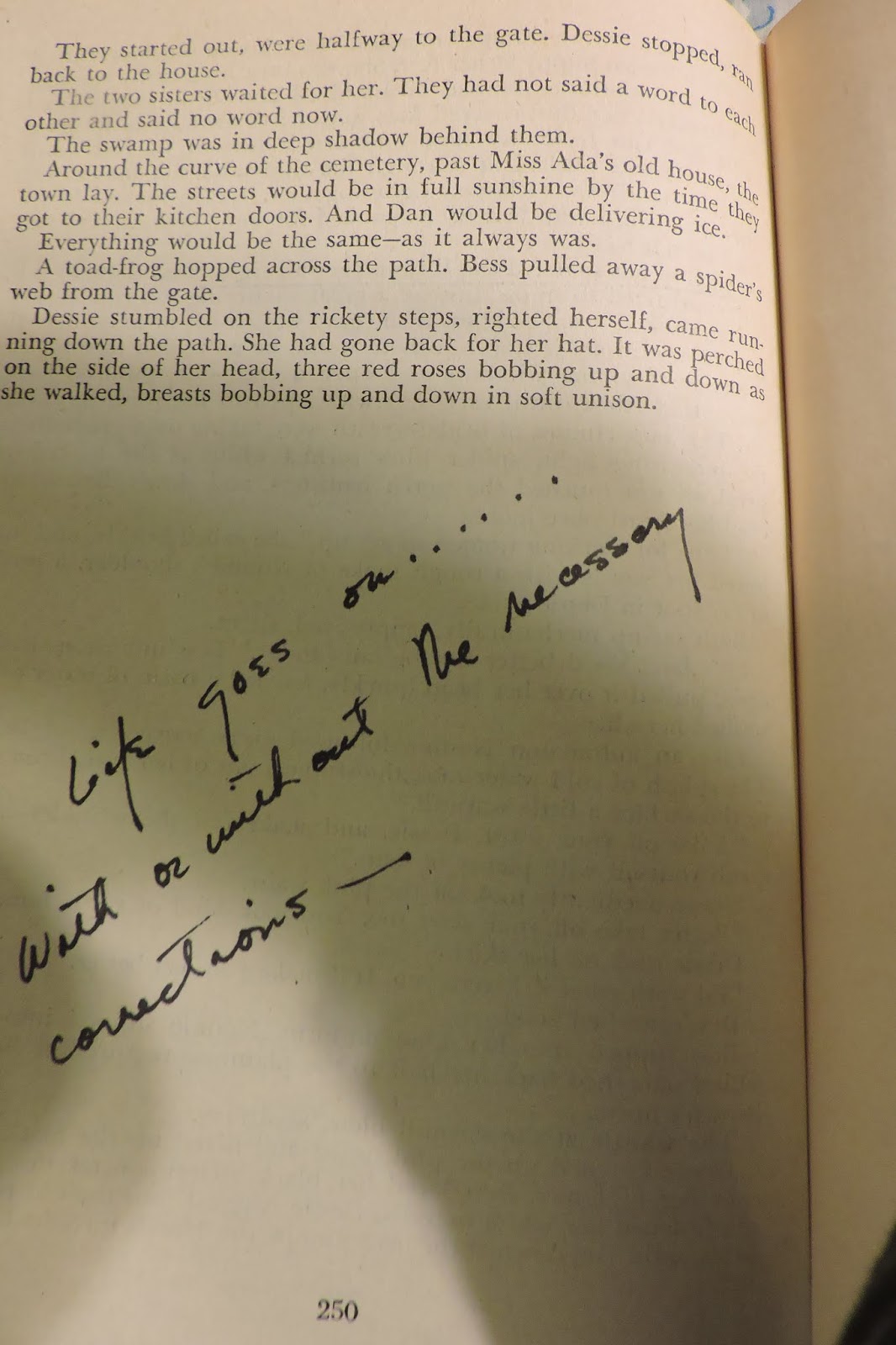
"Life goes on....... with or without the necessary corrections --"

***

Take it away, Billie Holiday:

Southern trees bear a strange fruit
Blood on the leaves and blood at the root
Black bodies swinging in the southern breeze
Strange fruit hanging from the poplar trees

Pastoral scene of the gallant South
The bulging eyes and the twisted mouth
Scent of magnolia, sweet and fresh
Then the sudden smell of burning flesh

Here is a fruit for the crows to pluck
For the rain to gather, for the wind to suck
For the sun to rot, for the tree to drop
Here is a strange and bitter crop

Friday, September 14, 2018

White Fragility: Discussing Racist Policies in the Age of Trump


I wrote this post after a few frustrating - and revealing - conversations with some older white persons of my acquaintance - but this is a microcosm of the experience of discussing race with many white people in the Trump Era. This has been particularly apparent when discussing anything related to either Black Lives Matter, or immigration policy.

Basically, the conversation tends to go like this:

I point out the glaringly obvious, that a particular policy of the Trump Administration or the Republican Party is openly racially motivated - and harming people. Something that is obvious to pretty much any person of color I know - and a large majority of those I know my age and younger.

A white person - usually older, but nearly always a Trump voter - gets all offended, claiming I am overgeneralizing, making accusations, or insulting them.

I point out that it takes an epic level of denialism to miss the obvious racism, and mention that this is common to white people - and to white people of a certain age and religious belief.  

Said white person takes this as a personal attack.

I have some observations about this. For what they are worth:

***

1. Denial runs so freaking deep.

I still cannot believe how impossible it is to convince Trump voters that his policies are racist. He practically BRAGS about it. The people he surrounds himself with (see: Stephen Miller and Steve Bannon, to name just two) use White Supremacist arguments and terminology - plus they push the exact same policies as white supremacist groups. His former chief advisor is touring Europe stirring up hate against brown-skinned immigrants. His ICE director attends anti-immigrant hate group conferences. At some point (and it has passed um...several years ago) this becomes willful ignorance. This is people refusing to see what is right in front of their eyes.


I have also pointed out - with reputable sources - over and over again the many - and increasing numbers of people genuinely harmed by Trump’s racist policies. And nothing changes. Denial isn’t just a river in Egypt.

2. White fragility is definitely a thing.

I will admit, I myself have this tendency, and I hadn’t really come to terms with it until relatively recently. My journey away from this way of thinking has been a process, significantly triggered by a series of events over the last 20 years. (Starting with my escape from the Bill Gothard cult after graduating from law school and moving out on my own. But particularly triggered by my wrestling with what it really means to love my neighbor as myself - including neighbors outside of my race and income level.)

But over the last few years, I have really started to notice white fragility. Any time I point out obvious racism, many white people in my life (particularly conservatives, Evangelicals, and Baby Boomers) get really freaking defensive. They take it really personally. In part, I believe this is because they voted for Trump. To vote for the KKK candidate and yet cling to one’s belief that Trump didn’t run on and isn’t governing on the KKK platform requires a lot of cognitive dissonance.

And, as I have come to understand, many Trump voters who would never consider themselves racist turn out to have really racist views - and political goals. (Particularly when it comes to immigration - that one is a real hot button.) So when I mention that Trump is pursuing racist policies, I implicate them.

In particular, my words and actions do the following, which trigger White Fragility (borrowed from the link above):

-           Suggesting that a white person’s viewpoint comes from a racialized frame of reference (challenge to objectivity)
-           Choosing not to protect the racial feelings of white people in regards to race (challenge to white racial expectations and need/entitlement to racial comfort)
-           As a fellow white not providing agreement with one’s interpretations (challenge to white solidarity)
-           Giving feedback that one’s behavior had a racist impact (challenge to white liberalism)
-           Suggesting that group membership is significant (challenge to individualism)
-           Acknowledging that access is unequal between racial groups (challenge to meritocracy)

These predictably result in hostility, defensiveness, and accusations against me that I am not being nice, that I am being misogynist (if the person I challenge is female - particularly an older female), that I have insulted them, and so on.

More than anything, I break the White Solidarity Code™ by actually using the “R Word” - Racism - to describe what is happening.

In addition, there is a demand that I not group them with others of their race. Individualism allows whites to distance themselves from the actions of their racial group and demand to be granted the benefit of the doubt, as individuals, in all cases. Which is exactly what is going on here. They want the benefit of the doubt - to be seen as good, moral people - even as they defend inhumane policies directed at people of color. They feel threatened when I point out that this election was a white temper tantrum that has gravely endangered the wellbeing of people of color - and make my words out to be more serious than the very real threats -backed by government power - to life, bodily integrity, and other human rights that have escalated against non-whites.

A few years ago, before the last election, I probably would have disputed the existence of White Fragility. Now, its existence is thoroughly proven.

3. Our biggest problem in political discussions is a pathological lack of empathy by those on the Right for people who are not white, straight, middle-to-upper class, male, and born in the United States.

Boy, people bristle when I say this. But it is absolutely f-ing true.

When you see unarmed African Americans (including children) gunned down by the police, and you say “Black Lives Matter is a media creation, and racialized police brutality is a myth,” you have a pathological lack of empathy.

When the response to a law (that nearly passed - thank you John McCain…) that would have stripped health care from the disabled, the elderly, and 45% of children under age 5 and you say “they are all just lazy,” you have a pathological lack of empathy.

When you see children separated from their parents (often permanently) and put in prisons and cages, and your reaction is “serves them right for coming here when our laws say we don’t want them,” you have a pathological lack of empathy.

When your response to refugees and asylum seekers is “why do we have any obligation to take them in?” you have a pathological lack of empathy.

When your response to an administration going through and revoking passports (and citizenship) for people because a midwife might have lied on the birth certificate is basically, “what’s wrong with that?” you have a pathological lack of empathy.

I’ve said it, and I will keep saying it, even though it offends a LOT of people in my life:

If your approach to immigration - or other racial issues - does not start with “how can I love my neighbor” and a recognition that immigrants ARE our neighbors, then you do not have a recognizably Christian ethic.

That virtually everyone in my life who has said one or more of the above things is 1) allegedly Christian, and 2) white, is strong evidence that we have a serious problem with empathy and basic human decency.

It seems for some reason that they are incapable of actually putting themselves in the shoes of others, and realizing the catastrophic damage which their political agendas would cause. That is why I say “pathological.” Their inability or unwillingness to use empathy causes violence and damage to other people. That is a pathology.

4. As a result of the above, many white people I know are FAR more offended that I called them on their racism than they are about children in cages, separated families, US citizens being persecuted and forced to prove they belong here, or unarmed African Americans being murdered by the police.

I am serious. I actually had someone claim my pushback on their racism was the harmful thing, not the genuine and serious harm being done to people because of the color of their skin.

And that is why White Fragility prevents us from having an honest discussion about racial issues - and specifically the malevolent and harmful policies that are damaging millions of people.

5. Trump voters have zero willingness to take responsibility for the harm they have caused.

When I was a kid, I was taught that you don’t harm people. But if you do, you apologise and try to repair the damage.

Along with many others, I spoke out before the election warning people that Trump promised to harm whole groups of people: immigrants, refugees, brown-skinned people, African Americans, LGBTQ people, low income people on Medicaid, disabled people, children.

And guess what? He is doing exactly what he promised to do. So, if you voted for him, you are morally responsible for the harm. Stop trying to weasel out of your responsibility.

I have seen ZERO remorse from Trump voters. I can point out the damage being done to people all day until I am blue in the face, but it does no good. It is hard not to conclude that there is such a pathological lack of empathy (see above) toward people outside the narrow tribe that nothing can penetrate it. No amount of horror and carnage will convince them that they made a mistake. Maybe someday when it is people like them, they will care. But “those people” apparently don’t actually matter.

6. Many white people have zero interest in actually asking WHY they support harmful policies.

They have no interest in asking why we even have a “denaturalization task force.” As in, “why do we want to take citizenship away from people anyway?”

They have no interest in asking why we put children in cages.

They have no interest in asking why the Trump Administration wants to virtually end immigration from the developing world.

They have no interest in asking what the common thread is that ties all of the harmful policies together.

Why not?

Might it be that they wish to support those policies without admitting to themselves that the motivation is racism?

It’s much easier to simply take offense when I point out the blindingly obvious: yes, these policies are motivated by racism. Yes, they harm people - including a lot of children. And yes, supporting them is strong evidence that you too are racist.

Get over it. If you want to be thought of as a decent, compassionate, non-racist person...it’s time to start acting like one.

***

Just an illustration here:

Recently in the news is the fact that the Trump Administration has been revoking the passports of people who are United States Citizens. Why? Well, over a 40 year period, some midwives falsified birth certificates to show that babies were born on US soil, when they were born in Mexico, just across the border. Said midwives were prosecuted. Now, the Trump Administration wants to strip citizenship from the persons (many of whom are middle aged), and deport them to Mexico.

So, let’s think this through:

An infant is born. Presumably said infant has no choice in where, and no memory of the event.

Infant grows up in the United States believing he or she is a native-born United States Citizen.

Former infant goes to school, gets a job, has a family, makes a life here. Eventually, that person gets a US Passport. (BTW, if you have a US Passport, that means you have no drug convictions, no restrictions on travel as a result of a criminal conviction, no back child support, no IRS liens, and no defaulted federal student loans. These are not, shall we say, terrible people - they are ordinary people with ordinary lives.)

Suddenly, they get a notice - or even a knock on the door by ICE - that their passports are being terminated, and they are being considered for denaturalization (losing citizenship) and deportation.

Being deported would mean their lives would be destroyed. They would be evicted from the only country they knew. They would lose their jobs. They probably would lose their families. Everything they had would now be gone.

Remember: these people have committed NO crime. They have done NOTHING morally wrong. They are innocent.

What is your response to this situation?

Think carefully before you answer.

Will your answer look like this:

“According to the article 79 midwives in that corridor were convicted of selling fake birth certificates for babies born In Mexico. That's probably many babies. Those babies are adults now and so in 2008 the law was made more restrictive and the checks more comprehensive. I guess my question is, what else should they do? Should they make it an all over the country search or concentrate on the area where there has been a problem?”

That’s an actual quote from an older white person I know.

Let that sink in for a few moments.

The response to a policy aimed at destroying the lives of innocent people is….wait for it….wait for it….

Should we do this everywhere, or just in the places where most of the bad acts occurred?

Yes, I lost it at that point. Sorry not sorry.

Because that is not the response of a person thinking with basic human decency. That is a person acting out of a pathological lack of empathy. And I said so.

Now, compare this with the response from another person I know. (BTW, also white, but...and I think this matters: with a non-white child.)

“The people who issued the birth certificates falsely should be prosecuted and the people who have them be left alone as the citizens that they are.”

Succinct, to the point, and morally admirable. Punish those who did wrong, but leave the innocent people alone.

People, this isn’t that hard. It’s basically ethics 101. My youngest child can understand this - and could have as a toddler.

Don’t hurt people. Don’t hurt innocent people. Don’t punish people when they haven’t done anything wrong.

Why is this so hard?

Again, decent human beings do not conclude “destroy the lives of innocent people.” You can only come to that conclusion if something has stripped compassion and empathy from your soul.

What might that something be? My personal theories are 1) Fox News has been spewing xenophobia for decades, and this has led to a dehumanization of immigrants - particularly the brown-skinned ones. 2) Partisanship - the GOP is viewed by whites (mostly Evangelicals and Boomers) as always right, even when they go full White Supremacist. 3) White Evangelicalism has taught people that sin is “breaking the rules,” and that God will eternally torment people for doing so. This, combined with the dehumanizing of people outside of the faith, has led to an automatic vindictiveness toward anyone who is perceived as having broken a rule - particularly if that person is outside the white Evangelical tribe. We try to emulate our gods, and when they are cruel and vindictive, we become so too.

The combination of these factors is why a depressing number of white people in my life keep defending the indefensible destruction of the lives of others, and can’t seem to get basic compassionate ethics right.

Honestly, I feel like I don’t even inhabit the same moral universe anymore. Many of the people who taught me my morals and ethics turn out to...not really believe them. I was taught hurting people was wrong. I was taught racism was wrong. I was taught that good people didn’t stand by and let minorities get abused by the government. I was told by people that they would have opposed slavery and supported the Civil Rights Movement. That one turned out to be bullshit once an actual, real life civil and human rights issue affected them. I am ashamed.

***

Here is the other question that I asked - and have never yet received an ethically informed answer.

What possible good would come out of denaturalizing and deporting people?

Clearly, it is horrible for the people having their lives destroyed. But what GOOD does it accomplish? These aren’t dangerous, criminal people. (And if they were committing crimes, presumably they were arrested and prosecuted just like any other citizen. Okay, if they had brown skin, probably they were more likely to be arrested and prosecuted.)

How is this good for the United States? You just kicked out a productive citizen. You created fear and uncertainty for thousands of others - including plenty who were literally born here but who would get harassed anyway. You made it less likely that they will feel like they (and people with their skin color) will feel welcome here and part of our nation. You just made it less likely that they will report genuine criminals to law enforcement. You have torpedoed the good will that they felt.

How is this a good thing?

***

Okay, how about the elephant in the room.

There is a class of people for whom the response is definitely “destroy the lives of innocent people.” There are people who think that discouraging immigration from so-called “shithole countries” is a good thing. These are the people who think that preserving the ethnic makeup of the United States is a legitimate policy goal.

The term for these people is “Racists.”

I’m not going to sugarcoat that one. If you want to keep - and force - people out who don’t share your skin color or national origin, then you are by definition racist. And racism is not in any way consistent with the teachings of Christ. Sorry not sorry. That’s the truth, and I will keep saying it.

The core belief here is one that has plagued the United States since its founding - although it isn’t just a problem in the United States. It is a belief in the inherent superiority of white people of European descent. That’s also known as “White Supremacy.” It is also completely incompatible with the teachings of Christ.

And please don’t give me the fiction of “we have to punish innocent people so others won’t break our laws.” First, that’s ethically ludicrous - find a way to punish the guilty, not the innocent. Second, wouldn’t a better way to fix the problem be to give people a reasonably easy and available way to come here legally? As in, actually fix our laws so that hardworking people who wish to immigrate can actually do so without restriction? (Like most of our [white] ancestors did, remember?)

And at this point in virtually every conversation I have had about immigration policy, the person shifts to some variant of “but we already have too many of those kind of people here.” Thus revealing that it is, in nearly all cases, really about racism after all.

***

One of the things I purposed to do in the wake of the election of The White Supremacist Who Shall Not Be Named is that no longer would I let racism and hate pass without comment from people I know. I was not going to just let people defend policies that actually hurt people without saying something. I was going to speak up. Yes, that makes people (particularly older white people) VERY uncomfortable, and they get defensive and try to make it about my tone. Sorry not sorry. I’m going to keep using the “R word,” and I am going to call you out if you support cruel, racist policies, or say racist shit on my posts.

***

I’ll end this post with a couple verses from Proverbs 3:29-30


Hint: This verse isn’t about people who make you uncomfortable when you defend racist policies or candidates. It’s about ACTUAL harm to your neighbor. Like putting kids in cages, separating families, kicking citizens out of our country, harassing brown-skinned people, and murdering African Americans. That’s real harm - not just white fragility.

***

I linked it above, but I really think it is worth reading.


When I discovered it in the aftermath of the election (I believe an African American friend posted it), it really changed my thinking. I recognized the source of my own defensiveness - which I still fight against. It also explained why using the “R word” freaked many of my white friends and family out. Around the same time, I read Martin Luther King Jr.’s “Letter from a Birmingham Jail” with my kids. Among other things, I was really struck by his view of the purpose of protest: to increase tension and discomfort. The enemy of reform isn’t angry racists - it’s white moderates who want to be comfortable and self righteous while quietly voting against reform. By challenging them, we make them take a side. They can either stop silently supporting the oppressors, or they can be exposed as racists. They can choose how to react, but the fault is not with those of us who make them uncomfortable.

***

And this one too, which is pretty much how any discussion of racism goes these days (follow the link for the whole thread):