I wasn’t entirely sure what to expect from these two plays, performed at Ovation Underground (Ovation Theatre’s basement), but I felt like I had at least heard something about Straight Play a couple years ago.
Lucy Fanucchi is a local playwright, and I wasn’t able to find much of a biography. About all I could locate was an Instagram account with next to nothing biographical - it even lacked pronouns, which might be helpful here. I did note with approval an abundance of cat pictures. But that is about it I can say about the author.
On the other hand, I certainly can say something about the plays themselves, and the particular productions.
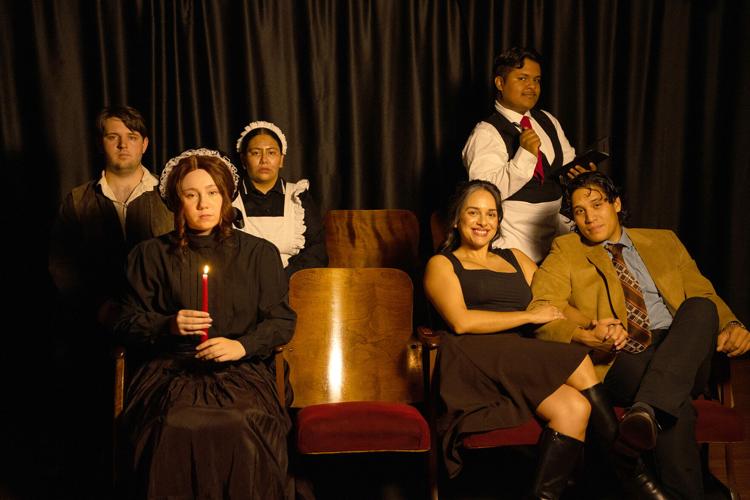
Ovation Underground seems to be taking on the niche formerly occupied by Stars Playhouse: tiny space, minimal sets, offbeat selections, low cost. I previously wrote about The Real Thing by Tom Stoppard.
I just happened to have a night free, and found the blurbs to be interesting. So my wife and I went.
The two plays are very different in setting. The Pleasures of the Afterlife takes place in a late Victorian English country manor, while Straight Play is contemporary. The sets consisted mainly of two reversible panels, and the period-appropriate things to sit on. Each play has three roles, and each play used a different trio of actors.
The Pleasures of the Afterlife starts out with socialite and gossip columnist Cecelia Sinclair happy to have inherited her uncle’s estate. But as she reads the local paper out loud, we discover that she is unhappy that, after a carriage accident, a rival is writing her column, and doing a bad job.
But things take a turn for the worse: her servant seems to be ignoring her, and a man suddenly appears in her mansion, insisting he lives there too.
Oh, and also that he is a ghost, and maybe she is too.
How inconvenient.
From there, we get a bunch of bickering, a long-kept and dark secret, and a decision that backfires humorously.
Along the way, we get a lot of sparkling dialogue, witty insults, and general comedy. Overall, it was well done, with my only quibble being that there were a couple of times the actors stepped on each other’s lines. And yes, real humans arguing do this all the time, but on stage, you want all the lines to be heard - the jokes have to land, and for that you need all the words.
I do have nice things to say about the acting, though. Sebastian Richardson as Alexander had great physical comedy, and his timing was excellent. He also looks just a bit like Gru (from the various Minion movies), and I think used a few moves. Mackenzie Flores (Cecelia) and Natalee Clark (Miss Mortimer) rounded out the cast, and played well off each other. They maybe should have warned about Clark’s voice, however, because that scream was far more ear-shattering than the gunshot.
Straight Play was a bit longer, and in my opinion, a more fully developed play. It also had absolutely delightful and hilarious dialogue that sounded both natural and unexpected. It was full of double entendres, both intended, and unintended, and much of the humor was (as is a farce tradition) based on characters not knowing what the audience knows.
Lee arrives at a trendy restaurant for a date with Sally - and he intends to propose to her. But it turns out his waiter is Michael, and the two of them dated for a couple of years. The breakup was not, shall we say, amicable.
When Sally arrives, she discovers Michael, and we learn that the two of them dated in high school, before Michael came out - and that he was just the first of several times Sally ended up dating a closeted gay man.
So you have a really awkward love triangle, so to speak, and neither Sally nor Lee knows about the other’s history.
How this all sorts itself out is hilarious and awkward as hell. But it also is all about the process of becoming at home with who you are, with one’s history, and with the complexities of other people’s pasts.
I will mention that all three characters also have a connection to theater, as well as a complicated relationship to that medium. This gives an opportunity to the playwright to use “improv” as the kind of multi-valenced term with a spectrum of double and triple meanings. Kind of like “Stockholm” in Anxious People.
The cast for this one was truly top notch. Nick Ono (as Lee) has been in every kind of local production for years now, and he is one of those veteran actors now who is a joy to watch in any role. He made Lee’s nervousness and vulnerability come to life - and made the reality of bisexual erasure and stigma feel palpable.
Ruth Luna is another stage veteran, most recently seen in The Children’s Hour. Her Sally was of a competent and capable woman who is all too often overlooked in favor of flashier sorts. Both her initial response to Lee and her later softening felt real.
Finally, Irving Cortes brought Michael to life as a man still not over his past loves, still insecure in his present and ashamed of his past. There is a certain nastiness in his behavior, but Cortes rooted it in the character’s trauma and hurt.
Great chemistry among the trio. And the dialogue, I am still thinking about that. The audience was laughing through the whole thing, at least when they weren’t gasping at revelations or wincing at the awkwardness.
Both plays, but especially the second one, are examples of how to write dialogue. It never felt stilted, and every word seemed important and necessary. To write humor that doesn’t feel forced, or like something no real human would say, is a talent.
I enjoyed both of the plays, and hope they find a wider audience as well.


No comments:
Post a Comment