Showing posts with label science fiction. Show all posts

Tuesday, April 21, 2020

Space Opera by Catherynne M. Valente


Source of book: I own this.

This was this month’s selection for our “Literary Lush” book club. One of the things I enjoy about this club is that I end up reading interesting books that I never would have discovered on my own. Space Opera was nominated by my wife, and won the vote this month. I was not really aware of this book, but was familiar with the author, who wrote a series of imaginative fairy tales for kids, starting with The Girl Who Circumnavigated Fairyland. Space Opera has some similarities, but is rather a different sort of book. 


 As the author explains in the “Liner Notes” at the end, she was introduced to Eurovision in 2012, and thought it was a fantastic idea. Birthed in the aftermath of two catastrophic world wars, it aimed to provide a more positive outlet for national rivalries than warfare - and became a deliciously campy, over-the-top spectacle that is like nothing else. Valente started live-tweeting the contest; then one year, a fan joked that she should write a science fiction Eurovision novel...so she did. 

The basic premise of the novel is this: due to a wormhole incident (one yawned - they are like giant pandas in spacetime), tempers flared among the galactic civilizations, and catastrophic war resulted. After much was reduced to rubble, the survivors decided that they needed a better option for competition than intra-galactic war. So, they established a song contest to be held yearly (based on a rather longer year - hey, planets differ!) This contest would determine how the galactic resources were divided for the next period. Oh, and if any planets with potentially sentient life were discovered, they would have to participate as well...and if they came in last, they were annihilated as non-sentient. 

At the beginning of the book, then, Earth is discovered, and finds to its horror that they face the end of everything if they can’t manage to score at least next-to-last in a contest they have never heard of, involving forms of life with far greater resources to draw on. 

And, the galactic powers that be have already selected the musicians to represent them: has-been “glitterpunk” glam-rock group Decibel Jones and the Absolute Zeros. Never mind that they broke up years ago, and that one member of the trio is dead. The aliens are, well, a bit behind the times, and every other group on the list is dead, so the last group left standing gets the nod. 

Space Opera clearly draws a lot of inspiration from Douglas Adams, both in the inspired zaniness and the tendency to go off on rabbit trails about different civilizations or events. However, unlike Adams, Valente actually uses a plot, and the satire is more focused and less scattershot. This is both good and bad. One of the great things about Adams is that, at his best, his work feels like pure escapism, and you don’t really see the zingers coming. The satire is unexpected most of the time, and there is no plot or “point” to worry about. In contrast, Valente definitely has an underlying theme: the problem of sentience and xenophobia, particularly in our Trumpian age. After all, is a species which has spent its entire history at war with itself - often trying to annihilate slightly different humans - really sentient? Or is it more like an existential threat to other civilizations? 

The book got mixed reviews from our club, in large part because of the long digressions. Valente’s tendency to string adjectives together also made it a bit difficult to follow - particularly on audiobook. (I am trying to imagine how impossible Henry James would be on audiobook, with his page-long sentences…) In fact, I would say that those who read the book in print or electronic form liked it better than those who tried the audiobook - and that is despite the narrator sounding a bit like Douglas Adams himself. I thought the book was good fun, laughed at the satire, and considered it a fun escape from our currently trying times. 

I think I probably appreciated some of the jokes more having watched enough Eurovision (after the fact) to understand how over-the-top it is. (Valente isn’t exaggerating that much, shall we say.) I also “cheated” and read the “Liner Notes” early in the book, so I knew, for example, that the chapter names were all actual titles from Eurovision winners and runners-up. And that the names of the various alien races were taken from words in languages spoken by Eurovision nations. (Great examples: the Flus, a race of identical genocidal narcissists which fail to make the cut, come from the Maltese word for money. Voorpret is Dutch for Anticipation. Utorak is Tuesday in Slavic.) Looking this stuff up is easier when you can put the book down and grab a computing device. Also, since I could take notes, I jotted down some good lines for later. 

Here is one satirical zinger. The Esca (Italian for bait) are the race chosen to make contact with earth, using billions of holographic communication somethings to manifest and speak to all humans at the same time. As the emissary explains, this saves time:

I can’t wait for your monarchs to decide to hide it, lose control of the narrative, deny the evidence, call me a weather balloon, confess and resign, and finally leak a half-redacted version of what I tried to say to a newspaper friendly to one faction or another. Who has the time? 

I snorted really hard at this one. While it is a fairly universal characteristic of rulers, it is so very Trumpian you can’t miss it. Except for the resignation. Trump will have to be dragged from the White House by force someday - unless he dies choking on his own narcissism first. 

The Esca go on to explain the need for the contest:

Here’s the catch, kitten: whenever evidence of a new species with significant potential for expansion is discovered, we all get very nervous. Sometimes, the new kids are clearly on the up-and-up, bright scaled and bushy tailed sensitive sweeties who really have their shit together. But not everyone cleans up nice for company. Not everyone can be trusted to play nicely with all the other children. Sometimes, a species gins up the technology necessary to well and truly muck things up for the rest of us before they develop anything like self-awareness or complex reasoning or radical empathic perspective, before their philosophical digestive tract can handle something spicier than malice aforethought or semibenign neglect. 

In our own reality, it is pretty clear that the Hitlers and Trumps of our species do not meet this requirement - they (and their followers) are characterized by a pathological lack of empathy that cannot imagine the level of self-awareness, complex reasoning, or ability to see things from the perspective of other groups necessary to play nicely in the sandbox. They end up starting wars, trying to exterminate people groups, and obsess about keeping “those people” out. Which is, of course, why we need to be more careful to keep people like that out of power and way from the technology that allows them to muck things up for the rest of us. 

Valente also gets a good dig in at the way that humans love to think that they and those like them are “superior” because they happened to have access to resources others didn’t. In the book, the Aluzinar happened to be closest to the wormholes, and thus controlled space travel. This is certainly been the story of humanity. Those with the guns, germs, and steel, so to speak, can slaughter and enslave those without, and then use their religion to claim god loves them more. 

In the early days of the universe, whether or not a habitable planet happened to have a wormhole nearby was as consequential to the eventual political map as whether or not a particular group of humans happened to be born on a continent with domesticable animals on tap or on an island the size of a doorknob where the only source of reliable protein was a semipoisonous tuber. Wormhole or no wormhole had just as little to do with the inherent superiority and/or possibly divine mandate of the smirking bastards who won the cosmic draw as cow or no cow, and yet, everyone everywhere will do, say, and stab nearly anything if it means they get to believe that they are blessed and their neighbors are basically toad-people. 

Yep. And Christ had a lot of harsh things to say about that too, which it is so ironic that most of his supposed followers say the complete opposite to what Christ taught…

I wish I could quote ALL of chapter 13, which essentially explains how the test for sentience works. After rejecting cities, self-awareness, tools, problem solving, love, language, object permanence and other tests - which some animals can pass - before settling on this:

Do you have enough empathy and yearning and desperation to connect to others outside yourself and scream into the void in four-part harmony? Enough brainpower and fine motor control and aesthetic ideation to look at feathers and stones and stuff that comes out of a worm’s more unpleasant holes and see gowns, veils, platform heels? Enough sheer style and excess energy to do something that provides no direct, material benefit to your personal survival, that might even mark you out from the pack as shiny, glittery prey, to do it for no other reason than that it rocks?

And not just that, but also:

Are you kind enough, on your little planet, not to shut that rhythm down? Not to crush underfoot the singers of songs and tellers of tales and wearers of silk? Because it’s monsters who do that. Who extinguish art. Who burn books. Who ban music. Who yell at anyone with ears to turn off that racket. Who cannot see outside themselves clearly enough to sing their truth to the heavens. Do you have enough goodness in your world to let the music play? 
Do you have soul? 

It is no accident that autocrats the world over, from Hitler to Stalin to...well everyone...crack down on the arts. The arts are not primarily “entertainment” - they are our prophets. (Hey, read the Prophets in the Old Testament - it’s great poetry!) It’s also why the United States has had such a love-hate relationship with popular music. Our unique contribution to art derives not from the dominant white people, but from the African American experience. Cult leaders like Bill Gothard, therefore, had to paint music with an “African” origin as demonic, insisting on the superiority of European art forms. It’s very much political, as all art is. It is the same reason that the GOP has targeted the National Endowment for the Arts for decades. While they like to parade out a few controversial artists, most of that money doesn’t go to controversy, but to a wide variety of programs which make art available to the non-moneyed classes. And that, of course, is anathema, because people who experience the prophecy and power of art have a transcendent experience they can share that is outside the pale imitation offered as “patriotism” by those in power. (I really need to write a post about this sometime. But for now, just read up on composers like Shostakovich and his subversion of Soviet politics.) 

As an alien later observes, “[T]he opposite of fascism isn’t anarchy, it’s theater. When the world is fucked, you go to the theater, you go to the shine, and when the bad men come, all there is left to do is sing them down.” 

I am reminded of two incidents here. The first is the way that facist-enabler Mike Pence got called out when attending a performance of Hamilton. The reeking hypocrisy of someone who stands for persecution of LGBTQ people and immigrants attending a play full of gay actors celebrating the life of an immigrant is foul indeed, and good for the cast for stating the obvious. 

The second is this: while imprisoned in a Nazi concentration camp, Olivier Messaien composed (and performed with other prisoners), an amazing work, Quartet for the End of Time, which in essence raised a middle finger to the Nazis, reminding them that judgment was coming for them when justice is done at the end of the world. 


Here is another way to look at art:

No matter how mad, bad, and dangerous to know a civilization gets, unto every generation are born the lonely and the uncool, destined to forever stare into the candy-store window of their culture, and loneliness is the mother of ascension. Only the uncool have the requisite alone time to advance their species. 

These are kind of the heavier themes, but the book as a whole is more lighthearted. I mean, other than the “will earth survive?” thing hanging there. Just before the big showdown, there is an extended scene set in a re-creation of a hotel lounge where the mixer from hell is going on. Valente has clearly been stuck in one before, and gets the details right. Well, almost right. Because the aliens who re-create it for the comfort of the newest contestant don’t quite understand how humans work. So there are a lot of drinks available, but nobody knows how to make one that won’t poison a human. It is not unlike those old American oddity shows where they put fake Native Americans on display in “traditional” costumes. Only a white person would think it looked right. (Or, think billionaire James Dolan trying to play blues…) 

As part of this scene, the digital race, the 321, have to manifest as...something so that they can be seen. So, with limited knowledge of human culture - and what they have from the digital realm, they choose, of all things, Clippy. Yep, the highly annoying digital “assistant” from past versions of Microsoft Office. I think everyone on earth hates him. Did anyone like him? Anyone? The 321 are a bit pissed that this went poorly for them. 


Printing a high-capacity three-dimensional corporeal interface isn’t as easy for us, you know. We have almost transcended the need for gross physical storage. We can’t just conveniently roll out of bed in a nice wash-and-wear body like the rest of these gooey bastards. Inasmuch as we have any home, we live in the rich router clouds of asteroid archipelago 192.168.1.1.

I can’t stop laughing at the reference to the default IP address for a router. 

There is one other chapter that would be great to quote at length, chapter 30, “Silence and So Many People.” (Portugal 1984) It brings up the idea of interspecies sex, and it is pretty hilarious. And also, realistically sex-positive, if that makes sense. It starts with “Everybody fucks. Well, almost everybody.” 

No force on this plane of reality can equal the drive to get a leg over, because it’s the nondimensional otherspace where all those nice, sophisticated fundamental forces meet and form a weird, wet, messy trashball: tension, friction, gravity, electromagnitism, thrust, torque, resistance, elasticity, drag, momentum, inertia, pressure, chemical reactivity, fusion, conservation of energy, self-loathing, humiliation, and loneliness.
Being ashamed of it makes about as much sense as being ashamed of the speed of light. 
Everybody is bizarre and disgusting and interesting and fixated on fetishes they wouldn’t admit to their grandmother on pain of vaporization and worthy of love. You are bizarre and disgusting and interesting and fixated on fetishes you wouldn’t admit to your grandmother on pain of vaporization and worthy of love. It’s a literal goddamned zoo out there, so this is the best I can offer you: don’t giggle when the other entity takes their clothes off, secure enthusiastic consent, don’t mix silicon and carbon without extensive decontamination protocols, tidy up your house if you expect to bring someone home, don’t expect anything you wouldn’t offer, remember that every person is an end in themselves and not a means to an end, don’t worry too much about what goes where and how many of them there are, don’t mistake fun for love, try your best, be kind, always make them breakfast, and use protection. Chromosomes are not nearly such picky eaters as you might think. 

That’s actually pretty decent advice, come to think of it. 

Finally, let’s talk about the songs. Well, there are actually two facets to the songs. First, the imaginary songs. Valente sprinkles band names and songs throughout the book, usually as part of the description of a species and how they make music. While there are some real groaners, I found some hilarious. Your mileage may vary. 

“I Can’t Get No Liquifaction” - sung by the viral species that creates zombies. 
“Gleams of Production” - by the Azdr (Armenian for “thigh”) who are locked in an oligarch/proletariat struggle.
“Abort, Retry, Fail” - by the 321 of course. (True story, every time I see that, I remember accidentally crashing a minor computer owned by the FAA as a kid while at work with my dad. Fortunately, the statute of limitations has long since run, no permanent damage occurred, and I was pretty young at the time.) 

And, my very favorite: “Clock Lobster” by Basstime Anomaly. Which is on my shortlist of best band names ever. 

Then, there are the real tunes. The ones the chapters take their names from. Most are available on YouTube, particularly if you translate the names. I’ve selected five to show the range. 

First, this one from 1969, back when Eurovision still had a live orchestra. The first chapter in the book uses this name. “Boom Bang A Bang”


Second, from Bosnia and Herzgovina in 2011, “Love In Rewind.” There is a lot to like about this - the old guy as frontman, the nostalgic instruments, the naive and earnest singing. I’d totally want to jam with this band. 


Third, from France in 1990, “White and Black Blues.” It is a reminder that France embraced African American musicians long before the United States let them stay in hotels and eat at restaurants and come in the front door of the theater. 


Fourth is a great example of how Eurovision has gotten completely over-the-top in recent years - and I mean that in the best way. Here is Austria’s Conchita Wurst with “Rise Like A Phoenix.” 


Last, in the category of Awesomely Campy is a song that is better than a lot of the pop I have heard on the radio lately, “Vampires Are Alive” - Switzerland 2007. 


These are just a few of the fun songs that the chapter titles will lead you to. Take the time and listen to each as you read….

No, it isn’t great literature. Yes, it can get wordy. But I had a fun time with it, and with taking a dive into the glitterpool that is Eurovision. Give it a shot.


Monday, January 6, 2020

A Swiftly Tilting Planet by Madeleine L'Engel


Source of book: Audiobook from the library

A Swiftly Tilting Planet is the third in L’Engel’s “Time” series, beginning with her best known book, A Wrinkle in Time, then A Wind in the Door. The story takes place a number of years chronologically after the others, with the Murry children all grown up, Meg married to Calvin, and pregnant with their first child.


The story itself is rooted in an old legend of Madoc, a Welsh prince who, in the folklore, sailed to the New World over a thousand years ago. His ostensible father, Owain Gwynned, was a real person, but his story and those of his children are, like King Arthur, papered over with much that is fantastic and imaginary. According to the legend, Madoc, fed up with the sibling squabbles over the throne, set sail across the Atlantic Ocean, eventually settling in...well, there are competing sites from Canada to Argentina, intermarrying with the Native Americans, and playing some role in the various indigenous empires in the Americas. 

This legend was widely believed, apparently, during the 18th and 19th Centuries, and the existence of a race of “Welsh Indians” was taken for granted as true. No surprise that it was the Welsh blood that was credited with establishing the Mayan, Aztec, and Inca empires, or that the tribes with white heritage were believed to be superior. It is this white supremacist assumption that taints the whole book just a bit, despite L’Engel’s efforts to remove it. Her fault lies solely in  the use of the legend, not her handling of it, which is mostly progressive by the standards of 1978, when the book was written. 

L’Engel starts with the legend, but adds layers of symbolism. One might say that it is really about Cain and Abel, with those two standing in for the dual nature of humanity. (It is fair to say that learning to think about Genesis as metaphor rather than literal history opened the book up to me as one of the finest explorations of human violence and hatred ever written.) For L’Engel, the Madoc legend becomes a way of looking at our good and evil natures in various expressions. 

The setup story is kind of meh. The Murrys are already insufferably above average in the other books, but now, Dad gets a call from the President of the United States with a request to somehow fend off nuclear war, started by a crazy dictator in an (imaginary) South American country. So, it ends up being Charles Wallace to the rescue. The more interesting twist is that Calvin’s mother, the bitter and difficult Mrs. O’Keefe, holds the key to success, in the form of an ancient Rune that was passed down to her for generations. This Rune, based on a condensed version of Saint Patrick’s Breastplate, ends up as the backbone of the book, and the adventures which follow. 

Charles Wallace goes to the star-watching stone (famous from the other books), and is put into a trance, where he is carried through time by a unicorn. His mission is to enter into the minds of various characters in the past, and, if he can, make a subtle change which leads to a different “might have been.” At the same time, he “kythes” with Meg - a kind of telepathic connection, so she can remain in the present world and yet experience his travels as if she were there. She is also able to assist him, but obtaining other information he needs. 

Charles Wallace starts by witnessing an incident in the original Madoc legend. Madoc turns out to have come to the New World with his brother, Gwydyr, but they become separated. Madoc and his descendents become the Abel figure, the personification of the good in humankind, while Gwydyr represents Cain, and the evil and violence of humankind. The two have a standoff, in which Madoc prevails, and Gwydyr flees, his descendents eventually ending up in Vespugia, the imaginary country near Patagonia. 

Next is a scene in Colonial America. A Welsh settlor has married a Native American woman, a descendent of Madoc. Charles Wallace has to work to prevent her from being hanged as a witch. In this way, L’Engel ties violence to witch hunts as well as genocide of the Native Americans, and suspicion of other cultures. (As I said, L’Engel does her best to defuse the racism in the original - she was pretty universalist in her views, which is why the Fundie culture I grew up in distrusted her.) 

After that, the book gets chronologically kind of weird. There are three connected threads, the first involving Mrs. O’Keefe’s brother Chuck, who had kind of a second sight before he was killed by their violent stepfather (the reason Mrs. O’Keefe is so bitter.) The second is their ancestor, the fictional novelist Matthew Maddox - another descendant of Madoc - who has written the definitive book on Madoc’s story, but doesn’t know the ending. The third involves Maddox’s brother and sister, who travel to Vespugia to find the Welsh colony. There, they encounter Gwydyr’s descendents, and the battle for who gains dominance and produces the ancestor of the dictator will determine the future. 

Throughout, L’Engle uses variants of the same names throughout. Madoc/Maddox, Gwydyr and various attempts to pronounce it, Zill/Zilla/Zillo representing both the feminine and the Native American element, and Bran as the Irish part of the line. (For the Rune, and for another link to Mrs. O’Keefe and her ancestors.) The names are combined and altered and remixed throughout, lending a continuity to the themes. One could view the characters as leitmotifs, perhaps, representing ideas rather than people. In that sense, I might classify Bran as some form of human potential, which is why his name is part of the dictator’s name, and so on. Charles/Chuck/Matthew and the equivalent Native American characters are both the alter egos for Charles Wallace and the prophetic voice. Zilla isn’t just Native American and female, she is also Mrs. O’Keefe and Meg and the other women who advocate for goodness, and yet are vulnerable to being victimized by the Gwydyrs of the world. 

I’ll admit to mixed feelings about this book. In general, I like L’Engel and her unusual perspectives. I thought that her idea of making a story of the dichotomy of human nature, and the way that small things can turn tides. She brought out the “brother versus brother” idea in a way that, unlike our discussion of the Civil War, doesn’t gloss over evil. She is spot on with her analysis that lust for power and privilege (economic and social) is at the root of evil of all kinds. The worlds she builds are fascinating, and are as consistent and well thought out as her plots. And she really worked hard to purge racism and sexism from her stories.

My main quibbles with this book are as follows. First, because of her choice of a framing myth, she cannot entirely escape the impression that this is a White Man’s Story. Both international politics (the threatened nuclear disaster) and Native American history become co-opted by a narrative of white people. It’s all about these two Welsh princes, ultimately, right? So that rubbed me wrong. 

Likewise, I had multiple issues with the idea of good and bad seed as a genetic legacy. Obviously, this is on one level a related issue to that of whiteness. Since both Madoc and Gwydyr intermarried with the Native Americans - as did their descendents - the Welsh blood would have been diluted significantly over the thousand year period. Why does the Welsh blood become the part that matters? Were there no Madocs and Gwydyrs (in the metaphorical sense) in the non-white lineage? 

Then too, there is the issue with the idea of character being passed genetically or culturally. I’m a bit sensitive about this for two reasons. The first is that both the genetic and cultural arguments have been and are still being used to justify white supremacy. The second is that the very premise is undermined by its origin. Madoc and Gwydyr both have the same parents (or at least parent - the book doesn’t mention which of Owain’s many wives and concubines mothered the two brothers, although it seems implied that they were closer than the average brothers.) And goodness knows my siblings and I are very different. 

So yeah, I get the need for that as part of the metaphor that runs through the whole thing, but it seems a bit determinativist. And also morally icky in the idea that whether the dictator is a good or evil man depends on who his [white] ancestor 1000 plus years ago is. 

That’s where my mixed feelings came from. For the first two books, there wasn’t really anything I could point to as problematic. The imprisonment of the father by a conformist cult leader? Hey, I can really relate to that one. The idea of love overcoming evil? The fruit of love being more important than theological differences? There was so much to love in the first book. The second book was very different, of course, but the exploration of molecular and cellular biology was fascinating, as was the damage caused when individual selfishness is allowed to take over. The idea that we are interconnected with our fellow humans - and nature - and that harm to one is harm to all is more timely than ever. That’s why L’Engel’s central point about power and privilege was so good, but the flaws detracted from that. It’s still an interesting book, and has some wonderful moments. 

***

The audiobook we listened to was read by Jennifer Ehle, best known to me for her turn as Elizabeth Bennet, in the BBC/A&E series, Pride and Prejudice, which is one of the best book adaptations ever. She did a fine job, although it was very different from version of the first book - read by L’Engel herself. 

Thursday, September 26, 2019

The Best of Gene Wolfe


Source of book: Borrowed from my brother

Books have always been a huge part of my life. My parents read stuff to us - crazy advanced stuff - from our elementary school years. As in, we ranged from ages five through nine when my mom read us David Copperfield. Then The Scarlet Letter. We had bookshelves in every room, and saved our money for more. 

All this to say that my brother and I both have extensive collections as adults, and read voraciously in our spare time. Our tastes overlap a lot, but there are some differences. While I have read some science fiction (and still do from time to time), he has been a huge fan since his teens. I have a bit of Asimov and Bradbury and a few others in my collection, but he has literally hundreds of books in that genre. His taste is (other than Clive Cussler) rather good, so if he recommends or lends me a book, I know it will be worthwhile. 

Prior to reading this book, I was not particularly familiar with Gene Wolfe. Which, I suppose, shows that my knowledge of modern SciFi is rudimentary at best. He is, it turns out, considered one of the best of all time - and indeed, one of the best modern American authors in any genre. He recently passed at the age of 87, leaving behind a large number of books. 

The Best of Gene Wolfe is a 2010 collection of short stories. I started it back in January, but finally made it through the nearly 500 pages of smallish print. It is a long book, containing 32 stories, several of which are really novellas, not short stories. In addition to the length, there is the fact that Wolfe’s writing is dense, full of allusions (some of which required research for me), and often filled with puzzles to be solved. Depending on your perspective, this is either great fun, or a bit annoying. I can’t decide myself. 

A bit about Wolfe. He was a devout Catholic, and this definitely shows in his writing. In many cases, specifics of Catholic theology and ethics are apparent, and the biblical allusions are everywhere. I wouldn’t say he is preachy, though. More that if you came to his writing without a solid foundation in the bible and in historical Catholic/Christian ethics, you might miss some important things and come away even more puzzled. 

Some of this is due to the fact that he loved to use unreliable narrators. What they say cannot always (or often) be taken for truth - or even their truth in some cases. This is both good and bad, in my view. Wolfe tells interesting stories, and the narrators are important to the effect. But sometimes, if you can’t believe anyone or anything, it is difficult to figure out the point. 

Wolfe didn’t start out as an author. He got his degree in engineering, and worked as an industrial engineer for years. His most known contribution to that field was contributing work on the design of the machine which makes Pringles potato chips. This background is evident in his writing as well, both in the places where machines are described (his accuracy and detail is admirable) and in the stories which touch on corporate bureaucracy. 

The stories themselves are “Science Fiction” in genre, but that is an oversimplification. Some even seem to me to be Magical Realism or even just regular realistic short stories. A number seem particularly concerned with post-colonialism, owing a debt to Conrad and Michener among others. There is a lot of variety, and Wolfe writes well in all of them. 


There are a few standouts that I thought I would mention. There is a trio of stories related to each other in the titles and themes (although not in the characters or even worlds those characters inhabit.) The collection kicks off with “The Island of Doctor Death and Other Stories,” a rather dark twist on the Walter Mitty idea. A boy survives an abusive and drug-saturated household by withdrawing into a fantasy world, which owes a lot to The Island of Doctor Moreau. Next in the “series” is “The Death of Dr. Island,” which takes a rather different look at abuse. Two young mental patients are essentially tortured by a sentient “island” in an attempt to cure a third patient. It is a rather horrifying story, honestly, but it sticks with you - which is probably the point. The third in the series, “Death of the Island Doctor,” is likewise completely different from the others. An ancient professor teaches a last class - on islands - and tries to pass on his love for them to a pair of students. The connections are loose, but definitely there. I loved a line in the third story. 

And there came a time, not in fall, but rather in that dreary tag end of summer when it is ninety degrees on the sidewalk and the stores have Halloween cards and the first subtly threatening Christmas ornaments are on display... 

Ah yes, Christmas Creep - when August heat combines with the first appearance of the Christmas Industrial Complex. 

Another notable was “The Fifth Head of Cerberus,” which is somewhere between a story and a novella in length, looks at cloning, among other issues. It shares the idea of a robot schoolmaster with a number of other stories - I think Wolfe was fascinated by the idea. This story was one of those that required a good bit of work to puzzle out and understand just what was happening. 

My brother particularly mentioned “Forlesen” as notable, and I have to agree. It contains its own version of horror - existential horror. By reducing a life as a cog in corporate meaninglessness and as a provider for a rarely-seen family, it taps into that fear that has haunted humanity ever since we evolved self awareness: that our lives might indeed just be meaningless. There is a particularly great line at the end, when the protagonist is about to experience death. He is being fitted for his coffin, in essence. 

“Now have you decided about the explainer?”
“I don’t know what you mean.”
“Didn’t you read your orientation? Everyone’s entitled to an Explainer - in whatever form he chooses - at the end of his life. He-”
“It seems to me,” Forlesen interrupted, “that it would be more useful at the beginning.”
“---may be a novelist, aged loremaster, National Hero, warlock, or actor.”
“None of those sounds quite right for me,” Forlesen said.
“Or a theologian, philosopher, priest, or doctor.”
“I don’t think I like those either.”
“Well, that’s the end of the menu as far as I know…”

And then, there is the ending.

“I want to know if it’s meant anything,” Forelsen said. “If what I suffered - if it’s been worth it.”
“No,” the little man said. “Yes. No. Yes. Yes. No. Yes. Yes. Maybe.”

Well, damn.  

On the more positive side, I should mention the very brief “Westwind.” In his comment after the story, Wolfe notes that he realized years after he wrote it that The Man Who Was Thursday by G. K. Chesterton was kind of like a longer version of the story. (Not exactly, but there are definite similarities.) Wolfe was a huge Chesterton fan, apparently, and considered that an influence on his writing. I agree. While Wolfe is an order of magnitude darker than Chesterton, the same use of paradox and unorthodox thinking shows through. And also, a general good-naturedness that pervades Chesterton’s works. The darkness of subject matter can’t hide that about Wolfe. 

Speaking of dark, some of the stories are really more horror than SciFi. One of those is “And When They Appear,” which combines a crumbling society with a christmas gone wrong. Or, “The Tree is my Hat,” which is a bit of a supernatural horror story. 

If I had to pick a favorite, though, it might be “Bed and Breakfast,” about an incident in such an establishment just outside the gates of Hell. I liked the ambiguity about who is human and who is demon, who is living, and who is dead, and the mystery about just who the narrator is. (Assuming you can believe anything he says.) I snickered at this line, about the demons who stay at the lodging. 

“I see.” She picked up another piece of chicken. “Nice demons.”
“Not really. But the old man tells me that they usually overpay and are, well, businesslike in their dealings. Those are the best things about evil. It generally has ready money, and doesn’t expect to be trusted.” 

So, there were definitely a lot of things I enjoyed about the stories. The writing quality is high, and the ideas often intriguing. There were a few sour notes, however. 

Probably the most annoying was that Wolfe is a bit retrograde on gender. The stories were written from 1970 to 1999 - not exactly a pre-feminist era. And yet, he indulges in lazy gender stereotypes on occasion. Perhaps worse, the stories are all very male-centric. I do not recall a single female protagonist - the women are foils for the men, rather than equal participants. I realize this is an endemic problem in SciFi, notwithstanding the accomplishments of luminaries such as Ursula Le Guin (who praised Wolfe, for what that is worth.) Still, I was surprised to see that the stories were as modern as they were - I honestly expected something more like the 1950s given the way they were written. 

My second complaint is less serious, and is a matter of taste. While I don’t mind having to pay attention while reading, some of the puzzles were a bit too involved and obtuse for me. I am thinking in particular of “Seven American Nights,” wherein a Middle Eastern man visits a post-collapse United States. The premise was great. The first few chapters (it is novella length) were fascinating and drew me in. But then, after all the setup, it fizzled out into an ending that answered nothing, and left the questions unanswered. I tried to look back and find the clues, but didn’t really figure it out. I then used the power of the internet. Fortunately, Wolfe has a huge fan base who loves to discuss the stories, and I did find a thread on this one. The best I can be sure of is that Wolfe intended that the original narrator be replaced by a machine trying to throw the person (in the framing story) off the track of what really happened. This makes sense in light of a few clues, and also in the “mistakes” the machine makes. So far, so good. But Wolfe’s fans can’t agree on when this occurred, and even less on what the “real” story actually is. The more I read the discussion, the less confident I felt about any of the theories. And, I also realized that there were even more loose ends that I hadn’t noticed. Things that were (I presume) intended to be clues, but were so unclear that there were a dozen theories about why they were there, or what they meant. My beef with all of this is that the story started out so good and compelling and then...fizzle. A puzzle that made sense only to Wolfe, and remains opaque to everyone else. 

There were a few stories like this, and, depending on how good they were to start, I either tried to figure them out or didn’t bother. 

All that said, I still found the book enjoyable, and several of the stories are ones that will stick in my head. Wolfe’s writing qualifies as literary fiction, not mere genre fiction. Whether or not you like SciFi for its own sake, these stories will appeal for their literary merit, their thoughtful exploration of universal ideas, and for their creativity. 


Friday, May 3, 2019

The Time Hackers by Gary Paulsen


Source of book: Audiobook from the library

This is a short, comedic book by Gary Paulsen. We have enjoyed a variety of his other books. Here is the list:


***


This book is, like others of his short, humorous books, not particularly deep, but just light entertainment. Of the ones we have read, this is probably the fluffiest, although it does have an interesting premise.

The idea is that someone found a way to bring holograms of things back from the past, which has led to, among other things, a total revision of the history curriculum. The problem is that eventually, strange things start happening to Dorso (the narrator) and Frank (his comedic wingman.) First, they are fairly harmless, like Dorso’s locker at school being filled up with dead rats - who mysteriously disappear a minute later. But eventually, they get serious, with Dorso and Frank getting suddenly transported to the past - and nearly getting killed. It turns out that someone - two someones actually - have hacked time, so to speak, and are playing a deadly game with time travel. (As in, can one of them alter history and violate the “grandfather paradox” before the other can set it right and prevent dire consequences up to and including the annihilation of the universe.) The problem for Dorso and Frank is that they have no idea what is going on or how they got involved. Or, for that matter, how to stop it, particularly since the cyber-authorities don’t believe them.

Things of note about this book: First, I think Paulson is excellent at setting the stage for a complicated technology without using too much space. He has a lot to do, and he does it gradually through the first few chapters - but he does it clearly and concisely. The entire book is all of two and a half hours of audiobook, so it is short. Paulsen can’t waste time on wordy descriptions, and has to be frugal.

Second, Paulsen uses the two essential Jr. High sources of humor: gross stuff, and nude girls. The book starts out with the discovery of an old medical cadaver in Dorso’s locker and a girl who faints at the smell. There is more of the same sort of stuff throughout. Because stinky stuff is funny. Just ask my younger kids.

The other running gag is that Frank keeps trying to circumvent the censorship of the time-web in order to see naked women. For “research,” of course.

As with all Paulsen books, it is tightly plotted, internally consistent, and modest in length. I didn’t find it quite as funny as, say, Masters of Disaster, which has comedic timing down to an art. But it was a diverting audiobook for our drive, and made the younger kids laugh. It is pretty hard to go wrong with Paulsen.  

Monday, March 25, 2019

The Restaurant at the End of the Universe by Douglas Adams


Source of book: I own this.

We listened to the audiobook read by Martin Freeman - which was really good. 


I first read the first Hitchhikers book when I was pretty young. Young enough to be mildly scandalized by the references to sex. But I thought it was hilarious even then, and proceeded to read all of them for the first time during my teens. I re-read them at least once thereafter, but it has been a while.

As a general rule, books change as you grow and age. A book has one vibe during one’s childhood, another as a teen, another as a young adult, and another as a middle aged sort. And I am speaking purely of how the reader changes. Other times, the historical moment itself is radically different, giving an entirely different meaning to the text.

This latter phenomenon is what I experienced this time through The Restaurant at the End of the Universe. The first book is pretty good, admittedly, and has so many good quotable lines that it sticks with one. I also remember that the third book (Life, the Universe, and Everything) was my favorite - probably because of the concept of the Somebody Else’s Problem Field - which I actually used in a case once. (The judge laughed…) But I didn’t really remember that much about the second book.

Reading/listening to it now, however, I realize that it expanded on the political satire of the first book - and both together sound like prophecy of the Trump Era. (Zaphod may be a lot more fun and harmless than Trump, but he has all the narcissism and inexplicable popularity.) The jokes at the expense of religion are also a lot more funny now that I am older and a bit more jaded.

To try to summarize the plot seems pointless. The plot mostly exists to carry forward the bizarre imagination of the author. Suffice it to say that the Vogons still want to kill Arthur Dent, Zaphod is still on the run for stealing the Heart of Gold, and bad things happen.

The details are fun, though. I vaguely remembered the scene where Arthur crashes the ship’s systems trying to get the replicator to make a decent cup of tea. I didn’t remember the hilarious repartee between Zaphod and his great-grandfather (Zaphod Beeblebrox IV - the numbers are backwards because of an accident involving a time machine and a contraceptive…)

I also remembered a good bit of the restaurant scene - which still rates as one of the best in the series. The uncomfortable exchange between the diners and the beast which has been bred to desire being eaten made me wince as much as I did when I first read it. What is it about us humans who have less difficulty eating something which definitely did not want to be eaten than we would something which did? That’s kind of weird if you think about it. I also didn’t anticipate last time I read it that I would eventually have a daughter (#2 - the morbid one) ask me at age 3 if animals liked being eaten.

So, there were a few lines that stood out enough that I remembered them even though I was driving while we listened.

The first is about the Hitchhiker’s Guide itself.

The Hitchhiker’s Guide to the Galaxy is an indispensable companion to all those who are keen to make sense of life in an infinitely complex and confusing Universe, for though it cannot hope to be useful or informative on all matters, it does at least make the reassuring claim, that where it is inaccurate it is at least definitively inaccurate. In cases of major discrepancy, it’s always reality that’s got it wrong.
This was the gist of the notice. It said “The Guide is definitive. Reality is frequently inaccurate.”

Hey, that sounds super familiar! And not just because the followers of Galen considered the corpse to be inaccurate when it failed to match Galen’s descriptions.

Rather, this is how the Fundamentalist tradition I grew up in approached the Bible - it was always the infallible guide to Life, the Universe, and Everything. It was to be taken literally as an instruction book and inerrant guide to everything from science to ethics.

And when reality contradicted it - or really, when reality contradicted the theological superstructure - the layers of interpretation and doctrinal dogma which told us what the ancient book meant, well, it was always reality which was wrong, not the dogma. So if the dogma told us that the book meant that women were to be subservient to men, then, well, the reality of the equal intelligence of women was clearly in error. Reality was “inaccurate.”

Adams is definitely on to something here. His analogy of the Guide is also interesting in a way I didn’t realize when I first read the book. The point of a guide book of this nature is that it should be constantly revised to reflect better knowledge, new information, and ongoing changes. That’s why nobody buys the 1976 AAA guidebooks now. (Actually, the internet has replaced those altogether these days.)

In our modern times, we, for reasons I am having a harder and harder time understanding, seem intent on considering our sacred books “definitive” because we view them - and their interpretation - as unchanging. As in the case of the Guide, this is rather obviously bunk. Not only that, it is exactly opposite from how the ancients viewed them. As Yale professor Christine Hayes points out in her fantastic course on the Old Testament, the ancients considered their sacred writings to be definitive not because they didn’t change, but because they did. They were living, and the stories were retold, rewritten, and reinterpreted to reflect changing needs and changing issues. (It is not an exaggeration to say that this course is the best thing I have ever listened to on the OT - it is such a refreshing look at a difficult collection of writings that have been so abused by my faith tradition.)

Not too long afterward, when Zaphod finds himself about to be put into the Total Perspective Vortex, the author writes a few more zingers.

The Universe, as has been observed before, is an unsettlingly big place, a fact which for the sake of a quiet life most people tend to ignore.
Many would happily move to somewhere rather smaller of their own devising, and this is what most beings in fact do.

Adams then cites an imaginary race which lives in a single tree - and the only way people leave is when they are kicked out for asking uncomfortable questions which presuppose a larger world out there.

Exotic though this behavior may seem, there is no life form in the galaxy which is not in some way guilty of the same thing, which is why the Total Perspective Vortex is as horrific as it is.
For when you are put into the Vortex you are given just one momentary glimpse of the entire unimaginable infinity of creation, and somewhere in it a tiny little marker, a microscopic dot on a microscopic dot, which says, “You are here.”
…[I]f life is going to exist in a Universe of this size, then the one thing it cannot afford to have is a sense of proportion.

I will mention the captain in the bathtub, the band Disaster Area and the whole mythology surrounding it, Max Quordlepleen - the quintessential Las Vegas MC and comedian, then endlessly delayed flight. And, of course, the real ruler of the galaxy, with is endless ontological uncertainty. I found that I enjoyed this installment more than I recalled enjoying it previously, presumably because I get more of the jokes this time around.

I mentioned above that Martin Freeman was excellent. I was a bit worried, because the audiobook of The Hitchhiker’s Guide to the Galaxy was narrated by Stephen Fry, who is so delightful that I expected disappointment. But actually, Freeman was great. In particular, his imaginative voicing of the various eccentric minor characters was impressive - you could easily believe it was different actors playing the parts. Our library has the third book also narrated by Freeman, which makes me happy. I am looking forward to that one.

Sunday, December 23, 2018

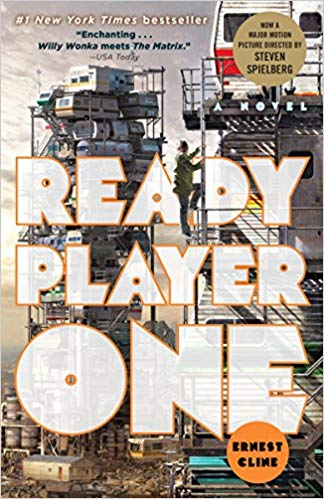
Ready Player One by Ernest Cline


Source of book: I own this.

This was this month’s selection for our “Literary Lush” book club. One of the things I enjoy about this club is that I end up reading interesting books that I never would have discovered on my own. This book is definitely in that category as I would never have picked it up on my own. 


It would be fair to say that I was pleasantly surprised by the book. I didn’t have that high of expectations since I am not really a pop culture maven, and I’m not really in to genre fiction. First, the bad stuff: there are a number of places where the writing is awkward. The characters aren’t particularly well developed, although that is rather par for the course with most genre fiction, particularly ones centered on action. The interpersonal interactions were particularly wince worthy. Cline doesn’t seem comfortable writing offline dialogue.

On the other hand, the book flows well, and makes for a compelling read. Although I will admit I didn’t get all the references (my family didn’t watch movies hardly at all during the 1980s), I was enough of a computer nerd to appreciate a good number. To a degree, it was a nice nostalgia trip back to the days of huddling over a computer - either our Commodore 64 or our cousin’s Apple - with my brother and cousins playing text-based games or dungeon style stuff like Gauntlet.

The universe in Ready Player One is well thought out. It is a dystopian future (like roughly half of new books these days it seems…), and a rather plausible one. A combination of environmental and economic factors have mostly destroyed society. Fossil fuels have run out, so vehicles are useless for the most part. Most people are deeply impoverished, and jobs are hard to come by. Children, at least, get food credits, so they don’t starve. The protagonist, Wade, lives with his aunt in “the stacks” - large towers of mobile homes and RVs which were created to make easy density within walking distance of public transit. But where Wade - and indeed most people - really live is in virtual reality. A system called OASIS is essentially the world of virtual reality, and contains millions of “planets” with different things to do on them. (To even begin to describe a few of them would take a chapter.) Even schooling for many is done in this reality. As our club - which contains a number of teachers - discussed, a lot of the features in this virtual school sound pretty cool, actually. Certainly, the fact that the student avatars can’t disrupt class or surf on their phones is a nice change from reality.

The creator of OASIS dies, and leaves his vast fortune to whoever can first successfully complete an elaborate quest he has left behind. Because the prospect of becoming the richest person in history has a lot of appeal, millions join the quest. They are hunting for what is essentially, the greatest “Easter Egg” ever. They are dubbed “egg hunters” - or “gunters” for short.

Because the creator was really into the 1980s, the gunters become serious students of 80s pop culture, hoping to find the clues necessary to lead them to the prize. In a very real sense, the creator becomes god, and his followers immerse themselves fanatically in the scriptures - the creator’s journal and those things known to be the creator’s favorite games, movies, songs, and so on.

For five years, nobody makes any progress. Then, Wade is able to solve the first riddle, and the game is on. Four other gunters are successful in clearing the first “gate,” and become the main competition to the IOI Corporation, a sinister global entity intent on taking over and monetizing OASIS. Two of these are particularly central to the story: Wade’s best - perhaps only - online friend, Aech (that’s the screen name - we don’t find out the real name until near the end), and Art3mis, a blogger who Wade has a huge crush for.

The bulk of the book is a fast paced narrative of the quest from Wade’s point of view. It is pretty easy to become immersed in the virtual world that Cline creates - I read through the book pretty quickly.

In addition to the fun of the plot itself, I thought the social commentary was well done. The book wasn’t particularly preachy, but it did gently bring to light some of the troubling trends of our own times, which in the book become even more pathological. One, of course, is growing economic inequality. When you combine this with the lure of affordable virtual reality, it is no wonder most people want to escape their crappy lives and live in a world where things are better and more equal - and meritocratic within the rules of the game. It is, at least, less destructive than drugs and booze. But, as it does for Wade, it becomes his entire life. After his early success, product endorsement money enables him to create his own fortress where he need have no actual interaction with other humans. His eventual liberation therefore requires that he set foot outside of virtual reality and experience real life.

The part about the nefarious corporation seeking to monetize everything was all too realistic. (Hello Facebook and Google...lately particularly?) Also too close for comfort was the idea of slavery as a result of debt. We are not that far removed from the days of debtors’ prison. Or from the days when half the population teetered on the brink of starvation, and lived literally decades shorter lives than the wealthy. It is the natural result of treating human beings as expendable cogs in the machine - and valuing them according to the money they bring.

Ready Player One isn’t a perfect book, but it exceeded expectations. I’m glad I was given a reason to read it.