Showing posts with label Florida. Show all posts

Thursday, March 21, 2019

Florida by Lauren Groff


Source of book: Borrowed from the library

Believe it or not, I DID check out this book before the “Florida Man Challenge” swept the interwebs. Actually, I have had this on my list since NPR did an interview with the author last year.


I have always loved short stories, and try to read a few collections each year as a contrast to the longer novels I read. For some reason, lately, I have ended up reading quite a few written by southern authors. It seems as if the last century or so has been particularly rich in authors from that region, perhaps because the rural South still seems foreign to many of us.

Florida is very much in the “gothic southern” tradition, with an underlying pedal tone of menace. I think that is the best way to describe it. There is a bit of a similarity with Flannery O’Connor (who I enjoy, even though I am not always certain why), but Groff doesn’t take things to that extreme. In fact, thinking back, most of the stories have a more or less non-terrible ending. I won’t say “happy” exactly. But people don’t necessarily end up dead, dismembered, or devastated either. Although I think there is the portent of divorce in a couple. I guess you could say that things end reasonably well given the circumstances, people are traumatized, but they mostly survive.

The menace comes from multiple directions. On the one hand, everything in Florida wants to kill you. The snakes and alligators. The mosquitos. The hurricanes. The heat. But even more dangerous than nature is humanity. People range from blithely uncaring to outright hostile and abusive. Perhaps the worst, however, is the monster within. Many of the characters battle their demons, and it isn’t clear who will win. Often, the story ends, but it is clear that the battle awaits another day.

Groff often tells the story from the point of view of a woman who is not quite her, but a lot like her - so the viewpoint is generally that of a middle class white woman. But Groff also intentionally expands outward from there. As one of her characters puts it, she refuses to “barricade myself with my whiteness in a gated community.” But she is aware of the privilege that comes with a choice.

One fantastic line comes in that story:

“Isn’t it...dicey? people our parents’ age would say, grimacing, when we told them where we lived, and it took all my willpower not to say, Do you mean black, or just poor? Because it was both.”

Some of the stories are about pretty normal situations, with relationships and tensions and discovery. But others are pretty crazy. There is the man who collects reptiles and eventually dies after a bite in the field. (He isn’t the main character - but his life sets the stage for the rest of the story.) There is a particularly harrowing tale of two small sisters abandoned by their mother and her boyfriend right before a hurricane hits their island. They are resourceful, and manage to survive for weeks before they are discovered. This is one where things end well, but just barely. It is also one of a few hurricane stories. There is another where a woman falls and gives herself a nasty concussion - and she has to hold it together enough to care for her small boys until her husband returns in a few days. Another is a story of a grad student whose life spirals into homelessness when her boyfriend leaves her, and she cannot afford a place to live.

There are also a couple of interesting longer stories about Floridians on vacation in France. The theme seems to be one of leaving Florida, but still having too much Florida in you. (I can sympathize - I am a Californian through and through, even - especially - when I travel.) You can travel the world, but you can’t really leave yourself behind...

Groff’s writing is excellent - this is definitely literary fiction, not genre fiction. I admired a number of turns of phrase as I read through the book, and the psychology was intriguing. The story about the concussion was particularly impressive in the way the narrator’s story blended between her rational brain and the addled and concussed brain in unexpected yet entirely believable ways. It is vivid, carefully crafted storytelling, and compelling.

***

Hey, this is a good excuse to link one of my favorite Clint Black tunes - it has been my anthem (or better yet, an anti-anthem) for the past couple decades.


Tuesday, July 18, 2017

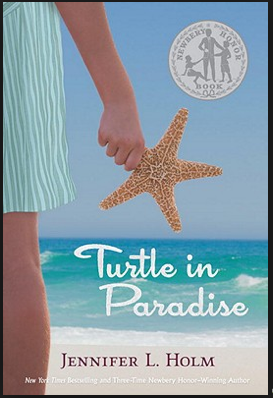
Turtle in Paradise by Jennifer Holm

Source of book: Audiobook from the library

This book is one in our series of not-particularly-systematic quest to read a lot of Newbery Award winners and honorable mentions. This book falls into the second category, named as an honor book for 2011. 


Author Jennifer Holm based the book loosely on the stories her great- grandmother told her of growing up on Key West during the Great Depression. Some of the characters are based on various relatives, and some of the incidents come from the stories. Not all, though, as the book has more of a narrative arc and drama than the originals. The buried treasure incident, for example, came from tales told by the Key West denizens (the “Conchs.”)

The basic gist is this: “Turtle” (we never learn her real name - or that of most of the other characters) is an eleven-year-old girl who is sent by her mother to live with her aunt and uncle in Key West. As we learn, this is just one twist in the hard life that Turtle’s mother has had. She got pregnant by a boy in Key West, was disowned by her rather vicious mother, and left, never to return. About all she can get for work is that of live-in housekeeper for rich people - and her latest employer will not permit children, so off Turtle goes. (This was pretty common in that day, actually. And it remains common in low income and immigrant communities. The idea that communities care for each other is one of the things that has been largely lost in middle class white suburbia…)

Turtle’s arrival comes as a shock to her Aunt Minnie - who didn’t receive the letter, because the local postal service misdirected it. But, she finds room for Turtle. Along with her aunt and uncle (who is mostly away working on the highway - one of the WPA projects), there are a bunch of boy cousins, and other local urchins. Turtle has to find a way to fit in, and find her place in Key West.

The book is full of local flavor - Holm draws on a universe of friends and family for help in getting the details of the past right. I was drooling at different points when the food was described. Particularly the tropical fruit. Other things were less attractive. Holm is up front that the Depression caused the economy of the Keys to collapse - and most residents were on aid in the 1930s. Rum running was a significant source of income, and everyone looked the other way. Financial hardship affected nearly everyone, and bootstraps weren’t enough.

Holm also writes complex characters. Turtle has to learn to be vulnerable - her hard life has led her to be cynical - and admittedly even within the story, she is given ample cause. Her cousins respond to her like you would expect real kids to. Nobody likes being displaced, and “Beans” is no exception. Aunt Minnie is stressed out already, so she alternates between compassion and irritation, like most of us would in a similar circumstance. There are few if any true villains, and no angels either. Just humans.

One of the more striking elements of the book is the group of boys that Beans heads. They are known as the “Diaper Gang.” Because they have made a business of assisting harried parents with their babies. They show up, swaddle the babies, and drag them around town in a wagon until they sleep. Or at least for a while so that the parents can have a break. The boys are actually quite good at it, and (amusingly) are unwilling to let a girl join them, because, well, girls aren’t as good at that sort of thing. (Holm apparently isn’t giving a modern gloss to this - the idea came from one of her great-grandmother’s tales. It is a reminder that the division of men’s and women’s work hasn’t always fallen along the same lines everywhere or at every time.) There isn’t money in this business, though - nobody has that to spare. However, the boys are given candy for their trouble.

The book is recommended for ages 8 to 12, which is probably about right. In my case, my 6 year old enjoyed it. And my older girls did too, in large part because of the humor, which takes the edge off what would otherwise be a tale of hardship and betrayal as much as it is of love and family. I also think this book succeeds at two of the main goals of fiction: it transports the reader to an unfamiliar time and place, and it encourages empathy for those in other circumstances.

The audiobook was narrated by Becca Battoe, who apparently was on Scrubs at one point. She is a pleasant enough reader - I have no complaints about her part of the recording. I was a bit irritated by the gaps between certain paragraphs. This is obviously a sound engineering issue, as I’m sure the book wasn’t read in a single take. A minor fault, but one amplified by the nature of listening to a CD in a vehicle: you can’t tell if there is a natural gap or if the CD has skipped. On the other hand, the relative volume levels were well balanced.