Showing posts with label hypocrisy. Show all posts

Wednesday, November 6, 2019

Strange Fruit by Lillian Smith


Source of book: I own this.

This was my selection for Banned Books Week. It took longer than a week, but I did start it during Banned Books Week. 

Just as a reminder, I use the week to read books which have been banned, which means that a government has outlawed sale, publication, or possession of the book. I do not count challenged books - those which citizens or parents have sought to keep out of school curricula or libraries. This isn’t because I think challenges are uninteresting, but because I wanted to focus my once-a-year project on those where the power of the state was employed in censorship. I believe that is a different level from a challenge. After all, any library has limited space and budget, and decisions must be made. (Personally, I would have preferred an extra - and local - copy of The Rest is Noise rather than one of the 20ish copies of Eat, Pray, Love.) Likewise, students can only study so many books, and the choice of which to study is a judgment call.

Here are my past selections, plus the introduction to Banned Books Week.

Catch-22 by Joseph Heller

***

“BANNED IN BOSTON!” is now a bit of a badge of honor, and it has a long history. Strange Fruit may not have been the first work that the overzealous Boston city officials (influenced by Anthony Comstock and his eponymous law), but it was the first number one bestseller to be banned in Boston. 

Strange Fruit was ostensibly banned due to references to sex - which are both crucial to the meaning of the book and handled in a tame manner by today’s standards - but everyone knew the real reason it was banned: the book is about a forbidden sexual and romantic relationship between a white man and black woman. In the Jim Crow South, this was literally illegal at the time the book was written - and was considered immoral and scandalous even in the North. 

It took me a while to get into the book, mostly because the first 50 or so pages jump around in time a lot. We know very early in the book what has happened: Tracy Deen has gotten Nonnie Anderson pregnant, and she is happy about it. Smith then fills in the backstory of both families. Nonnie Anderson is an elegant and educated young African American woman. Her family is well respected (after a certain fashion), and Nonnie turns everyone’s head. Her sister, the stolid and responsible Bess, can’t understand why Nonnie still works as a maid, rather than go north with their brother Ed, who has gotten a white-collar job. Nonnie claims to just not be ambitious, but the real reason is that she loves Tracy Deen.

Tracy is the feckless son of the local white doctor (the black doctor, Sam, figures prominently in the book as well - he is the best and most complex character in the book, in my opinion.) As we learn, when Nonnie was age 6, she was saved from a sexual assault by a group of white boys by Tracy. This is a moving incident, because the boys assume that Tracy “owns” Nonnie, and that is why they leave her alone. The idea that raping a black child was wrong never occurs to them. 

In fact, as the story unfolds, it becomes clear that many - maybe most - of the white men in town have had sex with black girls and women. Some of them openly keep a black woman as a concubine. (“That’s the bible word for it,” Tracy says.) 

Tracy is, despite his inability to figure out what he wants to do with his life (other than that he hates his dominant and controlling mother), isn’t a bad guy. He and Nonnie do eventually become sexual, coming together occasionally in their teens and then after she returns from college, and he from World War One. It is in their 20s that she gets pregnant - to his surprise - he figured that a college educated woman would somehow just know how not to get pregnant. (He’s not the sharpest tool, but, to be fair, men didn’t really learn about female bodies at that time. Information on contraception was still illegal to distribute in Georgia.) 

This pregnancy, naturally, causes no end of trouble. 

In a perfect world, Tracy and Nonnie would marry, and probably have a happy life together. Tracy actually considers taking her to France, where interracial marriage was accepted. But he has no nerve, no career other than his parents’ attempt to get him to take over the family store or the old farm. Nonnie doesn’t seem to know exactly what she wants. It is implied that she would accept being his concubine, but we never really know her thoughts on this. She is too smart to think he will marry her, and she never asks him to. 

Tracy is pressured by his family to finally “go straight,” which means joining the church, getting married, and settling down. The preacher (a complex character who combines some good traits with the wrong kind of pragmatism) tells Tracy that most men have had “nigger girls,” but that God wants him to repent of that and marry a virginal white girl. Tracy’s mom has the perfect one picked out. Tracy isn’t attracted to her, but he can’t tell his mother no. 

In an attempt to both “go straight” and settle things for Nonnie, he borrows a large sum of money from his mother (no questions asked), and tries to bribe Nonnie to marry the Deen family cook, Henry (who was Tracy’s childhood companion), and Henry to marry her. Henry doesn’t want to - he is in love with Dessie - but he can’t talk back to a white man in public. 

The meeting with Nonnie goes even worse: Tracy ends up hitting and raping her as a thoroughly unconstructive way of attempting to compartmentalize his relationship with her as “she’s only a nigger - they manage.” Meanwhile, Ed overheard the conversation with Henry, and when he sees that Nonnie is traumatized, he shoots and kills Tracy in the dark. 

With Sam’s help, Ed is rushed back to New York before the body is discovered in the woods. Henry is blamed for the death, and despite the efforts of Mr. Deen and the local factory boss (another complex and semi-decent character), is taken from jail and lynched. 

Billie Holiday claimed that Lillian Smith named the book after her song about lynching of the same name. Smith never confirmed this, and said that she meant “strange fruit” to mean the way humans, black and white, are twisted and damaged by America’s racist culture, rather than a literal reference to lynched bodies hanging in trees. It sure seems as if there was an intentional connection. 

There is lot to unpack from this book. The summary of the plot fails to capture all of the different facets of Southern Jim Crow culture - Smith grew up in the South, and portrays the culture with accuracy and detail. It is an unsparing portrait, painting the many ways in which the underlying belief in the superiority of white-skinned people warps and damages and destroys. 

Smith does not go easy on the role of religion. This part of the book was spookily familiar in the Trump era, where the Ku Klux Klan is again in open collaboration with white religion. It is no surprise that Smith deftly exposed the hypocrisy of Southern religion. As a young adult, she rejected religion, in part because of her experience with the double standards of the Southern church. In addition, Smith was outspoken in favor of civil rights for minorities - and also for women - both of which positions made her unwelcome in church. 

If that weren’t enough, Smith was lesbian in an era when it was even more taboo than racism. She lived with her partner, and the two of them published a magazine together. As their letters (discovered after their deaths) made clear, however, they were more than business partners. Lesbian themes make it into Smith’s books, including this one. Tracy’s younger sister (the one who seems made to succeed - and who is one of the very few truly progressive characters in the book) has a naked female figure in her drawer, and a relationship with another woman in town is hinted at, although not expressly stated. 

Another controversial theme in the book is abortion. Tracy and Bess and others wish Nonnie would just make the issue go away by quietly aborting the pregnancy. The local black herbal healer can get her some herbs, or she can go to the city and see a doctor there. But it isn’t just Nonnie. A 14 year old white girl gets pregnant from a young white boy, and her father goes to Dr. Deen to beg that he perform an abortion. There is an extended internal monologue where Dr. Deen wrestles with his conscience. What is most devastating about this is that he is clear that he would do the abortion without question if she had been raped or if the father was black. But, because it was consensual and the father is white, he can’t bring himself to do it, although part of him wishes he could. He ends up referring them to a city doctor. 

I noted above some of the more complex and conflicted characters. One of them is the newspaper publisher, Prentiss Reid, who has to keep his progressive ideas to himself or go out of business. It is an uncomfortable compromise - one made necessary by the culture of racism. He is also one of the few openly non-religious characters. He delivers this zinger to the daughter of the mill boss (who is more genuinely progressive):

“You’ve got it wrong, haven’t you? What they want you to do, my dear, is sponsor religion, not practice it. Don’t let your conscience mix you up. If you practiced the teachings of that man Jesus here in Maxwell, we’d think you were crazy - or communist. Don’t make any mistake about it--be damned embarrassing.” 

Not much has changed, alas. Try to actually practice the teachings of Christ these days, and you will, like me, be asked to leave the church. Know what else hasn’t changed? Religious views of gender and race. As Preacher Dunwoodie tells Tracy:

“On this earth, there’s two worlds, man’s and woman’s. Now, the woman’s has to do with the home and children and love. God’s love and man’s. The man’s world is--different. It has to do with work. Women teach us to love the Lord, and our children, and the we build the churches, don’t we, and we keep them going….Now, when a man gets over into a woman’s world, he gets into bad trouble. He don’t belong there...Too much love makes you soft.” 

He goes on to explain that being a good Christian means very different things for men and women. And yep, I feel like I have heard this sermon more than once. 

Tracy is susceptible to this sort of thing, of course, and finds himself trying to justify abandoning Nonnie. 

It’s like an obsession. Seems true to you, but everybody says it isn’t. You can’t love and respect a colored girl. No, you can’t. But you do. If you do--then there must be something bad wrong with you. It’s like playing with your body when you were a kid. You had to touch yourself. It felt good. It was good. But everyone told you it wasn’t good. Said it would drive you crazy or kill you. Decent people didn’t do it. Well...you did. You did it and liked it. And felt like hell afterward. You’d outgrown that. Now the preacher said time to outgrow this other. Past time. 

It’s this sort of gaslighting that characterizes so much of religious teaching about sex, of course. But in the American version, the sexual puritanism and the racism are one and the same. They are inseparable. Tracy never does get over Nonnie, as much as he tries. 

You’d think God wanted to play a fine joke and had made Nonnie. Here, He said, is a woman any man would love and be proud of. She has everything you could desire. But you can’t have her. No. You can have sips and tastes, but you can’t have her. And you’ll be ashamed and sneak around and feel nasty...That’s the price you have to pay--for the sips. 
Well...white men had paid it before. And thought it cheap. Guess he could too. 

This casual disrespect for the humanity of non-whites permeates the culture in the book. Even the “good guys” accept white supremacy at some level - nobody can escape it. Ms. Sadie, who is horrified by the way white men treat blacks, still thinks that “the entire Negro race was a mammoth trick which nature had played on the white race.” 

There is another great line about Mrs. Stephenson, who is quietly a loving and gracious person - but one who was strangely detached. 

You had a queer feeling about it--as if Mrs. Stephenson had died some time when nobody was noticing and now nothing was left of her but good deeds blooming like little flowers on her grave.

I want to return a bit to the role of religion as shown in this book. Preacher Dunwoodie shares something with modern preachers: he wants to save the “respectable” sorts. Meaning the wealthy, who will keep the church in business. All the Tracy Deen’s of the world are nice and all, and it is a good thing to save the mill hands, but what he really wants - and how he knows God is blessing his ministry - is for the “prominent citizens” to return to the church. And my goodness is this still true. I firmly believe one of the reasons my former pastor couldn’t do the right thing - even a little thing like keeping hate groups out of the church - is that certain prominent (and tithing) members were the driving force behind it. Address the white supremacist beliefs, and he would have lost some of his financial base. It’s that simple. 

But white supremacy goes deeper than money in religion, then and now. There is a chilling scene when the lynching party sets out. Smith makes it clear that the point isn’t justice - it is putting the “nigger in his place.” And lynching, just like our current cruelties toward brown-skinned people, is driven by a weird religious feeling. Smith describes it thus:

And sometimes there was laughter, or drawled words of voices not unkind in sound and not without humor; but eyes were hard and hating as they hunted a black victim to sacrifice to an unknown god of whom they were sore afraid. 

There is so much fear in white religion in America. A desperate fear of outsiders, of people who are different, whether racial minorities, immigrants, LGBTQ people, atheists, and especially people who don’t vote for Trump. Lillian Smith is on to something here - they seem eager to sacrifice other humans to an unknown god who they cannot name, but who terrifies them. Every time you see a brutal and cruel separation of immigrant families, children in cages, another African American murdered by the cops, or another gay or transgender person denied housing or a job - well, you are seeing a human sacrifice to a terrifying god that Evangelicals cannot name, even to themselves. 

Near the end, even as he realizes he can’t really publish an anti-lynching article, Reid thinks to himself of the core problem. 

That’s the South’s trouble. Ignorant, Doesn’t know anything. Doesn’t even know what’s happening outside in the world! Shut itself up with its trouble and its ignorance until the two together have gnawed the sense out of it. Believes world was created in six days. Believes white man was created by God to rule the world. As soon believe a nigger was as good as a white man as to believe in evolution. All tied up together. Ignorance. Scared of everything about science, except its gadgets. Afraid not to believe in hell, even. Afraid to be free. 

You can perhaps put “Evangelicalism” in for “South,” and “White Republican Americans” for “white man.” It’s the same thing today. Walled up in its own bubble of fear and ignorance and hate. It has been nearly three years since I left that cesspit, and as time goes by, I am ever more thankful I got out. 

This wasn’t an easy book to read. There is so much darkness in the human heart, and so much destruction caused by racism and hate. And religion, then and now, seems all too eager to feed the hate. This book is well worth reading, though, and shines an uncomfortable light on the dark realities of our culture. 

***

My wife found this book for me used. This hardback was the 13th printing (copyright 1944) Inside are a few notes by the previous owner, Kae Bell, and an inscription from the person who gave the book to her, apparently in 1944.

 Click to expand. The inscription appears to read "To Kae "44 from Bobby and Jan."

"Good comparison of life of a white & negro - so different? Afraid not. Damn these prejudices."
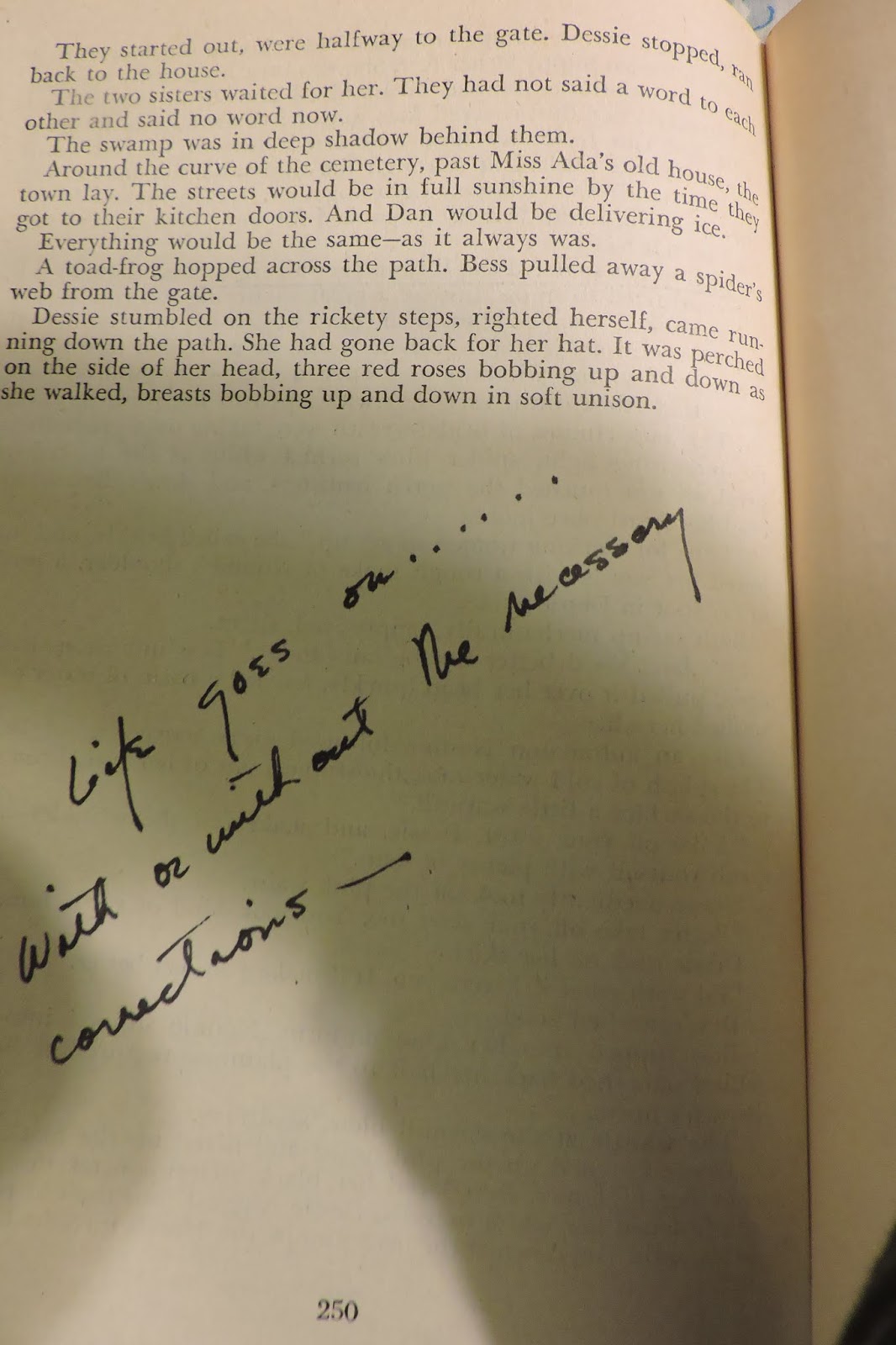
"Life goes on....... with or without the necessary corrections --"

***

Take it away, Billie Holiday:

Southern trees bear a strange fruit
Blood on the leaves and blood at the root
Black bodies swinging in the southern breeze
Strange fruit hanging from the poplar trees

Pastoral scene of the gallant South
The bulging eyes and the twisted mouth
Scent of magnolia, sweet and fresh
Then the sudden smell of burning flesh

Here is a fruit for the crows to pluck
For the rain to gather, for the wind to suck
For the sun to rot, for the tree to drop
Here is a strange and bitter crop

Monday, August 27, 2018

The Purity Myth by Jessica Valenti


Source of book: Borrowed from the library

Just some thoughts on this. I started this book a few years ago when my wife read it, but it was requested by another library patron, and thus had to go back before I could finish. A couple of online friends (cool people I met through my blog) expressed interest in reading and discussing it. 


Just at the outset, let me say a bit about the style and content, before getting into specifics. Jessica Valenti co-founded the Feministing website, and wrote for it for a number of years. The site is essentially a blog, and as the writer of one myself, I understand the significant differences in writing style that go along with it. These stylistic differences are apparent in the book, which more resembles a blog than a typical non-fiction book. This is not to say that it lacks citations: it is well researched as to the sources for quotations. But it isn’t intended to be a scholarly look at the subject so much as a cultural look. I think, therefore, that many who disagree with Valenti’s opinions will also be put off by the style. Valenti uses a breezy blog style, not formal English, so expect contractions, paragraphs not modeled on the MLA format, and overuse of parentheses. (Hey, a bit like my blog too!) So you may not find it to be what you expect. On the other hand, if you go in with different expectations, there is a lot of thought provoking stuff in the book.

Valenti’s premise is that in our culture here in America, women are assigned value based on their virginity and adherence to patriarchal gender roles. This allows women to be divided in the the “Madonna” sorts - the good girls - and the “sluts” - the bad girls. Step outside of expectations, and you are placed in the “slut” category.

Longtime readers of this blog will be familiar with my exploration of that theme in my Modesty Culture series. Since I wrote it, I have had a number of interesting conversations about it, and realized that Modesty Culture is just one facet of Purity Culture, which is about sex - and a lot more than just sex. The Purity Myth really explains a lot about how it fits together.

My wife and I have personally had plenty of unpleasant experiences with both Modesty and Purity Cultures, starting with my wife’s thoroughly unpleasant time in Jonathan Lindvall’s cultic home group. It has been obvious from the beginning that there were three interconnected - indeed inseparable - facets to this issue. Namely, the division of women based on their sexuality and adherence to gender roles, an obsession with controlling females, and a rigid view of gender roles and gender hierarchy. They are all connected, and you really don’t find one without the others. Thus, you find an obsession with female virginity, a need to control how women dress, and the belief that women shouldn’t work outside the home. All of these stem back to viewing women as sub-human, perpetual children who cannot be trusted to make their own decisions, and this in need of male control.

This is the uncomfortable truth about religious teachings on sexuality. You cannot separate beliefs about sex from beliefs about gender - because the teachings on sexuality are based on the views about gender. To give but one example, I was shocked when, in my law school days, I re-read the Old Testament in light of what I had learned about the history of the English Common Law, and realized that the OT says precious little to restrict what MEN do. As long as they didn’t mess with another man’s property, or have sex with an equal, I mean other male, most other behavior is acceptable or at least tolerated with little comment: prostitutes, plural wives, concubines, rape, sexual enslavement, you name it. In contrast, just like the culture in which it was written, female sexuality was brutally punished. (Honestly, the NT is only marginally better. It too draws heavily from misogynist cultural beliefs in many ways, even as it occasionally pushes back against them. In both cases, a lot of what I was taught about what the bible says turned out to not actually be in there…) This is why the religious discussion about sex - see more below - makes little sense in our time. Once you remove the sexual double standard - and the open misogyny - from the discussion, you are missing the key point: the rules derive from the misogyny.

On to some specifics. These are roughly in the order in which they appear in the book, and are taken largely from our discussion.

One thing that struck me when I first started this book years ago, and I thoroughly agree with now, is that in our culture (particularly religious culture), morality for women is defined in terms of sexuality. That is, a woman is considered to be “moral” if she is a virgin on her wedding night. Otherwise, she is considered immoral. As Valenti puts it:

I was the...burgeoning feminist who knew that something was wrong with a world that could peg me as a bad person for sleeping with a high school boyfriend while ignoring my good heart, sense of humor, and intelligence. Didn’t the intricacies of my character count for anything? The answer, unfortunately, was no, they didn’t.
When young women are taught about morality, there’s not often talk of compassion, kindness, courage, or integrity. There is, however, a lot of talk about hymens: if we have them, when we’ll lose them, and under what circumstances we’ll be rid of them.
While boys are taught that the things that make them men - good men - are universally accepted ethical ideal, women are led to believe that our moral compass lies somewhere between our legs.

This is otherwise known as the double standard. Men are judged on more universal character traits (unless they are Republican politicians, apparently…), while women are judged on their sexual status. This is far too true. I have seen it at work in two different arenas.

The first is my professional experience. I can tell you that there is nobody as self-righteous and full of entitlement as a woman who was a virgin on her wedding night, who has faithfully adhered to gender roles ever since. Nobody. These are the women who feel that their chastity and submissiveness has entitled them to a certain level of financial support from a man, and who are furious when that man lets them down. (Even if he lost his job through no fault of his own…) They did their part, why can’t he do his? These are, undoubtedly, the second ugliest divorces I have done. (The worst was the pastor who was raping and abusing his wife. Horrible case, in which a divorce was a happy ending in every possible way for her.) The problem here, naturally, is that the woman judges her own morality by virginity and meeting gender expectations. She is the counterpart to the man who judges his morality by his wealth and income - aka meeting male gender expectations.

The second is more personal. Within my extended family, there are a few women who base their morality on these things. Their virginal status in the past, their adherence to gender roles (stay at home mom, particularly), and their conservative clothing choices. This, while behaving abominably to others, in some cases including their own children. The problem isn’t just them, but the fact that others give them a pass on abusive behavior because, well, they must be good because of how they do sex and gender roles. As long as they dressed modestly, didn't work outside the home, manipulated rather than said what they meant, they could get away with mean, abusive behavior and still be considered "good girls."

Particularly good in this section of the book is the acknowledgement that raunch culture and purity culture are actually the same thing, just with slightly different manifestations. I myself noted in the aftermath of our cult experiences that it turns out that many of the men involved were outright creeps. Obsession with female sexuality and a need to control can be expressed as sexual repression of others - or in rapey porn fantasies. Often both.

One amusing bit in that chapter involves how one counts sexual partners. After all, what “counts”? Is one still a virgin after _____ [insert act here] is apparently a question often asked. The author mentions a female friend, who didn't count it as sex unless she had an orgasm. Valenti notes that this way of counting isn’t likely to be popular with certain men - they won’t end up counting for many of their partners.

I also found Valenti to be spot on about the role of race in purity culture. Here in the US, sex is all about race. Protecting white girls from brown men has been a justification for everything from Jim Crow to lynchings. But of course, it was actually the white slave owners raping the brown women. Thus, the myth that non-whites (particularly African Americans) are hypersexual and out of control. So race plays a definite role in purity culture - which idealizes young white women.

I cannot say how much I love the acknowledgement that the "ideal woman" of the Purity Movement is a little girl. Not an actual woman, but an undeveloped, subhuman. Someone who is passive and unassertive and, well, little girly. Valenti mentions a lot about American culture, but, as a father with daughters who love Anime, it isn't just an American problem. The juvenilization of femininity is pretty disturbing. I myself preferred a grown up woman (even if she was barely 21 when I married her...) I have read and continue to read a lot of Victorian literature. The idea of the "innocent" girlish female is all to common. I think my experience in reading has made it easier to detect where Victorian sexism is endemic to modern discussions of "purity." In my Modesty Culture series, I pointed out that sexualization of children and young women was central to both our culture and Modesty Culture, and it is nice to see someone else noticed too.

I agree with Valenti that the cure for both the oversexualization of girls and the obsession with female virginity  is the training of girls to find their identity in non-sexual things: intelligence, compassion, making the world a better place. Things males are expected to do.

The chapter on Purity Balls and the like, while something I was already familiar with from my experience, was creepy to read about again. You want to take a shower afterward. And, the whole idea of my daughters making a promise to ME about their sexuality is so beyond creepy I don't even want to think about it. Yuck, yuck, yuck!

The chapter on porn is interesting. This isn't my area of expertise, although I have professionally run across plenty of men with unrealistic ideas of women. I am not qualified to speak about whether this is due to internet porn, or if it is a longstanding problem not particularly connected to that. What I can say is that Valenti nails how Fundies talk about porn. They seem to either go for some ludicrous non-mainstream thing, or go ape-shit over...really mild stuff. This whole conflation of anything realistically sexual with porn is (in my view) self defeating. I recall from my own childhood people freaking out over classical art...nudes, yo. This ruins credibility over legitimate issues, such as misogyny that Valenti says is rampant in most mainstream porn.
I too hate the false dichotomy of either phallocentric smut or denying female sexuality.

I concur that Fundies really get their panties in a wad whenever female-controlled pleasure comes into view. Some Fundies do not appear to believe that "normal" females masturbate - which is denialism for sure. I think there is a general suspicion of the idea that women are actually sexual (at least good women - and white women too...right?) I see this too in the opposition to female-controlled birth control.

If I were to mention one significant paradigm change I experienced after I started dating my wife, it was that the Fundie teaching about female sexuality was bullshit on a stick, and that many (most?) women were highly sexual, and the canard of "women trade sex for love" was a male fantasy, not representative or reality.

Moving on to the next topic, I ran across something that was VERY typical of the Fundie teachings I know: the idea that girls won't want sex if they are getting affection from their fathers. I have heard this so many times, and it just feels so gross. I have three daughters (two of whom are decidedly post-puberty), and whatever else they need from me - and I have a good relationship with them! - they are most certainly NOT looking for a quasi-sexual something or another. A substitute for sex? Holy shit that is creepy as hell! And yet, I grew up in this mindset!

In the chapter on “Abstinence Education,” I was reminded of some research I did a few years back. I ran across actual curriculum - used in public schools! - and it was retrograde in a way that would have embarrassed my own parents. Good lord. A bunch of Victorian gender essentialism (“most women want to get married, have children, and let their husbands work”???) and heavy pushing of 1950s gender roles.

At this point, I do want to say really good things about my parents, who gave me generally accurate sex ed, and were always available for questions. I disagree with some of what they said, but I was not lied to like many fellow Fundies. There were a few things that I found out later didn’t apply as universally to all women as much as they did to my mom. Which, fair enough, her experience and feelings. Also, I was never given the "men can't help themselves" thing AT ALL. I always felt responsibility was on me as much as on women.

The chapter on abortion and birth control was interesting. Full disclosure. I am not a fan of abortion. But. But I really soured on the “pro-life” movement when big names filed amicus briefs in the Hobby Lobby case (Gothardites!) essentially opposing ALL female-controlled birth control. At that point, it became clear to me that this had nothing to do with actually ending abortion, and everything to do with punishing women for failing to attain “purity.” Which meant quiverfull and staying at home rather than working.

While I find this chapter to be a bit much in some ways - as I said, I am uncomfortable with abortion - it has turned out to be less alarmist than I would have thought before the last few years. She was ahead of the curve on this one. It is pretty scary. Particularly the bits about that proposed law criminalizing women who don’t promptly report miscarriages to the police. Imagine how that would work.

The chapter on rape was really good. One of the side effects of working in family law - and that means domestic violence cases too - is seeing the really ugly side of marital rape. (I mentioned that above. One quibble I have with Valenti on this issue is her tendency to see an increase in sexual assault. The better explanation is that in the last half century, sexual assaults have been prosecuted, which has led to more being reported. I am unaware of any reputable researcher who believes sexual assaults are on the rise. Rather, the consensus is that most were never reported - for the reasons Valenti outlines. Particularly non-white victims of white rapists. Just as one example, when my mom was an LVN before I was born, nurses tried to keep one hand free to swat away the groping from doctors. My wife would never put up with that - because she has other options my mom didn’t. On a related note, #metoo doesn’t reflect an increase in assaults. It reflects a change in culture, where nobody should have to fuck Harvey Weinstein to get a job.

Very interesting in this context for me personally is my law school experience. We had to study rape in our first year as part of Criminal Law. And got to read all the old cases arguing about how pure a woman had to be before it was “real” rape, and just how much “penetration” was necessary to be rape rather than assault. Sigh. It was pretty bad.

One more thing in this context. I have copied the thread of a conversation on a (now private) Facebook page devoted to Theonomic Reconstructionism that is both fascinating and horrifying. The discussion was on the OT laws regarding rape, and a few of the die hards (one of whom appeared to be a woman) were arguing that it wasn’t rape if you forced sex on a widow or divorcee. After all, the crime was not one of violence, but a property violation. Rape destroyed her economic value, and once that was gone, well, no crime… I’ll probably use it as a blog post someday.

The chapter on toxic masculinity was also good. The definition of masculinity as "not female" is seriously pernicious and widespread. It permeates the culture.

One of the most laughable things in this book is the seemingly ubiquitous quote from the various "purity" pushers: "Who will want me now that I've had sex?" Since the WWII generation, north of 80% - including females - have had sex before marriage. And I believe that it was pretty common during the 1920s too. (Or if you want to look back further to the Puritan era, a LOT of pregnant brides...) Seriously, last I checked, non-virgins have been getting married right and left for...well...since we ended arranged marriages. (And that's women. I strongly suspect male virgins have been as rare as unicorns since the dawn of the concept of marriage.) One has to wonder if the purity people get out much these days. For those under, say, age 80, most guys DON'T CARE. (And, in my professional experience, the ones who do tend to be controlling creeps.)

[Interesting case in point here: Josh Harris. As in, the author of I Kissed Dating Goodbye. As in, the demigod of the “courtship” movement. His wife had a sexual history. (I wouldn’t mention it if he hadn’t already gone public - in a freaking book - with the information.) And you know what? I bet that is the least important thing about her. To Josh’s credit, of all the Patriarchist figures, he is the only one I know who has actually admitted he was wrong, and is working to apologise to those he hurt.]

I laugh when I hear "Your virginity is the greatest gift you can give your husband." Really? Because if that is the best you have, I want a refund! But of course, my wife's virginity wasn't anywhere near the best of what she gave me. And gives me, every day. The whole idea only makes sense if you think of women as property. Buy new, not used.

Pretty hilarious too that there is all this moral panic. Millennials have first intercourse several years later, and will have fewer average partners than the Baby Boomers. And less teen pregnancy. Fewer STIs. So....this really is more about women not "knowing their place," isn't it? Things weren’t “better” in the good old days - but women sure are stepping outside their gender-role cages these days.

I really love the idea of female sexual self determination. And the idea that female pleasure matters. So many are terrified about a world where women have the same sexual self determination as men. Ha. I have lived that world for 17 years, and it is actually fantastic. At least with the right partner.

Lots more to say. This is one of the biggest flash points of our generation, as much of the world is transitioning to a view of women as equal - and equally entitled to decide what they do with their genitals (something men have had since the dawn of human history…) To a large degree, our Culture Wars™ are very much about whether we preserve the toxic injustices toward women from the past - or not.

One final quote here comes at the end of the book. It kind of sums up the message. For those of us who are feminists, and believe that women should indeed have political, economic, and social equality with men, it really rings true. Valenti gives brief stories of several younger women who are doing amazing things in the world, and finishes with this.

These are the kinds of women who make up America - diverse, engaged, smart, interesting, moral agents of change. Take a look at the work these young women and others are doing. Now tell me it matters whether they’re virgins or not (it doesn’t), or that their contributions to society have anything to do with their sexuality (they don’t). So let’s use these examples of amazing young women to remind ourselves why we’re fighting to end the purity myth - a myth that denies our value as whole human beings - and move forward with their work in mind. And let’s spread this message about all young women across the country: that we’re more than the sum of our sexual parts, that our ability to be moral and good people has to do with our kindness, compassion, and social engagement - not our bodies - and that we won’t accept any less for any longer.

***

This is not an argument for promiscuity. And certainly not an argument for using sex selfishly. Rather, Valenti argues - and I agree - that whether one has had sex, and with how many people is far less relevant than how one acts sexually. Is our sexual expression loving? Or does it express dominance over others, violence, or dehumanization? (Hello, Doug Wilson…) But if your sexual teachings are based on misogyny, you end up saying stuff like a woman seeking consensual sex is the same as a male rapist. (Hello, John Piper…) If a woman has had consensual sex with a few partners before she marries, that sure seems to be a low level fault at worst. In contrast, “grab ‘em by the pussy” is a serious indication of bad character. Not to mention a crime. Some of us are having a really hard time taking seriously the pearl clutching of a religious tradition that obsesses about the former, while giving a total pass to the latter. Just saying. Or a tradition that seems just fine with voting the Ku Klux Klan into office, while waging jihad against LGBTQ people. Remember that when you clutch your pearls over why young people reject church teachings on sexuality…


Friday, June 30, 2017

Since When is the Exclusion of Immigrants a "Christian Dream"?

Recently, Jerry Falwell Jr., president of Liberty University and leader in the Religious Right, went on Fox News and proclaimed that The Toupee Who Shall Not Be Named is a “dream president for Evangelicals.”

Let that sink in for a minute. That a person who exemplifies the exact opposite of every Christian virtue - greed, arrogance, self-aggrandizement, bragging about sexual exploits, cheating people with less power in his business dealings, and on and on - is now a “dream president for Evangelicals” is astonishing to me.

I could just let that sit, and end this post. Because it says a lot.

But there is more. First of all, while there has been some condemnation of this statement from progressive Christians, there has been a deafening silence from Evangelicalism itself. I guess since Russell Moore, probably the lone voice of opposition to Trumpism within the Evangelical Industrial Complex, was effectively silenced, nobody is willing to speak up.

But wait, there’s more!

In identifying exactly why Trump is a “dream president,” Falwell went well beyond the usual suspects. Sure, he mentioned getting a Supreme Court justice, and fearmongered about ISIS. (And pretty much any GOP president would have given Evangelicals those things.) But he also said some other interesting things, most notably this:

That Trump is a dream president for Evangelicals because...wait for it...he’s going to build a border wall and crack down on cities who don't make the deportation of immigrants a law enforcement priority. That is what distinguishes him from the average Republican.


But this is just astounding to me.

Falwell just stated that excluding Latin American immigrants (most of whom are Christian) from the United States is a dream for Evangelicals.

As Wallis points out, this is only a dream for WHITE evangelicals. And the fact that it is is deeply troubling to me.

In fact, let me just be clear about this: the deafening silence of Evangelicals about obvious, open racism in this election is one of the reasons I have left Evangelicalism and will not be going back. I can no longer believe the Evangelical system is a morally appropriate place to raise my children.

I’m not saying that every Evangelical is racist (although many are in deep denial about their racist attitudes). Rather, there are plenty who openly say racist things and this doesn’t bother the others, as far as I can tell. In particular, immigration has been one area that attracted a lot of white Evangelicals I know to Trump. And not just in the usual coded language of “I’m fine with the legal ones…” but in the outright sense of “we have too many Mexicans already.” (It’s beyond the scope of this post, but a lot of people do not actually have any clue what our immigration laws actually say. If you are not educated, wealthy, or have immediate family here, there is NO legal path to enter the US from Latin America - or south Asia. Impoverished people seeking a better life - like my ancestors - have no legal way to come here.) Even those who claim to be open to immigration turn out not to be when you suggest we should relax our laws so that those who wish to come here seeking a better life can come legally. Then you hear “we have too many already.”

And then there is the argument that they are moochers off the welfare state - as if people who work long, hard hours at low paying jobs are sponging off others by expecting to be able to feed,  clothe, educate, and obtain health care for their children like the rest of us. I would really love to see those people making the moocher argument have to spend 60 hours a week doing field work - and then be told that their children shouldn't get medical care because they are lazy.  

The worst of all was the argument - which more than one person made - that Latinos are like the Amalekites and thus we are justified in building walls to keep them out. Of course, this assumes that (white) America is the new Israel (which is an actual White Identity belief…) and that Latinos are pagans intent on conquering us. But it also assumes that White American = Christian and Brown Latino = non-Christian in some way, which is ludicrous if you think about it. This also assumes that people seeking a better life for themselves and their children are somehow invading hoards. Unlike our own white ancestors, of course. It was fine that we came, but nobody else should get to, right? We got ours, too damn bad for you...

This is particularly bizarre in light of the fact that the immigrants that white Evangelicals seem so eager to exclude are overwhelmingly Christian. But apparently not the right kind of Christian.

It isn’t hard to see where this came from, though. As Mark Noll noted in The Scandal of the Evangelical Mind, it has been a long time since Evangelicalism actually had a coherent - and truly Christian way of looking at the world. Instead, it has focused on the pursuit of political power and exclusion of others. It is no surprise, therefore, that the vacuum of actual Christian values on the issue of immigration would be filled by another source of philosophy.

First, I should just note that neither Scripture nor historical Christian thought has supported the exclusion of immigrants on a racial or political basis. Christ himself said that our eternal destiny would rest in significant part on whether we accept and embrace immigrants and refugees. Ezekiel noted that Sodom was destroyed, not for its sex, but for its poor treatment of the poor and immigrants.

But it is pretty clear that there has been a tradition that considered White Supremacy and exclusion of immigrants to be a “Christian” value. That would be the Ku Klux Klan. The massive wave of immigration that brought my own ancestors to the United States in the 1880s resulted in a backlash from, um, earlier immigrants who didn’t like the newcomers. The 1920s KKK political platform differs from the Trump platform only in that Islam, not Catholicism, is the bogeyman. And now it is the Mexicans, not the Irish, that are feared.  

By the way, the KKK has always considered itself to be a defender of Christianity. But their religion has less to do with the teachings of Christ, and more to do with “Christian Identity,” which includes a belief in the superiority of the white race.

Joseph Mitchell, who lived through the 1920s in a place where the KKK was active, once described their platform as:

“The Ku Klux Klan stands on a platform of 100-per-cent Americanism, white supremacy in the South, deportation of aliens, purity of womanhood, and eradication of the chain store.”

The more you read about the KKK - particularly in that era when it attempted to go mainstream - the more familiar it looks.

So where did this come from? Well, a good theory is that because white Evangelicals identify strongly with the Republican party and with right wing politics, they have simply followed the changing trends within those groups.

Here is an example. As recently as the Ronald Reagan years, the GOP was pro immigration. And even in the recent past - say, 2007 - that was still the case within the mainstream of the party. People like my parents, raised overseas, and under no illusion that Christianity and America were the same thing, were pretty typical in the Evangelical circles were ran in. And I sure don’t remember hearing a whole lot of overtly racist stuff - except from my grandparents’ generation. Good god, they were and are bad. But it wasn’t a position that was considered particularly central to Christianity.

But something did definitely change in the last few years. Between Fox News, the Tea Party movement, the rise of Breitbart and the Alt Right, and so on, the focus and identity of the Right shifted dramatically. Even 10 years ago, I cannot imagine that any of the Evangelicals I knew would have been touting Milo Yiannopoulos. But here we are. Because Evangelicals were not used to actually thinking in a Christian way about immigration, the vacuum was filled by White Nationalism.

Another possibility is that this is primarily about politics. White Evangelicals overwhelmingly vote Republican, regardless of the candidate. (And that is why Bill Clinton was evil while Trump is good…) Non-whites tend to vote for, um, the other side. So it is crucial to keep non-Whites out of the country so that the “right” party can prevail.

Folks, that isn’t Christianity. That’s Republicanity. Political power of one party trumps (sorry) the needs and well being of impoverished Christians from other countries. I’m embarrassed.

The point here isn’t that all Evangelicals hold these values. I don’t believe that to be the case. And I know not everyone who voted for Trump did so because of his racism - many held their nose because they disliked Hillary more.

The point is that someone like Falwell can stand up and claim that an appeal to xenophobia - and Nativist policies - makes someone a dream president for Evangelicals - and Falwell knows he will not be challenged or suffer any consequences for doing so. (Quite a contrast from what would happen if he, for example, broke ranks on the nature of hell…) In fact, in light of the Russell Moore situation, Falwell knows that anyone who challenges him on the grounds that racism and xenophobia is incompatible with Christianity will be silenced.

And now, here we are. A significant Evangelical leader can say that exclusion of brown skinned immigrants is an “Evangelical Dream” - and he is, I am sadly coming to realize, probably correct.

***

Actually, the answer to my question is “at least since the founding of the Religious Right.” Falwell Sr., Bob Jones Sr., and Phyllis Schlafly were all pro-segregation and anti-immigration from the beginning, and as Paul Weyrich stated in his book on the founding of the RR, segregation in “Christian” education was THE reason why it was founded in the first place. Racism and xenophobia were part of the movement from the beginning. But at least in my experience, that part of the platform went underground for a few decades, until the rise of the Alt Right and Trump made White Supremacy socially acceptable again.

***

Falwell has been kissing Trump’s ass since the primary, by the way. And he will now be rewarded for his loyalty with a political position

***

I linked it above, but really, read Jim Wallis’ piece.

***

On an island in New York Harbor stands a beautiful statue, a symbol of freedom - and welcome to the poor and downtrodden. In the adjoining museum is a plaque - formerly housed in the base - bearing the words of poet Emma Lazarus:

Not like the brazen giant of Greek fame,
With conquering limbs astride from land to land;
Here at our sea-washed, sunset gates shall stand
A mighty woman with a torch, whose flame
Is the imprisoned lightning, and her name
MOTHER OF EXILES. From her beacon-hand
Glows world-wide welcome; her mild eyes command
The air-bridged harbor that twin cities frame.

"Keep, ancient lands, your storied pomp!" cries she
With silent lips. "Give me your tired, your poor,
Your huddled masses yearning to breathe free,
The wretched refuse of your teeming shore.
Send these, the homeless, tempest-tost to me,
I lift my lamp beside the golden door!"

Once upon a time, most conservatives I knew said they believed this. Once upon a time, those who claimed to follow Christ acknowledged that He is the god of the outcast, of the refugee, of the immigrant (as the children of Israel were in Egypt…), of the poor and powerless.