Showing posts with label rape. Show all posts

Tuesday, February 4, 2020

John Ortberg and the ongoing inability of Evangelicals to think ethically about sex


First, the story itself: 

Evangelical megachurch pastor John Ortberg has been placed on administrative leave after it came out that he allowed a man who confessed to having sexual attraction to children (aka a pedophile) to continue to work with children at the church unsupervised - including overnight events. Apparently, Ortberg also did not even bother to inform the elder board of either the decision or the man’s pedophilia. 

Um, that’s pretty bad. That’s intentionally putting children at risk of abuse. 

In my book, that should be an automatic and permanent disqualification for ministry. 

But it gets even more interesting because of how it went down, and who blew the whistle on this. 

Ortberg has a transgender son, Daniel Lavery (formerly Mallory Ortberg) and it is he who, after confronting his father, went to the elder board - which is when this all blew up. 

Apparently, Daniel decided to elevate the issue after his dad basically said “you’re a pervert too, so you have nothing useful to say on how I should handle this.” I think it is safe to say that relationship is now over. (Daniel called it a breach of trust - and I very much agree.) 

I have some thoughts on this whole thing because of my own experience within Evangelicalism. Specifically, this was both thoroughly predictable, and also symptomatic of a deep sickness within Evangelicalism that makes it impossible for Evangelicals to think or act ethically when it comes to sexual issues. 

So here goes:

1. Evangelicalism protects predators

In the ongoing meltdown of Evangelicalism over the last decade or so, this has been a recurring problem. It is, indeed, endemic to the system. From C. J. Mahaney to Bill Gothard to Doug Wilson to Josh Duggar - I could name probably two dozen more prominent cases where church leaders have chosen to cover up child abuse and protect the perpetrators over the victims. 

There are three factors that I believe dictate this pattern:

a. Evangelical beliefs about gender essentialism include the belief that men cannot control their sexual urges, which are not really their fault anyway. Thus, women need to be controlled so men don’t lust, and women are expected to “fix” broken men by catering to their every sexual demand. This in turn leads to a culture in which predatory men are protected from justice. They get the benefit of the doubt in a way that women do not.

b. Evangelicals think about sex in terms of “forbidden” or “not forbidden” rather than in terms of ethics. Thus, there is no difference in their minds between raping children and having consentual premarital sex - it’s all forbidden sex. This means that they treat pedophile predators with the same “grace” that they do couples who get ahead of things, so to speak. This prevents them from seeing sexual predators as just that: predators. If they were recognized as predators, then leaders would focus on protecting their prey from predation. 

c. Evangelicals (just like Catholics and other religious groups) tend to believe that sexual predation is a “sin” problem, not a criminal problem or psychological problem. Thus, a pedophile can “repent” and then is not considered a problem. This is at the root of why churches cover up abuse rather than immediately report it to law enforcement. And it is also why they allow known pedophiles to have access to children. They genuinely believe that it is just another sin that can be repented from and then it will just go away. (Hint: it doesn’t.)

This is one reason why I don’t have our kids involved with church activities. The trust is broken. I have zero confidence that my kids’ safety will be protected. It is more likely that the hurt feelings of a predator will matter more to church leadership. 

This seems like it really should be a no-brainer: err on the side of protecting kids. Hey, didn’t a famous person once say something like that? 


2. Evangelicalism does not actually understand pedophilia

See above for part of this. By treating pedophilia as just another sin - something very much like making out with your girlfriend before marriage - they miss pretty much everything important about it. And that includes the information needed to help those pedophiles who can be helped (and are willing to be treated.) For more on the psychological diagnosis and treatment, this Psychology Today article is helpful

For what it is worth, Daniel is the one who seems to understand this - he is compassionate, and expresses his admiration for anyone who seeks to get help for sexual compulsion. (You can read his twitter thread about the incident here - I recommend it.) He also referred the pedophile to an appropriate counsellor. 

Here’s the thing: on the one hand, not all pedophiles are predators. And the recidivism rate is actually fairly low - most people do the right thing. But on the other, there are the predators, who generally share common traits, such as narcissism, charm, and the ability to avoid detection. These predators generally have dozens of victims before they are caught. 

This suggests something pretty damn obvious: a decent human being who finds himself (it’s mostly men) sexually attracted to children would decide to never work with children. It’s no different than a person with uncontrolled epilepsy: that person has no business driving a car, and a decent human being with that problem would never get behind the wheel knowing the damage he or she could cause. This isn’t rocket science. 

So, a person who expresses sexual attraction to children should not work with children. Period. If they are not a predator (and there is no indication at this time that this man ever acted on his urges), then I have no problem with them serving in other capacities or being treated with decency. But they shouldn’t be around children. And if they wanted to be around children knowing their urges, that in itself is a pretty good indication that they are in fact a predator. 

In light of this, just how horrifying is Ortberg’s decision? He literally encouraged a pedophile to continue to work unsupervised with children! What the actual fuck?!! Of all the things to do, that was literally the worst possible choice. 

And he couldn’t have asked for advice from his elder board? That’s problematic. (And also pretty much par for the course with Evangelical pastors in my experience.) Better yet, he might have asked advice from the mothers of small children in his congregation. But, well, women don’t really matter in Evangelical culture - they believe God wants only men to lead. 

3. Ortberg’s treatment of his son is thoroughly sickening

When I read Daniel’s thread, my jaw hit the floor and I felt nauseated. Because what Ortberg said was thoroughly sickening and disgusting. 

Let me be blunt:

Ortberg repeated the LGBTQ version of the “blood libel.” 

Let me explain that one. During most of the Middle Ages, one of the nastiest antisemitic belief was the “blood libel.” The church, sadly, encouraged a belief that an important Jewish ritual was murdering and draining the blood of Christian children to use in making matzah. 

Evangelicals have their own version of this, which is that LGBTQ people are all sexual predators who want to rape and molest children and turn them gay. (And, of course, the related idea that transgender people only do what they do so they can get into the “wrong” bathroom and rape innocent women.) Just as in the case of antisemitism, this gross slander of LGBTQ people is used as justification to persecute and perpetrate violence against them. And to legislate their rights out of existence.

So look at that again: Ortberg told Daniel that because he was a “pervert” too that he had no standing to suggest an alternative. Oh, and also said that homosexuality and pedophilia are similar. Yep, “you’re transgender which is similar to pedophilia so you are just as much of a threat as the pedophile is.”

Seriously sickening.

Daniel’s statement that this breaks the trust he once had with his family is an understatement. This is more like using a thermonuclear weapon to burn a bridge. If my parents ever did that, I would never be in their presence again - and they would not be around my children. 

This also illustrates the reasons that Evangelicalism finds itself completely unable to discuss sex in an ethical way. 

When you conflate the sexual assault and abuse of children with a loving and consensual same-sex relationship, you have already failed to make the most important ethical distinction. Consensual sex is NOT the same thing as rape and predation. It is not. And Evangelicals wonder why nobody gives a fuck about what they say about sex? Maybe because they show more sympathy for predators than for victims? Maybe because they can’t bring themselves to acknowledge that consent matters? 

And maybe because they insist on slandering LGBTQ people, who are no more likely to be predators than cishet people. 

Side note: I cannot help but feel that there is also an element of misogyny at work here too. I’ve spent enough time in Evangelicalism (4 decades!) to have seen time and time again a woman’s legitimate concerns pushed aside by a man who knows better. Women are (in practice and sometimes in theory too) expected to sit down, shut up, and know their place. 

So in this case, “You are really a woman, no matter what you say, and God speaks to me as a leader, not to people like you.” One of my theories about why Evangelicalism has gone so far off the moral rails is that they have systematically excluded women from decision-making at the higher levels. I cannot imagine that an elder board with equal representation for women would have supported Ortberg’s decision. 

4. Daniel Lavery deserves nothing but praise for his actions in this matter.

Seriously. At the cost of his relationship with his parents, he did the right thing. Multiple right things. 

First, he gave outstanding advice to the pedophile (who seems to have wanted to do the right thing himself): get treatment, get out of situations where you might be a risk to children. 

Second, he gave his father the chance to do the right thing. 

Third, when that didn’t work, he elevated the issue. Fortunately that worked. I hope Menlo Church does the right thing and permanently removes Ortberg from ministry - he is clearly unfit for leadership. [Note: I’m not holding my breath.]

Fourth, his statement on twitter is outstanding. He was clear about the situation, but without hyperbole. 

I don’t know if he will run across this blog, but if he does: Daniel, I admire you and support you one hundred percent. The world is a better place because of what you did. 

Having had a difficult relationship with my own parents over religious and political differences, I feel the pain too, although obviously not to that extent. It hurts when those you love choose toxic religious dogma over relationship and understanding. 

***

Note on Daniel Lavery:

Daniel Lavery has written for Slate.com, first as Mallory Ortberg, then Daniel Mallory Ortberg, and now Danny M. Lavery. I first ran across him there. 

In addition, he has written a few books, including The Merry Spinster, which I read last year. It is an enjoyable and bizarre mashup of fairy tales and other stories, with a decidedly gender-bending flavor. If you want to support him, why not buy one of his books?

Update: The Washington Post did a piece on Lavery recently

UPDATE JULY 2020:

Well, it turns out to be even worse. The pedophile in questions is....wait for it.....another of John Ortberg's sons.
So this isn't just bad judgment, it is nepotism and hypocrisy. One set of rules for the leaders, another for everyone else. And a bit of sibling favoritism in the bargain. Color me unsurprised. My own experience in my family is that theological and gender orthodoxy are valued above any virtues, and that following those rules entitles certain family members to a pass for psychopathic and abusive behavior.


Note on the use of the “Dead Name”:


It has been brought to my attention that it is problematic to refer to the former name of a transgender person - the old name is their “dead name.” In this particular case, I am uncertain how to handle things, because Daniel Lavery is a very new name for someone who has written a lot under both the actual dead name, and under his “maiden” name (for lack of a better term - I propose the use of “swain name” for those men who buck tradition and take their wives’ surname). In fact, his latest book, Something That May Shock and Discredit You, which comes out later this year, is published under “Daniel Mallory Ortberg.” Lavery does not have an official author website, alas, or I would just link to that. 

Anyway, this is an uncomfortable compromise no matter what, and I would prefer that readers be able to locate Lavery’s writing under all pen names, past and present. 

As is always the case, to the extent that I can, I try to accommodate the wishes of the author as to names and pronouns. Daniel, if you run across this post, feel free to contact me and help me out here.  


Wednesday, November 6, 2019

Strange Fruit by Lillian Smith


Source of book: I own this.

This was my selection for Banned Books Week. It took longer than a week, but I did start it during Banned Books Week. 

Just as a reminder, I use the week to read books which have been banned, which means that a government has outlawed sale, publication, or possession of the book. I do not count challenged books - those which citizens or parents have sought to keep out of school curricula or libraries. This isn’t because I think challenges are uninteresting, but because I wanted to focus my once-a-year project on those where the power of the state was employed in censorship. I believe that is a different level from a challenge. After all, any library has limited space and budget, and decisions must be made. (Personally, I would have preferred an extra - and local - copy of The Rest is Noise rather than one of the 20ish copies of Eat, Pray, Love.) Likewise, students can only study so many books, and the choice of which to study is a judgment call.

Here are my past selections, plus the introduction to Banned Books Week.

Catch-22 by Joseph Heller

***

“BANNED IN BOSTON!” is now a bit of a badge of honor, and it has a long history. Strange Fruit may not have been the first work that the overzealous Boston city officials (influenced by Anthony Comstock and his eponymous law), but it was the first number one bestseller to be banned in Boston. 

Strange Fruit was ostensibly banned due to references to sex - which are both crucial to the meaning of the book and handled in a tame manner by today’s standards - but everyone knew the real reason it was banned: the book is about a forbidden sexual and romantic relationship between a white man and black woman. In the Jim Crow South, this was literally illegal at the time the book was written - and was considered immoral and scandalous even in the North. 

It took me a while to get into the book, mostly because the first 50 or so pages jump around in time a lot. We know very early in the book what has happened: Tracy Deen has gotten Nonnie Anderson pregnant, and she is happy about it. Smith then fills in the backstory of both families. Nonnie Anderson is an elegant and educated young African American woman. Her family is well respected (after a certain fashion), and Nonnie turns everyone’s head. Her sister, the stolid and responsible Bess, can’t understand why Nonnie still works as a maid, rather than go north with their brother Ed, who has gotten a white-collar job. Nonnie claims to just not be ambitious, but the real reason is that she loves Tracy Deen.

Tracy is the feckless son of the local white doctor (the black doctor, Sam, figures prominently in the book as well - he is the best and most complex character in the book, in my opinion.) As we learn, when Nonnie was age 6, she was saved from a sexual assault by a group of white boys by Tracy. This is a moving incident, because the boys assume that Tracy “owns” Nonnie, and that is why they leave her alone. The idea that raping a black child was wrong never occurs to them. 

In fact, as the story unfolds, it becomes clear that many - maybe most - of the white men in town have had sex with black girls and women. Some of them openly keep a black woman as a concubine. (“That’s the bible word for it,” Tracy says.) 

Tracy is, despite his inability to figure out what he wants to do with his life (other than that he hates his dominant and controlling mother), isn’t a bad guy. He and Nonnie do eventually become sexual, coming together occasionally in their teens and then after she returns from college, and he from World War One. It is in their 20s that she gets pregnant - to his surprise - he figured that a college educated woman would somehow just know how not to get pregnant. (He’s not the sharpest tool, but, to be fair, men didn’t really learn about female bodies at that time. Information on contraception was still illegal to distribute in Georgia.) 

This pregnancy, naturally, causes no end of trouble. 

In a perfect world, Tracy and Nonnie would marry, and probably have a happy life together. Tracy actually considers taking her to France, where interracial marriage was accepted. But he has no nerve, no career other than his parents’ attempt to get him to take over the family store or the old farm. Nonnie doesn’t seem to know exactly what she wants. It is implied that she would accept being his concubine, but we never really know her thoughts on this. She is too smart to think he will marry her, and she never asks him to. 

Tracy is pressured by his family to finally “go straight,” which means joining the church, getting married, and settling down. The preacher (a complex character who combines some good traits with the wrong kind of pragmatism) tells Tracy that most men have had “nigger girls,” but that God wants him to repent of that and marry a virginal white girl. Tracy’s mom has the perfect one picked out. Tracy isn’t attracted to her, but he can’t tell his mother no. 

In an attempt to both “go straight” and settle things for Nonnie, he borrows a large sum of money from his mother (no questions asked), and tries to bribe Nonnie to marry the Deen family cook, Henry (who was Tracy’s childhood companion), and Henry to marry her. Henry doesn’t want to - he is in love with Dessie - but he can’t talk back to a white man in public. 

The meeting with Nonnie goes even worse: Tracy ends up hitting and raping her as a thoroughly unconstructive way of attempting to compartmentalize his relationship with her as “she’s only a nigger - they manage.” Meanwhile, Ed overheard the conversation with Henry, and when he sees that Nonnie is traumatized, he shoots and kills Tracy in the dark. 

With Sam’s help, Ed is rushed back to New York before the body is discovered in the woods. Henry is blamed for the death, and despite the efforts of Mr. Deen and the local factory boss (another complex and semi-decent character), is taken from jail and lynched. 

Billie Holiday claimed that Lillian Smith named the book after her song about lynching of the same name. Smith never confirmed this, and said that she meant “strange fruit” to mean the way humans, black and white, are twisted and damaged by America’s racist culture, rather than a literal reference to lynched bodies hanging in trees. It sure seems as if there was an intentional connection. 

There is lot to unpack from this book. The summary of the plot fails to capture all of the different facets of Southern Jim Crow culture - Smith grew up in the South, and portrays the culture with accuracy and detail. It is an unsparing portrait, painting the many ways in which the underlying belief in the superiority of white-skinned people warps and damages and destroys. 

Smith does not go easy on the role of religion. This part of the book was spookily familiar in the Trump era, where the Ku Klux Klan is again in open collaboration with white religion. It is no surprise that Smith deftly exposed the hypocrisy of Southern religion. As a young adult, she rejected religion, in part because of her experience with the double standards of the Southern church. In addition, Smith was outspoken in favor of civil rights for minorities - and also for women - both of which positions made her unwelcome in church. 

If that weren’t enough, Smith was lesbian in an era when it was even more taboo than racism. She lived with her partner, and the two of them published a magazine together. As their letters (discovered after their deaths) made clear, however, they were more than business partners. Lesbian themes make it into Smith’s books, including this one. Tracy’s younger sister (the one who seems made to succeed - and who is one of the very few truly progressive characters in the book) has a naked female figure in her drawer, and a relationship with another woman in town is hinted at, although not expressly stated. 

Another controversial theme in the book is abortion. Tracy and Bess and others wish Nonnie would just make the issue go away by quietly aborting the pregnancy. The local black herbal healer can get her some herbs, or she can go to the city and see a doctor there. But it isn’t just Nonnie. A 14 year old white girl gets pregnant from a young white boy, and her father goes to Dr. Deen to beg that he perform an abortion. There is an extended internal monologue where Dr. Deen wrestles with his conscience. What is most devastating about this is that he is clear that he would do the abortion without question if she had been raped or if the father was black. But, because it was consensual and the father is white, he can’t bring himself to do it, although part of him wishes he could. He ends up referring them to a city doctor. 

I noted above some of the more complex and conflicted characters. One of them is the newspaper publisher, Prentiss Reid, who has to keep his progressive ideas to himself or go out of business. It is an uncomfortable compromise - one made necessary by the culture of racism. He is also one of the few openly non-religious characters. He delivers this zinger to the daughter of the mill boss (who is more genuinely progressive):

“You’ve got it wrong, haven’t you? What they want you to do, my dear, is sponsor religion, not practice it. Don’t let your conscience mix you up. If you practiced the teachings of that man Jesus here in Maxwell, we’d think you were crazy - or communist. Don’t make any mistake about it--be damned embarrassing.” 

Not much has changed, alas. Try to actually practice the teachings of Christ these days, and you will, like me, be asked to leave the church. Know what else hasn’t changed? Religious views of gender and race. As Preacher Dunwoodie tells Tracy:

“On this earth, there’s two worlds, man’s and woman’s. Now, the woman’s has to do with the home and children and love. God’s love and man’s. The man’s world is--different. It has to do with work. Women teach us to love the Lord, and our children, and the we build the churches, don’t we, and we keep them going….Now, when a man gets over into a woman’s world, he gets into bad trouble. He don’t belong there...Too much love makes you soft.” 

He goes on to explain that being a good Christian means very different things for men and women. And yep, I feel like I have heard this sermon more than once. 

Tracy is susceptible to this sort of thing, of course, and finds himself trying to justify abandoning Nonnie. 

It’s like an obsession. Seems true to you, but everybody says it isn’t. You can’t love and respect a colored girl. No, you can’t. But you do. If you do--then there must be something bad wrong with you. It’s like playing with your body when you were a kid. You had to touch yourself. It felt good. It was good. But everyone told you it wasn’t good. Said it would drive you crazy or kill you. Decent people didn’t do it. Well...you did. You did it and liked it. And felt like hell afterward. You’d outgrown that. Now the preacher said time to outgrow this other. Past time. 

It’s this sort of gaslighting that characterizes so much of religious teaching about sex, of course. But in the American version, the sexual puritanism and the racism are one and the same. They are inseparable. Tracy never does get over Nonnie, as much as he tries. 

You’d think God wanted to play a fine joke and had made Nonnie. Here, He said, is a woman any man would love and be proud of. She has everything you could desire. But you can’t have her. No. You can have sips and tastes, but you can’t have her. And you’ll be ashamed and sneak around and feel nasty...That’s the price you have to pay--for the sips. 
Well...white men had paid it before. And thought it cheap. Guess he could too. 

This casual disrespect for the humanity of non-whites permeates the culture in the book. Even the “good guys” accept white supremacy at some level - nobody can escape it. Ms. Sadie, who is horrified by the way white men treat blacks, still thinks that “the entire Negro race was a mammoth trick which nature had played on the white race.” 

There is another great line about Mrs. Stephenson, who is quietly a loving and gracious person - but one who was strangely detached. 

You had a queer feeling about it--as if Mrs. Stephenson had died some time when nobody was noticing and now nothing was left of her but good deeds blooming like little flowers on her grave.

I want to return a bit to the role of religion as shown in this book. Preacher Dunwoodie shares something with modern preachers: he wants to save the “respectable” sorts. Meaning the wealthy, who will keep the church in business. All the Tracy Deen’s of the world are nice and all, and it is a good thing to save the mill hands, but what he really wants - and how he knows God is blessing his ministry - is for the “prominent citizens” to return to the church. And my goodness is this still true. I firmly believe one of the reasons my former pastor couldn’t do the right thing - even a little thing like keeping hate groups out of the church - is that certain prominent (and tithing) members were the driving force behind it. Address the white supremacist beliefs, and he would have lost some of his financial base. It’s that simple. 

But white supremacy goes deeper than money in religion, then and now. There is a chilling scene when the lynching party sets out. Smith makes it clear that the point isn’t justice - it is putting the “nigger in his place.” And lynching, just like our current cruelties toward brown-skinned people, is driven by a weird religious feeling. Smith describes it thus:

And sometimes there was laughter, or drawled words of voices not unkind in sound and not without humor; but eyes were hard and hating as they hunted a black victim to sacrifice to an unknown god of whom they were sore afraid. 

There is so much fear in white religion in America. A desperate fear of outsiders, of people who are different, whether racial minorities, immigrants, LGBTQ people, atheists, and especially people who don’t vote for Trump. Lillian Smith is on to something here - they seem eager to sacrifice other humans to an unknown god who they cannot name, but who terrifies them. Every time you see a brutal and cruel separation of immigrant families, children in cages, another African American murdered by the cops, or another gay or transgender person denied housing or a job - well, you are seeing a human sacrifice to a terrifying god that Evangelicals cannot name, even to themselves. 

Near the end, even as he realizes he can’t really publish an anti-lynching article, Reid thinks to himself of the core problem. 

That’s the South’s trouble. Ignorant, Doesn’t know anything. Doesn’t even know what’s happening outside in the world! Shut itself up with its trouble and its ignorance until the two together have gnawed the sense out of it. Believes world was created in six days. Believes white man was created by God to rule the world. As soon believe a nigger was as good as a white man as to believe in evolution. All tied up together. Ignorance. Scared of everything about science, except its gadgets. Afraid not to believe in hell, even. Afraid to be free. 

You can perhaps put “Evangelicalism” in for “South,” and “White Republican Americans” for “white man.” It’s the same thing today. Walled up in its own bubble of fear and ignorance and hate. It has been nearly three years since I left that cesspit, and as time goes by, I am ever more thankful I got out. 

This wasn’t an easy book to read. There is so much darkness in the human heart, and so much destruction caused by racism and hate. And religion, then and now, seems all too eager to feed the hate. This book is well worth reading, though, and shines an uncomfortable light on the dark realities of our culture. 

***

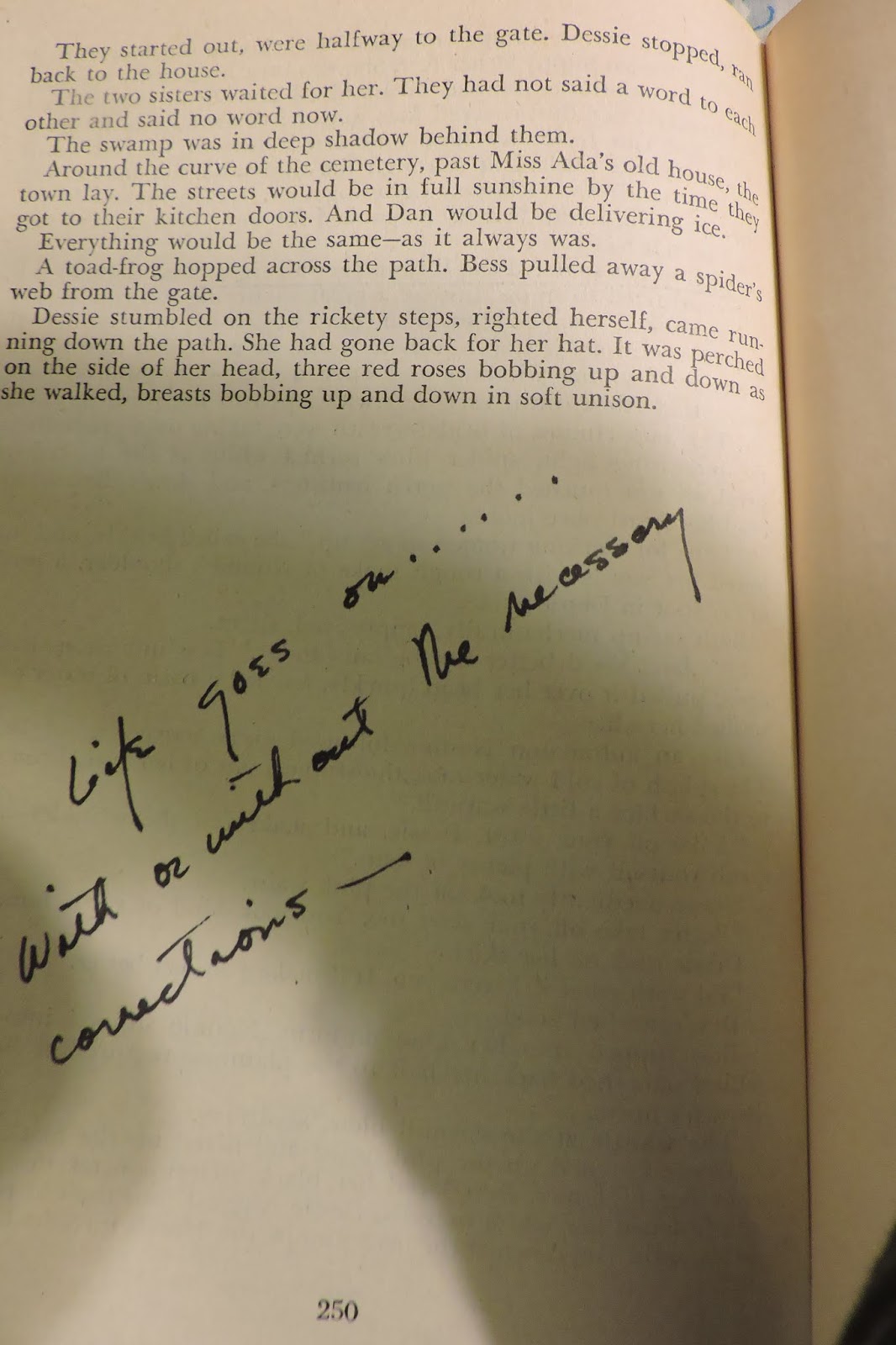
My wife found this book for me used. This hardback was the 13th printing (copyright 1944) Inside are a few notes by the previous owner, Kae Bell, and an inscription from the person who gave the book to her, apparently in 1944.

 Click to expand. The inscription appears to read "To Kae "44 from Bobby and Jan."

"Good comparison of life of a white & negro - so different? Afraid not. Damn these prejudices."

"Life goes on....... with or without the necessary corrections --"

***

Take it away, Billie Holiday:

Southern trees bear a strange fruit
Blood on the leaves and blood at the root
Black bodies swinging in the southern breeze
Strange fruit hanging from the poplar trees

Pastoral scene of the gallant South
The bulging eyes and the twisted mouth
Scent of magnolia, sweet and fresh
Then the sudden smell of burning flesh

Here is a fruit for the crows to pluck
For the rain to gather, for the wind to suck
For the sun to rot, for the tree to drop
Here is a strange and bitter crop