Showing posts with label Banned Books Week. Show all posts

Wednesday, November 6, 2019

Strange Fruit by Lillian Smith


Source of book: I own this.

This was my selection for Banned Books Week. It took longer than a week, but I did start it during Banned Books Week. 

Just as a reminder, I use the week to read books which have been banned, which means that a government has outlawed sale, publication, or possession of the book. I do not count challenged books - those which citizens or parents have sought to keep out of school curricula or libraries. This isn’t because I think challenges are uninteresting, but because I wanted to focus my once-a-year project on those where the power of the state was employed in censorship. I believe that is a different level from a challenge. After all, any library has limited space and budget, and decisions must be made. (Personally, I would have preferred an extra - and local - copy of The Rest is Noise rather than one of the 20ish copies of Eat, Pray, Love.) Likewise, students can only study so many books, and the choice of which to study is a judgment call.

Here are my past selections, plus the introduction to Banned Books Week.

Catch-22 by Joseph Heller

***

“BANNED IN BOSTON!” is now a bit of a badge of honor, and it has a long history. Strange Fruit may not have been the first work that the overzealous Boston city officials (influenced by Anthony Comstock and his eponymous law), but it was the first number one bestseller to be banned in Boston. 

Strange Fruit was ostensibly banned due to references to sex - which are both crucial to the meaning of the book and handled in a tame manner by today’s standards - but everyone knew the real reason it was banned: the book is about a forbidden sexual and romantic relationship between a white man and black woman. In the Jim Crow South, this was literally illegal at the time the book was written - and was considered immoral and scandalous even in the North. 

It took me a while to get into the book, mostly because the first 50 or so pages jump around in time a lot. We know very early in the book what has happened: Tracy Deen has gotten Nonnie Anderson pregnant, and she is happy about it. Smith then fills in the backstory of both families. Nonnie Anderson is an elegant and educated young African American woman. Her family is well respected (after a certain fashion), and Nonnie turns everyone’s head. Her sister, the stolid and responsible Bess, can’t understand why Nonnie still works as a maid, rather than go north with their brother Ed, who has gotten a white-collar job. Nonnie claims to just not be ambitious, but the real reason is that she loves Tracy Deen.

Tracy is the feckless son of the local white doctor (the black doctor, Sam, figures prominently in the book as well - he is the best and most complex character in the book, in my opinion.) As we learn, when Nonnie was age 6, she was saved from a sexual assault by a group of white boys by Tracy. This is a moving incident, because the boys assume that Tracy “owns” Nonnie, and that is why they leave her alone. The idea that raping a black child was wrong never occurs to them. 

In fact, as the story unfolds, it becomes clear that many - maybe most - of the white men in town have had sex with black girls and women. Some of them openly keep a black woman as a concubine. (“That’s the bible word for it,” Tracy says.) 

Tracy is, despite his inability to figure out what he wants to do with his life (other than that he hates his dominant and controlling mother), isn’t a bad guy. He and Nonnie do eventually become sexual, coming together occasionally in their teens and then after she returns from college, and he from World War One. It is in their 20s that she gets pregnant - to his surprise - he figured that a college educated woman would somehow just know how not to get pregnant. (He’s not the sharpest tool, but, to be fair, men didn’t really learn about female bodies at that time. Information on contraception was still illegal to distribute in Georgia.) 

This pregnancy, naturally, causes no end of trouble. 

In a perfect world, Tracy and Nonnie would marry, and probably have a happy life together. Tracy actually considers taking her to France, where interracial marriage was accepted. But he has no nerve, no career other than his parents’ attempt to get him to take over the family store or the old farm. Nonnie doesn’t seem to know exactly what she wants. It is implied that she would accept being his concubine, but we never really know her thoughts on this. She is too smart to think he will marry her, and she never asks him to. 

Tracy is pressured by his family to finally “go straight,” which means joining the church, getting married, and settling down. The preacher (a complex character who combines some good traits with the wrong kind of pragmatism) tells Tracy that most men have had “nigger girls,” but that God wants him to repent of that and marry a virginal white girl. Tracy’s mom has the perfect one picked out. Tracy isn’t attracted to her, but he can’t tell his mother no. 

In an attempt to both “go straight” and settle things for Nonnie, he borrows a large sum of money from his mother (no questions asked), and tries to bribe Nonnie to marry the Deen family cook, Henry (who was Tracy’s childhood companion), and Henry to marry her. Henry doesn’t want to - he is in love with Dessie - but he can’t talk back to a white man in public. 

The meeting with Nonnie goes even worse: Tracy ends up hitting and raping her as a thoroughly unconstructive way of attempting to compartmentalize his relationship with her as “she’s only a nigger - they manage.” Meanwhile, Ed overheard the conversation with Henry, and when he sees that Nonnie is traumatized, he shoots and kills Tracy in the dark. 

With Sam’s help, Ed is rushed back to New York before the body is discovered in the woods. Henry is blamed for the death, and despite the efforts of Mr. Deen and the local factory boss (another complex and semi-decent character), is taken from jail and lynched. 

Billie Holiday claimed that Lillian Smith named the book after her song about lynching of the same name. Smith never confirmed this, and said that she meant “strange fruit” to mean the way humans, black and white, are twisted and damaged by America’s racist culture, rather than a literal reference to lynched bodies hanging in trees. It sure seems as if there was an intentional connection. 

There is lot to unpack from this book. The summary of the plot fails to capture all of the different facets of Southern Jim Crow culture - Smith grew up in the South, and portrays the culture with accuracy and detail. It is an unsparing portrait, painting the many ways in which the underlying belief in the superiority of white-skinned people warps and damages and destroys. 

Smith does not go easy on the role of religion. This part of the book was spookily familiar in the Trump era, where the Ku Klux Klan is again in open collaboration with white religion. It is no surprise that Smith deftly exposed the hypocrisy of Southern religion. As a young adult, she rejected religion, in part because of her experience with the double standards of the Southern church. In addition, Smith was outspoken in favor of civil rights for minorities - and also for women - both of which positions made her unwelcome in church. 

If that weren’t enough, Smith was lesbian in an era when it was even more taboo than racism. She lived with her partner, and the two of them published a magazine together. As their letters (discovered after their deaths) made clear, however, they were more than business partners. Lesbian themes make it into Smith’s books, including this one. Tracy’s younger sister (the one who seems made to succeed - and who is one of the very few truly progressive characters in the book) has a naked female figure in her drawer, and a relationship with another woman in town is hinted at, although not expressly stated. 

Another controversial theme in the book is abortion. Tracy and Bess and others wish Nonnie would just make the issue go away by quietly aborting the pregnancy. The local black herbal healer can get her some herbs, or she can go to the city and see a doctor there. But it isn’t just Nonnie. A 14 year old white girl gets pregnant from a young white boy, and her father goes to Dr. Deen to beg that he perform an abortion. There is an extended internal monologue where Dr. Deen wrestles with his conscience. What is most devastating about this is that he is clear that he would do the abortion without question if she had been raped or if the father was black. But, because it was consensual and the father is white, he can’t bring himself to do it, although part of him wishes he could. He ends up referring them to a city doctor. 

I noted above some of the more complex and conflicted characters. One of them is the newspaper publisher, Prentiss Reid, who has to keep his progressive ideas to himself or go out of business. It is an uncomfortable compromise - one made necessary by the culture of racism. He is also one of the few openly non-religious characters. He delivers this zinger to the daughter of the mill boss (who is more genuinely progressive):

“You’ve got it wrong, haven’t you? What they want you to do, my dear, is sponsor religion, not practice it. Don’t let your conscience mix you up. If you practiced the teachings of that man Jesus here in Maxwell, we’d think you were crazy - or communist. Don’t make any mistake about it--be damned embarrassing.” 

Not much has changed, alas. Try to actually practice the teachings of Christ these days, and you will, like me, be asked to leave the church. Know what else hasn’t changed? Religious views of gender and race. As Preacher Dunwoodie tells Tracy:

“On this earth, there’s two worlds, man’s and woman’s. Now, the woman’s has to do with the home and children and love. God’s love and man’s. The man’s world is--different. It has to do with work. Women teach us to love the Lord, and our children, and the we build the churches, don’t we, and we keep them going….Now, when a man gets over into a woman’s world, he gets into bad trouble. He don’t belong there...Too much love makes you soft.” 

He goes on to explain that being a good Christian means very different things for men and women. And yep, I feel like I have heard this sermon more than once. 

Tracy is susceptible to this sort of thing, of course, and finds himself trying to justify abandoning Nonnie. 

It’s like an obsession. Seems true to you, but everybody says it isn’t. You can’t love and respect a colored girl. No, you can’t. But you do. If you do--then there must be something bad wrong with you. It’s like playing with your body when you were a kid. You had to touch yourself. It felt good. It was good. But everyone told you it wasn’t good. Said it would drive you crazy or kill you. Decent people didn’t do it. Well...you did. You did it and liked it. And felt like hell afterward. You’d outgrown that. Now the preacher said time to outgrow this other. Past time. 

It’s this sort of gaslighting that characterizes so much of religious teaching about sex, of course. But in the American version, the sexual puritanism and the racism are one and the same. They are inseparable. Tracy never does get over Nonnie, as much as he tries. 

You’d think God wanted to play a fine joke and had made Nonnie. Here, He said, is a woman any man would love and be proud of. She has everything you could desire. But you can’t have her. No. You can have sips and tastes, but you can’t have her. And you’ll be ashamed and sneak around and feel nasty...That’s the price you have to pay--for the sips. 
Well...white men had paid it before. And thought it cheap. Guess he could too. 

This casual disrespect for the humanity of non-whites permeates the culture in the book. Even the “good guys” accept white supremacy at some level - nobody can escape it. Ms. Sadie, who is horrified by the way white men treat blacks, still thinks that “the entire Negro race was a mammoth trick which nature had played on the white race.” 

There is another great line about Mrs. Stephenson, who is quietly a loving and gracious person - but one who was strangely detached. 

You had a queer feeling about it--as if Mrs. Stephenson had died some time when nobody was noticing and now nothing was left of her but good deeds blooming like little flowers on her grave.

I want to return a bit to the role of religion as shown in this book. Preacher Dunwoodie shares something with modern preachers: he wants to save the “respectable” sorts. Meaning the wealthy, who will keep the church in business. All the Tracy Deen’s of the world are nice and all, and it is a good thing to save the mill hands, but what he really wants - and how he knows God is blessing his ministry - is for the “prominent citizens” to return to the church. And my goodness is this still true. I firmly believe one of the reasons my former pastor couldn’t do the right thing - even a little thing like keeping hate groups out of the church - is that certain prominent (and tithing) members were the driving force behind it. Address the white supremacist beliefs, and he would have lost some of his financial base. It’s that simple. 

But white supremacy goes deeper than money in religion, then and now. There is a chilling scene when the lynching party sets out. Smith makes it clear that the point isn’t justice - it is putting the “nigger in his place.” And lynching, just like our current cruelties toward brown-skinned people, is driven by a weird religious feeling. Smith describes it thus:

And sometimes there was laughter, or drawled words of voices not unkind in sound and not without humor; but eyes were hard and hating as they hunted a black victim to sacrifice to an unknown god of whom they were sore afraid. 

There is so much fear in white religion in America. A desperate fear of outsiders, of people who are different, whether racial minorities, immigrants, LGBTQ people, atheists, and especially people who don’t vote for Trump. Lillian Smith is on to something here - they seem eager to sacrifice other humans to an unknown god who they cannot name, but who terrifies them. Every time you see a brutal and cruel separation of immigrant families, children in cages, another African American murdered by the cops, or another gay or transgender person denied housing or a job - well, you are seeing a human sacrifice to a terrifying god that Evangelicals cannot name, even to themselves. 

Near the end, even as he realizes he can’t really publish an anti-lynching article, Reid thinks to himself of the core problem. 

That’s the South’s trouble. Ignorant, Doesn’t know anything. Doesn’t even know what’s happening outside in the world! Shut itself up with its trouble and its ignorance until the two together have gnawed the sense out of it. Believes world was created in six days. Believes white man was created by God to rule the world. As soon believe a nigger was as good as a white man as to believe in evolution. All tied up together. Ignorance. Scared of everything about science, except its gadgets. Afraid not to believe in hell, even. Afraid to be free. 

You can perhaps put “Evangelicalism” in for “South,” and “White Republican Americans” for “white man.” It’s the same thing today. Walled up in its own bubble of fear and ignorance and hate. It has been nearly three years since I left that cesspit, and as time goes by, I am ever more thankful I got out. 

This wasn’t an easy book to read. There is so much darkness in the human heart, and so much destruction caused by racism and hate. And religion, then and now, seems all too eager to feed the hate. This book is well worth reading, though, and shines an uncomfortable light on the dark realities of our culture. 

***

My wife found this book for me used. This hardback was the 13th printing (copyright 1944) Inside are a few notes by the previous owner, Kae Bell, and an inscription from the person who gave the book to her, apparently in 1944.

 Click to expand. The inscription appears to read "To Kae "44 from Bobby and Jan."

"Good comparison of life of a white & negro - so different? Afraid not. Damn these prejudices."
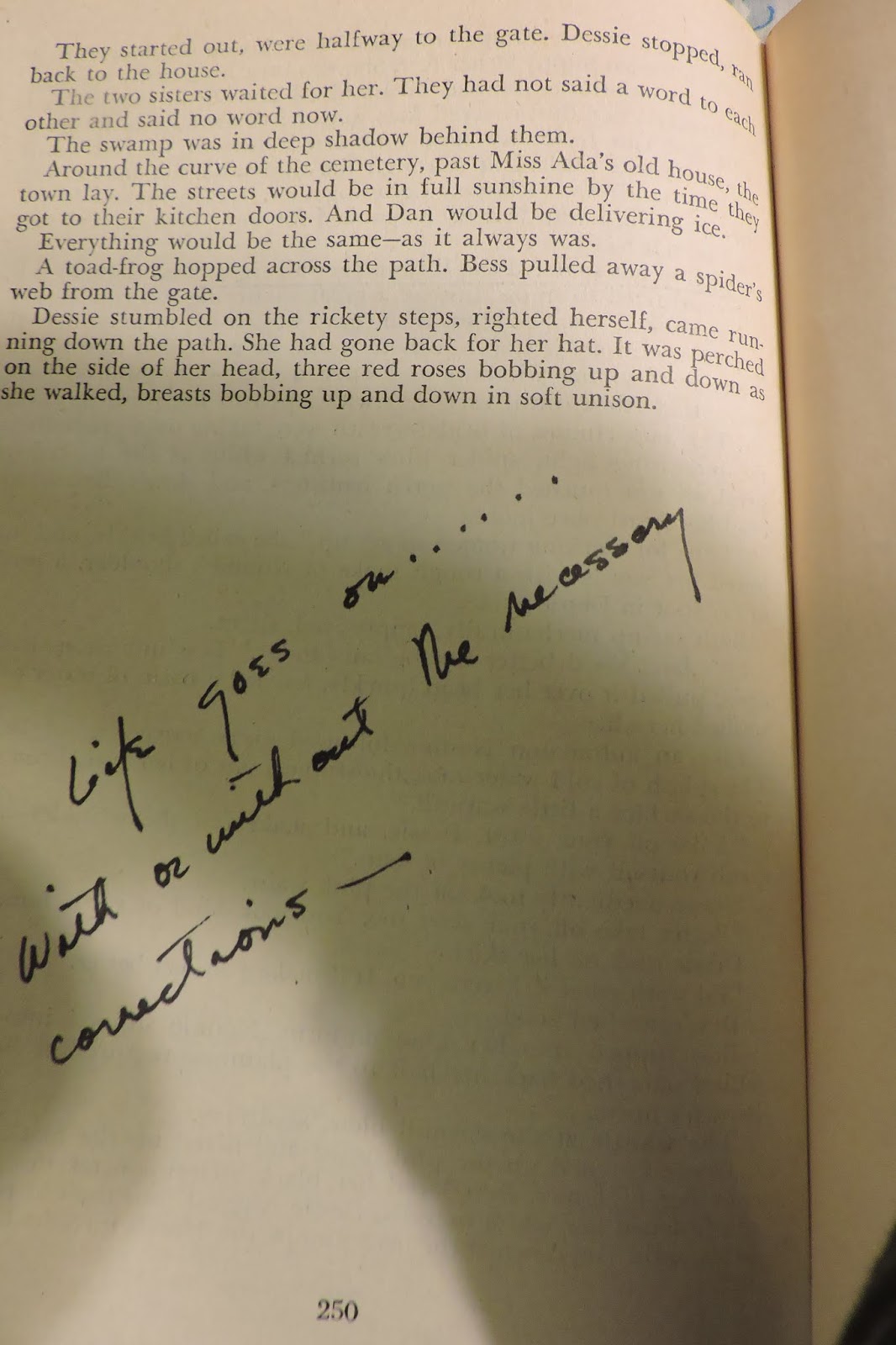
"Life goes on....... with or without the necessary corrections --"

***

Take it away, Billie Holiday:

Southern trees bear a strange fruit
Blood on the leaves and blood at the root
Black bodies swinging in the southern breeze
Strange fruit hanging from the poplar trees

Pastoral scene of the gallant South
The bulging eyes and the twisted mouth
Scent of magnolia, sweet and fresh
Then the sudden smell of burning flesh

Here is a fruit for the crows to pluck
For the rain to gather, for the wind to suck
For the sun to rot, for the tree to drop
Here is a strange and bitter crop

Sunday, October 21, 2018

Catch-22 by Joseph Heller


Source of book: Borrowed from the library.

This was my selection for Banned Books Week. At 415 pages, it took longer than a week, but I did start it during Banned Books Week.

Just as a reminder, I use the week to read books which have been banned, which means that a government has outlawed sale, publication, or possession of the book. I do not count challenged books - those which citizens or parents have sought to keep out of school curricula or libraries. This isn’t because I think challenges are interesting, but because I wanted to focus my once a year project on those where the power of the state was employed in censorship. I believe that is a different level from a challenge. After all, any library has limited space and budget, and decisions must be made. (Personally, I would have preferred an extra - and local - copy of The Rest is Noise rather than one of the 20ish copies of Eat, Pray, Love.) Likewise, students can only study so many books, and the choice of which to study is a judgment call.

Here are my past selections, plus the introduction to Banned Books Week.


***

This is another book which was - believe it or not - banned by a Western democracy during my lifetime. Several states banned it during the 1970s, as did Dallas, TX (1977) and Snoqualmie, WA (1979.) Ostensibly, the book was banned for referring to women as “whores.” This seems a bit specious, since the women in question were, strictly speaking, prostitutes. While there is sexual content, it isn’t particularly graphic, and it certainly isn’t gratuitous. For the 1970s (seriously, watch a movie from that era…), it is pretty tame. I suspect that two facets of the novel were what really drove the bans: it is somewhat anti-war - and it raises uncomfortable theological questions. With the 1970s as kind of ground zero for the fundamentalist Religious Right, I suspect that a novelist who raised the still-unsolved and debated Problem of Evil was unwelcome.

What Catch-22 is, without question, is one of the most important and influential novels of the 20th Century. I am kind of surprised that I didn’t end up reading any of it in high school, honestly, because at least one chapter seems like a perfect selection. I guess they can’t have you read everything. I can see the influence of the book on our perception of military life. Written in 1961, it is ostensibly set in World War II, but was intended by the author as a commentary not on that war, but on the Cold War - and even more so on the McCarthy hearings. To that end, there are multiple references to loyalty oaths and specific incidents from the hearings.

Catch-22’s vision of military life permeates so much of what was written or filmed thereafter. As a kid, I loved the Beetle Bailey comic strips - which draw a lot from the book, although the comic is more lighthearted. My dad’s favorite TV show, M*A*S*H, reuses a number of tropes - and the idea of using a satire of one war to critique another. As others have pointed out, The Office is to a certain degree Catch-22 without the blood. I suspect that having read this book, I will see even more references in popular culture.

The book isn’t a linear narrative. Rather, the first part of the book essentially tells a portion of the story (which is really the middle of the plot) from the point of view of various characters, filling in the missing pieces. As the story then progresses, more and more is told, but again, not in chronological order. It is rather like building a jigsaw puzzle from the center out, except you can’t figure out what stuff is until near the end.

The setting is the liberation (or invasion...take your pick) of Italy during the height of World War II. At that point, D-Day was in the future, and the outcome of the war was still in doubt, even though the tide had turned. The characters are part of an airborne bomber group flying B-25s. Unline the better known B-17 (one of the best looking bombers of the era, in my view) and the B-24 (much larger, and with a longer range, this was used in the Western Europe and Pacific theaters), the B-25 was a smaller two-engined bomber. The B-25 had a good reputation as one of the most durable aircraft of the war, reliable, and versatile. Because of its roles, however, it ended up being used for lower level bombing runs, which made it vulnerable to anti-aircraft flak, even if (as was the case in the book), there was no opposition from enemy fighters.

 B-25 operated by the Commemorative Air Force, at the Miramar USMC Station, 2018

One of the great things about this book was the realism in the airborne scenes. This is because Heller, like his anti-hero Yossarian, was a bombardier/navigator on a B-25 in Italy. In that sense, the book draws heavily from Heller’s own experiences. I’m a bit of an aviation buff - my dad was was an amateur pilot in his younger days, and was an air traffic controller before his retirement - and I grew up around aircraft. I still love flying (although airport security not so much), and my wife snickers at the way my head swivels whenever I hear or see an airplane.

However, Heller was quick to point out that while his experience in war helped him write the technical aspects of this book, he most certainly did not base his characters on his experiences. Heller said that his fellow soldiers and commanding officers were, by and large, exemplary men, and, while he suffered trauma as the result of war, he had nothing but positive feelings for those he served with. The book was therefore, not primarily a working out of his own baggage from the war, but a veiled commentary on the 1950s - specifically the McCarthy era, as noted above.

Catch-22 doesn’t have a hero in the traditional sense. There are a few more or less admirable minor characters, but for the most part, everyone is badly flawed or outright malevolent. And the central character, Yossarian, is a classic anti-hero. He is a coward, a lazy bastard, an insubordinate son-of-a-bitch, and more. (His commanding officers are certainly right to call him these things.) But, there is some mitigation. At the outset of the story, all personnel are supposed to be furloughed after a certain number of missions. That is the official policy. But Colonel Cathcart, who commands the unit, is determined to get his name into a magazine back home with a glowing story. And so he keeps raising the number of missions. So Yossarian and the others never get to go home. Here is the classic scene which explains the...well… “catch-22.”

“Daneeka was telling the truth,” ex-P.F.C. Wintergreen admitted.” Forty missions is all you have to fly as far as Twenty-seventh Air Force Headquarters is concerned.”
Yossarian was jubilant. “Then I can go home, right? I’ve got forty-eight.”
“No, you can’t go home,” ex-P.F.C. Wintergreen corrected him. “Are you crazy or something??”
“Why not.”
“Catch-22.”
“Catch-22?” Yossarian was stunned. “What the hell has Catch-22 got to do with it?”
“Catch-22,” Doc Daneeka answered patiently, when Hungry Joe had flown Yossarian back to Pianosa, “says you’ve always got to do what your commanding officer tells you to.”
"But Twenty-seventh Air Force says I can go home with forty missions."
"But they don't say you have to go home. And regulations do say you have to obey every order. That's the catch. Even if the colonel were disobeying a Twenty-seventh Air Force order by making you fly more missions, you'd still have to fly them, or you'd be guilty of disobeying an order of his. And then Twenty-seventh Air Force Headquarters would really jump on you."
Yossarian slumped with disappointment. “Then I really do have to fly the fifty missions, don’t I?” he grieved.
“The fifty-five,” Doc Daneeka corrected him.

“Catch-22” is never actually stated, but its effects are explained. Here is another mention of it:

There was only one catch and that was Catch-22, which specified that a concern for one's own safety in the face of dangers that were real and immediate was the process of a rational mind. Orr was crazy and could be grounded. All he had to do was ask; and as soon as he did, he would no longer be crazy and would have to fly more missions. Orr would be crazy to fly more missions and sane if he didn't, but if he was sane he had to fly them. If he flew them he was crazy and didn't have to; but if he didn't want to he was sane and had to.

Every absurdity in the book comes back to “catch-22.” Yossarian eventually decides that it doesn’t actually exist - it is just the justification for the impossible situations that abound. The source of the term is fascinating. When Heller first started writing the book, he released a draft of the first chapter as “Catch-18.” His agent, however, requested that it be changed so the book wouldn’t be confused with Leon Uris’ new book, Mila 18. “Catch 11” was suggested - the repetition fit the repeated, circular conversations which abound in the book. Except that Ocean’s Eleven had just been released. (The original, Rat Pack version, not the Brad Pitt and George Clooney remake.) “Catch-17” was too close to Stalag 17, a mostly forgotten WWII movie. Finally, someone realized the obvious: “Catch-22” was the perfect number. Repetitive like 11, but even more fun to say.

And now, nobody can imagine it being anything else.

For those of us who came of age at the end of the 20th Century, it is impossible to imagine life without this idiom. But without Heller’s book, it wouldn’t even exist.

I hesitate to actually try to summarize the book beyond saying that Yossarian is determined to stop flying missions, particularly after one of his crewmates is disemboweled and dies in his arms. He finds excuses, from a vague medical issue to strategic insanity. But even though he is utterly without scruple, there is one thing he won’t do to get discharged. (I won’t spoil it.)

Pretty much all of the characters are major. (And that includes Major Major - see below.) Everyone is important in some way, and each story is developed. The characters are memorable, and you care about them - even as they are systematically killed off. At least the ones you like. The loathsome commanding officers survive, of course - they don’t have to fly missions.

The book is pretty dang dark - particularly in the last fifth. But, at the same time, it is one of the funniest books I have read. There are many lines that are indeed laugh out loud hilarious...and then you feel guilty for laughing. It is that sort of a book. On the one level, it is a mockery of politics and power. The greed of capitalistic sorts - exemplified by Milo Minderbinder’s smuggling racket (another hilarious chapter) - and the lust for power and prestige of the various commanding officers is on full and amusing display. We all know people like this.

But there is something deeper than this. Yossarian eloquently takes on the fates - God himself - for the absurdity of human suffering. This exchange occurs between Yossarian and the wife of Lt. Scheisskopf (one of several not-particularly-subtle names in this book.)

“I bet I can name two things to be miserable about for every one you can name to be thankful for.”
“Be thankful you’re healthy.”
“Be bitter you’re not going to stay that way.”
“Be glad you’re even alive.”
“Be furious you’re going to die.”
...
“And don’t tell me God works in mysterious ways,” Yossarian continued, hurtling over her objections. “There’s nothing so mysterious about it. He’s not working at all. He’s playing or else He’s forgotten all about us. That’s the kind of God you people talk about—a country bumpkin, a clumsy, bungling, brainless, conceited, uncouth hayseed. Good God, how much reverence can you have for a Supreme Being who finds it necessary to include such phenomena as phlegm and tooth decay in His divine system of creation? What in the world was running through that warped, evil, scatological mind of His when He robbed old people of the power to control their bowel movements? Why in the world did he ever create pain? … Oh, He was really being charitable to us when He gave us pain! Why couldn’t He have used a doorbell instead to notify us, or one of His celestial choirs? Or a system of blue-and-red neon tubes right in the middle of each person’s forehead. Any jukebox manufacturer worth his salt could have done that. Why couldn’t He? … What a colossal, immortal blunderer! When you consider the opportunity and power He had to really do a job, and then look at the stupid, ugly little mess He made of it instead, His sheer incompetence is almost staggering. …”

This was a particularly sobering passage. I’ll admit this has been on my mind a lot lately. In particular, why God remains silent when a majority of those who claim his name continue to express hate and cruelty toward other human beings. But, really, this has been a major theme of our scripture: why the wicked prosper and are allowed to harm others, and why justice is delayed. And why God delays purging the filth from what claims to be his church.

On a somewhat related note, I was stunned to see a particularly cogent analysis of Right Wing views - and Calvinism - in this book. I mean, this is 67 years later, but it is exactly what I see going on right now.

Major Major is an, um, major character in the book. In a really hilarious way. He manages to avoid actually seeing anyone or doing anything. But his back story is also funny. His father names him, literally, “Major Major Major” when the mother is recovering from a difficult childbirth. And then, he is promoted to the rank of Major, so….Major Major Major Major. Yeah, it’s terrible. But an amusing terrible. But it isn’t this farce which is the most interesting part. Major Major’s father was a recognizable sort. Here are some excerpts of the description:

He was a long-limbed farmer, a God-fearing freedom-loving, law abiding rugged individualist who held that federal aid to anyone but farmers was creeping socialism. He advocated thrift and hard work and disapproved of loose women who turned him down.

As it turns out, he is part of the racket whereby he is paid by the federal government to not grow alfalfa. I won’t quote the whole section, but it is both accurate and freaking hilarious. And also a great description of how the Right LOVES socialism...for certain white people. Oh, and it gets better:

Major Major’s father had a Calvinist’s faith in predestination and could perceive distinctly how everyone’s misfortunes but his own were expressions of God’s will.

Can I use “amen” here? Because this is so amazingly true in our own time. The resurgence of Calvinism parallels the embrace of Social Darwinism by the Religious Right. And the two are absolutely connected - as Heller notes here. (This could be an entire blog post.) Basically, the misfortunes of, say, the working poor, or brown skinned people, or those born outside of the United States - all these are God’s will - and judgment on “those” people for being wicked. But the misfortunes of Calvinist whites, well, those are due to the depredations of those dirty poor people, or the dirty brown-skinned people. Heller was right on. Socialism for certain middle or upper class white people is fine. It’s just when you extend that to the less privileged that it becomes “socialism.”

I’m going to end with a lighter note. Yossarian is hardly an admirable character. But he is such a force of chaos and divergent thinking that you can’t really hate him - unless you lack a sense of humor. There is this delightful exchange between him and Major Sanderson:

“Hasn’t it ever occurred to you that in your promiscuous pursuit of women you are merely trying to assuage your subconscious fears of sexual impotence?”
“Yes, sir, it has.”
“Then why do you do it?”
“To assuage my fears of sexual impotence.”

I literally am laughing out loud just typing that one again. This is classic Yossarian: refusing to play the game, turning the rhetoric back on its user, and cutting to the heart of the issue. This is why he is a wonderful anti-hero. You really should hate him...but you can’t, because he is all too right. He sees through the rules of social behavior, the lies of honor and duty, and says what we think, but can’t bring ourselves to articulate. Yossarian (and Heller) tear away the mask, and show that protocol has replaced principle, “alternative facts” have replaced truth, and reason is now just a rigamarole to justify presupposition. It is largely how I feel about the sophistry that has been unmasked within my own religious tradition. Truth and human decency and the needs of real human beings are subordinated to power, culture wars, and self aggrandizement.

I probably wouldn’t have appreciated this book as a teen, and definitely appreciate it more in my 40s, with the sort of experience to make one a cynic, despite my generally sanguine tendencies. I can say for certain that this book is more humorous than I expected, even if dark and philosophical. It was definitely worth reading, and I think it earns its place as one of the best novels of the last century.

Wednesday, October 25, 2017

Into the River by Ted Dawe

Source of book: Borrowed from the library.

This book was my selection for Banned Books Week. Which happened to coincide with multiple Symphony concerts with crazy-difficult music. So I took a while to finish it.

Just as a reminder, I use the week to read books which have been banned, which means that a government has outlawed sale, publication, or possession of the book. I do not count challenged books - those which citizens or parents have sought to keep out of school curricula or libraries. This isn’t because I think challenges are interesting, but because I wanted to focus my once a year project on those where the power of the state was employed in censorship. I believe that is a different level from a challenge. After all, any library has limited space and budget, and decisions must be made. (Personally, I would have preferred an extra - and local - copy of The Rest is Noise rather than one of the 20ish copies of Eat, Pray, Love.) Likewise, students can only study so many books, and the choice of which to study is a judgment call.

Here are my past selections, plus the introduction to Banned Books Week.


This year, I chose Into the River by Ted Dawe, which is unusual in two respects. First, most of my other selections were banned (at least in part) for political reasons. (Palace Walk was banned in part for its sexual content as well.) This one was banned for sexual content and language. The other difference is that Into the River was banned by a modern democracy very recently.

Say what?

Yes indeed. This book was banned for sale to minors under age 14 in New Zealand in 2014. So basically, it was behind the counter with the porno mags and cigarettes, and younger teens needed a parent to buy the book or even check it out from the library.

Fortunately, this ban was short lived. The library association challenged the ban, and it was overturned, despite loud squawking from the Culture War type groups. Yes, the Culture Wars™ extend beyond the borders of the United States - although they tend to have less power elsewhere.

So, I picked this book for those reasons, and also because our local library had it on the shelf.
I think this book is an example a very interesting Culture War phenomenon: works which otherwise would probably have faded into obscurity are given inordinate attention after some fundamentalist group decides to start a crusade against it. The example from my childhood is the protest against The Last Temptation of Christ, which was by just about any account, a laughably terrible movie. The only reason it had an audience was because of the protests.

Into the River isn’t a bad book. But it isn’t, in my opinion, a great book. It is okay. It has some interesting points and observations. Some descriptions and scenes are quite compelling. And others are pretty much “meh.”

The plot is this (some spoilers): Te Arepa is a Maori boy who wins a scholarship to a prestigious boarding high school for boys. In order to fit in with a mostly wealthy and white culture, he must submerge his identity. The school has problems just below the surface in the form of sanctioned bullying, drug use, and a professor who trades for sexual favors from the boys. Te Arepa has to decide if the cost is worth it, or whether he will, like his legendary ancestor Diego, choose freedom.

Along the way, the book explores some other subcultures, from the Maori culture of Te Arepa’s family, to the upper crust of his friends Steph, to the lower class car culture of Mitch and his probably-not-entirely-within-the-law junkyard father, to the casually racist farming culture of “Wingnut” and his family.

This last one really sounded familiar - just substitute “Native American” for “Maori,” and Wingnut’s grandfather sounds a lot like many here in the US.

It is easy enough to see why certain groups got all up in arms. There is some sex, and it is reasonably graphic. There are drugs. And there is language. But there are also racial issues presented, which is why the book won several awards in New Zealand. I would also say that it has some subversive ideas - particularly a distrust of institutions, of adults, and of class and race based social structures. From my experience in Fundamentalism, I would say that it was probably was these subversive ideas and exposure of racism that proved to be the unspoken motivations for the campaign against this book. Sex (like magic) is often a pretext for keeping challenges to authority and white hegemony out of the hands of the kiddos.

I thought that the opening of the book, with its insight into Maori culture, was pretty strong, as was the scene on the farm. Dawe writes well and efficiently in these moments, and makes the settings come alive. I didn’t like the way the book ended, mostly because it seems more of a cliffhanger than anything. We know Te Arepa’s choice, but nothing of his plans - or lack thereof. We are left to guess at his future in kind of a “lady or the tiger” way. I’m not a fan of that approach at all, I’m afraid. Just my preference.

I also felt that the alienation was a bit extreme. One would like to think that Te Arepa would have someone who doesn’t let him down in a big way in his life somewhere. The world isn’t quite that dark and friendless - although I guess it is easier to feel that way at a certain age. It just made the book - and its ending - feel unmoored.

It was an interesting read, and worth the time, but not one of the best I have read this year. I am glad I explored the history, however, as it sheds light on our instinct toward censorship in our modern era.

***

From PBS, this article on what causes books to be challenged here in the United States is interesting. Primarily genitals and racial issues.


Sunday, October 16, 2016

July's People by Nadine Gordimer

Source of book: Borrowed from the library

For those who are unfamiliar with my Banned Books Week project, each year I read a banned book during (more or less) Banned Books Week. As I have explained each year, I count only books which have been banned by a government somewhere in the world at some time. “Challenged” books do not count - although they are worth reading too - for purposes of my project. For more on the difference, and my philosophy, please read my post on the project.

There are essentially two broad categories of banned books. The first is a ban of books that violate “moral” standards of the time. Or, to put it succinctly, books that have sex in them. Governments tend to ban these in response to pressure from religion and culture. Since cultural and religious standards change with time and place, these bans tend to change too, and many books once banned are readily available.

The second category is books banned for political reasons. These books threaten the current power structure in a society, and thus are banned by governments for their own protection. The worse the government, the more they fear ideas which threaten their power. Thus, of all the banned books, I believe these are the most important for us to read.

Here are the past Banned Book Week Selections:

Areopagitica by John Milton (2011) (Written in defiance of censorship laws - and thus pre-banned in England)
Uncle Tom's Cabin by Harriet Beecher Stowe (2012) (Banned in the Confederate States)
The Quest for Christa T. by Christa Wolf   (2013) (Banned in the author's native East Germany)
Palace Walk by Naguib Mahfouz (2014) (Banned throughout the Arab world)

***


July’s People was written in 1981, and was banned in South Africa, Ms. Gordimer’s native country. At the time, of course, the law of South Africa was Apartheid, a separation of black and white along strict lines of hierarchy. (With the whites on top, of course, not that anyone doubted that.) It is pretty obvious why this book was banned.

First of all, this is a profoundly uncomfortable book. Gordimer does an impressive job of bringing to light the problem of white fragility and privilege - and I will confess that this book made me profoundly uncomfortable.

Gordimer (a white woman, for what that is worth) imagines a horrible future for South Africa. The blacks have rebelled, and, unlike past rebellions, they have the firepower to carry out a revolution. Neighboring countries have lent them military weapons, including aircraft and missiles. Cuba and Russia sense an opportunity to get involved and add another communist nation to the quiver. The airport is shut down after civilian aircraft carrying whites seeking to flee the country are shot down. There is no escape. Johannesburg is being reduced to rubble by the fighting, and the outcome is very much in doubt. 


In this mix, you have Bam and Maureen and their three kids. They are a middle class white family - white collar, but not really rich exactly. But, like most white families of the era, they have a couple of black servants. A cook and a “house boy.” Bam and Maureen - particularly the latter - are liberal, decent people, who want to see Apartheid gone, and who do their best to treat everyone well. But, of course, as a 21st Century American can see easily, they are still taking advantage of the racist system. They have servants.

When everything goes south, so to speak, they withdraw their life’s savings, and flee the city, hoping eventually to get to safety somewhere. Or at least ride out the hostilities until they can rebuild their lives in whatever is left. They don’t flee to some remaining white enclave, however. They go “home” with July, their servant, to his village. Hence the name, as they go live with “July’s People.”

The problem is, the adjustment to this new life is hard on everyone. In essence, they are all dependent on July’s beneficence to survive, which is a total reversal of the previous hierarchy. Negotiating the new reality gives everyone fits. July is conflicted between his loyalty and his simmering rage at his lower status. Bam has lost the essence of his manhood: that of strong provider and leader. Maureen has prided herself on being progressive, and finds out that her good intentions don’t merit much outside of the racial reality she inherited. And she also finds that she cannot look at her husband the same way once he has lost his “manhood.” Even the kids cannot readily figure out what to do without the ability to purchase what they want, and eat “normal” food.

A few incidents are telling. While Bam essentially shuts down emotionally, and ignores the tension, Maureen attempts several times to engage with July, only to be reduced to shock and unbearable discomfort as July refuses to cater to her illusion that they had been friends before, rather than master and servant. Likewise, nobody will outright discuss the question of who now owns Bam’s “bakkie,” a little jeep-or-truck-like vehicle. This is how they made their escape, staying off roads, and following July’s intimate knowledge of the countryside. Bam and Maureen want to believe that it is still theirs, but it becomes increasingly obvious that July considers it to be his now.

This novella-length book never resolves the tension. At the end, there is essentially a “The Lady or the Tiger” moment, and it is over. Do the white protagonists get rescued? Or do they fall into the hands of the rebels? And in each event, what happens to July?

I fear I have done an inadequate job of describing the issues raised by this book. It is always awkward trying to discuss race in a productive manner, as Maureen finds out to her dismay. And sometimes, the world is so broken that there are no good answers. Most likely, everyone loses in the end in Gordimer’s dystopic view.

The silver lining, though, is this:

The real life future turned out to be much better than this book.

While I am certainly no expert in the history of South Africa, the end of apartheid happened during my lifetime - during my formative years, so to speak. When I was a kid, I knew about segregation in significant part because it was still very much real and enforced by law in another part of the world. (The issue if de facto segregation in the United States wasn’t really on my radar at the time.) The end of apartheid was a really big deal, and I remember it well. I remember being excited at the prospect, and - I’ll be honest here - a bit puzzled at the hostility of many I knew toward Nelson Mandela. It really hasn’t been until the events of the last couple of years that I have realized just how deeply racism and white supremacy is embedded in our culture, and how explicitly racist many, many friends and family really are. (Thank you very much, Toupee Who Shall Not Be Named. And thank you Ferguson for bringing this to light as well.) That’s perhaps a future post or two. 

 This one hits a bit too close to home. I've heard too much that is similar to this lately.

Back to the positive part. It would not have been a surprise in 1981 if Gordimer’s vision had come to pass. Ultimately, the state of affairs was unsustainable, and it was taking ever increasing levels of repression and violence to preserve the status quo.

Fortunately for everyone, productive progress was made. While some credit is certainly due to white liberals like F.W. De Klerk, who took action to end the legal apartheid system, we must absolutely never forget that the African National Congress, which took control of the government after the first free elections in 1994 (!!!), showed absolutely amazing restraint and grace. After decades - nay centuries - of oppression, murder, and hatred, it would have been fully expected (and very much in line with the history of European nations in the preceding centuries) if there had been mass purges, and an extermination or expulsion of all whites. It would not have been exactly unjustified. Queen Elizabeth I herself did no less to her political enemies.

But the ANC did what had to be the hardest possible thing to do, which was to forgive and move on. And we should never forget that Mandela eschewed revenge in what has to be one of the most striking instances of “In war, resolution; in defeat, defiance; in victory, magnanimity.” (To quote Churchill.)

Now, I am not saying South African society is perfect. I suspect that, like our own, there is plenty of remaining racism and privilege. But it is unquestionably better than it was in 1981. And the transition to legal equality (or close) was handled in a peaceful manner which is admirable.

So, in the end, things were not as bad as had been envisioned. While Gordimer’s book was banned, the ideas that it contained were spoken and spread by many others, black and white, and influenced the history that was to follow. What actually happened is both cause for optimism, and also a cautionary tale.

It is positive in that it is possible to move toward justice without a total destruction of society. It is rare, but it does happen.

It is a cautionary tale in another sense. Injustice cannot last indefinitely. Right now, in our nation, we are seeing a buildup of pressure and discomfort over injustice. As always happens, there is a natural reactionary tendency that arises in the ranks of the privileged to oppose it. Sometimes, as in the American Civil War, the tension is released through terrible bloodshed. In other cases, such as the Civil Rights Movement (which resulted in a number of important laws in the 1960s), there is unrest, some isolated violence, and social change. We are now on the cusp of another Civil Rights era, and we have our reactionaries. (Le Toupee’s entire campaign is based on racial reaction to a black president, Hispanic immigration, and islamophobia. That IS the campaign.) The warning from history should be apparent to the reactionaries. In a best case scenario, justice will flow. Impede that justice enough, and it will be purchased at the cost of many lives. The choice is yours. It is ours. Do we work to end the injustice? Or do we resist at the cost of far too much.

***

A personal story:

I grew up in Los Angeles. Specifically, in the eastern San Fernando Valley. For those who know the area and care, I was born in Van Nuys, and lived in the Arleta area from age 9 to age 16.

In 1991, an African American man named Rodney King was beaten on videotape by members of the LAPD.

This incident took place 4 miles from our house.

I remember seeing the video, and knowing, somewhere in my 14 year old soul, that this was wrong. Deeply wrong, and that there was a problem that I didn’t quite understand. It didn’t help that one of the officers referred to King and his buddies as “gorillas in the mist.”

Of course, in the aftermath, I heard a bunch of perspectives from white people. I had (and have) relatives who work with LAPD and other law enforcement agencies. And I would say that on balance, they are the good cops. But the wagons were definitely circled.

One reason that the beating went viral was that the person who filmed it initially notified the LAPD, and they blew him off. He then went to a local TV station, and it seriously blew up. I suspect that 25 years ago, nobody really anticipated the change that would occur with video cameras on everyone’s cell phones. But change was indeed coming.

The officers involved in the beating were eventually charged criminally. The aftermath of that trial would eventually lead to much of what we face with Black Lives Matter today. (I’ll try to explain at least a bit of that.)

The trial was moved from the area in which the incident occurred (the San Fernando Valley) to Simi Valley, west of the area. This was justified by the supposed notoriety of the incident in LA. But in retrospect, as an attorney, it is pretty damn obvious why the trail was moved. The eastern Valley, where I lived, was dominated by people of color. (We were one of only a few white families left on our block when we moved away.) Simi Valley, in contrast, was and is one of the premier areas for white law enforcement officers to live, while working in LA. And it was and is heavily white and middle-to-upper-middle class. (Venue will be important later in this discussion.)

To the surprise of pretty much nobody white in Los Angeles, the officers were acquitted. This is not to say that there were no whites that were surprised. Famously, then president George Bush "Viewed from outside the trial, it was hard to understand how the verdict could possibly square with the video. Those civil rights leaders with whom I met were stunned. And so was I and so was Barbara and so were my kids." But they weren’t from LA. I think we all knew that this would be viewed as cops threatened by the scary black people who were then justified to use any and all force.

And then Los Angeles rioted.

It is difficult to overstate the effect that the riots had on people. We heard the gunshots from our house, and my parents sat up with our firearms just in case we were the next to be looted or killed. It was a frightening time.

After the riots stopped, my dad was physically threatened by a (probably mentally ill) black man while getting gas near our home. By the end of the year, we had left LA for good. As did many, many others. I can count several dozen who headed to Oregon, or Idaho, or other states dominated by white people.

I can see a number of things that resulted from the riots. Most positively, the Rodney King incident and the Rampart Scandal led to reforms in the LAPD. Again, things are far from perfect, but I believe that some positive changes resulted to law enforcement in many places, not just LA, as a result.

Less positively, the Riots marked what I see in retrospect as a hardening of hearts against blacks on the part of many whites who were otherwise inclined to be progressive. Certainly I saw it in my own family. And, I’ll be honest, in my own heart. We saw ourselves in Reginald Denny, and this would make it, forever after, more difficult to see ourselves as Tamir Rice.

To this day, I am convinced in my heart, the resistance of many otherwise decent middle class whites - particularly of a certain generation - to Black Lives Matter, is a visceral reaction to the Riots. Whatever sympathy toward Rodney King arose in our hearts was extinguished by the riots.

This all happened 25 years ago, and I will admit that it wasn’t until perhaps the last 5 of those years that I myself have actually been open to change my mind. Such is the aftermath of those days. And such are the poisonous results of fear.

And the results linger to the extent that I have had to walk out of some conversations with friends and relatives, because to them, there is no possible answer other than that every single black person who is beaten or killed thoroughly deserved it. I hate to be blunt about this, but it is the truth. I have been told straight up by otherwise decent people that Black Lives Matter is a media creation, and that there is zero problem with our policing of people of color.

But the Rodney King incident had other effects. I feel awkward speaking of what I have not experienced, but let me at least give an educated estimate. I would say that the acquittal of the officers ruined whatever faith most African Americans had in the justice system, and in policing. It is pretty hard to think of a more convincing proof that black lives do not in fact matter in our system. A beating filmed in its entirety did not result in a conviction. (And no, the later civil rights trial of the officers didn’t erase the stink of the first trial.) And, as more and more videos come out, and there are still practically zero convictions, it just gets worse.

I also think the Rodney King incident and the Riots had a profound effect on law enforcement in other ways. One that I see is that there is a tendency to go to the gun first, rather than the taser or baton. Two factors contribute, in my view. One is an increased fear of blacks. The second is that after the verdicts, it is clear that there will pretty much never be consequences. In the vast number of cases, cops know that a dead body will never be their fault. And they aren’t wrong. Tamir Rice proves it. If gunning down a 12 year old with a toy gun within a split second of arriving at the scene doesn’t result in charges, what will?

So yes, I think this event, which took place within a few short miles of my home, had profound and largely negative effects on the next 25 years. And more. It saddens me that police brutality and criminal justice reform have largely (although not exclusively) taken on partisan overtones. One can pretty much predict a person’s view of the Tamir Rice killing based on the (R) or (D) after their voter registration. One can do the same with Black Lives Matter. And if you are talking about a white person over age 50, well, you can pretty much put it in the bank. I can count on one hand the number of white people over age 50 I know who support Black Lives Matter. And several dozen who are openly hostile. Once, an (R) meant a George H.W. Bush. Now it means, well, I don’t even need to tell you.

This breaks my heart. We can do better than this.

In telling this story, I know I am just another privileged white male, and that my own fears and insecurities are a bit silly by comparison. I am probably the safest anyone has been in recorded history, and the chances of my suffering harm from a person of color is vanishingly small. (If I am murdered, it will probably be a gun-toting redneck ex-boyfriend of a client…) But it is my story, and I hope it at least gives a picture of a certain perspective. My hope is to at least explain some of the emotional landscape that profoundly affects and dominates our current discussion of race, policing, and politics.

I am trying to do better, I want to do better, as do many of us. Perhaps the best I can do is to encourage people to immerse themselves in the perspectives of those outside our own little white middle-class tribe. 

***

More of the story:

It got late and I got tired, and I forgot to finish the story.

After the Riots, I believe the theological trajectory of my family changed as well. The Riots weren’t the only factor, of course, but I believe they were one of three. First, we got more into the “philosophy” of homeschooling, which meant Dominionism  and eventually Reconstructionism. (Bill Gothard was in all important respects, a Reconstructionist, even though he didn't use the term.) The second was that my sister hit puberty. In both my wife’s family and mine, the embrace of the Fundamentalist lifestyle coincided with the oldest girl developing breasts. I cannot help but think that there was a great deal of fear surrounding sex, particularly by females, and this was a driving factor.

But the Riots were very much a third impetus.

It was around this time that my parents read Larry Burkett’s fearmongering book The Coming Economic Earthquake. Like many at that time, they bought the baloney that the national debt would cause civilization to collapse. And they bought the outright slander that it was welfare payments to minorities that caused the debt. (In reality, by far the greatest portion of the federal budget is payments to old people. It’s not even close. And it is also the fastest growing portion of the federal budget by a large margin. If we suffer an economic collapse, it won’t be because of Jamal and Juan - it will be because of Leroy and Irma.) In the event of an economic collapse, we and many others believed that the brown skinned people would riot and pillage as soon as the welfare checks stopped, and that we would be targeted.

In the aftermath of the riots, in addition to leaving Los Angeles, we seriously shopped for some acreage somewhere that we could flee to when the inevitable race war erupted. Some place with white people, and where we could grow our own food. We even considered buying 5 years worth of food to weather the storm. We never truly followed through, fortunately. The “Prepper” rabbit hole is not a nice one. In particular, one had to be prepared to kill anyone who sought help, starving or not.

(This was, I suppose, the very thing that Bam and Maureen didn’t have, which is why they ended up with July’s people…)

Along with this, though, we also discovered Bill Gothard. I distinctly remember my parents being impressed with the large numbers of Institute teens, all dressed neatly in navy blue and white. And also that they looked like “middle America.” Meaning, a certain era’s white middle class look. And yes, even in LA, they were overwhelmingly white.

I have become more and more convinced that this was a large part of the appeal. It wasn’t just a desire to recreate the past. It was a desire to return to a time when racial tension didn’t reach beyond the ghetto, when an average white family could ignore the problems. Honestly, ever since the Riots, there has been an undercurrent to this effect. Kind of a dream of finding a place where uncomfortable racial problems never have to be faced, where one can still believe that opportunities are equal, and everyone has the same chance at life, liberty, and the pursuit of happiness. But this was, and always has been a fantasy escape.

***

Just to be clear: Black Lives Matter. They have not mattered enough to us, and we all too often act as if they don’t, but they should. May it truly be so within my lifetime.