Wednesday, November 6, 2019

Strange Fruit by Lillian Smith


Source of book: I own this.

This was my selection for Banned Books Week. It took longer than a week, but I did start it during Banned Books Week. 

Just as a reminder, I use the week to read books which have been banned, which means that a government has outlawed sale, publication, or possession of the book. I do not count challenged books - those which citizens or parents have sought to keep out of school curricula or libraries. This isn’t because I think challenges are uninteresting, but because I wanted to focus my once-a-year project on those where the power of the state was employed in censorship. I believe that is a different level from a challenge. After all, any library has limited space and budget, and decisions must be made. (Personally, I would have preferred an extra - and local - copy of The Rest is Noise rather than one of the 20ish copies of Eat, Pray, Love.) Likewise, students can only study so many books, and the choice of which to study is a judgment call.

Here are my past selections, plus the introduction to Banned Books Week.

Catch-22 by Joseph Heller

***

“BANNED IN BOSTON!” is now a bit of a badge of honor, and it has a long history. Strange Fruit may not have been the first work that the overzealous Boston city officials (influenced by Anthony Comstock and his eponymous law), but it was the first number one bestseller to be banned in Boston. 

Strange Fruit was ostensibly banned due to references to sex - which are both crucial to the meaning of the book and handled in a tame manner by today’s standards - but everyone knew the real reason it was banned: the book is about a forbidden sexual and romantic relationship between a white man and black woman. In the Jim Crow South, this was literally illegal at the time the book was written - and was considered immoral and scandalous even in the North. 

It took me a while to get into the book, mostly because the first 50 or so pages jump around in time a lot. We know very early in the book what has happened: Tracy Deen has gotten Nonnie Anderson pregnant, and she is happy about it. Smith then fills in the backstory of both families. Nonnie Anderson is an elegant and educated young African American woman. Her family is well respected (after a certain fashion), and Nonnie turns everyone’s head. Her sister, the stolid and responsible Bess, can’t understand why Nonnie still works as a maid, rather than go north with their brother Ed, who has gotten a white-collar job. Nonnie claims to just not be ambitious, but the real reason is that she loves Tracy Deen.

Tracy is the feckless son of the local white doctor (the black doctor, Sam, figures prominently in the book as well - he is the best and most complex character in the book, in my opinion.) As we learn, when Nonnie was age 6, she was saved from a sexual assault by a group of white boys by Tracy. This is a moving incident, because the boys assume that Tracy “owns” Nonnie, and that is why they leave her alone. The idea that raping a black child was wrong never occurs to them. 

In fact, as the story unfolds, it becomes clear that many - maybe most - of the white men in town have had sex with black girls and women. Some of them openly keep a black woman as a concubine. (“That’s the bible word for it,” Tracy says.) 

Tracy is, despite his inability to figure out what he wants to do with his life (other than that he hates his dominant and controlling mother), isn’t a bad guy. He and Nonnie do eventually become sexual, coming together occasionally in their teens and then after she returns from college, and he from World War One. It is in their 20s that she gets pregnant - to his surprise - he figured that a college educated woman would somehow just know how not to get pregnant. (He’s not the sharpest tool, but, to be fair, men didn’t really learn about female bodies at that time. Information on contraception was still illegal to distribute in Georgia.) 

This pregnancy, naturally, causes no end of trouble. 

In a perfect world, Tracy and Nonnie would marry, and probably have a happy life together. Tracy actually considers taking her to France, where interracial marriage was accepted. But he has no nerve, no career other than his parents’ attempt to get him to take over the family store or the old farm. Nonnie doesn’t seem to know exactly what she wants. It is implied that she would accept being his concubine, but we never really know her thoughts on this. She is too smart to think he will marry her, and she never asks him to. 

Tracy is pressured by his family to finally “go straight,” which means joining the church, getting married, and settling down. The preacher (a complex character who combines some good traits with the wrong kind of pragmatism) tells Tracy that most men have had “nigger girls,” but that God wants him to repent of that and marry a virginal white girl. Tracy’s mom has the perfect one picked out. Tracy isn’t attracted to her, but he can’t tell his mother no. 

In an attempt to both “go straight” and settle things for Nonnie, he borrows a large sum of money from his mother (no questions asked), and tries to bribe Nonnie to marry the Deen family cook, Henry (who was Tracy’s childhood companion), and Henry to marry her. Henry doesn’t want to - he is in love with Dessie - but he can’t talk back to a white man in public. 

The meeting with Nonnie goes even worse: Tracy ends up hitting and raping her as a thoroughly unconstructive way of attempting to compartmentalize his relationship with her as “she’s only a nigger - they manage.” Meanwhile, Ed overheard the conversation with Henry, and when he sees that Nonnie is traumatized, he shoots and kills Tracy in the dark. 

With Sam’s help, Ed is rushed back to New York before the body is discovered in the woods. Henry is blamed for the death, and despite the efforts of Mr. Deen and the local factory boss (another complex and semi-decent character), is taken from jail and lynched. 

Billie Holiday claimed that Lillian Smith named the book after her song about lynching of the same name. Smith never confirmed this, and said that she meant “strange fruit” to mean the way humans, black and white, are twisted and damaged by America’s racist culture, rather than a literal reference to lynched bodies hanging in trees. It sure seems as if there was an intentional connection. 

There is lot to unpack from this book. The summary of the plot fails to capture all of the different facets of Southern Jim Crow culture - Smith grew up in the South, and portrays the culture with accuracy and detail. It is an unsparing portrait, painting the many ways in which the underlying belief in the superiority of white-skinned people warps and damages and destroys. 

Smith does not go easy on the role of religion. This part of the book was spookily familiar in the Trump era, where the Ku Klux Klan is again in open collaboration with white religion. It is no surprise that Smith deftly exposed the hypocrisy of Southern religion. As a young adult, she rejected religion, in part because of her experience with the double standards of the Southern church. In addition, Smith was outspoken in favor of civil rights for minorities - and also for women - both of which positions made her unwelcome in church. 

If that weren’t enough, Smith was lesbian in an era when it was even more taboo than racism. She lived with her partner, and the two of them published a magazine together. As their letters (discovered after their deaths) made clear, however, they were more than business partners. Lesbian themes make it into Smith’s books, including this one. Tracy’s younger sister (the one who seems made to succeed - and who is one of the very few truly progressive characters in the book) has a naked female figure in her drawer, and a relationship with another woman in town is hinted at, although not expressly stated. 

Another controversial theme in the book is abortion. Tracy and Bess and others wish Nonnie would just make the issue go away by quietly aborting the pregnancy. The local black herbal healer can get her some herbs, or she can go to the city and see a doctor there. But it isn’t just Nonnie. A 14 year old white girl gets pregnant from a young white boy, and her father goes to Dr. Deen to beg that he perform an abortion. There is an extended internal monologue where Dr. Deen wrestles with his conscience. What is most devastating about this is that he is clear that he would do the abortion without question if she had been raped or if the father was black. But, because it was consensual and the father is white, he can’t bring himself to do it, although part of him wishes he could. He ends up referring them to a city doctor. 

I noted above some of the more complex and conflicted characters. One of them is the newspaper publisher, Prentiss Reid, who has to keep his progressive ideas to himself or go out of business. It is an uncomfortable compromise - one made necessary by the culture of racism. He is also one of the few openly non-religious characters. He delivers this zinger to the daughter of the mill boss (who is more genuinely progressive):

“You’ve got it wrong, haven’t you? What they want you to do, my dear, is sponsor religion, not practice it. Don’t let your conscience mix you up. If you practiced the teachings of that man Jesus here in Maxwell, we’d think you were crazy - or communist. Don’t make any mistake about it--be damned embarrassing.” 

Not much has changed, alas. Try to actually practice the teachings of Christ these days, and you will, like me, be asked to leave the church. Know what else hasn’t changed? Religious views of gender and race. As Preacher Dunwoodie tells Tracy:

“On this earth, there’s two worlds, man’s and woman’s. Now, the woman’s has to do with the home and children and love. God’s love and man’s. The man’s world is--different. It has to do with work. Women teach us to love the Lord, and our children, and the we build the churches, don’t we, and we keep them going….Now, when a man gets over into a woman’s world, he gets into bad trouble. He don’t belong there...Too much love makes you soft.” 

He goes on to explain that being a good Christian means very different things for men and women. And yep, I feel like I have heard this sermon more than once. 

Tracy is susceptible to this sort of thing, of course, and finds himself trying to justify abandoning Nonnie. 

It’s like an obsession. Seems true to you, but everybody says it isn’t. You can’t love and respect a colored girl. No, you can’t. But you do. If you do--then there must be something bad wrong with you. It’s like playing with your body when you were a kid. You had to touch yourself. It felt good. It was good. But everyone told you it wasn’t good. Said it would drive you crazy or kill you. Decent people didn’t do it. Well...you did. You did it and liked it. And felt like hell afterward. You’d outgrown that. Now the preacher said time to outgrow this other. Past time. 

It’s this sort of gaslighting that characterizes so much of religious teaching about sex, of course. But in the American version, the sexual puritanism and the racism are one and the same. They are inseparable. Tracy never does get over Nonnie, as much as he tries. 

You’d think God wanted to play a fine joke and had made Nonnie. Here, He said, is a woman any man would love and be proud of. She has everything you could desire. But you can’t have her. No. You can have sips and tastes, but you can’t have her. And you’ll be ashamed and sneak around and feel nasty...That’s the price you have to pay--for the sips. 
Well...white men had paid it before. And thought it cheap. Guess he could too. 

This casual disrespect for the humanity of non-whites permeates the culture in the book. Even the “good guys” accept white supremacy at some level - nobody can escape it. Ms. Sadie, who is horrified by the way white men treat blacks, still thinks that “the entire Negro race was a mammoth trick which nature had played on the white race.” 

There is another great line about Mrs. Stephenson, who is quietly a loving and gracious person - but one who was strangely detached. 

You had a queer feeling about it--as if Mrs. Stephenson had died some time when nobody was noticing and now nothing was left of her but good deeds blooming like little flowers on her grave.

I want to return a bit to the role of religion as shown in this book. Preacher Dunwoodie shares something with modern preachers: he wants to save the “respectable” sorts. Meaning the wealthy, who will keep the church in business. All the Tracy Deen’s of the world are nice and all, and it is a good thing to save the mill hands, but what he really wants - and how he knows God is blessing his ministry - is for the “prominent citizens” to return to the church. And my goodness is this still true. I firmly believe one of the reasons my former pastor couldn’t do the right thing - even a little thing like keeping hate groups out of the church - is that certain prominent (and tithing) members were the driving force behind it. Address the white supremacist beliefs, and he would have lost some of his financial base. It’s that simple. 

But white supremacy goes deeper than money in religion, then and now. There is a chilling scene when the lynching party sets out. Smith makes it clear that the point isn’t justice - it is putting the “nigger in his place.” And lynching, just like our current cruelties toward brown-skinned people, is driven by a weird religious feeling. Smith describes it thus:

And sometimes there was laughter, or drawled words of voices not unkind in sound and not without humor; but eyes were hard and hating as they hunted a black victim to sacrifice to an unknown god of whom they were sore afraid. 

There is so much fear in white religion in America. A desperate fear of outsiders, of people who are different, whether racial minorities, immigrants, LGBTQ people, atheists, and especially people who don’t vote for Trump. Lillian Smith is on to something here - they seem eager to sacrifice other humans to an unknown god who they cannot name, but who terrifies them. Every time you see a brutal and cruel separation of immigrant families, children in cages, another African American murdered by the cops, or another gay or transgender person denied housing or a job - well, you are seeing a human sacrifice to a terrifying god that Evangelicals cannot name, even to themselves. 

Near the end, even as he realizes he can’t really publish an anti-lynching article, Reid thinks to himself of the core problem. 

That’s the South’s trouble. Ignorant, Doesn’t know anything. Doesn’t even know what’s happening outside in the world! Shut itself up with its trouble and its ignorance until the two together have gnawed the sense out of it. Believes world was created in six days. Believes white man was created by God to rule the world. As soon believe a nigger was as good as a white man as to believe in evolution. All tied up together. Ignorance. Scared of everything about science, except its gadgets. Afraid not to believe in hell, even. Afraid to be free. 

You can perhaps put “Evangelicalism” in for “South,” and “White Republican Americans” for “white man.” It’s the same thing today. Walled up in its own bubble of fear and ignorance and hate. It has been nearly three years since I left that cesspit, and as time goes by, I am ever more thankful I got out. 

This wasn’t an easy book to read. There is so much darkness in the human heart, and so much destruction caused by racism and hate. And religion, then and now, seems all too eager to feed the hate. This book is well worth reading, though, and shines an uncomfortable light on the dark realities of our culture. 

***

My wife found this book for me used. This hardback was the 13th printing (copyright 1944) Inside are a few notes by the previous owner, Kae Bell, and an inscription from the person who gave the book to her, apparently in 1944.

 Click to expand. The inscription appears to read "To Kae "44 from Bobby and Jan."

"Good comparison of life of a white & negro - so different? Afraid not. Damn these prejudices."
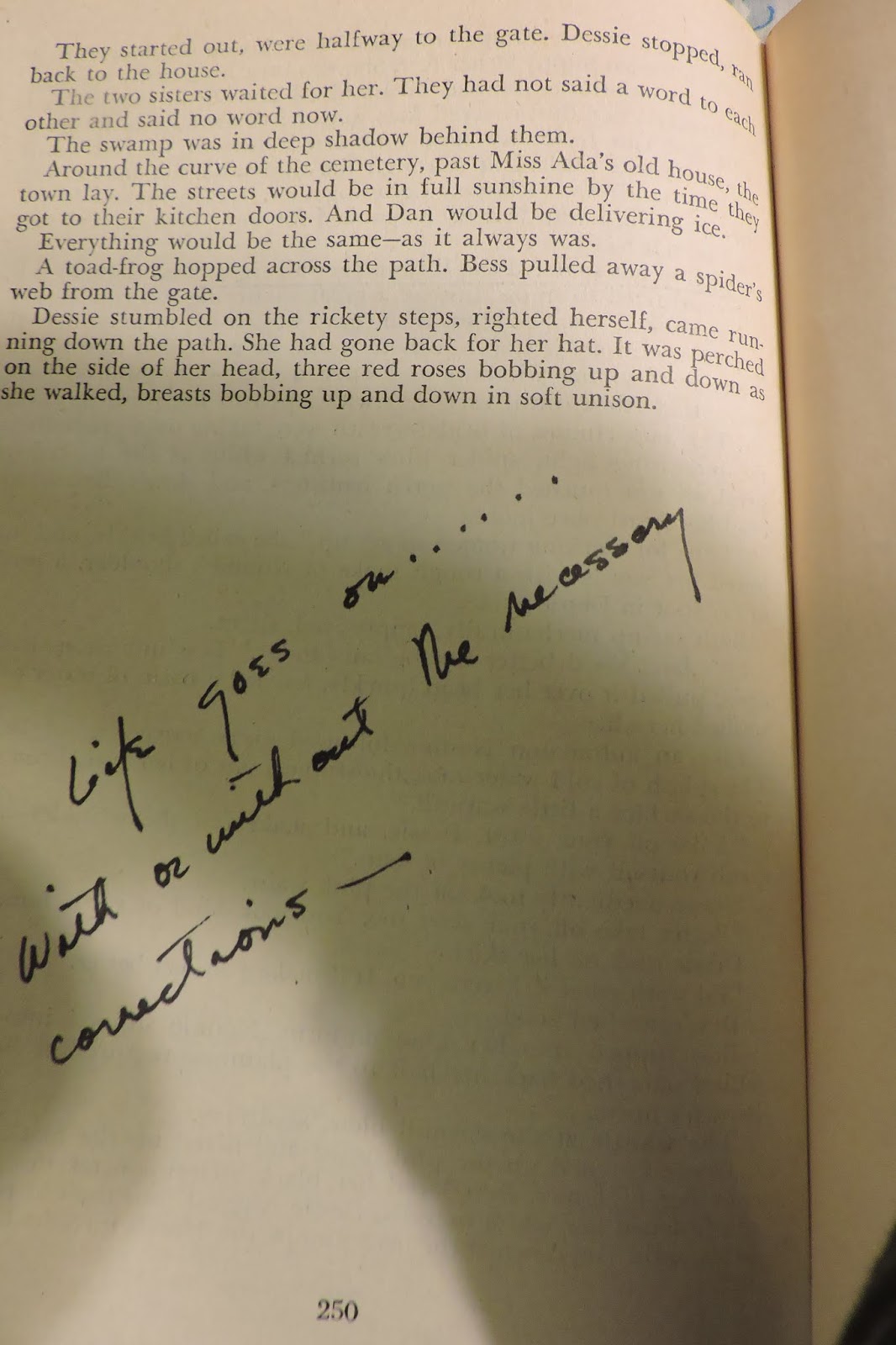
"Life goes on....... with or without the necessary corrections --"

***

Take it away, Billie Holiday:

Southern trees bear a strange fruit
Blood on the leaves and blood at the root
Black bodies swinging in the southern breeze
Strange fruit hanging from the poplar trees

Pastoral scene of the gallant South
The bulging eyes and the twisted mouth
Scent of magnolia, sweet and fresh
Then the sudden smell of burning flesh

Here is a fruit for the crows to pluck
For the rain to gather, for the wind to suck
For the sun to rot, for the tree to drop
Here is a strange and bitter crop

Monday, November 4, 2019

Green Day's American Idiot (Empty Space 2019)


Don't wanna be an American idiot
Don't want a nation under the new media
And can you hear the sound of hysteria?
The subliminal mind-fuck America
Welcome to a new kind of tension
All across the alien nation
Where everything isn't meant to be okay
Television dreams of tomorrow
We're not the ones who're meant to follow
For that's enough to argue
Well maybe I'm the faggot America
I'm not a part of a redneck agenda
Now everybody do the propaganda
And sing along to the age of paranoia

***

In doing my research for this post, I was startled to realize that the album, American Idiot, actually came out in 2004, which seems rather later than I thought. But I guess that is kind of the way it often works for me, given my, um, complicated, relationship with popular music. Maybe I should back up a bit and explain. 

Music is one of the most important parts of my life. I do not remember a time when I didn’t love music, and care deeply about music. Classical music in particular has been meaningful to me my entire lifetime. When I was very young, I remember snuggling in my parents’ bed after dark, listening to the classical program sponsored by a local utility. Somewhere around age 6, I saw a little friend of mine play a recital on violin, and I was struck by the idea that maybe I too could learn to play. I pestered my poor parents until they gave in and got me a violin and lessons for my 7th birthday. My mom probably deserves a sainthood for putting up with those first years until I got to the point where my playing was bearable. We didn’t have much money at that time, so even lessons were a stretch. But my mom also found a way to get a set of classical albums from a grocery store promotion, and from then on, classical has been a part of my listening. I worked my way from youth symphony to the grown up version around age 20, and have enjoyed making music with friends most of my life. 

So that’s the classical side. 

My dad always had a love for classic pop and rock from the 1960s, particularly The Beach Boys. I gained an introduction to that era from listening to the radio while driving around with him. 

Unfortunately, as I got to the age where I might learn the music of my own generation, my parents got into a bizarre bit of religious fanaticism on the subject of music. I don’t even remember the source or speaker on the tapes, but it basically tied all music that has an “African” origin - jazz, rock, pop, modern country, etc. - to “the devil’s music.” This idea was also a core part of Bill Gothard’s teaching, which dominated our family from my mid-teens onward.

This led to a huge tension in my life. I learned enough of the drums to play for our youth group and even fill in for the adult service. But I had to (more or less) lie to my mom that I played on beats 1 and 3 (God’s preference) rather than on 2 and 4 (the Devil’s beat). Which is - as any legitimate musician would know - utter bullshit. The history of Western music (and more) is that of bass on beats 1 and 3 and treble on 2 and 4. Basically, this whole thing was racism applied to music. Damn n----r beats, of course. 

So, my teen years were kind of a pantomime, in a way. Once I got my own car and license, I listened to stuff I liked (mostly learning the 60s and 70s on a good oldies station Bakersfield had at the time), playing music on drums, electric guitar, with actual syncopation. (Like, um, every classical composer too…) And, at the same time, trying not to freak my mom out any more than I had to. Which meant that I had to stay fully clear of anything actually modern on the radio. And certainly never listen to anything with a parental advisory on the cover. 

After I finally got a place of my own at age 22 - by which time the Internet had arrived - I had to go back and discover my own generation’s music. It has been a...process, shall we say. One thing I have had in my favor is a baseline of musical knowledge, which, along with a decent memory, allowed me to learn quickly. 

I do remember the first time I really listened to Green Day. It was around 1999 or so, when I was visiting friends (ironically, fellow Gothardites) who were a few years younger. We drove around Sonoma County in their Bronco and listened to forbidden music like Nirvana and Green Day - those were the two that stood out the most. Okay, and Weird Al Yankovic. 

It is hard to believe that American Idiot didn’t come out until a few years later, after I was married and had a couple kids. Somehow, the songs run together with the older ones of my first memory. 

So all this to come to the present. My eldest is, like me, a musical omnivore. This has meant a heck of a lot of fun, honestly. We saw Bohemian Rhapsody together (she’s a huge Queen fan), and we go to concerts and sing along with all the songs we know from the 60s to the 90s. When we saw that there was going to be a local production of American Idiot, we knew we had to go see it. 

I wasn’t entirely sure what to expect from the show. I got busy and didn’t have a chance to go through the album in detail and figure it out, so I had to kind of follow things as they came. 

The basic idea of the musical is a very barebones plot to hold together the songs themselves. The album is even more vague than the musical, of course. It has a basic idea, and the beginning of a plot, but it never really figures out what happens. Which is fine: it’s a concept album that just happens to have some amazing songs that have aged really well. 

If I had it to do over again, I would have gone ahead and read the Wikipedia plot summary first, to make things easier to follow. Basically, this is what it is: three friends growing up in a suburban dystopia decide to leave for the big city to find themselves. One ends up staying behind after his girlfriend gets pregnant. Another tires of the city quickly and joins the army, getting seriously wounded in Iraq. The third spirals down into drug addiction before deciding to return home. Which is what all three end up doing after their escapades. 

TES publicity photo  

Obviously, the plot isn’t the main point here. The songs are the thing, and they have stood up to time surprisingly well. Written three years into the Iraq War - which has turned out to have been the first in an 18 year (and counting…) debacle of absolute self-fuckery. The poets have turned out to be prophets in the end. 

To me and those like me, this wasn’t obvious at the time. I was all in on the war, having seen the towers fall. It was rah, rah, shock ‘n’ awe and this was totally going to work and be over fast and not turn into another Vietnam because this time we weren’t going to leave but were going to blow the bad guys to kingdom come and fuck the naysayers because the liberals were all a bunch of pansies and…

Well, here we are 18 years later. My children have never known a time we weren’t at war. We have caused, in all likelihood, well north of a million civilian casualties - innocent victims we euphemize as “collateral damage.” Saddam and Osama have been replaced by ISIS and others, and I can’t honestly say that any place in the Middle East is better off than before we intervened. (Although, to be fair, our disastrous interference dates back to World War I…) We have a generation of soldiers (as in Vietnam) who are traumatized by their experiences, causing ongoing issues with homelessness, suicide, and general dysfunction. And, as problematic as George W. Bush was (and I voted for him, twice, don’t judge), now we have gone far beyond him to the delightful combination of idiocy and virulent hatred that is personified in Trump. And it sure looks like Green Day was prophetic about the future, with Fox News and racist rednecks and bigoted theocrats in power. Good god. The poets (and musicians) have been and continue to be our prophets. 

So, a bit about this production. First, the bad. I found the vocals to be uneven, with some intermittent pitch issues. Combined with this (and perhaps causing it) was the challenging logistics. The Empty Space is a very small venue, in an older strip mall. Although they used mics this time - most shows have been pure acoustic - there is still no way to get around the acoustical challenges of the venue. For some shows, the vocals have been outstanding, but others, not so much. This one was a mixed bag. Interestingly, the best parts were the ensemble numbers. I get the feeling that the members of the ensemble cast were more comfortable singing under difficult conditions than the leads, and were able to carry the pitch. So, as a musician myself, there were some moments where I really wished the pitch had been better. 

On the more positive side, I loved that TES got some live musicians. In particular, Alex Mitts (who has been a favorite of mine as an actor and singer in past productions) rocked it on guitar and general enthusiasm in the on-stage band. (Two guitars and bass were placed at backstage behind a chain link fence.) Kudos as well to Scott Deaton and Luis Velez (who also act!) - I’ve played for musicals myself, and it is a freaking difficult and thankless job. 

The most major change that TES made from the original was flipping the gender of the lead character. Johnny, and part of the alter-ego “St. Jimmy,” were performed by Gari Galanski, which meant a lesbian love scene, and a somewhat different take on the character. Maybe it is just our culture, but I found her version less offensive than it might have been with a male lead. The love story with “whatshername” seems more equal and less “hump and dump” than with a guy, and the drug use more tragic and less “hey, look at me, I’m a heroic druggie!” than I have seen with male-oriented biopics. (Think the difference between, say, Hendrix, and Amy Winehouse…) 

 Johnny (Gari Galanski) and "whatshername" (Nancee Stieger) shooting up.
Oddly, I knew a heck of a lot more about heroin as a kid than I did about contemporary music...thanks to The Cross and the Switchblade and other religious books about drugs and gangs.

I should at least mention a few of the other performers. Kelsey Morrow carried the vocal duties for “St. Jimmy,” and she was the best vocal lead in the production. Jake Wattenbarger as Tunny captured the anguish of of war and injury - and looked a hell of a lot like Billie Joe Armstrong, although Armstrong never played that particular part. Nolan Long, a regular at TES, was rather strong as Will, the pothead loser who stays home. I don’t think I had ever heard him sing, but he was pretty good. And amusing as usual. Nancee Steiger who is good at everything, shined in her part as “whatshername.” And a few in the ensemble who always bring an amazing energy to the dance numbers. (Please don’t take it wrong if I don’t mention you - the ensemble was excellent and everyone contributed.) Corissa Garcia, Aron Clugston, Markelle Taylor, Kiera Gill, and Elizabeth Bomar, you guys stood out for energy and engagement. Rock on. 

 Will (Nolan Long), Johnny (Gari Galanski), and Tunny (Jake Wattenbarger)

 St. Jimmy (Kelsey Morrow)

As usual, I must commend The Empty Space for fantastic set design. From the floor (which had the entire song list) to the rolling couch to the slogans and posters on the walls, the atmosphere was perfect. Kudos to directors Perrin Swanson (no relation, but proud to share the name) and Mystie Peters for their vision for this. 

This show runs through the 23rd, so local folks might want to see it. TES is criminally inexpensive, so I never feel bad about grabbing a ticket and a cocktail or coffee there. Give it a shot.

***
Some personal stuff: 

During my first real crisis of faith this decade, a few Green Day songs have been meaningful to me. None more so than the quintessential misused graduation song, “Good Riddance.” That song was kind of my own personal anthem to both persons and institutions that were abusive to me and mine. Naturally, it has a badass violin part. If I hadn’t had a symphony concert in the middle of the run, I would have accepted the invite to be part of this production. Sigh. The sacrifices we make for art…

Anyway, I’ll just mention “Boulevard of Broken Dreams,” “Holiday,” “Extraordinary Girl,” “Wake Me Up When September Ends,” and “21 Guns” as additional favorites as songs from the musical. Again, “Holiday” seems to anticipate the Trump era in so many ways. Yeah, let’s embrace authoritarianism, wrap ourselves in the flag and faith, throw the Nazi salute at Il Toupeee, and kill the “fags” who disagree. Yeah, fuck that. 

So many of these songs speak to me. “Boulevard of Broken Dreams” is one of my all time favorite songs, and the video was filmed in my beloved Mojave Desert.  It has been a source of bonding with my eldest.

But is has to be “Good Riddance” that has been the genuine soundtrack for my break from, well, a lot of things. Evangelicalism, of course. But really, Billie Joe Armstrong wrote it as a breakup song for an ex, and it really captures the bittersweet essence of breaking up with...whatever. I have never had a nasty romantic breakup (that goes along with marrying your first real girlfriend - who is an amazing woman who you truly want to spend the rest of your life with), but I have had some truly traumatic breakups with my religious tradition and certain members of my extended family, some of whom I have retained a  relationship with - in a decidedly modified form - and others of which I have no relationship with because of their abusive behavior. And ditto for a few people in my religious history who went behind my back to propagate hate

Yet, when I look back, my personal and religious background also made me who I am. 

So take the photographs and still frames in your mind
Hang it on a shelf in good health and good time
Tattoos of memories and dead skin on trial
For what it's worth it was worth all the while

That’s absolutely me. I am, for better or for worse, a product of my upbringing. The good and bad of my parents, religion, religious leaders, politics, and extended family. My 40 years spent in Evangelicalism, my upbringing in Cultural Fundamentalism. Those memories and dead skin on trial - they made me who I am. Were they worth it? Hell if I know, but it’s not like I had a choice when it came to my family. And I can’t say I really should have known to reject my religious tradition until it became obviously toxic. There were good times too. It made me what I am, for better or for worse. 

But, as I have deconstructed things over the last decade or so, “Good Riddance” has been on my playlist for those late nights when I have been working through my baggage. In some ways, it has been permission to let go of those ideas - and people - who have been toxic in my life. 

Another turning point, a fork stuck in the road
Time grabs you by the wrist, directs you where to go
So make the best of this test and don't ask why
It's not a question, but a lesson learned in time

Those moments, those turning points in my past (and I can think of specific dates…) were indeed moments when time grabbed me by the wrist, and I had no real choice where to go. It wasn’t so much that I had a real decision to make, as that I had to learn a lesson. Evangelicalism wasn’t some benign religion, but a fucking white supremacist political movement. My family wasn’t ever going to truly accept the choices my wife and I made, but would insist on imposing 1850s gender roles and expectations on us. It was a lesson learned in time. I don’t really have to ask why (although I certainly do ask why, as a matter of theological necessity to myself), but I do have to learn the lesson. I hope I have. 

But at every major turning point in the road over the last decade, I have played this song as I have tried to deconstruct my own trauma. There is something about it, the combination of rejection of the past with the acknowledgement that who we are is totally about the reality we were raised in, that resonates with us Fundie survivors today. I wouldn’t give up who I am, even as I acknowledge how my past has traumatized me. And yes, Green Day is part of who I am as well. And for that I am thankful. 

Friday, November 1, 2019

All the Single Ladies by Rebecca Traister


Source of book: Borrowed from the library.

Where to even begin with this book? There is so much to say, and so many things in it which need to be better understood. 

Let me start with this: I was raised in Cultural Fundamentalism, which can probably best be understood as fighting to return to a mythical golden age. A key part of the myth and perhaps the biggest driving force in the Culture Wars™ is that of the supposedly ideal gender roles and hierarchies found in “traditional” marriages of the past. You know, where the man made all the money, the woman did the childcare and housekeeping, and everyone was happy...and if they weren’t they should be, damnit! 

Thus, a key sign of what they saw as cultural decline was the cultural shift away from women marrying young, having babies, and keeping the hell out of the halls of power. “Feminism” was seen as the great satan, the malevolent force which told girls that they could make their own choices, have their own lives, make their own money, and indeed exist without being owned by a male. 

Whatever I may have believed (or at least tried to believe) in my teens, I thoroughly rejected that paradigm when I left my parents’ home and established one of my own. When I fell in love with the woman who would become my wife, I knew that her decision to marry me was conditioned on our agreement that we would most certainly NOT have a “traditional” marriage. She was clear that she would have a career, and I knew that meant that both of us would have to make the adjustments necessary to make that happen. In practice, this has meant that she has worked nights and I have worked part time with a flexible schedule, so that our children have had a parent present. (We had some help from my mother-in-law when the kids were little, which we greatly appreciated.) 

Our marriage is, in a very real sense, non-traditional. She is more ambitious and driven, while I am more nurturing. It is just who we are, and traditional gender roles wouldn’t work for either of us. 

I tell this story because it really does fit in with the book. While primarily about singleness, it also discusses the way that singleness as a viable option for women has changed the entire landscape. It has, in fact, revolutionized marriage itself. Thus, the book isn’t “against” marriage (and the author is, in fact, married with kids) - but it does explore the implications and results of female independence.


The book can be divided into two main topics. The first is the history of single women, primarily in the United States. Pretty much every civil rights or social movement has drawn its force from single women. That includes causes from the abolition of slavery to voting rights to unionization to the civil rights movement. The second topic is the modern reality of increasing singleness. Marriage ages have risen dramatically (and are now higher than the average age of first birth), and a historically large portion of the female population is single. Traister looks at why this is, and also at what it means for society. Unlike the usual right-wing pearl clutching about cultural decay and such, she examines it as the natural result of women having - and making - choices about their own lives. 

There are so many outstanding passages and quotes that it is impossible to list them all. I did write down a bunch, though, and want to go through them a bit in this post. 

I also want to recommend a companion book to this one: The Way We Never Were by Stephanie Coontz, which looks at the myth of the “stay-at-home mom,” and how it is a historical anomaly and strongly connected to racism. Coontz is cited frequently as a source in All the Single Ladies - primarily her research into marriage and women in American history. 

Nellie Bly: “What do you think the new woman will be?”
Susan B. Anthony: “She’ll be free.”

This quote opens the book. And I think it captures the ultimate goal of feminism: to make women every bit as free as men have been for millennia. So why is this so controversial? 

The introduction is fascinating too. Traister explains that she hated it when the heroines in her books got married. Because marriage was the end. As in, it was the end of the woman as an interesting person. All the life and motion and vivacity of her childhood ends, and she becomes, well, a wife and mother and ceases to be interesting. This is, of course, a shame - but it is something I myself have felt reading literature. Traister loved Anne of Green Gables - as did I (I had a huge crush on Anne in Jr. High), but I never could get into the books after the first four. Because Anne just wasn’t much fun after she got married and had kids. All those hopes and dreams and adventures and passions...well, they “had narrowed, and now seemed to lead only to the tending of dull husbands and the rearing of insipid children…” And, while I am sure that most of us real-life husbands aren’t quite as dull as the ones in books, this is very true about the literary sorts. Gilbert isn’t much fun after marriage either. But shouldn’t adulthood and even marriage with kids be full of all those hopes and dreams and adventures and passions? 

Susan B. Anthony, who never married, is quoted again at the end of the introduction.

As young women become educated in the industries of the world, thereby learning the sweetness of independent bread, it will be more and more impossible for them to accept the...marriage limitation that “husband and wife are one, and that one the husband…” Even when man’s intellectual convictions shall be sincerely and fully on the side of Freedom and equality to women, the force of long existing customs and laws will impel him to exert authority over her, which will be distasteful to the self-sustained, self-respectful woman… Not even amended constitutions and laws can revolutionize the practical relations of men and women, immediately, any more than did the Constitutional freedom and franchise of Black men transform white men into practical recognition of the civil and political rights of those who were but yesterday their legal slaves. 

Anthony then predicts that, logically, when women gain their economic, social, and political rights, they would usher in an “epoch of single women.” And lo, it has come to pass. 

(Side note here: the anti-abortion lobby loves to claim Anthony as one of their own. But the evidence strongly indicates that she would have had no use for their patriarchal crap.) 

The rise of single women as a significant demographic has had a number of effects. One that Traister mentions that I found intriguing was the connection between single women and LGBTQ rights. Here is something to consider:

The journey toward legal marriage for gays and lesbians may seem at odds with what looks like a flight from marriage by heterosexuals. But in fact, they are part of the same project: a dismantling of the institution as it once existed--as a rigidly patrolled means by which one sex could exert legal, economic, and sexual power over another--and a reimagining of it as a flexible union to be entered, ideally, on equal terms.

Later in the book, Traister looks in more detail at the way that same-sex marriage has changed expectations in heterosexual marriages. 

If there are broad distinctions to be made between the nature of same-sex female pairs versus heterosexual ones, it’s that the same-sex unions have not entailed one of their members being automatically accorded more power, status, or economic worth based entirely on gender.

And THIS is what I mean when I call my own marriage “non-traditional.” We entered our marriage on equal terms, with the aim of flexibility. And never, ever, ever, as an institution which would allow me to exert power over her. 

In the long run, I believe this will be one of the biggest legacies of same-sex marriage: it will lead a complete rethinking of the institution, changing it from one of power to one of mutuality and love. 

After this bit, Traister takes a look at the Culture Wars™, specifically, the preservation of the (mythical) past. She looks at a few of the old white dudes who predicted that the power of the single female voter was destined to fade, because they would die out. This, as Traister points out, makes two ludicrous assumptions.

[Joel] Kotkin’s error, of course, is both in assuming that unmarried people do not reproduce--in fact, they are doing so in ever greater numbers--but also in failing to consider whence the gravitation away from married norms derived. A move toward independent life did not simply emerge from a clamshell: It was born of generations of dissatisfaction with the inequities of religious, conservative, social practice. Why should we believe that children born to social conservatives will not tread a similar path, away from conservative values, as the one walked by generations of traditionally raised citizens before them? The impulse toward liberation isn’t inoculated against by strict conservative backgrounds; it’s often inculcated by them.

 And that is it in a nutshell. I was raised ultra-conservative, as was my wife. And we both found our background to be a strong motivation to live very different lives than we experienced. 

Traister also takes a hard look at history. As Coontz explores in detail, the idea of limiting women to the home is, in some ways, modern. It is a product of the industrial revolution. With fewer people working in agriculture, and children no longer vital to economic success, something had to change. Alas, what happened was the sequestering of women to a narrow (and rather powerless) sphere, removing them from the visible political and economic life of the nation, while relying on them to do the unpaid drudge work necessary for men to work outside the home. 

Traister points out an extremely interesting phenomenon in this regard. As machines made household tasks quicker and easier, women had less that they had to do. (Seriously, compare hand washing clothes with a washing machine, or building a fire to cook with turning on a burner, to name just two.) 

Everyday tasks were made more time-consuming and taxing, so as to better fill the days of women who might otherwise grow restive and attempt to leave the house.

Exactly. Homes have expanded dramatically in size. (So much more to keep clean and decorated!) Children that used to have lots of unstructured time now have hours of homework and extracurricular activities that they must be doing or you are a bad parent. (The whole helicopter parent phenomenon exists to fill the lives of unhappy mothers, in my opinion.) Entertainment must be lavish. (Hey there, Martha Stewart!) And, in the more Fundie households, homeschooling is mandatory - a full time (if uncompensated) job requiring a woman at home. This is the modern manifestation of the phenomenon, but it dates back to the early 1800s - Traister quotes a number of publications from the era.

Moving forward a bit in history, Traister mentions the intimate connection between feminism and abolitionism. You might think, perhaps, that the subjugation of women and the subjugation of non-whites could be related. And you would be right. And not just about the connection back then, but in our own times as well. Almost universally, you will find that misogyny and racism go hand in hand. 

In this section, Traister also mentions one abolitionist and feminist who did marry: Lucy Stone. I must say, she was amazing. She was the first woman in the United States to keep her name after marriage, and she forewent the usual vows (including a promise to obey her husband) in favor of reading a protest against marriage laws. Her husband, in case you wondered, was also an ardent feminist, and fully on board with this. You can read the whole thing online here, but how about this badass opening?

While we acknowledge our mutual affection by publicly assuming the relationship of husband and wife, yet in justice to ourselves and a great principle, we deem it a duty to declare that this act on our part implies no sanction of, nor promise of voluntary obedience to such of the present laws of marriage, as refuse to recognize the wife as an independent, rational being, while they confer upon the husband an injurious and unnatural superiority, investing him with legal powers which no honorable man would exercise, and which no man should possess. 

In addition to timelessly great causes like abolition, single women also ignited the Prohibition movement. While that turned out to be a disaster on many levels, it didn’t come out of nowhere. Traister makes an excellent point:

There may be no greater testament to the suffocating power of marital expectation than the fact that, for a time, the banning of booze seemed a more practical recourse against spousal abuse than the reform of marriage law or redress of inequities within the home. 

Another bit of history that was interesting was on the topic of abortion. For centuries, abortion was largely the province of women - herbal healers with the knowledge necessary. Abortion was legal in many cases, believe it or not. However, as part of the backlash against feminism, there was a legal crackdown on the means by which women could evade or exert control over the “benign offices of wife and mother,” which was considered their destiny. That’s why abortion restrictions have always gone hand in hand with attacks on birth control and accurate sex education. Again, you can see this exact same thing happening today. The anti-abortion industry is now openly opposed to birth control and fights against scientifically accurate education. Why? Well, women might take control of their own reproduction - cutting men out of the loop perhaps. 

In the 1920s, another major shift occurred, one which is not talked about in conservative circles. Prior to the 1920s, it was commonplace - nay, normal and expected - for a young man to have his first sexual experience with a prostitute. Well, if he didn’t have it by raping a slave girl, perhaps. The price of the preservation of [white] female “purity” was widespread prostitution and rape of human chattel. However, the abolition of slavery, while it didn’t eliminate the problem of rape (which very much continued - a white man might get fined for raping a black woman or child but that was it), did give black women the option of leaving the situation rather than submit to further assaults. In the 1920s, the second shift occurred. “[Y]oung middle-class men were more likely to lose their virginity with women of their own class than with prostitutes.” Think about the magnitude of that shift. With it came what conservatives keep lamenting: women were far less likely to be virgins on their wedding night. 

Here’s another interesting parallel between the past and present. When Margaret Sanger founded what would become Planned Parenthood, there was a backlash that had some really unsavory overtones. While I admire some things about Theodore Roosevelt (his advocacy for public lands, his trust-busting, his progressive-for-their-time ideas), he was, like most of his era, racist. He disliked Sanger and the idea of birth control because he believed it kept the white birth rate down, thus leading to what he called “race suicide.” Ouch. “A race is worthless if women cease to breed freely.” Double ouch. But you see this today, notably in Evangelical circles. They don’t use explicitly racial terms (like the more Fundie groups absolutely do), but they use some nice dog whistles. Hence Al Mohler’s Freudian slip when he condemned women for choosing to be childless (making them, as he said, not fully human) - he actually said that childless people don’t tend to vote for Trump. Hey, you know who else doesn’t vote for Trump? Non-white people. And no, I do not think that was an accident. It’s the same recycled rhetoric about brown people reproducing faster than white people, just with dog whistles. I grew up in that nonsense. 

(Another side note here: one of the reasons that I think the anti-abortion movement is evil is that they lie incessantly about everything from science to medicine to history. One of the biggest is the gross slander of Margaret Sanger, wherein they “quote” from one of her letters...leaving out the part that makes it clear that she intends the exact opposite of what the anti-abortion industry claims.)

Speaking of racism, I think one of the strongest chapters in the book is the one that looks at the decline in marriage in African American families. Those of us who grew up conservative were taught that black poverty rates were driven by black women spreading their legs before marriage. And that the cause of that was social programs. (Never mind that more whites are on welfare than blacks, of course.) Traister takes a look at the real history. In the 1950s - before the social programs in question - black marriage rates declined. She looks at how explicitly racist policies excluded blacks from the heavily subsidized programs for whites that gave rise to the suburban family phenomenon. From jobs to housing to education to even Social Security - blacks were excluded. 

Here’s something for consideration: what if African Americans are neither stupid nor more immoral than white people? What if they too respond to circumstances in as predictably human fashion as we white people do? It is this question that nudged me away from my conservative beliefs after I got out of the bubble of childhood. I think Traister’s writing is strong on this issue. She makes a solid case for why marriage is not an advantage for everyone. And in particular, why marriage makes things worse for people in grinding poverty or in communities decimated by mass incarceration. In her evisceration of “pro-marriage” government seminars, Traister cites evidence that addressing poverty itself raises marriage rates. 

It seems clear that a government address of poverty is likeliest to make marriage more accessible to those who want it, while programs designed to shove marriage down the throats of Americans least equipped to enter it stably have little impact. If politicians are concerned about dropping marriage rates, they should increase welfare benefits. It’s that simple.

This is backed up by substantial evidence, by the way. But, as the Trump era has proven, conservatives have zero interest in actually improving life for the poor, who they view as undeserving. It is, and always has been, about racism. I would recommend this book for that chapter alone. 

Another great chapter is on the advantages of singleness - and delayed marriage. Conservatives (and patriarchists in particular) tend to push for women to marry young. Before they get too “independent.” (Yep, I grew up in that shit.) Traister points out that women are faulted for being “selfish” when they insist on the same self-determination as men have always had. For example, women have been expected to pick up and move to follow the man’s job. A man who did the same would be mocked as “whipped.” A man is entitled to build his life around his interests, but a woman who does so is often denigrated. (And always denigrated in Fundie circles. Believe me on that one.) Citing one of the many screeds against single women, Traister notes that it was “pathologizing unmarried women as flawed, sneakily laying out [the] self-interested female subject in comparison to a set of deeply ingrained cultural expectations: that a woman who really wants love and who is worthy of being loved should be willing to put her priorities second to those of a mate.” 

In my own experience, there will always be a tension between the desire to be partnered, and the desire for independence. But for men, that tension didn’t really exist until recently. A wife was there to support her man’s dreams. I was literally taught that. But in my non-traditional, egalitarian marriage, we both support each other’s dreams. And we have to compromise, because we are two different people with different desires and areas of interest. Sure, our dreams overlap quite a bit - that’s why we are married rather than single - but both of us have had to give up a bit so the other can have what they need. It’s worth it for what we gain. 

I have long said that the single most effective way for a woman to change the dynamics of a marriage (particularly a future marriage) is for her to have her own income. It literally changes everything. While Fundies fuss and fume about this, I have found it to be a much improved dynamic. This is also why the younger generations believe in being financially “set” before marriage or kids. 

They [women] see their own economic stability, their jobs, as a “defense against patriarchal sex role expectations and a defense against bad behaviors” including substance abuse, cheating, and domestic violence, as well as “insurance in case of a breakup. “They’re worried,” said [researcher Kathryn] Edin, “that if they don’t earn money they won’t have the power to negotiate for equal say in the relationship.” 

Again, this is exactly what I see in the marriages of people I know. While it is certainly possible to have a good marriage with economic inequality, it is hard to have a truly equal one. 

How about this irony: egalitarians are much more likely to get married and stay married. 

The great irony is that, as much as conservatives rage against the dying of traditional gender roles, by many measures, it’s the people who are messing with the old marital expectations who might be credited with saving marriage as an institution.

Much has been written about the malaise in Japan. An aging population, plummeting birth rates, shrinking workforce, and a generation seemingly uninterested in relationships and marriage. There have been a number of theories floated, and some have some truth in them. As in many other countries, concern about the future makes marriage less likely. The last several decades of neo-liberal economic policies have made younger people less well off than their ancestors, and they are not as optimistic about what their future will look like. I think, though, that there is a significant piece missing as to why Japan in particular has issues. 

Traister ties the best of the theories together with an idea that seems startlingly obvious once you see it. Japanese culture is based around an extreme version of patriarchy. Work hours are brutally long, and do not allow the needed time to care for children or build a home life. Traditionally, this was done by women, but, as women have become educated and had their first taste of an alternative, they have rejected the idea of becoming a servant to a man. Women can now earn a living, but they find that they still face the same domestic expectations from men. 

Guess what this led to? The fact that 90% (!!!) of young Japanese women told surveyors that they would rather stay single than enter into “what they imagine marriage to be like.” That’s a problem. If gendered marriage expectations are so bad that 9 in 10 women run away, then you are going to have a “celibacy problem.” Traister notes as well that there is a strong correlation worldwide on this issue. Countries with strong patriarchal expectations of women end up with lower marriage rates. Young women forgo marriage, and young men live at home as adults so their mommies can do their laundry and cooking for them. Grow up already. Countries with egalitarian cultures actually do better. Traister is pretty optimistic about the United States on this score - she sees the US as more willing to change due to its culture, loud Fundies notwithstanding. 

I think there is some truth in this. There has indeed been a massive shift in the culture. (Which is what terrifies Fundies.) Even in the days of Susan B. Anthony and Nelly Bly, Anthony could say that while men used to be afraid of suffragists, they now sought them out. At one time, educated women were less likely to marry. Those days have been gone for a while. Now, educated women - and employed women - are more likely to marry. They have become desirable because male tastes have adapted to change. At least in the circles I run in, most men my age, honestly, prefer smart, educated, and employed women. It’s a turn on. The shift, Traister believes, came because of single women who pioneered the entry of women into the workforce and other formerly male-dominated areas. 

More than that, unmarried women alter assumptions about women by working alongside men who come to see them as colleagues and bosses; by drinking beer and arguing politics with men who come to regard them as friends; by having sex with men who (hopefully) come to understand that sex does not mean ownership. By existing on their own terms in the world, women force men to reckon with them as peers and as human beings, not simply as subordinate helpmates or sexual objects.

Preach it! As American Evangelicalism and conservatism continue their dance down the path of misogyny and patriarchy, they will continue to lose the younger generations, who have experienced women as peers. As colleagues and bosses, friends and companions. 

I’ll end, as Traister does, with a bit about how society and government need to change. Much ink has been spilled by conservatives about how single women “expect the state to do for them what should be done by a husband.” I admit I bought into that in my youth. But it didn’t stand up well to real life. As the example of Japan shows in its extreme form, society has for centuries been set up to subsidize traditional male dominance. I could write an entire post on the ways in which female-dominated professions are paid less and have worse benefits than male-dominated ones. Or how subsidies and tax breaks shift money to wealthy (white) men. The system is set up to maintain male independence with the expectation that women will meekly get in line and work their asses off to maintain that, at the expense of their own independence. A truly just society would ensure that women receive the same financial compensation - and control over that compensation - as men do. And culture would then have to adapt to men taking an equal share on those unpaid duties of care. Guess what? We men can adapt - and we will have to, or we will increasingly be viewed by women as a bad investment. 

This book has so much in it, I just covered a few highlights. The bottom line: when feminism freed women from their status as chattel, and brought them closer to economic, social, and political equality, it brought significant social changes. Among them was that, given actual choices, women increasingly have rejected the rather one-sided “traditional” marital and gender role expectations. Humans have, as they always have, adapted to changes. Many women chose to be and continue to choose to be single - which I believe is far superior to being in a bad marriage. But men too have adapted - I have. And ultimately, there is no point in trying to preserve an unjust social relationship wherein one party owns and dominates the other. Marriage can be a good thing. But so can singlehood. And women are entitled to be considered fully human, with the same right of self-determination as men. Period. 

***

I couldn’t figure out where in the flow to put it, but I should mention that astronomer and all-around badass Maria Mitchell is quoted in connection with the tension between independence and partnering. Her poem, “How Charming Is Divine Philosophy,” is quoted in part. I can’t find the whole thing online, alas. 

***

I have probably mentioned this elsewhere, but it meshes with this post: my wife believed she would never marry. She had seen patriarchy up close, and had absolutely zero interest in having that kind of a marriage. She would have been one of the Single Ladies of this book. As it happened, she met and fell in love with me - at a young age, no less - and we ended up together. But she would have ended it if I had shown the least inclination to dictate her future to her. I am honored that she chose to share her life with me, make children with me, and conspire against the world together.