This post is part of my series on the National Park System.
One of my goals while the kids are still at home is to visit as many of the
National Parks and Monuments in the Western United States
as we can.
Southern Utah may very well
have the most concentrated set of natural wonders anywhere. (If you combine Utah with northern Arizona,
I bet you would.) Within a few hours drive of each other are no fewer than five
national parks and numerous national monuments. The parks get most of the press
- and traffic: Zion,
Bryce, Arches,
Canyonlands,
and even Capitol
Reef.
But don’t sell the monuments short. They are often less
crowded and more akin to wilderness. One great example of that is Cedar Breaks
National Monument. I am
embarrassed to admit that in 30 years of visits to Utah, it tool until 2016 to finally visit
this little gem. I had actually driven by it a few times on the way to Bryce,
but had never actually stopped there.
My wife attends the Utah
Shakespeare Festival (usually with a friend) every year for the last few,
and she actually beat me to Cedar Breaks - she and the friend took a morning
trip there, because it is pretty close to Cedar City. Our whole family traveled
there in 2016 both for some of the fall plays, and to visit the various parks
in the area.
Cedar Breaks is often called a “little Bryce.” It has the
same basic features: a canyon system with hoodoos and bright colors. It is
steeper, though, and there aren’t really trails down into the canyons except on
the one end. It is also quite a bit smaller and intimate. The biggest
difference, though, is the setting. The rim of Bryce is at 8,000 feet
elevation, which is cold enough during the winter. But at 10,000 feet, Cedar
Breaks tends to be cold and windy even in the summer - and it closes entirely
during the winter season. Because of the altitude, the wind, and the
temperatures, visitors should come prepared. Bring a jacket, even in the summer.
Just in case.
One thing the altitude does bring is marmots. I see these in
the high sierra all the time, but it was nice to see them here too. (For those
unfamiliar with them: if squirrels played football, marmots would be the
offensive line and the nose tackle.)
The views at Cedar Breaks are fantastic, and they can be
reached with a few moderate or easy hikes, depending on how far you want to go.
The rangers are friendly and helpful; and, because of the low number of
visitors, they actually have time to talk.
If I were advising someone new to the area as to a trip
here, I would recommend the following: First, plan on coming during the summer
or early fall, when the snow is gone. Cedar Breaks doesn’t open until the roads
are clear. Second, plan to catch a play or two at the Shakespeare Festival, which runs
(conveniently) during most of the time Cedar Breaks is open. Third, since Cedar
Breaks can be seen in one day, plan to visit other nearby places. In cooler
weather, Zion and Snow Canyon
State Park are lovely.
(Try to avoid Zion
on weekends, though - it can be super crowded.) If the weather is hot, Bryce
will be a cool relief. I also recommend seeking out Kanarraville Falls,
a little slot canyon with a beautiful waterfall.
There were quite a few wildflowers - even in September. It's a short growing season.
Marmot.
Yes, that's a Bristlecone Pine. Not as old as the ones in California or Nevada, but striking nonetheless.
I love the contrast of colors.
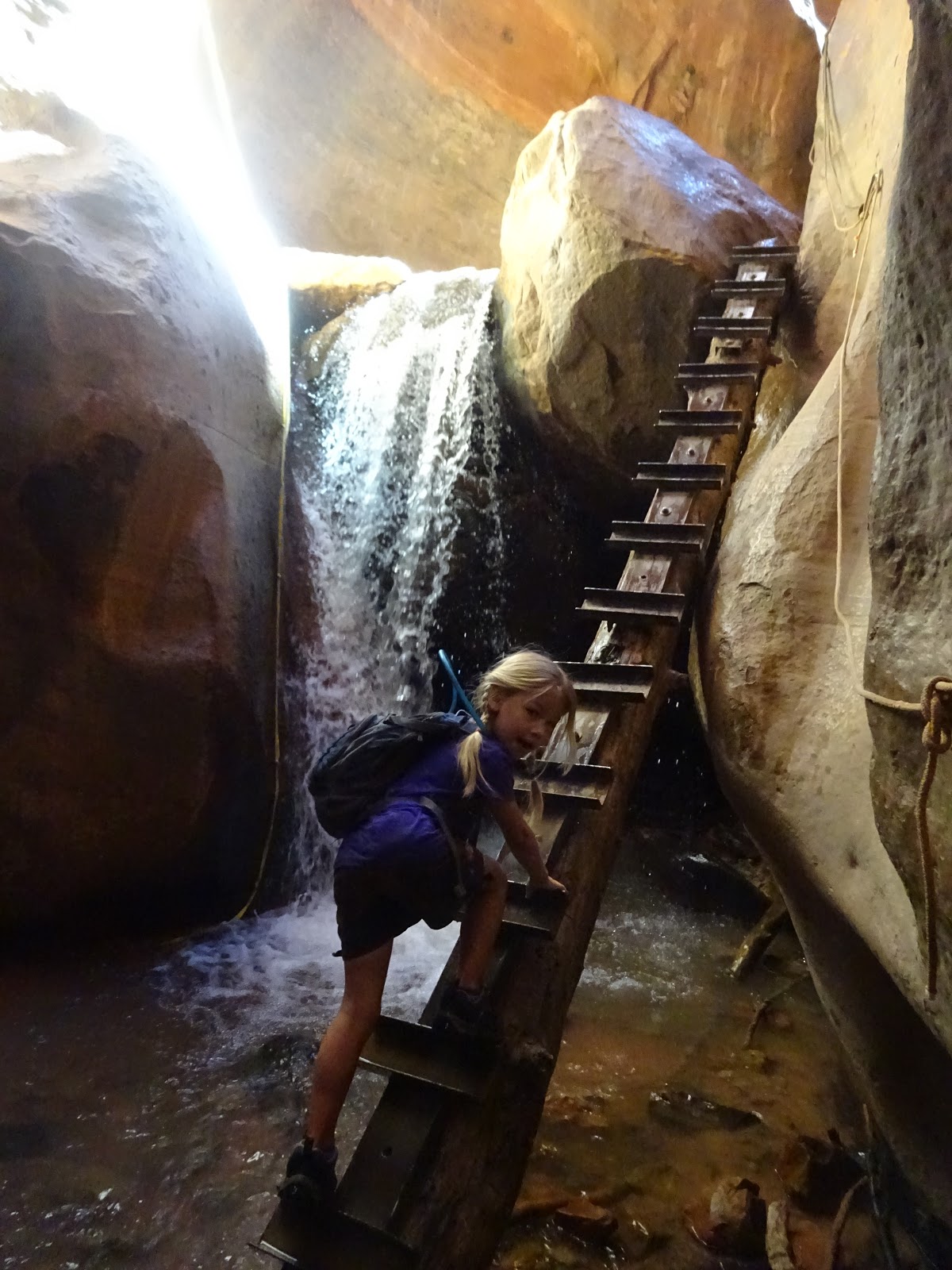
And, for good measure, here is Kanarraville Falls.
My youngest was age 5 when this picture was taken.
This post is part of my series on the National Park System. One of my goals while the kids are still at home is to visit as many of the National Parks and Monuments in the Western United States as we can.
I have a particularly special relationship with Zion National Park. I believe I was age 11 or 12 when I first visited - very briefly. We were on our way home from the Grand Canyon, having seen first the south rim then the north rim, and we decided to drive through the park on the way to St. George. I don’t think we even had time to drive the canyon itself, so we saw the east part of the park and the tunnels and not a whole lot more. But it was enough that we determined to come back and soon. It must have been later that year or maybe the next spring that we planned a trip solely to see Zion, and hiked a few of the shorter trails.
That was the beginning of a love affair that brought us back to Zion at least twice a year. Living first in Los Angeles, then near Frazier Park, and finally in Bakersfield, St. George was all of six and a half hours away, and the park less than an hour from there. Often, we would leave at midnight, drive straight to the park for an early start, hike until mid afternoon, then soak in the hot tub at the hotel, hike the next day, and drive back the day after, for a long weekend of at least ten miles of hiking and exploring. Each time, we would try to take someone who had never seen Zion with us.
I remember that first time at age 12 ascending Angel’s Landing. We were fairly inexperienced at strenuous hiking, and we were so sore afterward that getting to the second floor at the hotel was painful. But the views were so spectacular, we purposed to hike that route as often as we could. Angel’s Landing remains one of my favorite hikes - and it has been both thrilling and terrifying to introduce the kids one by one to it.
(The last half mile is on a knife edge with sheer dropoffs literally 1500 feet straight down on each side. You have chains to hang on to - it isn’t for the faint of heart. The heights didn’t bother me as a kid. Watching my kids now, it is a whole different ballgame.)
I also remember the time when I was a teenager when we hiked the Kolob Arch trail in a day. The 15 miles wasn’t the problem - it was fairly flat. It’s that the whole trail was this deep soft sand. We were so dead by the end, then we had to hike up about 400 feet of elevation to the trailhead - and a summer thunderstorm blew through. Soaked, hoping not to get hit by lightning, and dead exhausted. Good times.
After I moved out in my early 20s, we had a bit of a gap in our visits. Life got busy, I wasn’t flush with cash, and I had a girlfriend who I couldn’t exactly take along, as much as I wanted to. (Both of our parents would have strongly disapproved of such a scandalous thing…)
After we got married, things were obviously different. We visited together during our first year of marriage. Of all the odd things to remember about that trip, I recall watching the Lakers and Kings battle it out. (The end of the 2000-2002 dynasty.) But also, it was Amanda’s first trip up - where else? - Angel’s Landing. (Her dad is a legendary hiker, but he cannot do heights at all.)
Our next trip was when our eldest child was a year old - and Amanda was six months pregnant with our second. (Yeah, our first three kids are ridiculously close in age. Crazy times.) I had Ella on my back in a backpack and Amanda was rather gravid. So naturally, we tackled a trail 10 miles round trip with 2000 feet of climb. Because we could. We both remember her blowing by some college aged guys who gave her dirty looks because they couldn’t keep up. I just about died hanging with her myself. (In fact, my knees hurt so much on the downhill that I worried I was going to have to give up hiking. Instead, I made a lifestyle change toward regular exercise, taking up first soccer then running and making sure I did it 3-4 times each and every week. It made all the difference in the world, and the kids and I hike 120-150 miles together each year these days.)
Since then, we have gone back more or less every other year. My oldest two daughters have been up Angel’s Landing with me, and all the kids have gone to the overlook just before the chains on their own two feet. Last year, in our most recent visit, the two of them went partway up the Narrows with me, which was a fun adventure.
So what is Zion? To put it one way, it is a gigantic fossil. The sandstone cliffs are 3000 feet tall - they are petrified sand dunes from the ancient past. Actually, the entire area is a remarkably intact section of the geologic column. You can go from the bottom of the Grand Canyon to the formations on the mountains above Bryce Canyon National Park and traverse nearly a billion years in history.
The layers at Zion are particularly thick, and they are revealed by the action of the Virgin River, which has carved a slot through the sandstone, making a dramatic and unforgettable canyon. Even taking the shuttle through the canyon drive is a spectacular experience, but you really must get out and hike to get the full experience. Don’t expect solitude, but the spectacular views are worth it. Also, just like anywhere, the further you get away from the road, the fewer people. A short hike like the Emerald Pools (which you should do) will be crowded. The top of the overlook on the East Rim is less popular because of the long and strenuous hike to get there. Likewise, if you take the road toward the Kolob reservoir, most of those trails are empty during the week. The Kolob section of the park is also a great place to hike, with fewer people. The cliffs aren’t as high, but you get some excellent slot canyons.
Zion has always been a popular park, but the last decade or so, crowds have increased a lot. It is worth it to visit during the week, if you can - and definitely NOT during Spring Break. (They had record crowds, and despite an excellent shuttle system, parking was full by 8 AM many days.) The best times to visit are in Spring and Fall, but the park has its charms other times of the year. If you go in summer, hike early, and bring a lot of water. The sandstone concentrates the heat, and there isn’t much shade. I haven’t been there in the winter, but I think it could be interesting then as well.
If you have the time, there are also other places to see in the surrounding area. If you are there in the summer or fall, Kanarraville Falls is an amazing slot canyon we discovered last year. No technical skills are required. If you want solitude, get an early start. Snow Canyon State Park is also a delightful spot, with several short hikes with good scenery. It too is rarely crowded. Bryce Canyon National Park, Cedar Breaks National Monument, and Pipe Spring National Monument are all relatively close destinations. There is also a museum in St. George with dinosaur tracks that were discovered there. It’s a worthwhile place to visit.
Hotels in St. George are ludicrously inexpensive, which is why we don’t generally camp there. Good food can sometimes be difficult to find in smaller Utah towns - St. George is heavy on burger chains, for example. But there are some good exceptions here. We are particularly fond of the Mongolian BBQ place - a little hole in the wall that knows our family well. The Bear Paw Cafe is a good place for breakfast and coffee. Recently, a brewpub opened right by the entrance. Due to quirky Utah liquor laws, you have to have food if you want booze. But the food is solid, and the beer quite good, particularly after a hot hike. I’m happy to see places like these pop up. (One observation from our travels in small towns in flyover territory: brewpubs often have higher quality food - more imaginative and less 1950s - than other places. Yelp is your friend too. The 21st Century is looking to be a golden age for us foodies.)
From 2004: The very small Ella and a younger, thinner me. The backpack finally died after the fifth kid, but I am still hiking with that hat and stick - both of which I have had since my teens. The hat was from a tourist trap near Zion. The stick is diamond willow from Alaska, which a friend brought back for me. I sanded it and give it a new coat of tung oil finish every few years.
Amanda in 2004. She was 6 months pregnant with Cora here. This is at the entrance to Echo Canyon, on the East Rim trail.
Ella, Cordelia, and Amanda in 2006. Ted would have been an infant that year.
This is the Virgin River on the Gateway to the Narrows trail.
Cordelia, Ella, and Ted on the Emerald Pools Trail in 2009.
Ted, Ella, Cordelia, and Fritz on the Angel's Landing Trail, 2011.
Ella, Fritz, Amanda, Lillian, Ted, and Cordelia on the "Walter's Wiggles" section of the Angel's Landing Trail, 2013.
Real trails have curves. These are the lower switchbacks on the Angel's Landing Trail, viewed from the bottom of Refrigerator Canyon.
Ella on the edge of the world. This is the sheer north face of Angel's Landing,
literally 1500 feet straight down in front of her. (2013)
Cordelia, Ella, and me in the Narrows, 2016.
A better view of Walter's Wiggles, 2016.
Ella and Cordelia on the top of Angel's Landing, 2016.
Trying to capture the scope of Zion with a camera is difficult.
Source of book: Audiobook from the library - but I own the entire series and read it multiple times as a kid.
If you haven’t discovered the Great Brain series, you really should. The semi-autobiographical series set in Utah at the end of the 1800s by John Fitzgerald is really quite funny, yet full of more serious stuff than you might imagine. The basic setup is the same for each book. John D. is the youngest Fitzgerald sibling, and he narrates the story. The parents are Papa, an Irish Catholic, and Mama, of Danish descent. (The real life Mama was a Mormon, but in the books, she is Catholic as well.) The oldest kid, Sweyn, is a pretty typical kid; but Tom is a bit too smart for his own good, and proves to be a con man in the making. John is the gullible little brother.
The family lives in the (mostly) fictional town of Adenville, Utah, in the “Dixie” southwest part of the state. The author was raised in Price, Utah - as was my father-in-law. Adenville is mostly fictional because it appears that such a place did exist once upon a time - it is now a ghost town somewhere west of Cedar City which is mentioned in an obscure book, although it was never as big of a town as the author makes it out to be. Rather, it is most likely that the name and geography of Adenville was combined with the town life of Price to create the story.
(True story: Although I haven’t yet written about Zion National Park - stay tuned - my family practically lived there in my teens. We traveled to St. George multiple times a year for quick weekends of hiking and exploring. As a result, I got to know the area pretty well, and located a few towns that matched the description - particularly the ill-fated camping trip in one of the books. Still my best guess: Adamsville, just west of Beaver. It even has a mining town (Minersville rather than Silverlode) nearby, and the Beaver River would have fit with the stories too. Yeah, I was a weird kid. Anyway, a piece of my heart will always be in the Utah wilderness.)
Perhaps the real-life Adenville was closer to the Escalante Desert, but I still think Adamsville is a solid choice.
The Great Brain is the first of seven books published between 1967 and 1976. There is an eighth book, published posthumously from notes which I haven’t read. These books came about a decade after Fitzgerald wrote Papa Married a Mormon, which, while still fiction, was intended for adults, and hewed closer to the actual facts of his upbringing than the Great Brain books, which were aimed at children.
One of the reasons that these books remain a favorite of mine is that they combine laugh-out-loud humor with surprisingly serious themes. Just in this first book, there are two stories about racial prejudice, with serious results. In two other episodes, two brothers nearly die after getting lost in a cave, and a young boy attempts suicide after having a leg amputated. And this is just the first book! Later books also explore religious prejudice, terminal illness, the trauma of losing one’s entire family, and more. And yet, reading them, you spend most of your time laughing. I guess this is a sign of good children’s literature.
The book opens with a description of growing up Catholic in a Mormon town. While all non-Mormons are minorities in Adenville, Catholics are particularly so, being outnumbered by the Protestants. All the Mormons attend the same church - the big one. The Catholics and Protestants must make common cause and form a mutual church, and hire a mutually acceptable preacher, who “preaches strictly from the Bible” so that he doesn’t take sides on denominational issues. Once a year, a revivalist comes to town for the Protestants, and an itinerant priest comes likewise to baptize babies and perform weddings.
For the Fitzgerald boys, however, religion takes on a different color. Because they are the odd kids out, they are forced to demand respect, frontier style. As J. D. explains it in the opening chapter, they had to teach the other kids respect and tolerance - by licking every kid their size and smaller in a fight.
Mormons and non-Mormons had learned to live together with some degree of tolerance and understanding by that time. But tolerance hadn’t come easy for my oldest brother, Sweyn, my brother Tom, and myself. Most of our playmates were Mormon kids, but we taught them tolerance. It was just a question of us all learning how to fight good enough for Sweyn to whip every Mormon kid his age, Tom to whip every Mormon kid his age, and for me to whip every Mormon kid my age in town. After all, there is nothing as tolerant and understanding as a kid you can whip.
Even more than 30 years after I first read that last line, it still cracks me up. And it really is true about childhood anywhere. Sadly, tolerance and understanding do not come naturally to everyone, and sometimes you have to teach it. I’m not exactly a fighter - and I have always been small for my age. But I scrapped a bit in my day, and my brother and I had a reputation of being stronger than we looked. We’ll still bulldog you to death at soccer - we don’t quit or whine.
Tom D., aka The Great Brain, is an interesting character. He has some sociopathic qualities - he’s always out to make a buck, and takes advantage of J. D. all the time. However, he has his standards, and he is hardly a bad person in most situations. For example, it is Tom that takes the Greek immigrant boy, Basil, under his wing, and teaches him English and how to fight and get along in American society. Admittedly, he has his eyes on getting compensated for his trouble, but he is also genuinely concerned for Basil, and refuses to swindle a helpless mark. Likewise, it is Tom who steps in to prevent Andy’s suicide attempt (which the unwitting John is naively willing to assist with) and restore his sense of self worth. If anything, Tom is most interested in pulling the wool over the eyes of the adults, who (with the notable exception of Mama) are at least a step or two behind the workings of the Great Brain. (This is why my favorite book of the series is The Great Brain at the Academy, where Tom snookers the Jesuit priests at his boarding school - they are a mark truly worthy of his talents.)
I do want to mention the darker episodes in this book. First, when Abie, the Jewish peddler, is encouraged to set up a shop in town, it is inevitable that he will fail. And the author actually allows him to starve to death. It is in the speech to the townfolk at the funeral that Papa - who (as the later books demonstrate) is all too aware of fate of outsiders in a mostly homogenous community - that the problem becomes apparent. Abie doesn’t die because people hate him, but because they don’t notice that there is something wrong. Because he is the “other,” he just isn’t on their radar the way that even a fellow Protestant would have been to the town Protestants. Certainly someone would have seen that things were going wrong had a Mormon - if anything, the Mormons are legendary for caring for their own tribe when needed.
I think this is a really important lesson in these days as well. When we envision private charity magically taking over for the safety net, we tend to miss the fact that outsiders (particularly if they know they are outsiders) being too proud or embarrassed to ask for help. And, unlike those who are insiders in some way, we just won’t notice as they starve to death or die for lack of health care. And it isn’t that we would refuse to help. We just wouldn’t notice the need.
The other episode also rings true. Basil is bullied by Sammy, the son of a miner father who is deeply prejudiced against immigrants. When Tom asks Papa about it, Papa explains that Sammy’s father is always complaining about immigrants coming and taking jobs from “real” Americans. Tom, who is no fool, notes that Sammy’s grandfather was an immigrant. Papa explains further:
“When you come right down to it, we are all immigrants except for the Indians. What men like Mr. Leeds fail to understand is that it is the mingling of the different cultures, talents, and know-how of the different nationalities which will one day make this the greatest nation on earth. All intolerant persons must have somebody or something to hate. Mr. Leeds is an intolerant person who hates immigrants.”
In listening to this book again, I realized that this (along with similar things my parents taught me) has shaped my views to this day. This is why I recommend these books to people time and again. It is also why, when the GOP made the switch in the last decade from being at least tolerant to immigration to adopting the hateful anti-immigration rhetoric of the KKK of a century ago, I couldn’t go along with it. And now, I am left wondering if the people I know who keep repeating these horrible and untrue things about immigrants are just influenced by too much Fox News, Breitbart, and Milo Yiannopoulos - or if they are intolerant persons who just need somebody or something to hate. (And this also applies to those who seem obsessed with making sure LGBTQ people can be denied employment, housing, and government services…maybe you just need somebody to hate.)
Just a few more observations about these books. It is a well known truism that many children’s books rely on the “dead parents” to exist. Kind of hard to have certain adventures if the parents are right there, after all. These books are a definite exception. Not only is a parent present, both parents are, and are in an intact nuclear family. Furthermore, both parents are involved, intelligent, and helpful. (Although they aren’t exactly helicopter parents - times were different, and few parents would, for example, let the 12 and 10 year olds teach the 7 year old how to swim in the river, without adult supervision.) Both Papa and Mama are admirable, well drawn characters, who love their kids, and do right by them. They are also pretty progressive for their time, earning their kids’ respect without resort to the violence which is endemic in other families of the time. Because whippings are not an option, they talk to the kids as if they were rational human beings, able to understand ethics and empathy - and they do.
While these books have a particular setting - long ago in a small town - they have universal appeal because the human characters are universal. While we may not know someone quite like the Great Brain, we know people who are at least a bit like him. And we know more who are like Sammy, and Basil, and John, and Uncle Mark, and the other denizens of Adenville. And life in Adenville, just as in Mayberry, isn’t the idyllic version we sometimes remember. There is prejudice, hate, death, sadness, and angst too, and problems to be solved that stem from the darker side of human nature. Fitzgerald doesn’t sugar coat these at all - but he has optimism that decent people can and will make a difference. That the Toms and Papas and Mamas of the world will stand up for immigrants, that they will agonize over their role in the hardship the poor suffer, that they will insist that life is worth living and that people are worth helping and that love and decency and goodness can and will triumph over hate and intolerance and indifference if we make it happen.
Don’t let me create the wrong impression. These books are not heavy - they are filled with humor, slapstick, and silliness in good measure too. They just have more depth than you would expect from them. The whole series is worth reading. You can probably jump in anywhere, but they are best read in chronological order. I also recommend finding the original Mercer Mayer illustrations if you can - they are so very good.
This audiobook was read by Ron McLarty, who is fine. I haven’t really checked to see if the other books can be found in audiobook form, but I suspect they can somewhere.
***
The author had a rather varied life, starting out as a Jazz Drummer, and working at just about everything - including serving as a staffer on Wendell Willkie's presidential campaign. It is hard to find now, but Papa Married a Mormon is worth reading if you can find it. Fitzgerald also wrote a couple of textbooks on creative writing.
It takes a certain amount of chutzpah to take on a play that is so associated with particular actors that it is essentially inseparable from them. Taking on the iconic Marx Brothers would seem to be all risk with a low upside.
The Cocoanuts featured all four of the Marx Brothers in lead roles - even the rarely seen Zeppo as the protagonist and straight man Robert Jamison. In addition, there is a goofy (of course) story by George S. Kaufman (see my review of You Can’t Take It With You which we saw earlier this year), and songs by Irving Berlin.
So, how to pull this off? Well, you need your actors to have the skills to imitate the Marx Brothers without it looking like a cheap rip-off. And boy, did they pull it off.
Jim Poulos, John Plumpis, and Tasso Feldman
(Chico, Groucho, and Harpo)
The plot isn’t that important, but here it is: Groucho is Mr. Hammer, the owner of a failing seedy hotel in Miami during the 1920s land boom (which was followed by a crash, of course). His clerk, Jamison (Zeppo) is in love with Polly, the daughter of the wealthy Mrs. Potter. The Potter fortune is coveted by the slimey Harvey Yates, a broke scion of a high society family, and his co-conspirator Penelope. The plan is for Harvey to marry Polly, but she hates him. A conspiracy is hatched to steal Mrs. Potter’s valuable diamond necklace, and have Harvey discover it and win the family’s heart.
Of course, things go wrong. To begin with, Chico and Harpo, a couple of small time con artists, show up at the hotel. Hilarity and chaos follow, of course.
It is no use whatsoever to try to recount all of the many gags, terrible puns, and slapstick situations that fill this play from top to bottom. In addition, a number of the jokes were improvised, and thus different from night to night. My wife saw this play early in the run back in July, and then saw it again with us in September, and she said there were a number of lines which differed, and plenty of new jokes. (In some cases, these were aimed at the Utah luminaries attending, so they were intentionally specific to the performance.)
One in particular that stood out to me occurred when Groucho managed to work the Quadratic Formula into a joke. There were some scattered laughs, at which point Groucho broke the fourth wall and said, “I see there are some math majors in the audience…” And a few of us who paid attention in High School too, I guess.
I do have to tip my hat to John Plumpis, who played Groucho. It was an outstanding performance. On the one hand, you knew it wasn’t the real Groucho, but the voice and the mannerisms were so darn close, it was hard to tell. He also matched the comedic timing so well. In my experience, one of the biggest differences between an amateur play and a truly professional one is just how well the actors can gauge exactly how long to pause after a funny line. It is easy to jump in with the next too early, or look awkward in the interim. The best can make it flow as naturally as possible.
Also amazing was Tasso Feldman as Harpo. I saw Tasso last year playing Charlie in Charlie’s Aunt. In that role, he was a bit overshadowed by Michael Doherty, who played “Babbs” and the faux-aunt. In The Cocoanuts, Feldman is allowed to showcase his talent more freely, and he very nearly stole the show. It was freaky just how well he mimicked all of Harpo’s mannerisms, facial expressions, and more. For a part that does not in fact have any spoken lines, he truly acted the part. If you ever want to understand the difference between speaking and acting, this is a good example. I was blown away.
My kids were introduced to the Marx Brothers at a young age, beginning with A Night At The Opera. I am, after all, trying to raise them right. Of all the plays we planned to see, I think this was the one that four out of the five kids were most looking forward to seeing. (The macabre daughter was most thrilled to see Julius Caesar, because of the higher body count.) In any case, they enjoyed the jokes very much indeed - and I think every year they get more of the bad puns.
I should also mention the music. This is a musical, after all. Irving Berlin is always a pleasure, regardless of the topic. In this case, there were references to the Anvil Chorus and Carmen - jokes that were not lost on this classical musician.
But the very best part was this: not only was the music live and not canned, the musicians were on stage! Yes, there was a small “orchestra,” consisting of five musicians. Piano, drums, upright bass, a guy playing guitar, ukulele, banjo, and typewriter as needed, and a violinist. (Bonus points for that!) They were at the center rear of the stage, and were essentially the hotel’s house band. So you could watch them do their thing. The coolness level for that idea is off the charts.
Because the Orchestra always needs more credit in stage productions. Well done, fellow musicians!
Anyway, we had a great time, and I must commend the Utah Shakespeare Festival for stretching beyond the usual repertoire to find gems such as The Cocoanuts and Charlie’s Aunt. Shakespeare is of course at the heart of what they do, but their commitment to variety shows, and the “other stuff” is so very fun.
For the last three years, my wife has attended the Utah Shakespeare Festival in Cedar City with a friend. (Since the festival lasts all summer and part of the fall, she times it during one of the camping trips the kids and I take.) This year, however, she also decided that it would be nice to plan a trip with the kids and me so that we could see some of the fall plays together. We timed it to see the last of the summer plays and the openings of the fall plays. That way we could see Much Ado About Nothing together.
Early in our marriage, we saw this play together at the local community college, and found that we were the only people under the age of 60 who laughed at the naughty jokes. Apparently, the art of the Elizabethan double entendre doesn’t come easy to the young folks. Or something like that. Anyway, we enjoyed it, and I didn’t want to miss the opportunity of seeing a truly professional company perform this, one of my favorite plays. I was not disappointed. And the kids loved it, even my youngest. (Special points to the staff for letting us slip her in even though she is technically below the age limit.)
The very title is a pun. In Shakespeare’s day, “Nothing” and “Noting” were pronounced the same way, and throughout, there is great importance to the matter of noting what is going on. It is the failure to take note which leads to disaster, and the noticing of that which was there all along that leads to happiness. “Nothing” is actually a triple entendre as well: in Shakespeare’s time, it was also used as slang for a woman’s nether regions. As in they form an “O” and there is nothing else between the legs. Thus, throughout the play, there will be puns on all three meanings. Nothing, taking note, and sex. Also note that it is “Benedick,” not “Benedict.” He isn’t a benevolent sort, he’s, um, been a dick in the past. Isn’t Shakespeare fun?
Much Ado About Nothing has two main plots, one comic, and one serious. On the serious side, Claudio falls in love with the beautiful young woman, Hero, but disgraces her at the altar after the villainous Don John and his henchman Borachio trick him into believing Hero has been unfaithful.
The comic plot involves two of Shakespeare’s best characters, Beatrice and Benedick. He is a worldly wise old soldier, determined never to be caught in the coils of matrimony. He is openly disdainful of the trickery and falseness of women. Beatrice is the old maid equally determined never to become the property of a man, convinced that no male is worth surrendering her freedom and self.
And, of course, Beatrice and Benedick are old frenemies, dating back to their youth. As soon as Benedick comes with Don Pedro’s troop to stay with Leonato, Beatrice’s uncle, the two are caught up in a war of words, each seeing who can come out on top in the sparring match. Leonato has to explain to those unfamiliar with the two that they actually don’t hate each other. This is just what they do.
Don Pedro and Claudio decide to prank Benedick by arranging for him to overhear their conversation in which they assert that Beatrice is secretly in love with him, but is afraid to say so.
At the same time, Hero and her maid Ursula arrange the same thing for Beatrice. Unsurprisingly, they both fall for the trick. Actually, it is no real secret that they are meant for each other anyway, and the “trick” serves more to reveal the truth about their feelings than to create them.
After Hero is disgraced, Leonato is convinced by the priest to fake Hero’s death, as he believes there is some treachery going on. Since this is a comedy, there is a successful resolution, and happiness abounds to all except the evil Don John.
The treachery is revealed - accidentally almost - through and despite the hilarious bungling of the constable, Dogberry, and his equally moronic town watch. This part was particularly fun for my younger son (age 8) who laughed uproariously throughout the whole scene.
Dogberry is an early example of the Malaprop - a person who uses the wrong word. Richard Sheridan would create the best known version, Mrs. Malaprop, in The Rivals, but Shakespeare was there first.
After Conrade (another of Don John’s minions) calls him an ass, he makes sure it is written down, and later reminds Leonato of this:
[A]nd, masters, do not forget to specify, when time
and place shall serve, that I am an ass.
Yes, good times all around.
While in this case the humor is in the words, the real strength of this particular production was in the wordless acting. Much of the humor took place between lines. Benedick (Ben Livingston) was marvelous, hilarious to watch at all times. You couldn’t take your eyes off of him. He would have killed this part even without saying a word. The others too - Claudio, Don Pedro, Beatrice, and others - did a fantastic job at this as well. The choreography was well thought out, adding greatly to the effect.
Another facet of the production that I really appreciated was the choice in casting for Beatrice and Benedick. Both of them were (relatively) old, and neither was what one would call a traditional romantic lead. Benedick was grey, slight, and not terribly tall compared to the other soldiers. Beatrice was tallish (for a woman), with a deep and powerful voice. One suspected she could break him in half if she tried. At least in the figurative sense. And the two had great chemistry.
Ben Livingston and Kim Martin-Cotten in the lead roles.
Publicity photo.
Much Ado was notable in its time for its skewering of gender roles. There are many lines alluding to the need for female purity. In the case of Hero, these are played pretty straight. It’s horrifying how all the men are quick to assume she is playing the field, but it fits with the belief held throughout most of history in the West that women had uncontrollable libidos and would cheat in a heartbeat if they weren’t kept under tight control.
The other plot, however, turns this on its head, with the jester Balthazar asserting that it is actually men who play around, and women are left with the heartache.
Beatrice is hardly a feminine character, in the traditional sense. She is closer in spirit to Kate from The Taming of the Shrew, but never “reforms” in the sense that Kate does. One is left to believe that Beatrice and Benedick will continue engage in their “merry war,” and that the sparks will be verbal as well as romantic throughout their marriage. Even as they profess their love for each other, they can’t help but slip some barbs into the banter.
It’s also interesting that Hero, playing the traditionally feminine role, suffers immensely, while Beatrice remains mistress of her own fate.
Benedick gets what might be the most romantic line in all of Shakespeare. My lovely wife brought me back a shirt from the festival with this line on it, and I must say, I like it very much. It is a bit naughty, however.
I will live in thy heart, die in thy lap, and be buried in thy eyes.
***
This play calls for some music - and some history.
Hector Berlioz was perhaps one of the most memorable figures in classical music, with grand visions involving thousands of musicians, an innovative and imaginative - if not always the most polished - style, and a personality which was far from stable.
A touring Shakespeare company came to Paris, and he fell madly (literally) in love with Harriet Smithson, an Irish actress who played Ophelia and Juliet in their respective plays. He became obsessed with her, following her around and bombarding her hotel with letters. In our age, he would have been hit with a restraining order. She rebuffed him until years later, when she realized he had written a whole symphony about her. They eventually married, which was as disastrous as one might expect, and they separated after having a child together.
The legacy of Smithson, though, lives on in three works. Berlioz would write a choral work based on Romeo and Juliet, an opera entitled Beatrice and Benedict, based on Much Ado, and the Symphonie Fantastique.
Ah, the Symphonie Fantastique, which eventually won Smithson’s heart. What a bizarre work it is. Based on an opium dream that Berlioz had, it contains a theme that represents Harriet, as the artist follows her with an obsessive gaze. They meet at a ball, in the countryside, and he pursues. But things take a dark turn. He murders her in his obsession, and is sent to the guillotine for his crime. In hell, he meets her at a witches sabbath, where she presides. It’s trippy stuff, and the music is rather descriptive. (Who doesn’t love the moment when his severed head plops softly into the basket?)
The fact that this creepy tale told in music was attractive to her (in the romantic, rather than musical sense) indicates she may have been as crazy as Berlioz himself.
Here is the overture to Beatrice and Benedict, with the banter between the two portrayed in Berlioz’s typical sparkling fashion.
And here is the fourth movement of Symphonie Fantastique, the March to the Scaffold. The march builds as the artist is marched to the guillotine. The crowd quiets toward the end, and he briefly recalls the melody of the beloved, before the stroke of the axe falls, the head drops into the basket, and the bloodthirsty crowd roars its approval. Brilliant stuff.