Showing posts with label Medieval. Show all posts

Saturday, November 25, 2017

The Inquisitor's Tale by Adam Gidwitz

Source of book: Borrowed from the library

This book is a Newbery Honor Book, so it fits with our rather unsystematic exploration of Newbery winners and honors. I’m not quite sure how to describe this book, as it is unusual, to say the least. Let’s start with this: the book is definitely an example of Magical Realism. So there’s that. But it is more than that, and unusual for more than that too.

As the title suggests, The Inquisitor’s Tale is a bit of a nod in the general direction of The Canterbury Tales. Most of the book consists of a series of tales told at an inn. However, these are not a bunch of unrelated or loosely related stories, but one story, told by a series of narrators who witnessed various parts of the story. Oh, and telling the tale of what went on in the inn is the Inquisitor (whose identity doesn’t become clear until near the end of the book.) So that is one way to look at this book.

Another is that it is a collection of Medieval legends retold in an imaginative way. After all, very little of the story is truly “original.” Gidwitz borrows ideas liberally, but weaves the threads into a single story. 


The story itself is of three children from disparate backgrounds who are thrown together by circumstance. And also a venerated dog come back from the dead.

The first child is Jeanne, a French peasant girl. The dog is Gwenforte, a greyhound who saves Jeanne from a snake, but is killed in the mistaken believe she has harmed Jeanne. The peasants of the village venerate Gwenfortet as a saint for her heroism, and decorate her grave. Then, an inquisitor is sent to stop this idol worship, and things start to get magical - and scary for Jeanne. The incident of the holy dog, minus the resurrection, is based on real events.

The second child is William, who is based loosely on Guillaume D’Orange, a real person who later became legendary as a kind of monkish Paul Bunyan. In this story, William retains his large size and superhuman strength, but becomes the illegitimate child of a crusader and an African woman. William is abandoned at a monastery by his father after his mother dies in childbirth, and William is raised as an oblate. When we meet him in this book, he is on a mission to deliver books to Saint Denis for his superior.

The third child is Jacob, a Jewish boy recently escaped from the destruction of his village. (This incident is also based on an historical event.)

The children are thrown together by chance, and end up fleeing together as Jeanne is sought by the inquisition, Jacob is trying to find out if his parents survived, and William has his books to deliver. Along the way, they meet some memorable characters, from Michelangelo di Bologna, a giant monk who may be the villain - or not - to King Louis IX and his mother, Blanche of Castille, to Mamaluke, the good hearted but slow witted knight. Their adventures include historical events such as the mass burning of Talmuds by Louis, as well as legendary ones like the curing of the Dragon of Deadly Farts.

This second story is the one my kids thought was the most hilarious. But it isn’t original to Gidwitz. Rather, it comes from, of all places, a collection of tales told about the saints. Who says the Middle Ages were dour?

On the one hand, there are humorous moments like this. On the other, there are some really serious topics in this book. Religious and class prejudice pervade Medieval society, and all three children are looked down on as a result. Religious persecution is addressed without softening the blow at all. People are burned to death, books are burned, villages are burned. All in the name of religion.

There is also an extended examination of the Problem of Evil. I appreciate that Gidwitz doesn’t talk down to the intended audience on this. Or worse, lecture and pretend that he has a solution. There is no solution, just a combination of questions and potential partial answers. And that is okay! No person, religious or not, should fear this question or gloss over it. Humans have pondered this since the dawn of civilization. Gidwitz presents two contrasting views. The first is that of Job, where the answer is merely a question back: “where were you?” The second is that of the troubadour, who theorizes that life is like a beautiful yet tragic song. The bad things that happen are not beautiful, but the song itself is, and both the good and bad that happen are necessary for the beauty of the song of life.

The book has a rather modern sensibility, rather than a Medieval one. The author (although not always the characters) is aware of the evil of prejudice, of religious persecution, of sexism, and of superstition. As one of the characters puts it, part of being a saint (in the general sense) is to fight for good and kindness and love, and against the forces of hate and ignorance. (Hey, we could use a bit of that right now in our present time, yes?) Gidwitz gently argues for religious tolerance (also pointing out teachings in the Talmud similar to those of Christ.)

My kids liked this, but I will warn that there are some pretty intense scenes. Some children might find things scary. (And, adults should find this stuff scary. Humans can be so dreadful to each other.) This is a book full of humor, but not particularly lighthearted in its themes. But it is, like the famous cheese which gets a scene, strong and complex, and a lot like life itself.

***

I strongly recommend reading the Author’s Note at the end. Gidwitz explains how he came to write the story, and indicates where the various legends and tales that are incorporated came from. 

***

The audiobook is read by a full cast, including the author. I approve of this approach, and thought the Listening Library version was excellent. 

Thursday, August 31, 2017

A Connecticut Yankee in King Arthur's Court by Mark Twain


Source of book: Audiobook from the library - but we also own this in hardback.

My first introduction to A Connecticut Yankee was as a fairly young child, in the form of an abridged edition someone gave us. Yeah, yeah, I know. No, it wasn’t great, and yes, it omitted a lot of the book - the stuff that makes the book a good satire, not just a story. But whatever. I went back and read the real thing in my teens. However, I wonder if I still had some of the abridgement in my mind even up till now, because I had forgotten a few passages that I am thankful my children did okay with, because the are a bit traumatic.

The basic story is pretty well known, so I won’t worry about spoilers. An American engineer, Hank Morgan, is bopped on the head in a fight, and awakens to find himself in King Arthur’s england in the 6th Century CE. He escapes being burned at the stake by accurately predicting a solar eclipse (making this a perfect book for our eclipse trip…), and rises to power due to his scientific and mechanical knowledge. He attempts to modernize the kingdom through 19th Century technology - and more importantly, Enlightenment values - but eventually fails to overcome the superstition and prejudice of the time. 

 
Original illustration by Daniel Carter Beard, 1889

Twain had a purpose in writing this book: to combat the idolization of the Middle Ages, particularly the class distinctions, religious superstition, glorification of violence, and the view that the law should protect the powerful at the expense of the poor. Twain had particular ire toward Sir Walter Scott, whose historical novels about the middle ages were popular in the American South. In Twain’s view, Scott’s romanticized views of a society wherein the nobility practically owned the serfs gave cover to the enslavers of the South, who imagined themselves to be great lords, beneficent to their dark skinned vassals, even as they brutalized and dehumanized them.

This is a bit unfair to Scott himself, who hardly intended that sort of result. However, there is some truth in Twain’s charge. Many Scots settled in the South, and in fact did idolize Sir Walter’s works. In the most extreme case, the Ku Klux Klan adapted the Highland call to arms - the burning cross described in The Lady of the Lake - as a symbol of violence against African Americans. You can even draw a depressing line to the present. The Scottish Presbyterian tradition (which Sir Walter portrays in The Heart of Midlothian) was a dominant religious tradition in the Antebellum South. That Reformed tradition continues to be central to the Southern Baptist Convention - a denomination founded as a bulwark against the abolition of slavery. In the present day, the loathsome Doug Wilson makes much of his Scottish heritage and his Reformed beliefs. And also defends slavery and claims the Middle Ages were the most perfect “Christian” society ever. (Second is the Antebellum South, of course…) Kind of an interesting, um, let’s call it a coincidence. Or not.

So anyway, Twain attempts to de-romanticise the Middle Ages by portraying the often brutal realities of the era. In this, he is a bit anachronistic. The setting is the court of King Arthur, and that legend is itself anachronistic. Such things as plate armor didn’t exist back then in reality, Arthur historically didn’t rule much more than a portion of Wales, and feudalism was hardly as developed as we tend to think. But Twain isn’t striving for historical accuracy anyway. He is addressing the myth as it stands. So he accepts and uses the blend of early and late Middle Ages and the legends from Arthur on down as it existed in popular imagination. To this end, he quotes extensively from Mallory’s Mort D’Arthur - the characters tell some of the tales - and has Hank comment on the passages, usually by noting the endless and senseless violence. (For what it is worth, Stephen Pinker gives a more scholarly look at violence in the Middle Ages in The Better Angels of our Nature and confirms the truth that violence was indeed shockingly routine…)

Another case in which Twain takes a historical liberty is in the matter of Droit du seigneur, the right of a lord to have sex with any peasant girl on her wedding night. This probably did not officially exist as a right - instead, there was a tax the peasants had to pay when they married (and pretty much for everything else - as a book I read once about the society of the Middle Ages detailed in excruciating detail) - but later writers such as William Blackstone mention it, so it was popularly believed to exist. More likely, powerful men raped whomever they wished without any meaningful penalty - when you are rich, you can get away with anything, right? This particular scene in the book is one I hadn’t remembered, and I am glad I didn’t get awkward questions about it. What is most interesting to me about it, though, is the fact that Southern enslavers did believe they had the right to rape their slaves - and the genetic evidence is that it happened all the time.

This isn’t the only instance of oppression Twain illuminates. The nobility generally gets to abuse the lower classes at will, and they have no recourse. Seemingly minor crimes are punished by death - at least if you are a peasant. (This too is historically accurate. I was shocked to find in law school that ALL felonies were capital - even theft. The only way out was to be aristocracy, in which case you were pardoned by the king, or clergy, which gave you a right to imprisonment instead of execution…) This, alas, isn’t something we have entirely outgrown. While a fundamental American value is that we are all equal under the law, this has not always been true in practice. It is beyond the scope of this post to get into the details of that, but it is impossible to avoid the evidence that money and social class can indeed determine all too many outcomes in our society, from stop and frisk to arrest rates to prison terms to implementation of the death penalty. And then, those in power can literally get away with murder all too often. (See Tamir Rice, for example.)

In this respect, Twain’s satire fits today pretty darn well. He intended it to be a pointed commentary on his own society - particularly on the social and racial inequality that existed in the Gilded Age - but it still seems fresh and relevant. There is still the idea that it is okay that the working poor starve so that the rich can have even more. There is still the belief that people are expendable, and that their lives do not really matter. And there is still the idea that wealth and power mean a person is morally “better” than those below him.

Twain is brutally hard on the Roman Catholic Church in this book. He wasn’t particularly fond of religion in general, but he believed that the worst of all was the unholy marriage of political power and religion. Throughout the book, he makes the case that church and state should be separate, and that there should not be an established religion of any sort. I thoroughly agree (as did C. S. Lewis) with that principle. Twain further castigates religion for preaching submission to the masses as a way of making them accept abuse and injustice. Marx too noted this, and it is to the everlasting shame of religion that it has allowed itself to be used to this ignoble end. (I’ll also note that Saint Augustine encouraged the poor to seek social justice. That was 1600 years ago too - the Church hasn’t always been a tool of the rich.) It would do us good as Christians to note that the founder of our religion said that a sign that he was from God was that “the good news is preached to the poor.”

Other concerns of Twain also appear in this book. He advocates for universal suffrage. And yes, that includes women, who he noted could, with a little education, show better judgment than most men. Twain had an interesting marriage for the time. He married Olivia Langdon, who came from a family that was fiercely in favor of the abolition of slavery and for women’s suffrage. She was a fiery feminist, educated and intelligent, and Twain’s match. Until her death, she edited his works and gave him opinionated feedback. By all accounts, it was an egalitarian marriage, and he was devastated by her death.

More surprising, though, was Twain’s take on racial issues in this book. Twain was, alas, of his time in some respects. He said some pretty horrid things about Native Americans in some of his books (particularly Roughing It, which was an earlier book), and shows some of the racial prejudice of his age in others. However, for his era, he was rather progressive, and appears to have become more so as time went on. In Pudd’nhead Wilson, for example, he imagines a slave baby and a free baby which are switched at birth, and makes the case that nurture, not genes, are the difference. Likewise, in Huckleberry Finn, his deeply human portrayal of Jim shows his abiding belief that all men are created equal.

In this book, there is a jarring observation early on. Hank decides that the denizens of Arthur’s England are “savages,” directly analogous to the Native Americans of his time. So, ouch, a bad stereotype, and not exactly an accurate one. But Hank is equally clear that he believes that in both cases, the cause is a lack of education, not an unbridgeable deficit, and that both would be equally “civilized” with that deficit remedied. For its time, that was nothing less than a radical idea. Likewise, Twain draws direct comparisons between the oppression of the serfs in England and the oppression of free Blacks through sharecropping and segregation in his own America. Again, very radical for his time, when it was still taken for granted by most that non-whites were genetically inferior and thus should be kept from mixing with the superior race.

Twain’s philosophy - or at least Hank’s philosophy - is also very pro-science. To our postmodern ears, sometimes this seems a bit optimistic. After all, we have lived through two world wars and the Cold War. (Although, as Raymond Aron pointed out, the parts of the globe that have enjoyed the most peace in the last half century are the ones that have superpowers with nukes aimed at each other…) On the other hand, though, Twain was right. We should celebrate the fact that superstition is increasingly superseded by knowledge. For Twain, who grew up in the age after the Smallpox vaccine was developed, the idea that whole families - whole communities - would succumb to that disease was horrifying. A return to the idea that incantations work better than vaccines would not be an improvement. (Um, anti vaxxers, take note…) Modern sewer and water systems likewise are a blessing brought to us by a scientific understanding of germ theory. Science doesn’t solve every problem, obviously, but it has made vast improvements to our lives.

The second part, though, is also valuable. Twain believed strongly in human rights, the dignity of all, regardless of sex, race, wealth, or religion. Hank isn’t just intent on introducing technological advances to Arthur’s England, he wants to bring the core values of human rights, freedom of religion, freedom of speech, freedom of thought, equality under the law, representative government, just laws, and empathy to that society as well. And Twain wishes to bring them to his own, affirming the primacy of these core values to the ideal American society and government. To a large degree, those of us with these Enlightenment values have the same goals as Twain. We too wish to see that sort of a society, informed by truth, driven by empathy, and devoted to equality and justice.

That Hank fails is a given. After all, had he succeeded, he would have changed history, and we would be speaking of Arthur’s England in the 6th Century as one of the great democracies. But he almost succeeds. And he would have succeeded had he been able to break the hold of superstition. Today, we too face that challenge. “Alternative Facts” are still widely believed, and many cling to a belief in some form of “karma” as a better explanation of what is better termed “injustice” - something that the prophets and Christ himself spoke about - as did many of the church fathers. Twain’s tale is a reminder that positive change doesn’t just happen by magic. People have to go out and make it happen by reforming institutions, educating, changing laws and society to protect the vulnerable and limit the power of those would oppress others. Infrastructure doesn’t grow, it is built, whether physical like sewers and roads, institutional like schools and hospitals, or metaphysical like empathy.

A Connecticut Yankee in King Arthur’s Court suffers a bit from some long winded sections. It isn’t as tightly written as his very best works. It is also a transition between his more obviously humorous works and the sharp satire of later writings, so it has a peculiar mix of hilarious farce and bitter edged rants against deserving targets. But despite the flaws, it is a worthy work, ahead of its time politically, and perceptive of the faults of societies past and present.

My older son particularly enjoyed this book, and got more of the satire than I expected. I think it was a bit over the head of my youngest, but she laughed at the slapstick moments. The hilarious spoofs on chivalry and quests are classic, and never grow old. My eldest had to head home for school before she heard the end of it, so she will need to finish it on her own. This book is probably best for teens, but advanced tweens might find it interesting as well.  

Thursday, December 31, 2015

A Morbid Taste For Bones by Ellis Peters

Source of Book: I own this.

I’ve been meaning to read some Ellis Peters for some time, and finally got around to doing so.

In some ways, this is an interesting contrast to Dissolution by C. J. Sansom, which also involves monks and murder. While Dissolution is set in the days of Henry VIII, and the dismantling of the monasteries in the wake of the English Reformation, this book is set during the heyday of the English monasteries, the 12th Century.

Ellis Peters is the nom de plume of Edith Pargeter, who also wrote under her own name. This book is the first of her most famous works, the Cadfael Chronicles, written between 1977 and 1995, when the author was in her 60s, 70s, and 80s.

Many in the series are based in part on historical events, although obviously the connection is tenuous, given the limited records from that time. In this book, the relocation of the bones of Saint Winifred from a graveyard in Wales to the Shrewsbury Abbey. (You can read the story of Saint Winifred here if you like.

 St. Winifred. 1934 Stained Glass at Saint Non’s Chapel.

I grew up as a Protestant, and my ancestors were Mennonites, so the whole saint thing was not at all part of my upbringing. Thus, I had no idea that Saint Winifred was apparently a significant character, making an appearance in Sir Gawain and the Green Knight, and in a fragmentary poem by Gerard Manley Hopkins. Her shrine in Wales was popular, but the one at Shrewsbury was legendary until its destruction in the Dissolution under Henry VIII. (Weird how stuff connects in my reading sometimes.)

In Peters’ story, the current prior seeks to add to the prestige of the abbey - and to his own glory and ambition - by obtaining a relic for the monastery. Prior Robert appears to be based on a real person, who eventually realizes his ambition to become abbot of Shrewsbury. 

The remaining portion of the original Abbey at Shrewsbury

In order to obtain these bones, a group of monks travels to Gwytherin, Wales, to secure the relics. They are met with some resistance from the locals, who aren’t too keen on letting the English - or Normans in particular - obtain their local saint. Then, the chief objector, a local squire, turns up dead. Brother Cadfael, who is Welsh himself, sets himself to solving the mystery.

Cadfael is an interesting character. He has entered the priesthood late in life. (Well, at around age 40, which was pretty darn late in those days.) He once fought in the Crusades, and has been around the block in more ways than one. He has a knowledge of the medicine - herbology - of the time, and is the monastery’s gardener. It is also strongly implied that he has had quite a number of flings with women, some more serious than others, in his younger and wilder past. Cadfael is also the voice of modernity into a Medieval world. He has a bit of a feminist streak, and a leaning toward a future understanding of social egalitarianism and human rights. Which makes him quite subversive of the established social order. Although Peters does make sure to keep the romances which occur strictly within class lines. This is definitely more realistic in that sense, I suppose, as a true cross-class romance (as opposed to the more usual predatory sexual relationship) would have been rare indeed.

Cadfael also falls into the long tradition of English mysteries, wherein the sleuth relies on a combination of psychological insight and careful attention to the details. One might see an echo of Father Brown (written by G. K. Chesterton) who fell later in time, although he was written nearly a century earlier.

This was an enjoyable mystery, with good plotting, and careful and consistent clues. I intend to read the rest of the series as well.

I should mention one really good line. One of the Welsh characters opined that a priest could not be the murderer because “Holy men do not murder.”

Cadfael responds as follows:

[T]here are as holy persons outside orders as ever there are in, and not to trifle with truth, as good men outside of the Christian church as most I’ve met within it. In the Holy Land I’ve known Saracens I’d trust before the common run of the crusaders, men honorable, generous and courteous, who would have scorned to haggle and jostle for place and trade, as some of our allies did. Meet every man as you find him, for we’re all made the same under habit or robe or rags. Some better than others, and some better cared for, but on the same pattern all.

I cannot agree more.


Sunday, September 20, 2015

Pre-Shakespearean Drama - Part 2 (Non-Cycle Plays)

Source of book: I own this.

This is the second installment of plays from Chief Pre-Shakespearean Dramas, edited by Joseph Quincy Adams. Since many of the plays are in Middle English, and the entire rather long book has small print, I decided not to attempt a straight read-through. Instead, I have tackled it piecemeal. In the first installment, from about three years ago, which you can read here, I read the early Medieval liturgical plays (translated from the original Latin), the first plays in the vernacular, and the Craft Cycle plays.

This time, I read the four “Non-Cycle” plays contained in this collection:

Duk Moraud
The Conversion of Saint Paul
Mary Magdalene
The Play of the Sacrament

Each of these plays has its own flavor, and its own intended instructional purpose. They were written in the 14th and 15th Centuries, and were intended to be performed at more permanent locations than the traveling Craft Cycle plays. It is believed they were popular at celebrations and other great events, and a wealthy nobleman could enhance his reputation by his sponsorship of a production. Some things never change.

One of the indications that these plays would be less suited to the wagon-based traveling shows is the increased use of special effects. Even today, staging these properly can be a significant undertaking. Saint Paul, for example, calls for pyrotechnics, thunder and lightning, and two fantastic devils. Mary Magdalene calls for a ship to “sail” around between the stations. The Play of the Sacrament calls for an oven that leaks blood before bursting, and a talking face of Jesus appearing in the oven. One wonders how this was pulled off in those days. The record shows, however, that the effects were part of the attraction, and the Non-Cycle plays were wildly popular. In many ways, the drama of the age of Shakespeare was rather constrained and small scale in comparison. It would not be until the grand operatic spectacles of the 19th Century that the sheer scale and sumptuousness would be surpassed.

These four plays fall into two categories: Miracle Plays, and Saint Plays. The non-Cycle Morality plays are treated separately in this collection, so those will wait until next time.

The Saint plays tell of the lives - and gruesome deaths in some cases - of the saints. The two here have little blood, however.

Like the Cycle plays, these plays have multiple “stations,” with the action moving from station to station as the setting changes.

Duk Moraud

This play is a bit of a heavy-handed tale of lurid sin, a miracle, and conversion. The titular duke engages in incest with his adult daughter, they conspire to murder his wife (her mother), and generally live a debauched life thereafter. She becomes pregnant by him and gives birth. Fearful of discovery, he convinces her to kill it. (The child doesn’t even get the dignity of a gender…) Later on, a miracle of some sort occurs (parts of the manuscript are lost), and he repents.

The surviving fragment of this play is pretty short, so there is not that much to say about it, other than that even after Moraud repents, he still seems to blame his daughter for the whole thing. “The woman you gave to me…” remains a popular sentiment.

The Conversion of Saint Paul

This play closely follows the biblical account in plot, but fleshes out the conversations between Paul and his servants, the encounters with Ananias, and the theological change in Paul’s heart. While the theological parts are clearly influenced by Medieval Catholicism, including the popular conception of demons, most of it is pretty straightforward. A modern version as acted out in churches across the world today wouldn’t look substantially different.

Mary Magdalene

Unlike The Conversion of Saint Paul, this play deviates substantially from the text of the Bible. Included are many scenes from the mythology that sprang up around her centuries after the fact.

Primary in these myths is an obvious mistake: Mary Magdalene was not the same person as Mary the sister of Martha and Lazarus. Likewise, she is not the same person as the unnamed “sinner” who anointed Christ’s feet. I suppose this confusion stemmed from the fact that Mary was a popular female name, with no fewer than five individuals in the Gospels with that name.

Around the 4th Century CE, these three somehow became merged into one character, representative of fallen womanhood. Any guess which sin was associated with her? Why, sexual sin, of course! That is the primary female failing, after all. Traditionally, she is depicted with red clothing, in contrast to Mary, Christ’s mother. The scarlet A wasn’t entirely an invention of Nathaniel Hawthorne.

The Penitent Magdalene by Dominico Tintoretto (1598)
A fairly typical picture with a combination of penitence and sexiness.


In the Bible, Magdalene is said to have been cured of seven demons, and to have been one of the women who supported Christ’s ministry out of her own funds. So, more likely than not - if one were to take the ancient view of the world and update it to reflect modern knowledge - one could say that she probably was a wealthy woman, who was cured of a mental illness.

Magdalene was also notable for being the first “apostle.” As Saint Augustine put it, she was the “apostle to the apostles,” the messenger chosen by God to reveal the resurrection to the (male) disciples. This was extraordinary at the time, because women were not permitted to testify in court. As in other cases, Christ turned the patriarchal gender roles on their heads.

As to the telling of the tale in this play, Mary is melded with the other Mary,  becoming the sister of Martha and Lazarus. They are left wealthy orphans when their father dies. Mary succumbs to the lure of the alehouse, and embarks on a series of sexual escapades. She enjoys her encounters (thus establishing her as a true hussy), but eventually meets with Christ, who brings her to repentance. From there, the Biblical account predominates, again with the story of Martha and Lazarus, rather than the more limited references to Magdalene herself.

There are a few interesting lines in this play. First is one that I noted in my earlier installment of this book:

All the villains worship Mohammed.

This is an amusing anachronism, considering that Mohammed wouldn’t live until 600 years after Christ, and thus would have been unknown to New Testament characters - to say nothing of the Old Testament characters in some of the Cycle plays. But, never mind. It makes a nice shorthand for “heathens,” or in many cases, “Jews.” The irony there is a bit thick.

In this case, it is King Herod who plays the villain early in the play. He rails at his advisors for talking too much:

No noyse, I warne yow, for geveyng of me!
Yff yow do, I xal hovrle of yower hedes, be Mahondes bones,
As I am trew kyng to Mahound so fre.

In another anachronism, Pilate threatens to have any law breaker “hangyd and draw.” That is, hanged and drawn. This punishment wasn’t used by the Romans, who prefered crucifixion. But it was certainly well known to the audience of the play.

While the anachronisms show the change over time, other things have stayed very much the same. While Middle English words often have grown archaic, or mean something entirely different now (“benign” meaning “happy”), but the expletives haven’t changed in 800 years. Neither have certain terms and methods of verbal abuse.

Satan makes an appearance, and he is in a bad mood, as his minions have let Christ redeem Magdalene. In the time honored tradition of villains with incompetent minions, he lets them have it:

A, owt! owt! and harrow! I am hampord with hate!
I hast wyl I set on iugment to se!
With thes betyll-browyd bycheys I am at debate.
How! Belfagour, and Belzabub! com vp here to me!

Take it from the Devil himself: there is no greater insult than to call a man a woman…

The Play of the Sacrament

This is perhaps the best known of the miracle plays. A couple of rich merchants, one Christian and one Jewish, meet, and come to an agreement. The Jewish Jonathan checks all three boxes of the generic Medieval heathen:

He is Jewish. He is a skeptic in that he doesn’t believe in miracles. He worships Mohammed. 

Hey wait! If you remove “Jewish,” that sounds an awful lot like the common shorthand for “bad heathen sorts” today. They are either Muslim or Atheist…

Naturally, he is due for a serious comeuppance.

The Christian, Aristorius, does share one negative trait with Jonathan: he too is a merchant, and therefore assumed to be greedy. Not in the same way quite that Jonathan is assumed to be greedy because he is Jewish in addition to being a merchant, but close enough.

So, they meet to discuss some trades they want to do with each other, and Jonathan asks that Aristorius bring him the host from the Eucharist. When the price is raised high enough, Aristorius is overcome with greed enough to agree to steal the host.

This done, Jonathan and his servants nail the bread to a board and attempt to cook it. The bread bleeds, and bursts the oven, and eventually sticks to Jonathan’s hand enough that he cuts the hand off in his panic.

After Christ appears, Jonathan seeks out the priest, who heals the hand and converts Jonathan and his servants. Aristorius is overcome with guilt, and repents as well.

There are some pretty funny sections in this play. My favorite was the digression when the quack doctor appears on the scene. He has his servant out there drumming up business, making ludicrous claims about the curing effect of the doctor’s medicines. He hears through the grapevine that Jonathan has a little problem, and seeks him out in his home. Jonathan tries to shoo them away, but the servant is persistent.

Syr, ye know well yt can nott mysse,
Men that be masters of scyens be profytable.
In a pott yf yt please yow to pysse,
He can tell yf yow be curable.

Now, really. The man has cut off his hand, and the quack wants to examine his urine to see if it can be fixed…

One final reference warrants a mention. Jonathan lists a whole host of spices he has brought up from Asia. Many of these are familiar, a few are in infrequent use these days, but one stood out.

The text refers to “ganyngale.” I had my suspicions about what this was, and I turned out to be correct. This is an archaic word for galana, a relative of ginger. It is commonly used in Thai and other South Asian cuisines, and is just becoming known again in the United States. My favorite restaurant in Thai Town, Los Angeles, makes a superb Tom Yum Gai, which uses fresh slices of the root. There is nothing else quite like galanga. Unlike Jonathan, we can find the fresh root, rather than just dried pieces, in many Asian groceries here in California. 


***

Stay tuned for the next installment. My ability to read these is getting better, but it is still a slog, as I have to say stuff out loud sometimes to “hear” what the word should be. A few more years of this, and I will, I hope, be able to read Chaucer in the original reasonably fluently.

Wednesday, September 25, 2013

Nazis, Nietzsche, and Narrative

I was inspired to write this post by our book club discussion of Daniel Deronda, by George Eliot. My review and those from other book club members are linked here.


One of the two major plots of that book relates to the questions of anti-Semitism and the Zionist push to re-establish the nation of Israel as a political entity. I had originally intended to write this as a note to that review, but it was really too long of a discussion to have in a footnote.


The Twentieth Century, viewed in retrospect, is notable for two worldwide wars. Three, really, if the Cold War is counted. While there were battlefield casualties enough, the non-combat deaths loom larger both in number and in significance.


The purges of Stalin, Mao, Pol Pot, and other Communist dictators led to the greatest slaughter; but it is the Holocaust that remains seared into our memories like no other. Hitler’s “Final Solution” to the “Jewish Problem” is so unthinkable to us now. I myself will never forget standing in the crematoriums in the concentration camp at Dachau, where the stench of burned human flesh remained 60 years later. How did Germany get there, and what does it mean for us? These are questions that still provoke ardent discussion today.


I was raised in a conservative Christian home, and learned most of what I knew about history from the conservative Christian curriculum our homeschool used. Fortunately, it was academically rigorous, and much of what was contained in it was in line with mainstream consensus. I am happy to say that it even avoided the temptation to whitewash slavery in favor of a pro-Confederacy stance. (The State of Virginia was in the news recently for history books that still included Lost Cause myths.)


Still, there were a few interesting claims that didn’t stand up well upon further investigation after my high school days.


One of the dubious assertions was this: The Holocaust was caused by the rejection of Christianity by German intellectuals and philosophers of the Nineteenth Century. Held up for particular culpability was Friedrich Nietzsche.


Now, I want to state at the outset that I am not a fan of Nietzsche. Not that I have read that much of his stuff, but from what I have read, he comes off as far too full of himself. I find the very concept of the ubermensch loathsome. While I find the description of master-morality versus slave-morality to be accurate to a degree in describing actual beliefs and behaviors, I disagree that it is a desirable state of affairs. I might even put it as a key point of my legal philosophy that no one is above the law or should ever be above the law. I wince when I hear people who would claim to reject Nietzschean  philosophy repeating his anti-egalitarian views without realising it. (I’ll include my libertarian friends who gush about Ayn Rand in this category.)


I also freely acknowledge that some of Nietzche’s ideas were used by the Nazis. I do want to point out that the Nazi’s favorite idea, that of the ubermensch, wasn’t exactly original. In the previous centuries, it was often called “The Divine Right of Kings.” For reasons obvious to most, the idea that one can be exempt from restraints while everyone else - those lesser beings - have to follow the rules, is a really popular one. Human nature hasn’t changed.


Where I feel the need to give some clarification is this: The anti-Semitism that led to the Holocaust existed long before the Nineteenth Century. That fact tends to be ignored because it contradicts the preferred (meta)narrative that apostasy caused the Holocaust. Likewise, Nietzsche's  contributions to Nazi thought are stretched and overstated because they confirm the preferred narrative.


(I am going to use “narrative” rather than “metanarrative” here because I see these narratives as more specific to the subculture than overarching.)


The concept of narrative in history is an important one to understand. I believe that one of the reasons that men like Hitler have succeeded is their ability to impose an attractive narrative on the facts of history. We tend to forget that, and blindly assume that history is the story of the success of our own nation, or of our own religion.


Let me give a few obvious examples of narrative. When we talk of the “discovery” of the New World, we impose a narrative centering on the colonizing Europeans and their point of view. From the point of view of those people already living here, it did not need “discovering.”


So, we say things like, “God gave us America to conquer and colonize” because of our narrative that we were advancing the cause of civilization or Christianity, or whatever. From the point of view of the Native Americans, the narrative would be more one of tragedy, in which vast numbers were slaughtered by war, starvation, and disease.


As in most cases, the victors get to set the dominant narrative.


Or take this one: China was, at several times during its history, arguably the most powerful empire on the face of the earth. In terms of wealth, technology, population, or any number of measures. From the point of view of its narrative, it was the center of the civilized world. From the Roman point of view, of course, China didn’t even exist. Later, the West would steal a bunch of technological ideas from China, and gain the upper hand for a while. In our current narrative, China is either returning to its natural status as the dominant power, or is posing an evil threat to the glories of Western Civilization. It depends on the narrative.


One might also go with the narrative of the decline of the Roman Empire. What really caused it? Certain of the Romans themselves attributed it to the decline in worship of the traditional Roman gods. The military attributed it to a lack of funding to fend off the barbarians. Later historians might cite economic issues (skyrocketing corruption and cost of government, increasing inequality of wealth), or social issues of one sort or another. In all likelihood, there were many “causes” that all worked together.


The Christian narrative has long been that Rome collapsed because of its lack of sexual morality. That’s the one I heard most, at least. Again, this is a narrative. What is your view of the sweep of history?
We all select the facts we present to further our own preferred narrative, whether we admit it or not. Thus, I believe it is important to acknowledge this, and to be careful not to ignore key history simply because it contradicts our preferred narrative.


Okay, with that out of the way, let me give a quick and dirty history of anti-Semitism.


Sadly, if anything can be said to be universal about the human condition, it is the desire to divide humanity into “us” and “not us.” Pretty much every culture at every time in history, as considered itself superior to every other culture. Every race has considered itself to superior to other races. Everyone is susceptible to the temptation to de-humanize the “not us” and treat them with contempt. This tendency expresses itself in racism, nationalism, sexism, and classism.


The very first “anti-Semitism” was thus no more than a racial, national, or ethnic dislike of the “other.” Babylon, Persia, Macedonia, and then Rome all conquered ancient Israel for the same reason they conquered whomever else they could. There was nothing truly special about this. The contempt for Jews was the same, for the most part, as contempt for all “barbarians.” The “not us.”


It is generally agreed by historians that the first true anti-Semitic writings were by Manetho, an Egyptian priest and historian who wrote in the 3rd Century BCE. These writings took the usual distaste for “barbarians” further by comparing Jews to lepers. At this point, the dehumanization begins. The loathed group is thought of with disgust. (This becomes important because few will be willing to exterminate people considered to be fully human. One must first mentally categorize them as somehow “sub-human.)


This early anti-Semitism focused on two distinctions which still characterize it: race and religion. Jews were considered loathsome ethnically, but also religiously. They wouldn’t bow down to anyone, man or god.


A number of Roman writers give evidence of anti-Semitism in the Empire. Tacitus was flagrantly anti-Semitic, while Josephus mostly noted the prejudice of others. There is some dispute (naturally) about the extent to which the Jews were singled out for harsh treatment. The Roman Empire wasn’t exactly known for its kindness to conquered peoples. However, many historians consider the later history of European anti-Semitism linked to Roman policy.


Things start to get really inconvenient for the preferred Christian narrative in the 4th Century CE. When Constantine I established Christianity as the official state religion of the Roman Empire, he instituted a series of laws restricting the Jewish religion, prohibiting intermarriage and proselytizing, and so forth.


It got even worse in the next century, when Jews were barred from civil service, military service, and, interestingly, the legal profession. Synagogues were confiscated or destroyed.


What was the philosophical reason giving justification for this persecution?


Let me introduce you to the key concept: deicide. The killing of God. It is impossible to understand the history of anti-Semitism - including the Holocaust - without understanding this idea.


Beginning probably around 160 CE, in a sermon attributed to Melito of Sardis, a number of Christian theologians ascribed the blame for the death of Christ to the Jewish race. (Pilate was largely excused from blame because, you know, the Jews made him do it. Don’t even get me started on the theological errors in this philosophy.) The idea caught on in popular imagination, even if it didn’t become an official doctrine of the church.


The history of the treatment of Jews during the Middle Ages is rather sordid. They were accused of witchcraft, and of kidnapping Christian infants to use their blood in their rituals (look up “blood libelfor more on this), and slaughtered and banished during the Crusades. (We conveniently forget that the Crusades sought to free the Holy Land from Jews as well as Muslims.)
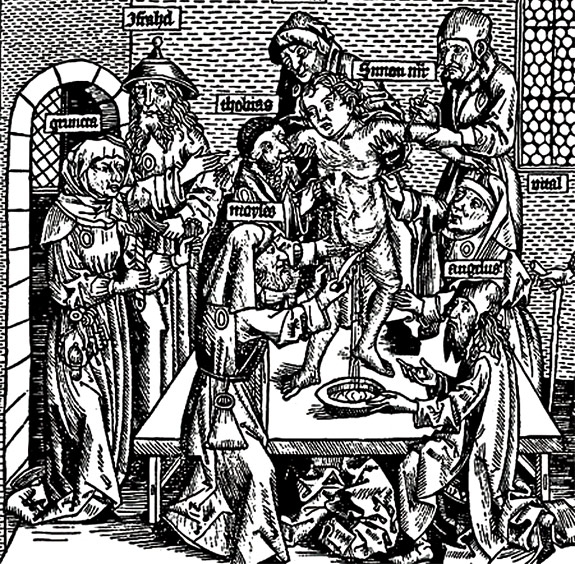

Medieval woodcut depicting the draining of a Christian infant’s blood in a supposed Jewish rite.


At this time as well, Jews were excluded from most professions (including law). A few “necessary evils” were left to them. The could collect taxes and rents. And, most importantly, they could engage in money lending.


Why was this?


Well, official Church doctrine at the time forbade Christians from charging interest when they lent money. But, for some crazy reason, people were unwilling to lend out their money if there was no financial reward for doing so. So who would lend the money? Well, perhaps the Jews can.


Ever wonder where the stereotypes of Jews as insolent, greedy usurers came from? From this era. Nobody who owes money loves their creditors. (Capital One’s amusing commercials notwithstanding, banks and credit card companies are hardly looked on with affection…) The contrast was enhanced by the fact that the lenders were Jews. The “not us.” And the debtors were often - usually - Christians. The “us.” Add in the fact that they were used to collect taxes. They were the face of the IRS in those days, so to speak. The fact that they collected for rich noblemen and the richer Catholic Church was insufficient to save the reputation of the Jewish tax collector.


(Side note: this is one of the cases where a literalist theonomy can produce immoral and catastrophic results. The interpretation of the Bible to forbid the charging of interest - despite the Parable of the Talents - was a major contribution to anti-Semitism.)


The Jews were in many cases force to live in ghettos. In fact, the very word “ghetto” comes from the Jewish Ghetto in Venice - the word means “slag” - the original ghetto housed a foundry and the Jews of the city.


Beginning in the 13th Century CE, Jews were forced to wear identifying badges or clothing in many places.


Wait. What was that?


You mean that the little gold stars of David weren’t an invention of Hitler, but actually originated 700 years before the Nazis? Yes indeed! Hitler wasn’t even particularly original. He was just more “successful.”
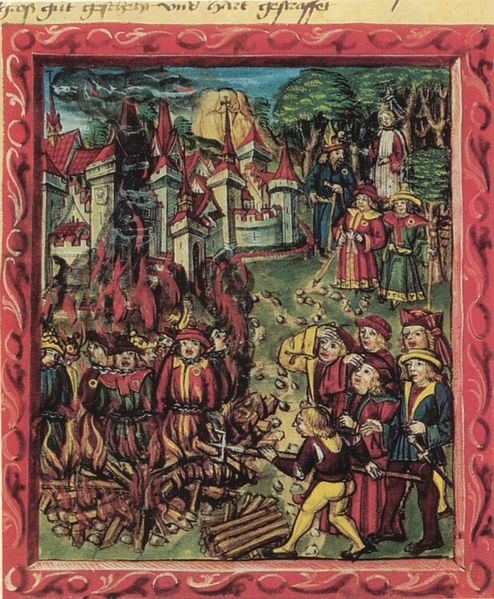

Painting by Diebold Schilling, 1515, depicting Jews being burned at the stake during the height of the Black Death.
Note the identifying emblems: “Jewish” hats and gold circles.


I could cite dozens of sordid incidents from this period. Those unfamiliar with this period of history would be wise to familiarize themselves with the persecutions of the Jews during the Crusades.


When the Black Death swept Europe, guess who was blamed? I guess when one-third of the population of Europe dies, it is tempting to look for a scapegoat. The Jews were accused of deliberately poisoning wells, and, naturally, tortured and slaughtered as a result.


Some of the literature of this period - and literature about this period - show the prevailing attitudes.


I still remember the harrowing scene in Sir Walter Scott’s Ivanhoe when the Jewess Rebecca is kidnapped by the evil knight Brian de Bois-Guilbert, who attempts to seduce her. At the same time, Rebecca’s father Isaac is tortured by one of the other villains, Reginald Front-de-Boeuf, in an attempt to exact a ransom. This wasn’t exactly uncommon. When noblemen grew tired of paying interest on their debts, they confiscated the property of their Jewish creditors, or tortured them to get ransom from other Jewish creditors.


I noted in my post on the early pre-Shakespearean dramas that anti-Semitism makes its appearance in the church plays about the Resurrection.


(From a 13th Century version of Sepulchrum. This would have been part of the easter church service.)


To make the representation of the Lord’s sepulchre, first let three brothers, prepared beforehand and clothed in the likeness of the three Marys advance slowly and as if sad, alternately singing these verses. The first of them shall say:


First Mary: Alas! the good shepherd is killed,
Whom no guilt stained.
O lamentable occurrence!


Second Mary: Alas! the true shepherd is dead
Who gave life to the upright!
O lamentable death!


Third Mary: Alas! vile race of Jews,
Whom a dire madness makes frenzied!
Detestable people!


First Mary: Why condemned ye to an impious death
The Holy One with savage hate?
O direful rage!


Second Mary: How has this righteous man deserved
To be crucified?
O race accursed!


(Leave aside for a minute the fact that Christ said he came to give life to sinners, not the “upright.” Medieval theology was focused on good works as the means of salvation.)


This would be spoken or sung in church. Let’s all sing together, “vile race of Jews…” Okay, so we don’t do that anymore.


Anti-Semitism wasn’t just something a few people clung to. It was an essential part of the fabric of the European world.


One could also list Shakespeare’s The Merchant of Venice here as a disturbingly anti-Semitic work. Or Fagan in Dickens’ Oliver Twist. How many books mention the stereotype of the Jewish moneylender or pawnbroker?


One might even list Mel Gibson here, with his drunken anti-Semitic rant, which regurgitated the propaganda of the radical Catholic splinter group his father is heavily involved in. (Yes, these people still exist. This is why Jewish groups were worried about The Passion of the Christ. Gibson Sr. was known to be part of organized anti-Semitism.)


It didn’t end with the dawn of the Modern Era.


As European nations gradually moved toward democratic governments, they had to deal with what was termed “The Jewish Question.


How would one treat the communities of Jews? Should they be allowed to vote? Should they be forced to assimmilate? Should they be deported? Resettled? (I find it interesting that a number of anti-Semitic writers supported the creation of a Jewish state, whether in Palestine or elsewhere.)


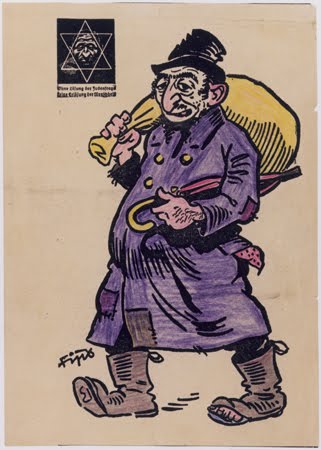
A Nazi era coloring book. For kids. Caption:
"Do you know him? Without a solution to the Jewish question there will be no salvation for mankind."


In light of this, the term “Final Solution” makes sense. There was a question. A problem. And genocide was certainly “final.”


So what about modern times?


We Protestants tend to remember the Spanish Inquisition as a means of the persecution of Protestants and an attempt to repair the damage to the fortunes of the Catholic Church caused by the Protestant Reformation. This is a true, but incompletely true version of the facts.


The Inquisition wasn’t just used on Protestants. It was an instrument of persecution of the Jews as well. About 30,000 were burned at the stake, and many times that fled Spain and Portugal.


So much for the Catholics. But were the Protestants any better?


I have to admit the next point even though it makes me feel like vomiting.


Actually, the treatise that the Nazis distributed at their rallies, the one that historians consider the single document that most laid the foundation for the holocaust, was written by a Protestant.


And not just any old Protestant either. His name?


Martin Luther.


Yes. That Martin Luther.


This sickens me because there are lots of things I admire about Luther. His insistence on salvation by grace alone through faith. His radical idea of the individual priesthood of believers, without the intervening mediator of the Church, set the stage for the eventual freedom of conscience and religion that would eventually follow. That part of his legacy is good. (At least from the narrative point of view of a Protestant. Catholics may disagree.)


But one cannot simply ignore the fact that it wasn’t Nietzsche’s Man and Superman that the Nazis handed out at that Nurnberg rally. It was Martin Luther’s The Jews and Their Lies.


Reading through that pamphlet is painful, to say the least. It is available online in translation here.


Actually, it IS possible to ignore this pamphlet and its role in the Final Solution. The Protestant narrative has generally chosen to ignore it and the role of the institutionalized anti-Semitism in the policies of Church and State.


So what is in The Jews and Their Lies, described by the Nazi magazine, Die Stűrmer, as the most radically anti-Semitic tract ever published?


Well, a LOT of ad hominem attacks. “Full of the devil’s feces.” “Thieves and robbers.” “Liars.” “Vermin.” See the dehumanization occurring?


This line is so bad it is humorous: “Did I not tell you earlier that a Jew is such a noble, precious jewel that God and all the angels dance when he farts?” (Luther was notorious for his flatulence jokes.)


And what does Luther propose we do with the Jews? An extended quote is in order:


What shall we Christians do with this rejected and condemned people, the Jews? Since they live among us, we dare not tolerate their conduct, now that we are aware of their lying and reviling and blaspheming. If we do, we become sharers in their lies, cursing and blasphemy. Thus we cannot extinguish the unquenchable fire of divine wrath, of which the prophets speak, nor can we convert the Jews. With prayer and the fear of God we must practice a sharp mercy to see whether we might save at least a few from the glowing flames. We dare not avenge ourselves. Vengeance a thousand times worse than we could wish them already has them by the throat. I shall give you my sincere advice:
First to set fire to their synagogues or schools and to bury and cover with dirt whatever will not burn, so that no man will ever again see a stone or cinder of them. This is to be done in honor of our Lord and of Christendom, so that God might see that we are Christians, and do not condone or knowingly tolerate such public lying, cursing, and blaspheming of his Son and of his Christians. For whatever we tolerated in the past unknowingly ­ and I myself was unaware of it ­ will be pardoned by God. But if we, now that we are informed, were to protect and shield such a house for the Jews, existing right before our very nose, in which they lie about, blaspheme, curse, vilify, and defame Christ and us (as was heard above), it would be the same as if we were doing all this and even worse ourselves, as we very well know.
Second, I advise that their houses also be razed and destroyed. For they pursue in them the same aims as in their synagogues. Instead they might be lodged under a roof or in a barn, like the gypsies. This will bring home to them that they are not masters in our country, as they boast, but that they are living in exile and in captivity, as they incessantly wail and lament about us before God.
Third, I advise that all their prayer books and Talmudic writings, in which such idolatry, lies, cursing and blasphemy are taught, be taken from them. (remainder omitted)
Fourth, I advise that their rabbis be forbidden to teach henceforth on pain of loss of life and limb. For they have justly forfeited the right to such an office by holding the poor Jews captive with the saying of Moses (Deuteronomy 17 [:10 ff.]) in which he commands them to obey their teachers on penalty of death, although Moses clearly adds: "what they teach you in accord with the law of the Lord." Those villains ignore that. They wantonly employ the poor people's obedience contrary to the law of the Lord and infuse them with this poison, cursing, and blasphemy. In the same way the pope also held us captive with the declaration in Matthew 16 {:18], "You are Peter," etc, inducing us to believe all the lies and deceptions that issued from his devilish mind. He did not teach in accord with the word of God, and therefore he forfeited the right to teach.
Fifth, I advise that safe­conduct on the highways be abolished completely for the Jews. For they have no business in the countryside, since they are not lords, officials, tradesmen, or the like. Let they stay at home. (...remainder omitted).
Sixth, I advise that usury be prohibited to them, and that all cash and treasure of silver and gold be taken from them and put aside for safekeeping. The reason for such a measure is that, as said above, they have no other means of earning a livelihood than usury, and by it they have stolen and robbed from us all they possess. Such money should now be used in no other way than the following: Whenever a Jew is sincerely converted, he should be handed one hundred, two hundred, or three hundred florins, as personal circumstances may suggest. With this he could set himself up in some occupation for the support of his poor wife and children, and the maintenance of the old or feeble. For such evil gains are cursed if they are not put to use with God's blessing in a good and worthy cause.
Seventh, I commend putting a flail, an ax, a hoe, a spade, a distaff, or a spindle into the hands of young, strong Jews and Jewesses and letting them earn their bread in the sweat of their brow, as was imposed on the children of Adam (Gen 3:19). For it is not fitting that they should let us accursed Goyim toil in the sweat of our faces while they, the holy people, idle away their time behind the stove, feasting and farting, and on top of all, boasting blasphemously of their lordship over the Christians by means of our sweat. No, one should toss out these lazy rogues by the seat of their pants.


I wish and I ask that our rulers who have Jewish subjects exercise a sharp mercy toward these wretched people, as suggested above, to see whether this might not help (though it is doubtful). They must act like a good physician who, when gangrene has set in, proceeds without mercy to cut, saw, and burn flesh, veins, bone, and marrow. Such a procedure must also be followed in this instance. Burn down their synagogues, forbid all that I enumerated earlier, force them to work, and deal harshly with them, as Moses did in the wilderness, slaying three thousand lest the whole people perish. They surely do not know what they are doing; moreover, as people possessed, they do not wish to know it, hear it, or learn it. There it would be wrong to be merciful and confirm them in their conduct. If this does not help we must drive them out like mad dogs, so that we do not become partakers of their abominable blasphemy and all their other vices and thus merit God's wrath and be damned with them. I have done my duty. Now let everyone see to his. I am exonerated.


At one point, he even goes so far as to say, “we are at fault in not slaying them.”


Wow. Just wow.


That’s pretty hard to defend. Luther, for all his virtues, had a HUGE blind spot.


Again, Hitler wasn’t really all that original. He was just more successful.


So let’s go back to Nietzsche. I already indicated that I am not a fan. Many were, however. Some very interesting people.


First, there were Nazis that were enamoured of his philosophy. Also, Richard Wagner, the composer and notorious anti-Semite. (The villain in The Ring of the Nibelungs is a poorly disguised Jew.)


This might seem amazing, but some of the early Zionists, such as Martin Buber, extolled his philosophy as well. (Buber called him a “creator” and “emissary of life.”)


Theodore Roosevelt, a hero of the American right and left alike, was noted by H. L. Menken as having been influenced by Nietzsche’s philosophy.


In many ways, many people can find themselves reflected in Nietzsche’s writings. The Anarchists were eager to embrace him and call him their own, but he loathed the Anarchists. Just about anyone with a self-aggrandizing lust for power has found “support” for his cruelties in Nietzsche’s words.


Actually, I have come to believe that Nietzsche’s writings are the philosophical equivalent of a Rorschach Test.


What you see in Nietzsche reveals more about you than it does about him. Those with a will to violent power will see an excuse for brutality. Those who exemplify both rugged self-determination and a desire to make the world a better place (such as T. R.) will find inspiration as well.


And, of course, some of the Nazis loved Nietzsche.


In defense of Nietzsche himself, he vowed ”to have nothing to do with anyone involved in the perfidious race-fraud.”


It should not surprise anyone that the Nazis made highly selective use of Nietzsche’s writings. They are nothing if not fertile ground for the gathering of “proof texts” in favor of violent action. One could probably find a quote out of context to support any action from the most noble to the most perfidious.


Again, I am not here as one who particularly likes Nietzsche.


I do think he got a bad rap as the cause of the Holocaust.


Again, all this comes down to narrative. What is your view of the overall sweep of history?


Here is where I think that modern Protestants have gone wrong on this issue. Why they have whitewashed their textbooks.


(And, let me note, even those that do admit the bad stuff done in the name of Christ utilize the “No True Scotsman” fallacy to preserve the narrative. No “true Christian” would do the bad stuff.)


First, human nature is reluctant to admit the mistakes of our forebearers. That’s just basic human nature. It’s why we glorify Christopher Columbus even though most of his actions were despicable. It’s why we like to conveniently ignore Thomas Jefferson’s writings on how much money he made when his slaves had babies.  None of this is fun. It makes me sick, actually. We humans have a lot to be ashamed of in our history.


Second, I want to call attention (as I have before) to what I believe is a fundamental error regarding truth.


I think I may have mentioned Cornelius van Til in passing. At the risk of grossly oversimplifying, he had a fundamental disagreement with Karl Barth. (Both were Calvinist theologians. Barth was accused of being a heretic in the circles in which I was raised.) Van Til’s big claim to fame was his idea that Christian and non-Christian thought are fundamentally incompatible and separate. That, in essence, one who is not a believer cannot possibly know or understand the truth about anything at all, because the depravity of Original Sin colors everything.


The conclusion drawn by Conservative Christianity from this idea is that by definition, a Christian will have a more complete view of the truth than a non-believer. As I said, by definition.


As Van Til put it, “The argument in favor of Christian theism must therefore seek to prove if one is not a Christian-theist [he means a regenerate believer] he knows nothing whatsoever as he ought to know about anything … On the contrary, the Christian-theist must claim that he alone has true knowledge about cows and chickens as well as about God.” (From Metaphysics of Apologetics.)


Thus, Luther’s views, even on the Jews, will be, by definition, closer to the truth than, say, Nietzsche. Thus, when it comes time to place blame for an event that was truly and unmistakably evil, one cannot believe that it might be the Christian that is to blame. One must find a non-Christian scapegoat.


So, hey! Some Nazis liked Nietzsche! The Holocaust must have been HIS fault! If everyone would have just been Christian, it could all have been avoided! Don’t look at the 2000 year history of anti-Semitism in Europe! Don’t look at the Crusades! Don’t look at the years of murder, relocation, pogroms, restrictions, gold emblems, and stuff! That isn’t relevant! Look over here! Infidel blaspheming Nietzsche! It’s HIS fault!


Here is the fundamental error. We are unable to admit that we have been wrong in the past (or may be wrong now) because that would cast into doubt the narrative. By definition, we should have been the people with the truth, fighting against those unenlightened unbelievers who by definition could not know the truth.


We really don’t believe that we are as capable of saying and believing wrong, evil stuff. We are immune because of our theological beliefs. When highly inconvenient facts like these pop up, we have to ignore them, because to acknowledge them would in fact threaten the narrative of Christians as the good people versus everyone else as the bad people. (Hmm. Another “us” versus “not us” thing again.)


I am not a historian, and do not claim to have some special understanding of historical thought.


Still, I can see something here that looks to be the common thread in all of this that led to the Holocaust.


Occam’s Razor dates back at least to Aristotle and Ptolemy, who articulated it as, “We consider it a good principle to explain the phenomena by the simplest hypothesis possible.” It isn’t an irrefutable logical device, and it isn’t true in every situation. It is, however, a useful tool in cutting through unnecessary complications when a simple explanation will do.


In this case, the simplest explanation for the Holocaust is anti-Semitism.


That is the thread that runs through history from three centuries before Christ to the Final Solution. A view of Jews as vermin. Subhuman. Inherently evil. A blight on the earth.


I mentioned dehumanization several times, and I believe it really is the key factor in the switch from “mere” racism to attempted extermination. When we react with contempt rather than compassion, with disgust rather than love, we are one step closer to turning our backs while the gas chambers work overtime.


I think this is another reason we wish to make events like the Holocaust into something someone else would do. We don’t really want to look at how we dehumanize others in our own lives. (This might be an interesting future post.)


A great book about the Nazi era is They Thought They Were Free, by Milton Meyer, which I read last year. It is a sobering look at how easily a small group was able to control a nation of ordinary people.


It also brings out how anti-Semitism was so ingrained in the national consciousness that, even though most would have objected to the concentration camps had they known at the outset, the average person was content to just have the Jews disappear from Germany. Really sobering. We don’t really miss the “not us” when they disappear.


And in this, Hitler was truly brilliant - in an evil way. Germany had been brutally beaten in the last war. The economy was shattered, and crushing reparations loomed. Germany needed a way forward, and a way to find blame for the disaster.


Hitler had the answers. Lots of new programs and optimism. (Many of them objectively good.) And a nice little scapegoat. The target was SO easy to find. Europeans had hated them for 2000 years. Who got blamed for the Black Death? Who sucked the economic lifeblood of good Christians through high interest? Who stood to profit from Germany’s downfall?


Guess who?
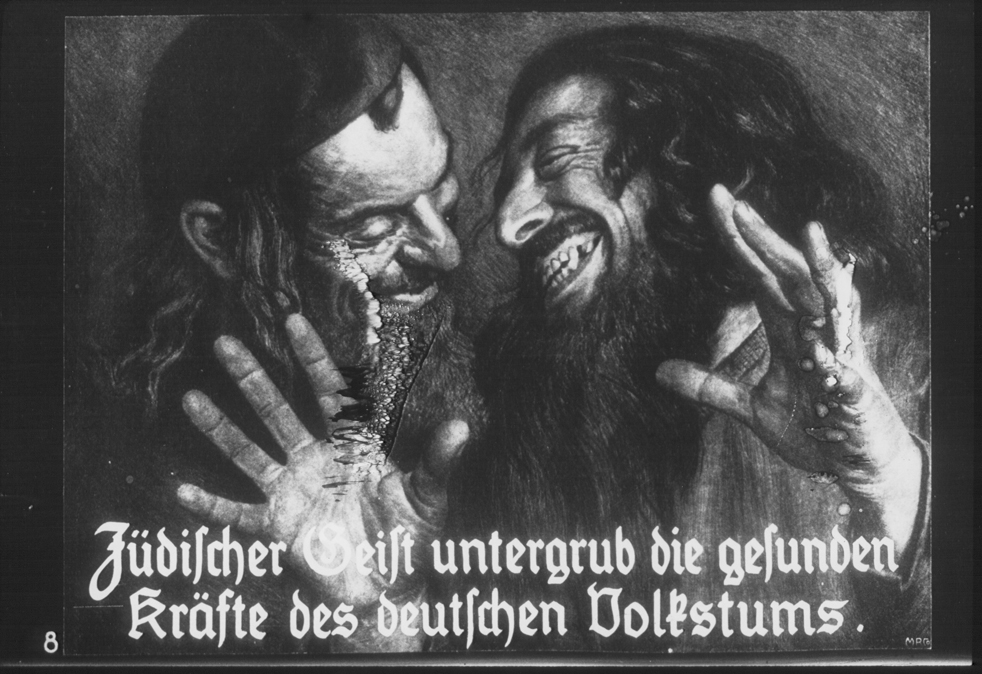

Nazi Propaganda poster:
"The Jewish spirit undermines the healthy powers of the German people."


Because the root of anti-Semitism ran so deep, it was never even questioned. And so, the Jews were led away to slaughter.


I don’t want to give the impression that I consider Christianity to have been the cause of the Holocaust. Religion and politics and philosophy and economics were so closely tied together in the Middle Ages as to be difficult to impossible to separate. Each fed on the others.


Likewise, I do want to note that many Christians stood against the Nazis, even at the cost of their lives. Dietrich Bonhoeffer comes to mind as a true hero. Also, Corrie Ten Boom and the rest of her family who helped hide Jews from the Nazis. (There were many, many more, Christian and not, whose stories remain unknown.)


In the same way, while there were those who justified American slavery using the Bible, there were many, many others who helped slaves to freedom and fought to end the “peculiar institution.” Wilberforce put his reputation on the line to end the trade. And so on.


The point isn’t that Christianity can be a force for evil. (Which is true.) Or that it can be a force for good. (Also true.) The point is that religion does not guarantee a full grasp of truth. One can have enormous blind spots that become obvious only in historical retrospect. Sometimes, as in the case of slavery and the Holocaust, the issue was not resolved by a theological or philosophical consensus, but by military force and the cost of millions of lives.


One should not hide the unflattering stuff under the rug and hope that nobody notices. One should not make a claim of universal goodness defeating universal evil by telling a story of history as the triumph of Christianity. One should not let our preferred metanarrative cause us to ignore or spin our errors. History is too messy for that one simple narrative. People are too messy. We cannot afford to be arrogant about ourselves and our role in history.


And, finally, we should take warning from this sordid history that we are treading on dangerous ground when we dehumanize anyone.


In fact, a common thread in the embarrassing statements made by Christian “heroes” of the past is that they contain contempt for others. Sometimes for those with theological differences. (Read what the Calvinists and Arminians said about each other - and the wars they fought.) For those of “inferior” races. For women. Expressions of contempt do not generally look good in the light of subsequent history, as Luther aptly demonstrated.


So we ought to be careful when we find ourselves using the language of contempt. “Disgusting.” “Full of the Devil.” “Lazy.” "The cause of the problems in our country." And so forth. We ought to remember that Christ came not to pat the backs of the “righteous,” but to redeem the untouchables of His time.

***

UPDATE OCTOBER 2018:

Here is an interesting article from The Guardian about how Nietzsche had his legacy plundered by his viciously racist sister. And also about his contempt for Nationalism, Antisemitism, and Totalitarianism. It's worth a read.