Wednesday, April 3, 2013

Iron Curtain: The Crushing of Eastern Europe by Anne Applebaum

Source of book: borrowed from the library


Totalitarianism (Merriam-Webster Dictionary):
1: centralized control by an autocratic authority
2: the political concept that the citizen should be totally subject to an absolute state authority


Totalitarianism (Benito Mussolini):
“Everything within the state, nothing outside the state, nothing against the state.”


Totalitarian Regime (Carl J. Friedrich & Zbingiew Brzezinski):
A dominant ideology, a single ruling party, a secret police prepared to use terror, a monopoly on information, and a planned economy.


If there is one political philosophy that I hold to without reservation, it is my hatred of totalitarianism. The Twentieth Century saw the rise of totalitarianism on a global scale, and hundreds of millions would be sacrificed to its need for control.


The names are familiar to all of us. Mussolini first coined the definition - and he meant it as a compliment and an aspiration. Hitler and Stalin seem to have competed as to who could slaughter more. (Stalin won, by the way.) Mao and Pol Pot and a host of lesser imitators added to the carnage.


This book was published just last year, and contains a wealth of information from recently opened archives throughout Eastern Europe. In addition, Applebaum interviewed a number of survivors of the Stalin era. Their words are often the most haunting of all.


I first became familiar with Anne Applebaum from her nuanced reporting and writing in the Washington Post and on Slate.com on foreign affairs. From 1988 through 1991, she chronicled the collapse of communism for the Economist, writing and reporting on location in Warsaw. She also wrote from first hand experience in the Baltic States when they were on the verge of independence. While on this assignment, she met and married Radoslaw Sikorski, currently the Minister of Foreign Affairs in the Republic of Poland. One of her previous books (which I want to read), Gulag: A History, won the Pulitzer prize in 2004.


Iron Curtain covers the period from the last years of World War Two through the death of Joseph Stalin, (1944-1956) focusing on three Eastern European countries: Poland, Hungary, and East Germany. It is an excellently researched and written book. Although it is not exactly easy reading, it is compelling. While most of us are at least passingly familiar with the basics of how Stalin “perfected” the art of using violence to suppress dissent, this book shows just how it was done, and how Communism was able to destroy the existing civil society and attempt to replace it with an all-encompassing State that attempted to control the very thoughts of the people it conquered.


Probably the thing that struck me the most while reading this book was the similarities between totalitarian systems and cults. Here I use “cult” not in the sense of non-mainstream religious organizations, but in the sense of dangerous, controlling and destructive movements. Think Jim Jones or the Branch Davidians. These movements employ manipulative and authoritarian mind control over members, have a totalitarian and communal organization, aggressive proselytizing, and systematic indoctrination. Add the coercive power of the State, and secret police, and you pretty much have Nazism or Stalinism. (Raymond Aron makes a compelling case that Communism is a religion in The Opium of the Intellectuals. I think the case that it is a cult is quite strong as well.)


It wasn’t just the common features listed above, it was the way that Communist ideology was deified and made into an article of faith that was immune to all proof to the contrary. As a biographer of Walter Ulbricht of East Germany noted, “here was a seemingly simple, convincing formula that enabled him to categorize and explain everything he learned, heard and saw.” It was a complete worldview. A complete lens by which all truth could be perceived.


But how could such a cult take over such a large portion of the world in such a short period of time?


According to those Applebaum interviewed, it came about primarily because of the terror and destruction of the war, which caused a desire to return to “normal.” When combined with the apathy by the Allies, and the military force of Stalin’s army, it seemed inevitable.


In my review of They Thought They Were Free, I noted that the Nazis were able to gain power in the aftermath of World War One and the subsequent collapse of the German economy. Anything seemed better than the status quo. Similarly, in Eastern Europe, the Nazis destroyed much of the conquered nations, and the Soviets could appear on the surface as liberators, if only by comparison. After all, of the Jewish population in Poland, barely ten percent remained. Anything was better than that, right?


But it was an illusion. The Soviet army was every bit as brutal as that of Hitler. The old concentration camps, including Auschwitz, were simply repurposed for new political prisoners. As in wars from time immemorial, gang rape was used as a military and political weapon. (There are some heartrending first-hand accounts in this book. Not graphic, but awful nonetheless.) If there were not enough reasons to hate Stalin, his response to reports that soldiers were looting and raping, demanded to know how the complainant could not, “understand it if a soldier who has crossed thousands of kilometers through blood and fire and death has fun with a woman or takes some trifle.” (More than any of the other good reasons I loathe Sartre is that he defended Stalin’s evil behavior as justified under the circumstances. Ick.)


Another interesting fact brought to light is that the first thing the Soviets established was not a collective economy, or communist schools, or puppet leadership. It was the secret police. The basis for all that would come after.


This was necessary because the first order of business was to destroy all competition in the realm of ideas. This was the closest cult parallel, in my opinion. True cults - and cult-like organizations (such as the one I experienced) depend on limiting information. They depend on complete control over the ideas that are allowed to be heard. For Stalin, this meant eliminating everything that was not Communist propaganda.


It is probably impossible to overstate the degree of suspicion that the Communists had for all institutions other than the Party. As Christians, we have generally been aware of the atheistic nature of Communist philosophy - and also of the systematic campaign by Communist regimes to destroy the Church. However, this hatred and destruction was much broader than that. Any small group that met for any purpose was suspect. In Poland, there was a particular distrust of Chess clubs; but all civic organizations such as charities, sports clubs, literary groups, social groups were targeted for either destruction or assimilation into the Party.


For the same reason, those who owned books were often arrested - they might have unapproved ideas. Barbers and pub owners were suspected because of the informal “groups” that might naturally meet at their establishments. As Applebaum puts it:


In the end, the fate of the Polish Scouts, the Hungarian People’s Colleges, the German Christian Democratic youth, and a vast range of other institutions - mainstream and idiosyncratic, political and apolitical, from shooting clubs and fencing teams to folk-dance troupes and Catholic charities - was the same. The nascent totalitarian states could not tolerate any competition whatsoever for their citizens’ passions, talents, and free time.


Likewise, education itself became based exclusively on Marxist/Stalinist theory, and all “Western” influences (such as Montessori - which was popular in Eastern Europe) were purged. The idea was that acquired traits could be inherited. Thus, if the next generation could only be raised without any taint from “capitalist” ideas, this would then be passed on to succeeding generations, and presumably the Communist Utopia would follow. (This is roughly the same philosophy followed by the Christian Reconstructionists, in my opinion, particularly Douglas Phillips and Jonathan Lindvall, who advocate extreme restriction on reading materials and essentially forbid friendships outside of the group. If only one can shelter the children from all “secular humanist” ideas and control every influence, the slate will be wiped clean, and eventually a new Christian Utopia will follow. It’s kind of uncanny how totalitarian systems end up resembling each other.)


In the end, all organized resistance was either destroyed by force, assimilated, or faded away under threat. The book illustrates these options with the stories of the two Catholic cardinals that took different approaches. The cardinal for Hungary actively resisted, and was destroyed along with most of the church organization in that nation. In contrast, the cardinal for Poland played along to a degree in order to survive, but was accused of collaboration. In the end, the Polish church was to be a crucial factor in the liberation and rebuilding of Poland after the fall of Communism. Which choice was better?


For most, there was little day-to-day reason to resist. (I discussed this at greater length regarding They Thought They Were Free.) As Applebaum puts it, unless there were “dramatic circumstances,” there was no reason to buck the system. After all, they depended on the State for food, health care, housing, jobs, and pretty much everything. One defied the State only when circumstances demanded it.


Somehow, though, all of the rosy dreams of the doctrinaires never came to pass. As a Hungarian joke went, “The definition of socialism: an incessant struggle against difficulties that would not exist in any other system.”


One of the surprising things about this book was the wealth of information from those who hated the system, but had no power to change it. Particularly in the intellectual and artistic realms, the officially approved forms were stultifying, and the products laughable. (Some of the poetry quoted - later disowned by its reluctant authors - such as an ode to a steel foundry are so bad as to be impossible to parody.)


One of my favorites was this slogan printed on a banner.


Every artificially inseminated pig is a blow to the face of Imperialist warmongers.


The poor guy who had to come up with that - and the one that had to design the banner. Applebaum sums this up with another great quotable line: “The experience of living in a society that forced everyone to sound enthusiastic all of the time, and that forced many people to say and do things they didn’t believe in, eventually had profound psychological consequences.”


Naturally, such control over every aspect of life, and the attempt to control even thoughts would lead to subtle forms of protest. Eventually, the entire system would collapse as a result.


I love the chapters on the the passive forms of protest. Since everything was controlled, even the silliest things could be serious protest. For example, in a system of “enthusiasm,” and earnest seriousness, even ordinary jokes would be seen as subversive. Actually, the root of much humor is the absurdity of the status quo, so this was naturally alarming to the authorities.


I found it immensely interesting that jazz, of all things, came to be the music of protest. Because of its American roots, it was viewed as the very devil by the Stalinists. Here is the money quote from an East German musicologist (speaking the official position, no doubt):


"American entertainment kitsch" was a  "channel through which the poison of Americanism penetrates and threatens to anaesthetize the minds of workers." The threat from jazz, swing and big band music was, he said, "just as dangerous as a military attack with poison gases." After all, it reflected: "the degenerate ideology of American monopoly capital with its lack of culture ... its empty sensationalism and above all its fury for war and destruction ... We should speak plainly here of a fifth column of Americanism. It would be wrong to misjudge the dangerous role of American hit music in the preparation for war."


I just about fell off my chair when I read this. In a past post on Christian Patriarchy, I noted that Rousas Rushdoony (a holocaust denialist and segregation proponent) condemned jazz (and later rock and roll) as inherently evil. As I noted then, it was really the fact that it was derived from Africa that made it problematic. So, lo and behold! The communists hated it too, once again for its political meaning. I doubt Ellington and Gillespie were thinking specifically about Stalin when they performed - but Stalin thought so, and therefore, the music was political on both sides. It was shocking to see the exact same rhetoric in a different context. (I need to write a post someday about the political nature of music throughout history. Notes in and of themselves are not “good” or “evil,” but they have always been used as symbols - and have always been a threat to autocrats. Someday.)


Again, this protest was inevitable. One of the most powerful quotes in the book is from an anonymous blacksmith quoted in one of the semi-underground newspapers.


"How many times have I been obliged to accept the opinion of others, one which I perhaps don't share. As that opinion changes, it's demanded that mine change equally. And that makes me feel sick, sicker than if I'd been beaten. I'm a man, I too. I also have a head which I use to think. And I'm not a child. I'm an adult, who gives his soul, his heart, his youth and his energy for the construction of socialism...I do it willingly but I want to be considered like an adult who lives and knows how to think. I want to be able to speak my thoughts without having anything to fear - and I want to be heard as well..."


For those who have survived any autocratic system, this is at the heart of the issue. This is freedom of thought and speech in a nutshell - and it is what the First Amendment of the Constitution has at its core. Freedom to disagree.


Soon after Stalin’s death, some things loosened up in Eastern Europe. Applebaum considers the end of Stalinism in Poland to have begun with a festival wherein representatives of a variety of nations were invited. Things quickly got out of control (from the communist point of view), and there was spontaneous mingling and communication, and the cat was out of the bag. It was no longer possible to maintain the illusion that the capitalist nations were impoverished, or that there was no world worth having outside of the Marxist paradise. In contrast to the grey and humorless - gloomy even - officially approved clothing and conversation was the fun of spontaneity.


As a Polish newspaper reported, “It turned out that it was possible to be ‘progressive’ and at the same time enjoy life, wear colorful clothes, listen to jazz, have fun, and fall in love.”


(I hate to have to refer to this again, but this is exactly the kind of thing that my friends who have escaped from the Christian Patriarchy paradigm have been saying. In an ideology that controls clothing, music, and particularly love and romance, this is precisely the freedom one misses.)


Two quotes provide a good closing to this book.


The first is from Doctor Zhivago (the book, not the movie):


And so it was necessary to teach people not to think and make judgments, to compel them to see the nonexistent, and to argue the opposite of what was obvious to everyone.


This quote parallels the one I loved from Why Does the Universe Exist. The demise of any cult occurs when the members realize that they are being fed a lie.


The second, is Applebaum’s:


By trying to control every aspect of society, the regimes had turned every aspect of society into a potential form of protest.


I note that there are plenty of online reviews from people who hate the book because of its supposed bias. In response, I would note that the history of repression by the communist regimes is so well established as to be rather beyond dispute. The gulags were not an invention. The evidence from those who escaped, survived, or perished is overwhelming. Those who, like Sartre, continue to drink the koolaid continue to look at the flaws of the West and capitalism (and there are many) and cling to the dream that there is one “simple, convincing formula” explains everything - and shows the way to utopia. I would also note that, like the Party apparatchiks before them, these reviewers cite suppose Western sabotage of the economies of communist nations. Some things never change.


Note on the music:


Here are four musical selections which dovetail nicely with this book.


First, when the Nazi’s conquered Poland, the last broadcast from the radio was a live rendition of Franz Chopin’s Nocturne in C# Minor by Wladyslaw Szpilman (who would later write The Pianist). Upon liberation from the Nazis, he would repeat the performance on live radio, but the station would again be silenced by the Soviets.


The ludicrous interference with the arts led to some bad art, but many true geniuses managed to hide their protest within their “officially approved” works. Sergei Prokofiev wrote Lieutenant Kije for a film of the same name, which officially poked fun at the old Tsarist bureaucracy. A paperwork mistake is made, attributing great heroism to Kije, who doesn’t actually exist. In order to keep the mistake from being discovered, the bureaucrats invent an entire life for Kije - and eventually kill off their creation. (In other words, Manti Te’o wasn’t that original...) The music is full of humor, and clearly shows how ludicrous the whole thing was. The communist officialdom apparently never realized that the joke worked well on them too.


Bela Bartok fled to the United States ahead of the Nazis, and died there before the end of the war. Had he lived to see the Soviet tanks rolling through Budapest, he would have wept as much as he did for the German tanks. I love the Divertimento for Strings, and had the chance to play it a decade and a half ago. The middle movement is widely believed to represent his sorrow at the destruction of Hungary. Starting at the 3:45 mark, there is an ostinato in the lower voices that starts soft, but eventually overwhelms everything, while the higher voices scream in anguish. The machine has crushed all, and nothing is left but mourning. 


The final selection combines so many elements hated by totalitarians everywhere. Rock and roll. Check. African American musicians. Check. Atonality borrowed from “degenerate” classical music. (“Degenerate” and "decadent" were code for “Jewish” in the Nazi lexicon, and “American” in the Stalinist dictionary. And, I should add, “N------” in the Rushdoony paradigm.) And, well, it is about the Cult of Personality. I present Living Color, and some pretty rad 80s pants.



Sunday, March 31, 2013

Introduction to Wilkie Collins - Book Club 2013

For those new to my blog, I am participating for the second year in an online book club, hosted by my friend Carrie, who has a popular book blog, Reading to Know. I am no longer the token male member, as she has convinced her husband to participate this year. My selection is No Name by Wilkie Collins.  If you want to join in or see what we are reading, the link to that post is here:


Wilkie Collins (named William Wilkie after his father) was one of the most influential authors of the Victorian era, yet his name is often just a side note. He is known for The Woman in White and maybe The Moonstone, but little else. During his lifetime, his best known novels were classified as “sensation novels.” We now recognized them as early examples of detective and suspense fiction. Although Edgar Allan Poe wrote the first true detective story, “The Murders in the Rue Morgue,” which set the conventions of the genre that would eventually be associated primarily with Sherlock Holmes, it was Collins who expanded the form into the full length mystery. The Woman in White is his first effort, containing most of the usual elements; but it was The Moonstone that is the fully developed prototype of the genre. T. S. Eliot and Dorothy Sayers (herself a master of the mystery) both gave high praise to The Moonstone.


No Name belongs to the other side of Collins’ writing: suspense fiction. There is no mystery to be solved - unless you count the mystery of what will happen next. The book begins a bit slowly, and appears to be a novel of domestic manners, perhaps in the vein of Jane Austen, or Anthony Trollope (one of my favorite authors); but it eventually goes completely off the tracks as tragedy strikes. The two daughters are orphaned, left without an inheritance or means of support and must fend for themselves. The elder, Nora, is quiet and staid - completely the conventional Victorian female. She finds work as a governess. Magdalen, on the other hand, is a force of nature. It is her adventures that are chronicled in this book. Actually, “chronicled” is a completely insufficient description of what happens. Magdalen drags the author and the reader along on her outrageous escapades at a breathtaking pace. When I first read this book in my late teens, I found myself gasping at the crazy things she does, and her supreme force of will. Whether she is a heroine or an antihero is an open question, but she is unforgettable.


Collins and Charles Dickens were close friends throughout a good part of their lifetimes. They were each influenced by the other, collaborated on several projects, and probably influenced each other’s writing. Certainly they both shared a concern for social issues, and brought servants from their roles as background figures to the forefront as human, sympathetic characters. Although Dickens was more successful in his social criticism, Collins has some good points to make in this book. The ending (which I will not disclose) would have been affirming to many Victorians, but it is about as convincing as the living statue in A Winter’s Tale. I believe Collins, like Shakespeare before him, backed away from the more realistic tragic ending, while understanding that those of his readers that would look beneath the surface would find the underlying injustice readily apparent.


You don’t have to be an official member of the book club to read along. We post our reviews the last week of April. Feel free to link your thoughts on my page in the comments.

Thursday, March 28, 2013

The Secret Agent by Joseph Conrad

Source of book: I own this.

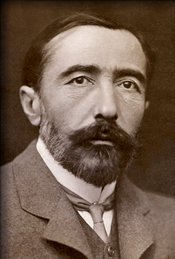
Conrad is one of those individuals that I find amazing for unlikely achievement. Born Józef Teodor Konrad Korzeniowski in 1857, in the Ukraine, but to a family of Polish nobility, he managed to become one of the most highly regarded English authors. This despite not attaining a fluency in spoken English until his 20s, and waiting until his mid-30s to switch from his maritime career to writing. 


His parents took part in the resistance movement, seeking to throw off Russian domination of both Poland and the Ukraine. As a result, they were both exiled to northern Russia when Conrad was a small child. Both would die of privation and tuberculosis by the time their only child was eleven. He was then raised by a maternal uncle, until departing for training for a seaman’s career at sixteen. Since Conrad showed no interest or skill in academic pursuits - although he was an avid reader - his uncle figured he needed to learn a trade. He also seemed to have a knack for languages, learning French, German, Latin, and Greek: a useful skill for a merchant sailor.


As the son of a dissident, he could not well return to Russia, so he sought foreign citizenship, eventually becoming a British subject and rising to the level of Captain in the Merchant Marine.


But for a fortunate meeting, he might have been a footnote in the ledger of the annals of the British Empire. On one of his voyages, he met a discontented young lawyer named John Galsworthy, who was himself considering a career change. As a result of this meeting, both resolved to seek their fortunes in literature. Both would go on to success, and the literary world may be forever grateful for this fortuitous meeting.


Conrad is generally a pessimistic author, and things do not typically end well for his characters. While this was not particularly popular in his time, it was influential on later generations of writers. Furthermore, the Twentieth Century played out in a way that followed his dark vision far more than the optimism of the late Victorian period. Removed from their time and technology, his books could easily represent our own times.


The Secret Agent was written toward the end of the early part of Conrad’s writing career, in 1907, before he gained a real literary reputation.


The title character, Mr. Verloc, is a lazy double agent of sorts. He is not a glamorous James Bond type, but a man seeking to make a living to support his wife, her mother, and her half-wit brother. To this end, he nominally runs a shop selling goods of dubious legality and morality, while working as an agent for the Russian embassy in London. At the same time, he also serves as an informant to the local police force.


These two jobs were not really in opposition in practice, however much they might be in theory. Verloc’s job is to infiltrate and inform on a local anarchist cell, which both the Russians and the London police wish to keep in check.


Compared with the far more successful Communists, the Anarchists never really accomplished enough to gain a significant following in the United States, although they were a key factor in the Spanish Civil War. (See my review of the excellent The Cypresses Believe in God.) They came to my attention a few years ago with their rather bungled protests of the World Trade Organization. While not a major factor in the last fifty years, they were once a force nearly as feared as the Communists themselves.


(Quick primer: Anarchists believe in the complete destruction of both government and all authorities and hierarchies. Many support the use of violence and destruction to accomplish this. While this much is agreed, the various branches of Anarchism differ as to what should replace the status quo. Some support complete collectivism resembling Socialism or Communism. Others envision a libertarian society. Still others believe that once the current institutions are destroyed, a new society will spontaneously arise, a kind of utopia perhaps. All of these viewpoints find their homes in characters in this book.)


Conrad uses the Anarchists as the basis for his plot, in the process giving a remarkable picture of their beliefs and goals. Impressively, he does this using very little of the book, sneaking it into the conversations of the characters in a minimum of space, never interrupting the narrative enough to bog it down.


The inciting event occurs soon after the opening. Mr. Vladimir, who works for the embassy, has become Verloc’s new boss. He demands that Verloc earn his keep by arranging for a bomb to be set off at the Greenwich Observatory, which would then be blamed on the Anarchists, leading (Vladimir hopes) to the British people suspending their pesky belief in the rule of law and simply liquidating the Anarchists without proof of overt acts. Verloc knows that this is not at all in his line of work, and he further knows that the motley group of “revolutionists” that meets at his apartment lacks anyone with both the nerve and the desire to do it. In theory, these are dangerous men, but in practice, only the “Professor,” who manufactures explosives, poses any danger in reality. And the Professor has no intention of getting his own hands dirty: he is, after all, the only one who can make bombs.


As becomes rapidly obvious, this cannot possibly end well. And, indeed, it ends in “success” for the authorities, the disgrace of Vladimir; but the utter destruction of the smaller players in the drama. The attempted bombing goes horribly awry; and an inexorable destiny leads to a stabbing, suicide, and insanity.


Along the way, Conrad takes jabs at both the Anarchists and the hierarchies they seek to destroy. Mr. Verloc himself is of the Establishment, as he muses early on.


He surveyed through the park railings the evidences of the town's opulence and luxury with an approving eye. All these people had to be protected. Protection is the first necessity of opulence and luxury. They had to be protected; and their horses, carriages, houses, servants had to be protected; and the source of their wealth had to be protected in the heart of the city and the heart of the country; the whole social order favourable to their hygienic idleness had to be protected against the shallow enviousness of unhygienic labour.


What I particularly love about this passage is that he cuts right to the heart of class snobbery. The great “unhygienic” masses.


Also in that vein is Conrad’s description of the wealthy patroness who supports Michaelis, the formerly imprisoned Anarchist.


A certain simplicity of thought is common to serene souls at both ends of the social scale. The great lady was simple in her own way. His views and beliefs had nothing in them to shock or startle her, since she judged them from the standpoint of her lofty position. Indeed, her sympathies were easily accessible to a man of that sort. She was not an exploiting capitalist herself; she was, as it were, above the play of economic conditions. And she had a great capacity of pity for the more obvious forms of common human miseries, precisely because she was such a complete stranger to them that she had to translate her conception into terms of mental suffering before she could grasp the notion of their cruelty.
…
She had come to believe almost his [Michaelis’] theory of the future, since it was not repugnant to her prejudices. She disliked the new element of plutocracy in the social compound, and industrialism as a method of human development appeared to her singularly repulsive in its mechanical and unfeeling character. The humanitarian hopes of the mild Michaelis tended not towards utter destruction, but merely towards the complete economic ruin of the system. And she did not really see where was the moral harm of it. It would do away with all the multitude of the "parvenus," whom she disliked and mistrusted, not because they had arrived anywhere (she denied that), but because of their profound unintelligence of the world, which was the primary cause of the crudity of their perceptions and the aridity of their hearts. With the annihilation of all capital they would vanish too; but universal ruin (providing it was universal, as it was revealed to Michaelis) would leave the social values untouched. The disappearance of the last piece of money could not affect people of position. She could not conceive how it could affect her position, for instance.


Lest one think that Conrad sympathises with the one side of the issue, there are corresponding passages in which he skewers the beliefs of the other characters in turn. None escape either his mockery or his sympathy.


For example, “Toodles,” the (unpaid) personal secretary to the Home Secretary (equivalent to our Secretary of State), has socialist ideals. But he never lets these ideals interfere with his desire to hobnob with high society.


Toodles was revolutionary only in politics; his social beliefs and personal feelings he wished to preserve unchanged through all the years allotted to him on this earth which, upon the whole, he believed to be a nice place to live on.


The characterizations are really the most memorable part of this book. The plot is necessary to reveal the characters, but they never are there just to serve the plot. The plot takes the shape it does because of who the characters are, and how they react to bad circumstances and worse luck.


Verloc, of course, is well drawn.


Mr. Verloc would have rubbed his hands with satisfaction had he not been constitutionally averse from every superfluous exertion. His idleness was not hygienic, but it suited him very well. He was in a manner devoted to it with a sort of inert fanaticism, or perhaps rather with a fanatical inertness. Born of industrious parents for a life of toil, he had embraced indolence from an impulse as profound as inexplicable and as imperious as the impulse which directs a man's preference for one particular woman in a given thousand. He was too lazy even for a mere demagogue, for a workman orator, for a leader of labour. It was too much trouble. He required a more perfect form of ease; or it might have been that he was the victim of a philosophical unbelief in the effectiveness of every human effort. Such a form of indolence requires, implies, a certain amount of intelligence. Mr. Verloc was not devoid of intelligence - and at the notion of a menaced social order he would perhaps have winked to himself if there had not been an effort to make in that sign of scepticism. His big, prominent eyes were not well adapted to winking. They were rather of the sort that closes solemnly in slumber with majestic effect.


The others of the Anarchist cell are interesting individuals. Michaelis, released after a lengthy prison sentence for serving as a locksmith in a prison escape that went wrong, who becomes a mystic and, as it were, a saint; content in his belief in the inevitability of the Revolution. Karl Yundt, the fiery old man - who has never actually lifted a finger in action. Ossipon, the lecherous and hunky young man, who lives more to leverage his Anarchism to aid him in bedding women than in taking any personal risks. The Professor, short and unimposing, who attempts to compensate for the lack of respect he gets through firmness of will -  who carries a bomb in his vest at all times to prevent arrest. The authorities also are memorable. The Chief Inspector, who would much rather be chasing burglars, who abide by a recognizable code. The Home Secretary, who seems more concerned with arcane domestic issues than terrorism. The Assistant Commissioner, who was forced to leave his preferred employment in Colonial Asia because of his marriage to a controlling woman.


The complex relationships between the members of Mr. Verloc’s extended family are also well drawn. Verloc himself fancies that he is loved simply for being himself, but the reality is more complicated. Mrs. Verloc intended to marry a poorer man, but was prevented because she was weighed down by her crippled mother and mentally challenged brother. She considers it her duty to make provision for their support. Thus, Verloc is primarily important to her because of what he represents as both breadwinner and as a father of sorts to her brother. When things unravel, these expectations lead to a tragic and violent end.  


The Secret Agent formed the basis for Alfred Hitchcock’s early film, Sabotage. It was also adapted to film in a more faithful version in 1996. This scene between the Professor (Robin Williams) and Ossipon (Gerard Depardieu) in the cafe preserves most of the original dialogue, and is remarkably faithful to the original. And, the score is by Phillip Glass. The cello solo (played by Fred Sherry) undergirding this scene is stealthily sinister. (Note: I haven't seen this movie, so I assume it takes liberties elsewhere, but this scene at least is well done.)


Wednesday, March 27, 2013

Why Does the World Exist by Jim Holt

Source of book: borrowed from the library


“‘cause.”
“‘cause why?”
“Just ‘cause!”


Actually, that is the way every theory about why there is something rather than nothing seems to end. At the end of the speculation, there is some fact that simply must be assumed. (The book refers to them as “brute facts,” the philosophical term for a fact that does not have an underlying explanation. Philosophers debate whether “brute facts” can exist or not.)


Jim Holt is an author, but also a philosophy major. This book straddles the lines between science, religion, and philosophy as it explores contemporary and historical thought about the title question. The existential question.


Why is there something rather than nothing?


Or, as Julian Huxley put it (as quoted in the book):


“The clear light of science, we are often told, has abolished mystery, leaving only logic and reason,” Huxley wrote. “This is quite untrue. Science has removed the obscuring veil of mystery from many phenomena, much to the benefit of the human race: but it confronts us with a basic and universal mystery - the mystery of existence...why does the world exist?”


Holt starts by laying out the three ways of approaching the question. The optimist point of view is that there is a reason for the universe, and we may well discover it. The pessimist point of view is that while there may be a reason, we probably won’t discover it. The rejectionist view is that there is no reason for the universe. The universe and the question are both meaningless.


Since there wouldn’t be much of a book without the optimist viewpoint, Holt spends most of the book on various ideas of the reason there is a universe.


To that end, the author discusses the ultimate question with a number of scientists and philosophers, challenging the weaknesses of each position. Holt’s goal is not to draw a conclusion, but to explore the question and its potential answers.


Although this book can be enjoyed by the average educated person, I must say that it helps to have a working knowledge of philosophy, quantum mechanics, and string theory. Especially philosophy, since the language and technique of philosophy permeate the book. I highly recommend the venerable textbook  Socrates to Sartre: A History of Philosophy as a good starting point for neophytes. (It is readily available used for very little cost.)


First of all, there are some things I found annoying about the book. Pretty much all of them are to be expected from a philosophy major (and perhaps philosopher) writing a book of his experiences. The most egregious is the fact that not one, but two scenes in the book involve the author sitting in Sartre’s favorite cafe on Paris’ Left Bank, reading. (Hegel in one case. Surprise. Or not.) Similarly, the book occasionally focuses too much on what read as set pieces, where he thinks about what he discussed, while dropping the name of a pretentious wine he is drinking. (I have a feeling I could easily write like that, so I know the temptation. I excoriate his editor, however.)


The other thing which was disappointing (to me at least) is that he mentions his own philosophy near the beginning, but never goes on to explain it or how he came to that conclusion. (He says he has adopted a variation of the gnostic belief that the physical world was created by a malevolent being, but one that was largely incompetent, thus giving rise to a world that failed at being the worst possible world.) I am curious how he came to the conclusion (particularly in light of the rest of the book.) The only clear clue here is his conversation John Leslie, in which Leslie posits that of all the possible universes, ours was pretty far from the most perfect. However, he opined that, “Still, I think you’d have to go quite far below us to have a world which was not worth having at all.”


Those flaws notwithstanding, this was an interesting and worthwhile read. Here are a few that stood out to me:


I did not realize that Edwin Hubble’s theory of an expanding universe that can be traced back in time to a singularity (colloquially known as the “Big Bang”) was initially embraced by Christians, particularly Catholics, as proof of a creator. Or that for the same reason, it was rabidly hated by atheists. Essentially, the idea of a definite beginning implied that something (or nothing) existed before that. An eternal, unchanging universe better suited the premise that there was no need for a creator.


(Personal note here: As a theist, I find the idea of creating the world through a singularity to be great fun. If I could create the universe, I think it would be a gas to use a tiny pill that would expand to make everything - kind of like the best of all possible versions of those expanding foam animals my kids play with. Bang! It would be awesome.)


Also good was the point made by Heidegger that fear has a definite object. Anxiety, in contrast, is directed at the unknowable. The nothing, as it were.


It was also interesting to be reminded that nearly everything in the history of philosophy can be traced back to Plato and Aristotle. Despite all of the scientific advances that have illuminated so much of the physical world, the two of them asked so many of the great questions - and answered them in contrasting ways that are reflected in philosophy throughout the ages.


The age old ontological proof, first used by Plato in his forms, and best known, perhaps, as stated by Aquinas, rears its head throughout the book. But its flaws are also apparent. (As I stated above, everything boils down to “‘cause!” The competing scientific theories at some point are reduced to a brute fact as well. Perhaps the laws of the universe inevitably give rise to a universe. But why are there laws? “‘cause!” Or perhaps all universes and all laws are possible. But why are they possible? It all eventually goes to the same place, and one must choose what seems to be more likely in view of the fact that there does appear to be a universe, governed by rational and discoverable laws.


Another strong point of this book was the way the author made his various interview subjects come to life. Their conversations are a high point of the book - and much more interesting than the author’s own navel gazing. For example, the interview with the late John Updike revealed a man far more fun and human than I would have expected. He sounded rather delightful to talk to - not always the case with famous authors or celebrities in general.


Or his visit to the house of David Deutsch, who a previous journalist described as “setting international standards of slovenliness.” Holt adds his own memorable description of it as “experiments in indoor composting” and (my favorite) “an adventure in high-entropy housekeeping.” (Some days, my own house could be described as rather “high-entropy...”)


Holt also gets points from me for his clever use of quotations from The Devil’s Dictionary by the poisonously pithy Ambrose Bierce.


Beyond the stuff that was interesting, thought provoking, or amusing, two additional passages stood out to me.


The first is the chapter (at the end) devoted to the return to nothingness. Death. The author’s mother passes as he watches, and he is forced to confront why death causes us anxiety. Why, after all, can we not make peace with it? Holt notes that (with a very few exceptions), we can imagine a time before we were born, but have great difficulty imagining the universe without us. We understand beginnings, but resist final ends. Why do we “rage, rage against the dying of the light.”? Or, as Ecclesiastes puts it, eternity has been placed in the hearts of men. Holt has no real answers here.


The second passage is one that I find explains a problem that I have been struggling with over many years. Holt interviews Richard Swinburne, an Oxford professor and Eastern Orthodox Christian, (not to be confused with Algernon Charles Swinburne, the poet) who lays out a case for the existence of God. In fact, a pretty good defense of the Gospel is given by Swinburne. I found it interesting that Swinburne came across as remarkably understated. He didn’t claim that he could prove more than he could, acknowledged the weaknesses of his arguments, and didn’t name-call. (A total contrast to Richard Dawkins, the prominent atheist, who commonly resorts to flame-throwing and name calling rather than intellectual proof. Holt quotes him at length, and acknowledges that he is rather a bully.)


The argument made by Swinburne was not revolutionary to my thinking. It built on Aquinas and others, and was interesting.


What has stayed in my head since reading it, is his explanation for why so many philosophers violently rejected the concept of God.


“Many philosophers were brought up in strictly religious households. As adolescents, they found their religion in conflict with things that were obviously true, and they rebelled against it. Then later, when someone shows them a more appealing sort of religion, they’re not going to grasp it.”


I have had conversations with a number of friends about why many of my generation (and the next) have left the Christian faith. This tendency seems to be particularly strong among those who were raised in strict environments. (Such as the Christian Patriarchy movement.)


This explains that, and even more, it explains the struggles that I have had with my faith and my worldview. It explains why those who suffered abuse by their parents in the name of Christ have rejected everything.


When one is told that something is true, when it clearly is utter bullshit, and then told that one is rebellious for not believing it, it is natural to reject the entire worldview.


And then, many within the Church double down by claiming that all those who reject Christianity do so simply because they prefer to sin. In addition to being self-righteous, condescending, and cruel, this statement is false. Obviously false, to anyone who actually has friends who are Christians-turned-atheist, always-atheist, or even atheist-turned-Christian. There are many reasons we believe or disbelieve. Some are intellectual. Some, admittedly, might be moral. But so many more stem from hurt and pain. To tell the child of an alcoholic mother who beat him, while all the time pretending to be a perfect church member that he just “wants to sin” is truly lacking in truth, understanding, or love.


I’ve already written about a few of the patently untrue things I was expected to swallow, and I hope to do more in the coming year.


In summary, this book has flaws, but it is a worthwhile read. I believe it is vitally important to understand the arguments on all sides of this issue, particularly before making moral judgments about the intentions of those who hold to different viewpoints.


(And yes, I still loathe Sartre...)

Saturday, March 16, 2013

The Nothing That Is: A Natural History of Zero by Robert Kaplan

Source of book: borrowed from the library
Date originally published on Facebook: December 3, 2010.

I am republishing my early Facebook reviews on my blog. This book was fascinating. Definitely one of my favorite books in the sciences and mathematics category.

The title for this book comes from Wallace Stevens’ poem, The Snow Man.

One must have a mind of winter
To regard the frost and the boughs
Of the pine-trees crusted with snow;

And have been cold a long time
To behold the junipers shagged with ice,
The spruces rough in the distant glitter

Of the January sun; and not to think
Of any misery in the sound of the wind,
In the sound of a few leaves,

Which is the sound of the land
Full of the same wind
That is blowing in the same bare place

For the listener, who listens in the snow,
And, nothing himself, beholds
Nothing that is not there and the nothing that is.

I quote the whole poem because I like it, not that it is central to the book. Except for the last line.

In order that there be no confusion, I want to clarify that this book is written by Robert Kaplan the mathematics professor and author; not Robert S. Kaplan, of Harvard Business School, also a professor and author; or Robert D. Kaplan, of The Atlantic Monthly; or even Bob Kaplan, former Canadian MP. Since all except for the last have been published recently, it is easy to get mixed up.

Robert Kaplan teaches an interesting variety of subjects. Math, of course, but also several languages including Sanskrit. He also has taught “Inspired Guessing”, which sounds intriguing. This book is mostly about math and the history thereof, but also about the intersection of math and philosophy.

The Nothing that Is looks at the history of the concept of zero. For anyone who has attempted to multiply using Roman numerals, it is clear that zero was a revolutionary change in mathematics. The use of a placeholder simplified notation, certainly, but it also opened up new worlds of calculation.

I am not a mathematician like several in my family and in my wife’s family. I did fine in high school, but never went beyond trigonometry and coordinate geometry. It would have been fun to take calculus, but I never was able to fit it in. That said, I still remember my algebra and plane geometry pretty well. Thus, with this limited scope of knowledge, I was happy that I made it through 150 pages before my head got spun. I’m thinking I should take a look at calculus sometime, but I probably need someone to walk me through it until I get a “eureka” moment.

This book could have been boring, but wasn’t, largely because Kaplan writes with both skill and enthusiasm. Kaplan uses his broad knowledge of literature and philosophy to connect the math with the era and its ideas and prejudices. His discussion of the Mayans alone was worth the time spent.

I do not intend to reiterate the substance of this book, as I could, at best, make a pale imitation. Zero’s story is fascinating whether you liked math or not, and Kaplan tells it well.

In addition to the history, Kaplan spends some time discussing philosophy. After all, numbers (other than counting numbers used for specific things) are an abstract construction. We define them, and manipulate them using rules that are as much invented as discovered. Despite this, as we have built ever more complex systems of calculation, we have discovered that they in fact represent the nature of the world. The development of calculus enabled every science dealing with curves from engineering to astronomy. If the math can be used to predict the actual world, how in fact are they related? Kaplan has no axe to grind here, and doesn’t tip his hand as to his own philosophy. Instead, he examines through both math and philosophy how both attempt to approach and define truth.

I suspect the book may seem simplistic for a true math scholar, but for a dabbler like me, it was both entertaining and thought provoking. Unless you hate math, history and philosophy (in which case I pity you), give this book a read.